Ashthorpe 5-String vs Washburn M3SWK-D
Quick Verdict
These two instruments are not the same kind of instrument. The Ashthorpe 5-String is a five string banjo with a genuine Remo head and a complete accessory bundle, while the Washburn M3SWK-D is an F-style mandolin with a solid carved spruce top and maple back and sides. Choose the Ashthorpe if a banjo is wanted for country, folk, bluegrass or clawhammer style playing. Choose the Washburn if a mandolin is wanted for bluegrass or Americana tone with all-solid tonewood construction. Scored at 86 and 84, both are well specified instruments in their own right, and the real decision is which instrument family the buyer actually needs, not which scores higher.
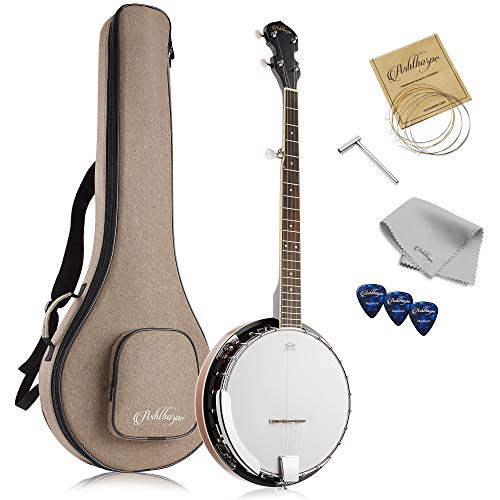

| Spec | Ashthorpe 5-String | Washburn M3SWK-D |
|---|---|---|
| Instrument | 5-string banjo, right-handed, with a guitar-style headstock and tambourine shaped body | F-style mandolin with F-holes, Americana Series |
| Size | Not published in listing as a specific scale length or fret count | Standard full size F-style mandolin body (exact dimensions not published in listing) |
| Materials | Mahogany neck and body with a high-gloss finish, a purpleheart fretboard, a 5-ply maple and mahogany shell, a 5-ply maple rim, and a 5/8 inch maple and ebony bridge | Solid carved European spruce top; solid carved Canadian maple back and sides |
| Key or tuning | Not published in listing as a specific tuning; 15:1 ratio geared tuners and a geared 5th string tuner are confirmed | Standard mandolin tuning (not stated in listing) |
| Finish | High-gloss mahogany finish | Not published in listing |
| Included accessories | A 15mm premium fabric padded gig bag with a pocket, carry handle and shoulder strap, plus extra strings, a polishing cloth, and three celluloid picks | Hardshell case; D'Addario J73 light gauge strings installed |
| Skill level | Not published in listing as a specific level; described as suited to country, folk, bluegrass, clawhammer-style and rock playing | Intermediate upgrade instrument, based on all-solid construction (not explicitly stated in listing) |
| Weight | Not published in listing | Not published in listing |
| Made in | Not published in listing | Not published in listing |
| Notes | Remo head secured with 24 chrome-plated brackets, an adjustable hinged tailpiece, a chrome-plated armrest, an adjustable truss rod, and a removable closed-back resonator allowing the banjo to be played open back | Fingerboard wood, tuner hardware, bridge material and nut width are not published in the bullet specification |
Sound Engine and Tone
The Ashthorpe 5-String is a banjo built on a mahogany neck and body with a high-gloss finish, a purpleheart fretboard, a 5-ply maple and mahogany shell, and a genuine Remo head secured with 24 chrome-plated brackets. A 5/8 inch maple and ebony bridge is specifically cited for superior string vibration transfer.
The Washburn M3SWK-D is a mandolin with a solid carved European spruce top and solid carved Canadian maple back and sides, construction the listing says is usually reserved for instruments above entry level. Fingerboard wood, bridge material and nut width are not published in the bullet specification.
These are fundamentally different tonal instruments, a banjo's bright, percussive drum-like voice from a Remo head against a mandolin's carved tonewood resonance, so the tonal comparison is really about which instrument family's sound the buyer is after rather than which is built better. Both score 26 of 30 on tone and intonation in their own breakdowns, an identical mark that suggests each is well regarded within its own instrument category rather than one outperforming the other.
Hands-On Control and Workflow
The Ashthorpe banjo uses 15:1 ratio geared tuners plus a geared 5th string tuner, described as an upgrade over common friction tuners, and an adjustable truss rod for neck relief adjustment over time.
The Washburn mandolin ships with D'Addario J73 light gauge strings installed at the factory, though its tuner hardware is not published in the listing. Standard mandolin tuning is implied but not explicitly stated.
On tuning hardware specifically, the Ashthorpe banjo is the more thoroughly documented instrument, with named gear ratios and a geared 5th string tuner, while the Washburn's tuner type remains an open question a buyer would need to confirm separately. The Ashthorpe scores 17 of 20 on playability and setup against the Washburn's 16 of 20, a small gap that tracks with the extra tuning hardware detail published for the banjo.
Sequencer, Effects and Features
The Ashthorpe banjo includes a removable closed-back resonator, allowing it to be played either as a resonator banjo or opened up for an open-back tone, plus an adjustable hinged tailpiece and a chrome-plated armrest for comfort during extended playing.
The Washburn mandolin has no equivalent switchable tonal feature described in the listing. Its F-style body with F-holes is a fixed construction choice suited to bluegrass and Americana tone rather than an adjustable or convertible design.
The Ashthorpe's removable resonator gives it a genuine dual-mode versatility that the Washburn's fixed F-style body does not offer, though the F-style design itself is the traditional, expected form for a bluegrass mandolin and is not a shortcoming on its own terms. The Ashthorpe's outfit and accessories score of 9 of 10 reflects that convertible resonator feature alongside its full accessory bundle, against the Washburn's 7 of 10 in the same category.
Build, Design and Portability
The Ashthorpe banjo's scale length, fret count and weight are not published in the listing, though its shell is confirmed as a 5-ply maple and mahogany construction with a 5-ply maple rim.
The Washburn mandolin's exact body dimensions, weight and country of origin are also not published in the listing, beyond confirming a standard full size F-style mandolin body.
Neither listing gives exact weight or dimension figures, which is a shared gap at this price tier. The Ashthorpe does confirm more detail about its shell ply construction than the Washburn confirms about its own body dimensions. On build and materials specifically, the Ashthorpe scores 18 of 20 against the Washburn's 17 of 20, a narrow margin given how close the two listings are in overall construction quality claims.
Connectivity, MIDI and Sync
Neither instrument is electronic, so there is no MIDI, pickup system or amplification described in either listing. Both are acoustic instruments meant to be played unplugged or miked externally.
The Ashthorpe banjo's notes describe its physical hardware, the Remo head, brackets, tailpiece and armrest, in detail, but nothing about electronic output. The Washburn mandolin's listing is similarly silent on any pickup or electronics.
For a player who specifically needs stage amplification built in, neither instrument as described here offers that, and an external pickup or microphone would need to be added to either one separately. This shared gap means neither instrument has an advantage in this category, and a buyer planning to perform live with either one should budget for an add-on pickup system regardless of which instrument is chosen.
Setup and Daily Use
The Ashthorpe banjo comes with a 15mm premium fabric padded gig bag with a pocket, carry handle and shoulder strap, extra strings, a polishing cloth, and three celluloid picks, a genuinely complete accessory bundle for daily use.
The Washburn mandolin comes with a hardshell case and factory-installed D'Addario J73 light gauge strings, a shorter accessory list than the Ashthorpe's but still covering the basics of protection and ready-to-play strings.
For day one playability and protection, the Ashthorpe's bundle includes more accessories by count, picks, a cloth and extra strings alongside the gig bag, while the Washburn's hardshell case offers sturdier protection than a padded gig bag typically provides. Both instruments score well on durability and care, the Ashthorpe and the Washburn each earning 8 of 10 in that category despite their different accessory approaches.
Who Should Buy It
The Ashthorpe 5-String suits players who want a genuinely well specified banjo with a named Remo head, premium bridge and tuning hardware, plus a complete accessory bundle, at a budget price tier, for country, folk, bluegrass, clawhammer or rock playing.
The Washburn M3SWK-D suits bluegrass and Americana players upgrading from a laminate beginner mandolin who want confirmed all-solid carved tonewood construction, even though several hardware and finish details remain unconfirmed in the listing.
Both occupy a similar price range, with the Ashthorpe scoring 86 and the Washburn scoring 84, and the right choice depends entirely on whether the player needs a banjo or a mandolin, not on which instrument is the better built example of its type. The Washburn actually leads on value, scoring 10 of 10 against the Ashthorpe's 8 of 10, which suggests its price relative to its all-solid construction is rated as the stronger deal of the two.
The Deciding Question
The deciding question is simply which instrument family the player plays or wants to learn, since a banjo and a mandolin are not interchangeable despite both appearing in bluegrass and Americana ensembles.
A second consideration is how much a buyer values confirmed hardware detail versus confirmed tonewood construction. The Ashthorpe publishes more hardware specifics, bridge material, tuner ratios and shell ply count, while the Washburn's headline strength is its solid carved spruce and maple construction, with several hardware details left unconfirmed.
Scores of 86 against 84 are close, and both instruments carry the same caution for buyers: confirm the unpublished details, scale length and fret count for the Ashthorpe, fingerboard wood and nut width for the Washburn, before finalizing a purchase. Neither gap is large enough to override a buyer's basic need for one instrument family over the other.
Who Should Buy Which
Buy the Ashthorpe 5-String if a five string banjo is the goal, and a genuine Remo head, premium maple and ebony bridge, geared 5th string tuner, and a complete gig bag and pick bundle matter at a budget price tier.
Buy the Washburn M3SWK-D if an F-style mandolin is the goal, and solid carved European spruce and Canadian maple construction, factory-installed D'Addario strings, and a hardshell case matter more than a fully itemized hardware list.
Since these are different instrument families entirely, a buyer should not weigh one against the other based on score alone. The decision should be made first by instrument type, banjo or mandolin, and only then refined using each listing's specific hardware and construction details.
Ashthorpe 5-String
Pros
- Genuine Remo head secured with 24 chrome-plated brackets
- 5/8 inch maple and ebony bridge for superior string vibration transfer
- Mahogany neck and purpleheart fretboard with finely manicured, smooth seated frets
- 5-ply maple and mahogany shell with a 5-ply maple rim
- Geared 5th string tuner, an upgrade over common friction tuners, plus 15:1 ratio geared tuners
- Removable closed-back resonator, allowing open back play as well
Cons
- No stated scale length or specific fret count
- No stated specific tuning
- No stated weight
- High-gloss finish may not suit buyers who specifically want a more vintage, matte appearance
Washburn M3SWK-D
Pros
- All-solid carved European spruce top
- Solid carved Canadian maple back and sides
- F-style body suited to bluegrass and Americana tone
- D'Addario J73 strings installed at the factory
- Hardshell case included
Cons
- Fingerboard wood and hardware not published
- Finish not confirmed in the bullet specification
- Weight and country of origin not stated
- Not an ideal first instrument for absolute beginners
Who Should Buy Each
Ashthorpe 5-String
- Players who want a genuine Remo head secured with named, specific hardware
- Buyers who want a geared 5th string tuner rather than a common friction tuner
- Players who want the flexibility of open back or closed back resonator play
- Buyers who want a complete accessory bundle, gig bag, strings, cloth and picks, included
Washburn M3SWK-D
- Bluegrass and Americana mandolin players stepping up from a laminate instrument
- Players who specifically prefer an F-style body over an A-style oval soundhole mandolin
- Buyers comfortable confirming unpublished hardware details directly with the seller
Quick Decision Guide
| If you want a five string banjo for bluegrass or clawhammer playing | Choose Ashthorpe 5-String |
| If you want an F-style mandolin with solid carved tonewood | Choose Washburn M3SWK-D |
| If you want a complete accessory bundle with a gig bag, picks and extra strings | Choose Ashthorpe 5-String |
| If you want factory-installed D'Addario strings and a hardshell case | Choose Washburn M3SWK-D |
| If you want the option to switch between resonator and open-back tone | Choose Ashthorpe 5-String |
FAQ
About This Comparison
Mandrillis Team
The Mandrillis editorial team researches and compares audio and music gear using manufacturer documentation, verified specs and real buyer feedback, so you can make a confident purchase without wading through marketing claims.
Read our full research methodology.
We may earn a commission at no extra cost to you.