Bluesound Node vs FiiO S15
Quick Verdict
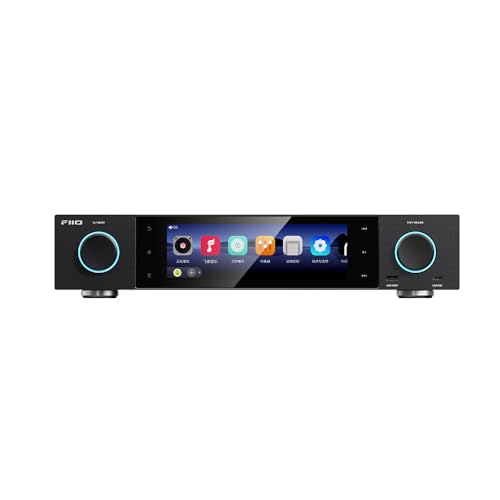
The Bluesound Node is a hi-res network streamer built around an ESS ES9039Q2M SABRE DAC, Dirac Live room correction, and BluOS multi-room grouping, aimed at buyers who already own an amplifier or powered speakers. The FiiO S15 is a network audio streamer and desktop DAC with a 7.84-inch touchscreen, open Android 12, and an AK4191 and AK4499EX converter stage, aimed at buyers who want one component to handle streaming, local files and television audio with a large screen. Choose the Node if Dirac Live calibration and the BluOS ecosystem matter most. Choose the S15 if an open Android platform, a touchscreen interface and the widest digital connector list matter most. Scored at 84 and 83, both are strong source components without built-in amplification.

| Spec | Bluesound Node | FiiO S15 |
|---|---|---|
| Type | Hi-res network audio streamer functioning as a source component, pre-amplifier, headphone amplifier, and digital to analog bridge, confirmed directly in the feature bullets. | Network audio streamer and desktop DAC with 7.84-inch touchscreen, open Android 12 |
| Power output | Not published in listing. The Node is described as a pre-amplifier and headphone amplifier rather than a power amplifier meant to drive passive speakers directly. | Not applicable. Source component with no amplifier stage, and no power figure is published in listing |
| Channels | Not applicable in the usual multichannel sense. The Node is a two-channel source and preamp component rather than a multichannel power amplifier. | Stereo line output on RCA and balanced XLR |
| Inputs and outputs | HDMI eARC and an analog and digital combo input with auto-sensing are confirmed, along with a subwoofer output that includes bass management options. | Inputs: AES, coaxial, optical, HDMI with ARC, USB drives, TF card, external hard drives. Outputs: I2S, AES, coaxial, optical, HDMI, RCA line out, XLR balanced line out |
| HDMI and video | HDMI eARC is confirmed for television sound. No video pass-through or video processing is described, consistent with an audio-only streaming component. | HDMI input, HDMI output and HDMI ARC. Video passthrough details not published in listing |
| Wireless and streaming | Tidal, Qobuz, Deezer, and Spotify streaming are confirmed, along with internet radio, at up to 24-bit and 192kHz hi-res quality through the BluOS platform. | Roon Ready, AirPlay, DLNA, Bluetooth, plus UPnP, SMB and WebDAV network access. Wi-Fi and Ethernet hardware not explicitly stated |
| Phono input | Not published in listing. No phono input is mentioned anywhere in the feature bullets. | Not published in listing. No phono stage is described |
| Dimensions and weight | Not published in listing. No size or weight figures appear in the feature bullets. | 430mm chassis width. Height, depth and weight not published in listing |
| Remote and app | The BluOS controller app is confirmed, along with an IR remote using learning functionality for traditional remote based control. | Dual knobs and dual virtual buttons on the unit, Bluetooth remote control and app-based remote control |
| Included accessories | Not published in listing. The feature bullets describe internal components and streaming features rather than box contents. | Not published in listing |
Power and Sound Quality
The Node is confirmed as a pre-amplifier and headphone amplifier rather than a power amplifier meant to drive passive speakers directly, built around an ESS ES9039Q2M SABRE DAC and a quad-core 1.8GHz processor, both named directly in the listing.
The S15 is also a source component with no amplifier stage, built around an AK4191 and AK4499EX DAC pairing with separated digital and analog architecture, plus selected femtosecond clocks mentioned in its pros list.
Neither device can drive passive speakers on its own, so both require a separate amplifier downstream. On power and sound quality, the S15 scores 25 of 30 against the Node's 24 of 30, a narrow one point edge for the FiiO. Both named DAC chips are specific enough that a buyer can research the ESS ES9039Q2M or the AK4191 and AK4499EX pairing independently rather than relying only on marketing language.
Connectivity and Inputs
The Node confirms HDMI eARC, an analog and digital combo input with auto-sensing, and a subwoofer output with bass management options, but does not publish a phono input or dimensions.
The S15 lists a notably longer connector set: AES, coaxial, optical, HDMI with ARC, USB drives, TF card and external hard drive inputs, plus I2S, AES, coaxial, optical, HDMI, RCA line out and XLR balanced line out as outputs.
On raw connector count, the S15 is the more completely connected device, with balanced XLR output and multiple digital input and output formats that the Node's listing does not match. Both score 22 of 25 on connectivity despite that difference in itemized detail, which suggests the Node's smaller connector list is still considered complete enough for its intended role as a streaming source feeding an existing amplifier.
Formats, Processing and Room Correction
The Node's standout processing feature is Dirac Live room correction, described in the listing as a genuine, independently developed calibration system, supporting streaming at up to 24-bit and 192kHz through the BluOS platform.
The S15 does not list a named room correction system, though its open Android 12 platform and dual DAC architecture support a wide range of file formats and app-based playback, with maximum sample rate and DSD support not published.
On formats and processing, the Node scores 13 of 15 against the S15's 12 of 15, with Dirac Live room correction standing out as a specific, named advantage that the S15 listing does not counter with an equivalent feature. For a listener dealing with a difficult room, uneven bass or early reflections, that named calibration system is a concrete reason to favor the Node over a device with a wider but less room-aware feature set.
Features, Streaming and Apps
The Node confirms Tidal, Qobuz, Deezer and Spotify streaming plus internet radio through the BluOS controller app, with multi-room grouping and independent zones supported from a single app, and DSD playback listed only as coming soon.
The S15 confirms Roon Ready status, AirPlay, DLNA and Bluetooth streaming, plus UPnP, SMB and WebDAV network access, with the added benefit of open Android 12 letting major streaming apps install directly onto the device.
Both score 9 of 10 on features and apps, an identical mark, with the Node's named streaming services and BluOS multi-room grouping balanced against the S15's broader protocol list and open app platform. A household already invested in multiple BluOS-compatible speakers would gain more from the Node's zone grouping than from the S15's single-device app flexibility.
Build, Design and Controls
The Node's dimensions and weight are not published in the listing, and its remote control options are the BluOS app plus an IR remote with learning functionality.
The S15 confirms a 430mm chassis width, though height, depth and weight are not published, and its controls include dual knobs and dual virtual buttons on the unit itself, a Bluetooth remote, and app-based remote control.
The S15 gives at least one physical dimension, chassis width, that the Node's listing does not provide at all, while both score 8 of 10 on build and design in their own breakdowns. Buyers planning a specific shelf or rack space should request the Node's missing dimensions directly from the seller before purchase, since the listing leaves that gap open.
Setup and Daily Use
Setting up the Node means connecting it to an existing amplifier or powered speakers, pairing HDMI eARC to a television if desired, and configuring Dirac Live room correction through the BluOS app for the listening space.
Setting up the S15 means connecting its chosen digital or analog outputs to an amplifier, and optionally using its 7.84-inch touchscreen directly as a control surface since it runs open Android 12 rather than a closed app-only interface.
Daily use differs mainly in interface style: the Node is controlled primarily through the BluOS app and IR remote, while the S15 can be operated directly from its own touchscreen in addition to app and remote control. A household member unfamiliar with the system may find the S15's onscreen menu more approachable than hunting for a phone app, while a BluOS household already knows the Node's interface from other zones.
Who Should Buy It
The Node suits buyers who already own an amplifier or powered speakers and want a well-documented hi-res streaming source with Dirac Live room correction built in, based on its confirmed DAC, processor and calibration system.
The S15 suits listeners who want one full-width component to handle streaming, local files, television audio and digital to analog conversion with a large screen, based on its open Android platform, Roon Ready status and extensive connector list.
Neither suits a buyer who wants an all-in-one streaming amplifier that can drive passive speakers directly, since both the Node and the S15 are confirmed source and preamp components without a power amplifier stage. Value scoring favors the Node slightly, at 8 of 10 against the S15's 7 of 10, suggesting its price relative to its confirmed feature set is seen as marginally better.
The Deciding Question
The deciding question is whether named room correction or platform openness matters more. The Node's Dirac Live system is a specific, independently developed calibration feature the S15 does not list, while the S15's open Android 12 platform lets a buyer install streaming apps directly rather than relying on a closed app ecosystem.
A second question is connector completeness. The S15's AES, coaxial, optical, HDMI, balanced XLR and multiple input options outnumber the Node's HDMI eARC and combo input, which matters for buyers integrating into a larger multi-component system with several digital sources to switch between.
Scores of 84 against 83 put the Node very slightly ahead, driven mainly by its named Dirac Live feature, while the S15 closes the gap with its broader connector list and open platform flexibility. The one point difference is small enough that either device is a reasonable centerpiece for a hi-res digital front end, provided the buyer's priorities line up with that device's specific named strength.
Who Should Buy Which
Buy the Bluesound Node if an amplifier or powered speakers are already in place, and Dirac Live room correction, BluOS multi-room grouping, and named streaming service support for Tidal, Qobuz, Deezer and Spotify are priorities.
Buy the FiiO S15 if the goal is one component with the widest possible connector list, balanced XLR output, Roon Ready status, and an open Android 12 touchscreen that can run streaming apps directly without relying solely on a dedicated app.
Both require a separate amplifier to drive passive speakers, so buyers should factor that additional purchase into either decision rather than treating either device as a complete standalone system. Whichever is chosen, the amplifier or powered speakers on the other end of the signal chain will ultimately shape the final sound as much as the source component itself.
Bluesound Node
Pros
- ESS ES9039Q2M SABRE DAC and a quad-core 1.8GHz processor are both confirmed by name
- Dirac Live room correction is a genuine, independently developed calibration system
- Tidal, Qobuz, Deezer, and Spotify streaming at up to 24-bit 192kHz are all confirmed
- BluOS multi-room grouping and independent zones are supported from a single app
- HDMI eARC and an auto-sensing combo input simplify connecting a TV or analog source
Cons
- No power amplifier wattage applies since this is a pre-amplifier and streaming source, not a speaker-driving amplifier
- No phono input is confirmed, so a turntable needs a separate external phono preamp
- DSD playback is described only as coming soon via a future update, not available now
- No dimensions or weight figures are given anywhere in the feature bullets
FiiO S15
Pros
- AK4191 and AK4499EX DAC pairing with separated digital and analog architecture
- Open Android 12 lets major streaming apps install directly
- Roon Ready, AirPlay, DLNA and Bluetooth streaming
- I2S, AES, coaxial, optical and HDMI digital outputs plus balanced XLR
- 7.84-inch touchscreen with knobs, remote and app control
- HDMI ARC for television audio
Cons
- Maximum sample rate and DSD support not published
- Height, depth and weight not stated
- No amplifier, so passive speakers need a separate amp
- Open Android adds complexity for users who want an appliance
Who Should Buy Each
Bluesound Node
- Buyers who want a confirmed, named DAC and processor rather than vague digital audio claims
- Households planning a BluOS multi-room system across several rooms or zones
- Listeners who want Dirac Live room correction paired with hi-res streaming services
- Anyone who wants HDMI eARC television sound routed through a dedicated streaming preamp
FiiO S15
- Roon subscribers and NAS owners with mixed local and streamed libraries
- Owners of a good amplifier who want a modern source with balanced outputs
- Listeners who want television audio through a two-channel system via HDMI ARC
- Enthusiasts who value a large display and flexible control options
Quick Decision Guide
| If you want named Dirac Live room correction built in | Choose Bluesound Node |
| If you want the widest digital connector list including balanced XLR output | Choose FiiO S15 |
| If you want BluOS multi-room grouping across named streaming services | Choose Bluesound Node |
| If you want an open Android platform that can install streaming apps directly | Choose FiiO S15 |
| If you already own an amplifier and just need a well-documented hi-res source | Choose Bluesound Node |
FAQ
About This Comparison
Mandrillis Team
The Mandrillis editorial team researches and compares audio and music gear using manufacturer documentation, verified specs and real buyer feedback, so you can make a confident purchase without wading through marketing claims.
Read our full research methodology.
We may earn a commission at no extra cost to you.