Casio Celviano AP-300 vs Yamaha Arius YDP-145
Quick Verdict
Choose the Casio Celviano AP-300 if you want a traditional cabinet with a soft-close lid, a 40 watt speaker system, Bluetooth audio and MIDI, and 19 voices. Its Smart Scaled action is lighter than Casio hybrid actions but scores slightly above the Yamaha GHS. Choose the Yamaha Arius YDP-145 if you find it at a clear discount and want 192-note polyphony, the CFX sample with resonance, a bench and 303 lesson songs included, plus dual headphone jacks. The YDP-145 lacks Bluetooth and has modest speakers, but its value score is higher.
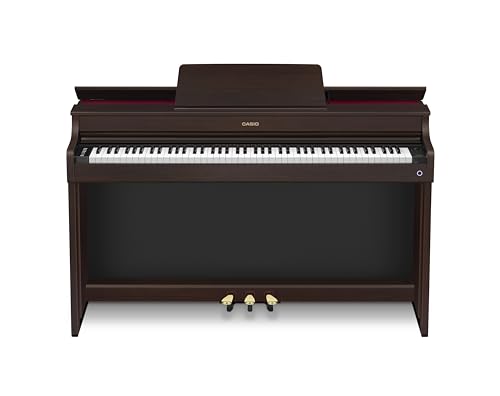

| Spec | Casio Celviano AP-300 | Yamaha Arius YDP-145 |
|---|---|---|
| Key Action | Smart Scaled Hammer Action | GHS (Graded Hammer Standard) |
| Sound Engine | Casio AiR with new concert grand sample | Yamaha CFX sample with damper and string resonance |
| Voices | 19 | 10 |
| Polyphony | Not published in listing | 192 notes |
| Speakers | 40 W system | 2 x 8 W |
| Bluetooth | Audio and MIDI via included WU-BT10 adapter | No |
| USB | USB to Host | USB to Host |
| Pedals | 3 pedals built in | 3 pedals built in |
| Weight | Not published in listing | 83.8 lb (38 kg) per listing |
| Form Factor | Traditional console with soft-close cover and movable top lid | Upright console with bench |
Key Action
The Casio Celviano AP-300 uses Smart Scaled Hammer Action. The Yamaha Arius YDP-145 uses GHS, or Graded Hammer Standard. Both are weighted hammer actions designed for piano-style practice. The key action scores are close, with Casio at 24 out of 30 and Yamaha at 23 out of 30.
The Casio action is described in the listing as lighter than the hybrid keys on the Casio AP-S450 and AP-550. The Yamaha GHS is listed as an entry action. This means neither model offers the most advanced action from its brand. Touch-first buyers should compare these actions in person if possible.
The listing for the Casio does not publish polyphony, but that does not affect the action comparison. The Yamaha's GHS action is a standard weighted design, but the listing does not describe any additional action improvements. Both models have three built-in pedals. Overall, the Casio holds a one-point advantage on paper.
Piano Sound and Speakers
The Casio uses the Casio AiR sound engine with a new concert grand sample. The Yamaha uses a Yamaha CFX sample with damper and string resonance. Piano sound scores are 22 out of 25 for Casio and 23 out of 25 for Yamaha. The Yamaha edges ahead on sound scoring despite having fewer voices.
The Yamaha lists 192-note polyphony. The Casio listing does not publish a polyphony figure, so that spec cannot be compared directly. The Casio speaker system is rated at 40 watts total. The Yamaha has two 8 watt speakers, which is much less powerful.
In practical terms, the Casio should produce louder and fuller sound through its onboard speakers. The Yamaha may deliver more detail through headphones or external amplification because of its specified resonance and high polyphony. Both models are designed as upright consoles for home use. The listings do not state whether a line out is available, so the speaker difference is important for room sound.
Features and Modes
The Casio has 19 built-in voices. The Yamaha has 10 voices. The Casio also includes Bluetooth audio and MIDI through the included WU-BT10 adapter. The Yamaha does not have Bluetooth.
The Yamaha includes 303 lesson songs, which can help beginners with practice. The Casio listing does not mention any lesson song library. The Yamaha also has dual headphone jacks. The Casio listing does not state the number of headphone jacks.
Feature scores are 11 out of 15 for Casio and 10 out of 15 for Yamaha. The Casio's higher voice count and Bluetooth give it the edge. The Yamaha counters with its lesson library and dual headphone jacks for student and teacher use. The Casio has a touch-sensor panel, which is listed as a con.
Build, Design and Portability
The Casio AP-300 is a traditional console with a soft-close sliding cover and a movable top lid. The listing describes a rosewood finish. The Yamaha YDP-145 is an upright console with a bench. The Yamaha weight is published as 83.8 lb, or 38 kg.
The Casio listing does not publish a weight, so portability cannot be fully compared. Build and portability scores are 10 out of 10 for Casio and 9 out of 10 for Yamaha. The Casio cabinet features may appeal to buyers who want a classic furniture look. The movable top lid is a distinct design element on the Casio.
The Yamaha's published weight shows it is a heavy console that is not meant for frequent transport. The Casio's unknown weight means buyers should confirm that detail before purchase. Neither model is a portable stage piano. Both include a built-in three-pedal unit as part of the console base.
Connectivity
The Casio includes Bluetooth audio and MIDI through the included WU-BT10 adapter. It also has USB to Host for wired connection and three built-in pedals. The Yamaha has USB to Host but no Bluetooth. The Yamaha also has three built-in pedals and dual headphone jacks.
Connectivity scores are 9 out of 10 for Casio and 5 out of 10 for Yamaha. The Bluetooth adapter gives the Casio wireless options for apps, audio streaming and MIDI control. The Yamaha requires a cable for any digital connection and cannot stream audio wirelessly. The Casio's included adapter means no separate purchase is needed.
The Casio listing does not mention headphone jacks, so the Yamaha's dual headphone jacks are a clear advantage for silent practice with a teacher or partner. Both models use USB to Host for computer and tablet connections. The Yamaha's lack of Bluetooth is its main connectivity weakness.
Setup and Accessories
The Casio AP-300 includes a Bluetooth adapter and three built-in pedals. The listing does not state that a bench is included. The Yamaha YDP-145 includes a bench, three built-in pedals and 303 lesson songs.
Both consoles require some assembly of the cabinet and stand, but the listings do not provide detailed setup steps. The Yamaha's included bench saves an extra purchase for a beginner. The Casio's included Bluetooth adapter means no separate wireless accessory is needed.
The Casio listing does not mention any lesson songs or method books. The Yamaha's 303 lesson songs are built into the instrument, though the listing does not specify the exact songbook content. The Casio's traditional cabinet with soft-close cover and movable top lid is part of its furniture design.
Daily Use
The Casio's touch-sensor panel is listed as a con, which may mean the controls are less tactile than buttons. The 40 watt speaker system should fill a room with sound. The Bluetooth adapter allows wireless connection to apps and devices.
The Yamaha's dual headphone jacks make it easy for two people to practice silently. The 303 lesson songs support daily practice routines. The Yamaha's 2 x 8 watt speakers are modest, so the sound may be quiet in a large room.
The Casio's 19 voices give more variety for practice and play. The Yamaha's 10 voices cover the basics but may feel limited over time. Daily use differences center on wireless connectivity, speaker volume and included learning content. Both have built-in pedals for practice.
The Deciding Question
The main question is whether you value the Casio's stronger speakers, Bluetooth and classic cabinet with movable top lid. Or do you value the Yamaha's published 192-note polyphony, CFX sample with resonance, included bench and lesson songs? These are the biggest differences. The action and sound scores are very close.
If you want wireless audio and MIDI, the Casio is the only one that offers Bluetooth out of the box. If you do not need Bluetooth and find the YDP-145 at a clear discount, the Yamaha becomes a strong value. The action and sound scores are close enough that these practical differences matter more. The Casio's stronger speaker system may be the deciding factor for room sound.
The Casio's value score is 5 out of 10, while the Yamaha's value score is 10 out of 10. That suggests the Yamaha is priced very competitively in its current position. The Casio's higher overall score comes from connectivity and build, not from value. Buyers who focus on value may prefer the Yamaha.
Who Should Buy Which
Buy the Casio Celviano AP-300 if you want a traditional rosewood-finish cabinet with a soft-close cover and movable top lid, a 40 watt speaker system, Bluetooth audio and MIDI included, and 19 voices. You should also be comfortable with a Smart Scaled action that is lighter than Casio's hybrid actions. The Casio is the choice for wireless connectivity and louder onboard sound.
Buy the Yamaha Arius YDP-145 if you find it at a discount and want 192-note polyphony, the CFX sample with damper and string resonance, a bench and 303 lesson songs included, plus dual headphone jacks. You should be fine without Bluetooth and with GHS entry action. The Yamaha is the choice for a complete beginner package at a lower cost.
If you plan to use apps wirelessly and want louder onboard sound, lean toward the Casio. If you want a complete beginner package at a lower cost and do not mind using a cable, the Yamaha is the better fit. Both are home console digital pianos, not portable stage pianos. The final decision should come down to Bluetooth and speaker power versus included accessories and value.
Casio Celviano AP-300
Pros
- Traditional rosewood-finish cabinet with a soft-close sliding cover and a movable top lid
- 40 watt speaker system
- New concert grand sample in the AiR engine
- Bluetooth adapter included
Cons
- Smart Scaled action is lighter than the hybrid keys on the AP-S450 and AP-550
- Polyphony not published on the listing
- Touch-sensor panel
Yamaha Arius YDP-145
Pros
- CFX concert grand sample with resonance at a mid Arius price
- 192-note polyphony
- Bench, three pedals and 303 lesson songs included
- Dual headphone jacks
Cons
- No Bluetooth; replaced by the YDP-146 which adds it
- GHS entry action
- Modest 2 x 8 W speakers
Who Should Buy Each
Casio Celviano AP-300
- The piano must look like a traditional upright in rosewood
- You want 40 watts of speakers and Bluetooth
- A movable top lid matters to you for tonal control
Yamaha Arius YDP-145
- You found the YDP-145 clearly cheaper than the YDP-146
- You want the CFX sound and a bench in one box
- Wireless streaming is not something you will use
Quick Decision Guide
| If you want Bluetooth audio and MIDI without buying an extra adapter | Choose Casio Celviano AP-300 |
| If you need a published 192-note polyphony and a CFX sample with damper and string resonance | Choose Yamaha Arius YDP-145 |
| If you want a 40 watt speaker system for louder room sound | Choose Casio Celviano AP-300 |
| If you want a bench and 303 lesson songs included in the box | Choose Yamaha Arius YDP-145 |
| If you find the YDP-145 at a clear discount and do not need Bluetooth | Choose Yamaha Arius YDP-145 |
FAQ
About This Comparison
Mandrillis Team
The Mandrillis editorial team researches and compares audio and music gear using manufacturer documentation, verified specs and real buyer feedback, so you can make a confident purchase without wading through marketing claims.
Read our full research methodology.
We may earn a commission at no extra cost to you.