JBL Bar 1000 vs Sennheiser Mini AMBEO
Quick Verdict
The JBL Bar 1000 and Sennheiser Mini AMBEO score within a point of each other, but they serve different buyers. Choose the JBL Bar 1000 if you want a confirmed 7.1.4 Dolby Atmos system with a 10 inch wireless subwoofer and 880 watts of power for a large room. Choose the Sennheiser Mini AMBEO if you prefer a compact all-in-one soundbar with self-calibrating room tuning, built-in Alexa and Chromecast, and no separate subwoofer. Both listings omit key specs like HDMI eARC and dimensions, so verify those details elsewhere. The JBL is the safer choice for true surround and deep bass; the Sennheiser is better for minimalists who value smart features over raw power.
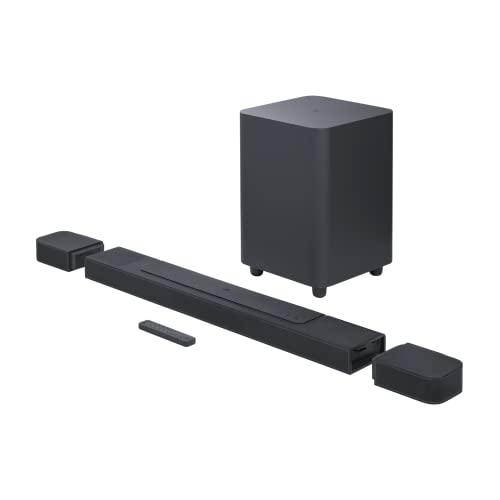

| Spec | JBL Bar 1000 | Sennheiser Mini AMBEO |
|---|---|---|
| Channels | 7.1.4 | Not published in listing |
| Drivers | Listing notes two up firing drivers in the main bar and two more in the detachable surround speakers. Full driver complement is not published. | Not published in listing; listing mentions audiophile-grade drivers |
| Power | 880 watts total system power | Not published in listing |
| Subwoofer | 10 inch wireless subwoofer | Dual built-in subwoofers |
| Dolby Atmos and DTS | Dolby Atmos and DTS:X with MultiBeam | Not published in listing; listing mentions 3D sound codecs |
| HDMI eARC and inputs | Not published in listing | Not published in listing |
| Wireless and streaming | Built in Wi-Fi with AirPlay, Alexa Multi-Room Music and Chromecast built in | Bluetooth, Wi-Fi, Alexa built-in, Chromecast built-in |
| Dimensions | Not published in listing | Not published in listing |
| Remote and app | Not published in listing | Not published in listing; self-calibrating algorithm mentioned |
| Included accessories | Detachable battery powered surround speakers and 10 inch wireless subwoofer. Remote, cables and mounting hardware are not published in listing. | Not published in listing |
Sound Quality
JBL Bar 1000 earns 26 out of 30 for sound quality, one point ahead of the Sennheiser Mini AMBEO at 25 out of 30. The JBL lists a 7.1.4 channel layout with dedicated up firing drivers in the main bar and in the detachable surrounds, plus 880 watts total system power. The Sennheiser does not publish a channel count, driver sizes, or power output, making its sound architecture harder to evaluate from the listing alone.
The Sennheiser listing mentions audiophile-grade drivers, which suggests a focus on tonal accuracy, but without specifics on driver type or size, that claim cannot be verified. The JBL clearly states up firing drivers for height effects and a full 7.1.4 configuration, which implies a more immersive and powerful presentation for movies and games. On paper, the JBL appears stronger for buyers who want confirmed speaker channels and high output.
Both models score closely, but the JBL provides more concrete audio specifications, while the Sennheiser relies on brand reputation and vague descriptors. If raw power and discrete channels are your priority, the JBL Bar 1000 has a clear advantage based on published facts. If you value compactness and trust Sennheiser's tuning, the Mini AMBEO may still satisfy in smaller spaces, but the listing leaves room for uncertainty.
Surround, Atmos and Audio Formats
JBL Bar 1000 explicitly lists Dolby Atmos and DTS:X support with MultiBeam technology, along with true up firing drivers and detachable battery powered surround speakers. This means it offers both physical rear channels and height channels for object-based audio. The Sennheiser Mini AMBEO does not list Dolby Atmos or DTS:X support anywhere; the listing only mentions 3D sound codecs without naming them.
The Sennheiser's omission of specific codec support is a significant gap for buyers who want guaranteed playback of Atmos or DTS:X content from streaming services or Blu-ray. The JBL's clear codec support and multichannel layout make it a safer choice for home theater enthusiasts. The Mini AMBEO may rely on virtualization and upmixing, but without explicit confirmation, it cannot match the JBL's stated surround credentials.
In terms of surround performance, the JBL Bar 1000 offers a more traditional and verifiable 7.1.4 surround setup with physical surrounds, while the Sennheiser appears to be a virtual immersive bar. If your content library includes many Atmos titles, the JBL is the more reliable option on paper. The Sennheiser may still create a wide soundstage, but its lack of published Atmos support is a drawback.
Subwoofer and Bass
The JBL Bar 1000 includes a 10 inch wireless subwoofer, which suggests deep and room-filling bass for action movies and music with heavy low end. With 880 watts total system power, the subwoofer likely receives a substantial portion of that power, though the listing does not break down power allocation. The Sennheiser Mini AMBEO relies on dual built-in subwoofers inside the soundbar itself, which is impressive for a compact unit but cannot match the displacement of a dedicated 10 inch driver.
The Sennheiser's built-in subwoofers are designed to save space and eliminate a separate box, which is a practical advantage for small rooms or minimalist setups. However, the listing does not state the size, power, or frequency response of those built-in drivers, so their bass extension is unknown. The JBL's external subwoofer is a known quantity in terms of driver size, and its wireless design allows flexible placement in the room.
For bass-heavy content, the JBL Bar 1000 is the clear winner based on published specs. The Sennheiser Mini AMBEO may produce surprisingly good bass for its size, but without specs, buyers cannot compare its low-frequency performance to the JBL's 10 inch sub. If you want the physical impact of a dedicated subwoofer, the JBL is the safer recommendation.
Connectivity and TV Setup
Both soundbars leave key wired connectivity details unpublished. The JBL Bar 1000 does not list HDMI eARC or HDMI inputs, which are critical for passing through high-quality audio from a TV. The Sennheiser Mini AMBEO also does not publish HDMI eARC or wired input specifications. This is a significant omission for both products, as buyers need to know whether they can connect a TV, game console, or Blu-ray player directly.
On the wireless side, the JBL Bar 1000 includes built-in Wi-Fi with AirPlay, Alexa Multi-Room Music, and Chromecast built in. The Sennheiser Mini AMBEO includes Bluetooth, Wi-Fi, Alexa built-in, and Chromecast built in. Both offer excellent wireless streaming options, but the JBL adds AirPlay support, which is useful for Apple device users. The Sennheiser adds Bluetooth, which may be convenient for quick pairing with phones or tablets.
For TV setup, both bars likely connect via HDMI or optical, but neither listing confirms the available ports. Without eARC or input details, users may face limitations with high-bandwidth audio formats. The JBL's AirPlay support gives it a slight edge for wireless music streaming, while the Sennheiser's Bluetooth adds flexibility for non-Wi-Fi sources. Overall, the connectivity comparison is a draw on wired specs due to missing information.
Features, Apps and Voice Control
The JBL Bar 1000 listing does not mention a remote control, companion app, or EQ settings, which is unusual for a modern soundbar. It does list Alexa Multi-Room Music, but that is a streaming feature, not necessarily full voice control from the bar. The Sennheiser Mini AMBEO listing also omits remote and app details, but it does mention Alexa built-in, which implies hands-free voice control directly from the soundbar. That gives the Sennheiser a potential advantage for smart home users.
The Sennheiser Mini AMBEO also mentions a self-calibrating algorithm, which adjusts the sound to the room's acoustics automatically. The JBL listing does not mention any room correction or calibration feature. For users who want a plug-and-play experience with minimal manual tuning, the Sennheiser's self-calibration is a valuable feature. The JBL may rely on manual setup or default tuning, but without app details, it is difficult to assess.
Both soundbars support Chromecast built in and Wi-Fi streaming, but the Sennheiser's Alexa built-in and self-calibration give it a slight edge in features based on published information. The JBL counters with AirPlay and Alexa Multi-Room Music for multi-speaker setups. If you prioritize voice control and automatic sound adjustment, the Sennheiser Mini AMBEO is the better choice from the listing.
Design and Fit Under a TV
Neither product publishes its physical dimensions, so a direct comparison of size and fit under a TV is impossible from the listings. The JBL Bar 1000 is a multi-piece system with a main soundbar, a 10 inch wireless subwoofer, and two detachable surround speakers. This means it requires more space overall and may not suit a minimalist setup. The Sennheiser Mini AMBEO is described as compact, with everything including dual subwoofers built into a single bar, making it easier to place in front of a TV.
The JBL's detachable surrounds are battery powered, which adds flexibility but also means you need to place and periodically charge two additional speakers. The Sennheiser has no external speakers or subwoofer, so it is a true all-in-one design. For a clean TV stand or wall mount, the Sennheiser is likely more discreet. However, without dimensions, neither can be confirmed for fitting under a specific TV height.
Buyers with limited space should consider the Sennheiser Mini AMBEO for its compact footprint, even though the exact size is not listed. The JBL Bar 1000 is better suited to larger rooms where a separate subwoofer and surround speakers can be arranged. Until dimensions are published, fit under a TV remains a guessing game for both models.
Who Should Buy It
The JBL Bar 1000 is best for buyers who want a true 7.1.4 Dolby Atmos system with wireless surrounds and a separate 10 inch subwoofer. It is designed for larger rooms where 880 watts of power and physical rear speakers can create an immersive movie experience. If you desire deep bass and discrete surround channels without running speaker wire across the room, the JBL fits that need on paper.
The Sennheiser Mini AMBEO is best for buyers who want a compact all-in-one soundbar for small to medium rooms. Its built-in dual subwoofers, self-calibration, and smart features like Alexa and Chromecast make it a good match for spaces where a separate subwoofer and rear speakers are impractical. It appeals to users who prioritize simplicity and smart home integration over maximum channel count.
Both products target different segments. The JBL leans toward home theater enthusiasts who want a complete surround package, while the Sennheiser targets minimalist users who still want immersive sound. The choice depends heavily on room size and tolerance for multiple components.
The Deciding Question
The deciding question is whether you need confirmed discrete surround channels and a dedicated subwoofer, or whether you prefer a compact, self-calibrating soundbar with built-in smart features. The JBL Bar 1000 clearly advertises 7.1.4 channels, Dolby Atmos and DTS:X, and a 10 inch wireless subwoofer. The Sennheiser Mini AMBEO does not publish channel count or codec support, but it offers a space-saving design with dual built-in subwoofers and automatic room tuning.
Another factor is the unknowns in both listings. Neither model states HDMI eARC, wired inputs, or physical dimensions, so both carry setup risks. The JBL also lacks published app or remote details, while the Sennheiser lacks explicit Dolby Atmos support. Your decision may hinge on which unknowns you are willing to accept after checking other sources.
Ask yourself: Do I want a guaranteed multi-speaker surround system with big bass, or do I want a simple one-bar solution that adapts to my room? If the former, the JBL is the safer bet on paper. If the latter, the Sennheiser may be more appropriate, provided its 3D sound performance lives up to the vague claims.
Who Should Buy Which
Choose the JBL Bar 1000 if you plan to watch action movies or play games in a large living room and want physical rear speakers and a powerful subwoofer. Its 7.1.4 channel layout, 880 watts, and 10 inch wireless subwoofer give it a clear advantage for enveloping, bass-heavy content. The detachable surrounds eliminate rear speaker wires while still providing true surrounds.
Choose the Sennheiser Mini AMBEO if you live in a smaller space or want a clean, minimal setup with no external boxes. Its built-in dual subwoofers and self-calibrating algorithm aim to deliver immersive sound from a single bar. Built-in Alexa and Chromecast add convenience for voice and streaming, and Bluetooth allows quick connection from mobile devices.
If you are still uncertain, consider what matters more: the JBL's confirmed surround specs and power, or the Sennheiser's compactness and smart features. Both score within one point of each other, so the right choice comes down to your room, setup preferences, and tolerance for missing specifications. Check manufacturer websites for full details before finalizing.
JBL Bar 1000
Pros
- True 7.1.4 channel layout with dedicated up firing drivers
- Detachable battery powered surrounds remove rear speaker cables
- 880 watts total system power for large rooms
- Built in Wi-Fi with AirPlay, Chromecast and Alexa Multi-Room Music
- 10 inch wireless subwoofer for deep bass
- Dolby Atmos and DTS:X support included
Cons
- HDMI inputs and eARC details are not published
- No stated remote, app or EQ controls in the listing
- Dimensions and weight are not listed, so under TV fit is uncertain
- Full driver complement beyond up firing units is not published
- Battery life for detachable surrounds is not specified
Sennheiser Mini AMBEO
Pros
- Compact design with built-in dual subwoofers
- Self-calibrating room adaptation
- Alexa and Chromecast built in
- Bluetooth and Wi-Fi streaming
- Immersive 3D sound virtualization on paper
Cons
- Key specifications like driver size and power are not published
- No explicit Dolby Atmos or DTS support listed
- No mention of HDMI eARC or wired inputs
- No external subwoofer output mentioned
- Unproven performance claims from the listing
Who Should Buy Each
JBL Bar 1000
- Movie watchers who want real rear channels without running wires
- Large room owners who value high amplifier power and a 10 inch sub
- Streaming listeners already using AirPlay, Chromecast or Alexa multi-room
- Buyers who want Dolby Atmos and DTS:X in a single mid range package
Sennheiser Mini AMBEO
- Apartment dwellers who want a single-unit upgrade from TV speakers
- Users who value Alexa and Chromecast built in
- Buyers who prefer automatic room calibration
- Sennheiser fans looking for a compact bar
Quick Decision Guide
| If you want a large-room home theater with wireless surrounds and a dedicated subwoofer | Choose JBL Bar 1000 |
| If you want a minimalist one-bar setup with built-in smart features and no external boxes | Choose Sennheiser Mini AMBEO |
| If you watch lots of Dolby Atmos and DTS:X content and need certified codec support | Choose JBL Bar 1000 |
| If you prefer automatic room calibration and voice control over raw channel count | Choose Sennheiser Mini AMBEO |
| If you want Wi-Fi streaming with AirPlay for Apple devices and Alexa Multi-Room Music | Choose JBL Bar 1000 |
FAQ
About This Comparison
Mandrillis Team
The Mandrillis editorial team researches and compares audio and music gear using manufacturer documentation, verified specs and real buyer feedback, so you can make a confident purchase without wading through marketing claims.
Read our full research methodology.
We may earn a commission at no extra cost to you.