JBL Bar 300MK2-5.0 vs Polk Audio Signa S4
Quick Verdict
Choose the JBL Bar 300MK2-5.0 if you want a single soundbar with no separate subwoofer, strong streaming support, and an extra HDMI input for a source device. Its PureVoice 2.0 and 450W max output target clear dialogue and wide sound. Choose the Polk Audio Signa S4 if you want a slim 2.36 inch bar that fits under a TV and includes a wireless subwoofer for deeper bass. Its up-firing drivers and VoiceAdjust support Atmos height and voice clarity. Both lack DTS. The JBL is better for network audio and clutter free setups. The Polk is better for movie bass and known TV fit.

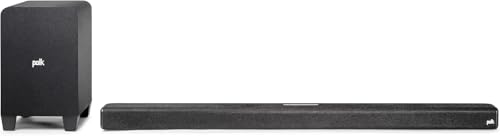
| Spec | JBL Bar 300MK2-5.0 | Polk Audio Signa S4 |
|---|---|---|
| Channels | 5.0 channel | Not published in listing; the 7-driver array includes left, right, center, and up-firing height channels plus a wireless subwoofer |
| Drivers | Not published in listing | Left and right 0.98-inch tweeters, two 4.7 by 1.57 inch racetrack mid drivers, one 0.98-inch center driver, two 2.59-inch up-firing elevation speakers |
| Power | 450W max output power | Not published in listing |
| Subwoofer | No separate subwoofer; built-in bass ports | Wireless subwoofer with a 5.9-inch driver |
| Dolby Atmos and DTS | Dolby Atmos; DTS not mentioned in listing | Dolby Atmos support; DTS and DTS:X not mentioned in listing |
| HDMI eARC and inputs | HDMI eARC with 4K Dolby Vision passthrough; one HDMI input | HDMI eARC for TV connection; no additional HDMI inputs or other ports specified in listing |
| Wireless and streaming | AirPlay, Google Cast, Spotify Connect, Tidal Connect, Roon Ready | Bluetooth with multi-device streaming; Wi-Fi and network streaming not mentioned in listing |
| Dimensions | Not published in listing | Soundbar height 2.36 inches; width, depth, and weight not published in listing |
| Remote and app | JBL ONE app; remote not mentioned in listing | Not published in listing; Bass Adjust and VoiceAdjust are present but the control method is not detailed |
| Included accessories | Not published in listing | Not published in listing |
Sound Quality
Both soundbar models score 23 out of 30 for sound quality, suggesting comparable overall performance in the lower mid-range tier. The JBL Bar 300MK2-5.0 is a 5.0 channel bar with 450W max output power, but its driver sizes and frequency response are not published in the listing. The Polk Audio Signa S4 lists a 7-driver array with two 0.98 inch tweeters, two 4.7 by 1.57 inch racetrack mid drivers, one 0.98 inch center driver, and two 2.59 inch up-firing elevation speakers. The Polk listing does not state total power output.
JBL emphasizes dialogue clarity through PureVoice 2.0 and SmartDetails processing, which likely helps voices cut through background noise. Polk has a dedicated center channel with VoiceAdjust for targeted dialogue enhancement. Without in-person testing, it is impossible to declare one objectively better, but the published driver details on the Polk give a clearer picture of its hardware configuration. The JBL relies more on proprietary processing such as MultiBeam 3.0 to create a wide soundstage from a single enclosure.
In terms of raw bass potential, the JBL lacks a separate subwoofer and depends on built-in bass ports within the bar. The Polk includes a wireless subwoofer with a 5.9 inch driver, which typically produces more low frequency energy. Buyers who prioritize clear dialogue and wide sound may find the JBL strong, while those who want fuller sound for action scenes may lean toward the Polk. Both models likely perform well for TV audio, but the JBL's lack of a sub is a known limitation for deep bass.
Surround, Atmos and Audio Formats
Both soundbars support Dolby Atmos, and both receive 11 out of 15 for surround and audio formats. Neither listing mentions DTS or DTS:X decoding, which is a significant omission for buyers with physical media or rips that use DTS soundtracks. The Polk Audio Signa S4 explicitly includes two up-firing elevation speakers for Atmos height effects, physically bouncing sound off the ceiling. The JBL Bar 300MK2-5.0 does not publish its speaker configuration, but the listing mentions Dolby Atmos processing and MultiBeam 3.0, which may use virtualization or beamforming for a surround effect.
The JBL's approach appears to rely on digital signal processing to create a wider soundstage without discrete rear speakers. Polk's physical up-firing drivers are a concrete hardware feature for Atmos, which often translates to more convincing overhead sound. Neither bar includes rear surround speakers or expansion options for discrete rears. The lack of DTS support is identical between the two, so neither is ideal for a mixed format home theater.
For audio formats beyond Atmos, neither listing states support for Dolby TrueHD, Dolby Digital Plus, or other codecs. HDMI eARC is the primary connection for both, allowing passthrough of Atmos from a TV if the TV supports it. Buyers with a large library of DTS encoded content should verify compatibility elsewhere, as the listings do not cover those formats.
Subwoofer and Bass
The JBL Bar 300MK2-5.0 has no separate subwoofer. Its bass output relies on built-in bass ports inside the single bar enclosure. The 450W max output power is a stated figure, but without driver sizes or frequency response, the actual low frequency extension is unknown. The listing itself notes that deep bass may be limited without a separate sub.
The Polk Audio Signa S4 includes a wireless subwoofer with a 5.9 inch driver. This separate cabinet can produce lower frequencies than a typical soundbar alone. The Polk also offers a Bass Adjust feature, allowing you to tune the subwoofer level to your room or preference. The listing does not publish total power output for the Polk, so direct wattage comparison is not possible.
For buyers who cannot place a subwoofer, the JBL is the only option between the two. For buyers who want more physical impact from explosions or music, the Polk's dedicated wireless sub is a clear advantage on paper. Both lack published frequency response, so actual bass extension remains an unknown. The decision hinges on whether you can accommodate a separate sub in your room.
Connectivity and TV Setup
The JBL Bar 300MK2-5.0 offers HDMI eARC with 4K Dolby Vision passthrough and one additional HDMI input. This means you can connect a streaming box, game console, or Blu ray player directly to the soundbar and pass video to the TV. The Polk Audio Signa S4 lists HDMI eARC for TV connection only, with no additional HDMI inputs or other ports specified in the listing. For single TV audio, both work, but the JBL offers more flexibility for external devices.
On the wireless side, JBL supports AirPlay, Google Cast, Spotify Connect, Tidal Connect, and Roon Ready. This is a strong set of network streaming protocols for multi-room or high quality music playback. The Polk only lists Bluetooth with multi-device streaming, with no Wi-Fi or networked multi room streaming mentioned. Bluetooth is convenient for casual listening but has range and quality limitations compared to Wi-Fi protocols.
Connectivity scores reflect this difference. The JBL scores 13 out of 15, while the Polk scores 10 out of 15. For TV setup, both use HDMI eARC, simplifying cabling to a single HDMI cable. Neither listing mentions optical or analog inputs, so those connections may be absent or not published. Buyers with multiple HDMI sources should lean toward the JBL.
Features, Apps and Voice Control
The JBL Bar 300MK2-5.0 uses the JBL ONE app for control and setup, though the listing does not mention a physical remote. The Polk Audio Signa S4 does not mention a companion app or remote in its listing. Its Bass Adjust and VoiceAdjust features are present, but the control method is not detailed, meaning they could be controlled via remote buttons, an app, or both.
JBL includes PureVoice 2.0, SmartDetails, and MultiBeam 3.0 as notable audio processing features. These target dialogue enhancement, detail extraction, and wide soundstage. Polk offers VoiceAdjust and Bass Adjust, which are simpler but practical for dialogue and subwoofer tuning. The features score is 12 out of 15 for JBL and 11 out of 15 for Polk, reflecting JBL's broader app and processing suite.
Neither soundbar has a built-in voice assistant. The JBL listing explicitly states no built-in voice assistant and requires an external voice-enabled speaker for voice control. The Polk listing does not mention voice assistant support at all. For smart home users, the JBL at least has a defined app and path for streaming integration, while the Polk appears focused on core TV audio with basic Bluetooth.
Design and Fit Under a TV
The Polk Audio Signa S4 has a published soundbar height of 2.36 inches, which is quite slim and should fit under many TVs without blocking the screen or IR sensor. The width, depth, and weight of the Polk bar are not published in the listing. The JBL Bar 300MK2-5.0 does not publish any physical dimensions at all, making TV fit impossible to confirm from the listing.
The JBL's single bar design means only one component to place, with no separate subwoofer cabinet. The Polk's bar is thin, but the wireless subwoofer adds another piece that needs floor space and a power outlet. For wall mounting, the Polk's slim profile helps, but the JBL's dimensions are unknown, so its wall mount compatibility cannot be assessed.
Design and TV fit scores are 11 out of 15 for JBL and 13 out of 15 for Polk. The Polk earns a higher score because at least its height is known and favorable. JBL's lack of published dimensions is a clear disadvantage for buyers who need to verify clearance under a wall mounted TV or on a stand. Potential buyers should confirm the JBL's size from the manufacturer before purchasing.
Who Should Buy It
Buy the JBL Bar 300MK2-5.0 if you want an all-in-one soundbar with no separate subwoofer, clear dialogue via PureVoice 2.0, and strong network streaming with AirPlay, Google Cast, Roon Ready, and Spotify Connect. It is well suited for TV viewers who prioritize voice clarity and want to connect one HDMI source such as a streaming box or game console through the bar.
Buy the Polk Audio Signa S4 if you want a slim soundbar that fits under a TV and includes a wireless subwoofer for deeper bass. Its up-firing drivers support Dolby Atmos height effects, and VoiceAdjust targets dialogue. Bluetooth multi-device streaming covers casual music, but there is no Wi-Fi for high quality network audio.
Both are lower mid-range options with similar overall scores. The JBL scores 78 out of 100 and the Polk scores 75 out of 100. The small score difference is not decisive. Your choice should depend on whether you can accommodate a separate subwoofer and how much you value network streaming versus physical bass.
The Deciding Question
The core question is whether you want a separate subwoofer or an all-in-one streamlined setup with more wireless protocols. The JBL Bar 300MK2-5.0 has no sub but offers an HDMI input, 4K Dolby Vision passthrough, and a broad set of streaming protocols. The Polk Audio Signa S4 has a wireless sub and a known slim height, but lacks Wi-Fi, extra HDMI inputs, and a published app.
If you mostly watch dialogue driven content and use network streaming for music, the JBL is stronger on paper. If you watch action movies with deep bass and have an eARC TV, the Polk's physical subwoofer will likely add more impact. The absence of DTS on both models means neither is ideal for a DTS heavy physical media collection.
Buyers should also compare published specifications. Polk lists driver sizes and bar height, which are helpful. JBL lists total power output, which Polk does not. Each model has unknowns. The deciding factor often comes down to whether a separate subwoofer is acceptable and whether Wi-Fi streaming matters to you.
Who Should Buy Which
Choose the JBL Bar 300MK2-5.0 for a clutter free Atmos experience with clear dialogue and strong music streaming. Its single bar design means no subwoofer to place or wire. The extra HDMI input and 4K Dolby Vision passthrough add flexibility for a source device. The 450W max output is a stated figure, but bass without a sub may not satisfy deep bass lovers.
Choose the Polk Audio Signa S4 for a slim Atmos soundbar with a wireless subwoofer and adjustable bass. Its 2.36 inch height fits under many TVs without blocking the screen. The 7-driver array with physical up-firing speakers is a concrete hardware advantage for Atmos height effects. Bluetooth multi-device streaming covers basic music needs.
For most buyers who can accommodate a separate subwoofer and want more physical bass, the Polk is the practical choice. For buyers who cannot place a sub and rely on AirPlay, Roon, or an HDMI input, the JBL is compelling. Both are solid lower mid-range options, but neither supports DTS. Confirm dimensions and bass expectations before purchase.
JBL Bar 300MK2-5.0
Pros
- Dolby Atmos processing in a single bar
- 450W max output power with built-in bass ports
- PureVoice 2.0 and SmartDetails for dialogue clarity
- HDMI eARC with 4K Dolby Vision passthrough
- Broad streaming support including AirPlay and Roon Ready
- No separate subwoofer to place or wire
Cons
- No separate subwoofer, so deep bass may be limited
- DTS support not mentioned in listing
- Driver sizes and frequency response not published
- No built-in voice assistant, requires external voice-enabled speaker
- Dimensions and weight not published, so TV fit is unclear
Polk Audio Signa S4
Pros
- Slim 2.36-inch profile fits under many TVs without blocking the screen or IR sensor
- Up-firing height drivers support Dolby Atmos height effects
- Dedicated center channel with VoiceAdjust targets clearer dialogue
- Bass Adjust lets you tune the wireless subwoofer level
- HDMI eARC provides single-cable TV connection with Atmos passthrough
- Bluetooth multi-device streaming adds casual music playback
Cons
- No DTS or DTS:X decoding mentioned in the listing
- No Wi-Fi, Ethernet, or networked multi-room streaming described
- Total power output and full dimensions are not published
- Only one HDMI eARC connection is described, with no extra HDMI input
- No rear surround speakers or separate height expansion options
Who Should Buy Each
JBL Bar 300MK2-5.0
- Movie and TV watchers who prioritize dialogue clarity
- Music streamers who use AirPlay, Google Cast, Spotify Connect, Tidal Connect, or Roon Ready
- People with limited space or who dislike separate subwoofer clutter
- Owners of TVs with HDMI eARC that need a simple one-cable audio upgrade
Polk Audio Signa S4
- Buyers with a TV that has HDMI eARC and supports Dolby Atmos
- Small to medium rooms where a slim soundbar and wireless sub are practical
- Listeners who prioritize clear dialogue for movies and TV
- People who want an entry-level Atmos experience from a known speaker brand without rear speakers
Quick Decision Guide
| If you want a single soundbar without a separate subwoofer and you value AirPlay, Google Cast, or Roon Ready streaming | Choose JBL Bar 300MK2-5.0 |
| If you want a slim soundbar that fits under a TV and a wireless subwoofer for extra bass | Choose Polk Audio Signa S4 |
| If you have an external HDMI source such as a streaming box or game console to connect through the soundbar | Choose JBL Bar 300MK2-5.0 |
| If you prefer published driver details and physical up-firing height speakers for Dolby Atmos | Choose Polk Audio Signa S4 |
| If you prioritize clear dialogue and network streaming over deep bass impact | Choose JBL Bar 300MK2-5.0 |
FAQ
About This Comparison
Mandrillis Team
The Mandrillis editorial team researches and compares audio and music gear using manufacturer documentation, verified specs and real buyer feedback, so you can make a confident purchase without wading through marketing claims.
Read our full research methodology.
We may earn a commission at no extra cost to you.