JBL Go 5 vs Anker 2
Quick Verdict
These are both small, budget-friendly portable Bluetooth speakers, but the JBL Go 5 scores higher at 80 out of 100 against 75 out of 100 for the Anker 2, largely on the strength of its feature list. The JBL Go 5 is IP68 rated for water, dust and drop protection, supports Auracast broadcasting, AirTouch stereo pairing and USB-C lossless audio, and uses recycled, PVC-free materials. The Anker 2 offers an IPX7 rating, a 24 hour claimed battery life from a 5200mAh cell, 12W of stereo output and BassUp bass enhancement at a lower price tier. Choose the JBL Go 5 for ruggedness and modern connectivity extras. Choose the Anker 2 if the longest claimed battery life and the lowest price matter most.
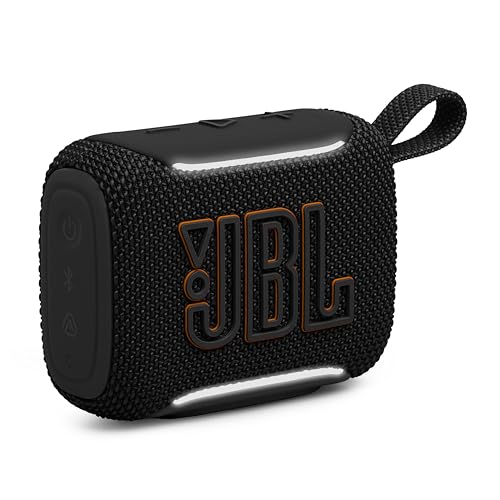

| Spec | JBL Go 5 | Anker 2 |
|---|---|---|
| Type | Portable Bluetooth speaker | Portable Bluetooth speaker |
| Drivers | Not published in listing | Dual neodymium drivers |
| Power or sensitivity | Not published in listing | 12W total power |
| Frequency response | Not published in listing | Not published in listing |
| Inputs and connectivity | USB-C for lossless audio, Bluetooth with Auracast, AirTouch stereo pairing | Bluetooth (version listed as Bluetooth 6), wireless stereo pairing |
| Bluetooth and streaming | Bluetooth with Auracast broadcast support, AirTouch pairing for two speakers, lossless USB-C playback | Bluetooth 6 (per listing title), wireless stereo pairing |
| Dimensions | Not published in listing | Not published in listing |
| Weight | Not published in listing | Not published in listing |
| Finish | Black, recycled plastic and fabric, PVC-free | Not published in listing |
| Included accessories | Not published in listing | Not published in listing |
Sound Quality
The JBL Go 5 scores 24 out of 30 on sound quality, though the listing does not publish wattage, driver size, frequency response or sensitivity figures, leaving actual audio performance to be judged mostly on brand reputation and feature claims of louder sound and deeper bass.
The Anker 2 scores 22 out of 30, built around dual neodymium drivers delivering 12W of total power, with BassUp technology and a spiral bass port the listing credits with enhancing low-end output from such a compact design.
The Anker 2 publishes more concrete driver and wattage information than the JBL Go 5, even though it scores slightly lower overall, suggesting the published score weighed JBL's broader feature set and brand strength over the Anker 2's more documented but modest power figures. Neither listing states a frequency response range, so neither speaker's true tonal balance can be confirmed beyond the general claims each makes.
Drivers, Power and Room Fit
The JBL Go 5's listing does not state a wattage or driver size figure, instead emphasizing an ultra portable, palm sized design that trades room filling output for pocketability, which the listing itself acknowledges may limit bass depth and room filling output.
The Anker 2 states a clear 12W total power figure from dual neodymium drivers, a modest number appropriate for close, personal listening rather than filling a room, backed by BassUp technology aimed at boosting perceived bass from that smaller driver pair.
Neither speaker is built to fill a large room, and the JBL Go 5's own cons note that its small size may limit bass depth, a tradeoff shared with the Anker 2's stated 12W rating. Both are best understood as personal or near field speakers rather than party speakers. Neither listing publishes weight or dimensions, so exact pocketability still has to be judged from product photos rather than a stated measurement.
Features and Connectivity
The JBL Go 5 scores 16 out of 20, with USB-C for lossless audio playback, Bluetooth with Auracast broadcast support, AirTouch instant stereo pairing for two speakers, and ambient edge lighting with multiple themes.
The Anker 2 scores 14 out of 20, with Bluetooth listed as version 6 in the title, wireless stereo pairing for two speakers, but no aux input or speakerphone function mentioned in the listing.
The JBL Go 5's Auracast support and lossless USB-C playback are more advanced connectivity features than anything described for the Anker 2, which relies on a more basic wireless stereo pairing setup without the broadcast capability Auracast provides. Neither listing names a specific Bluetooth codec beyond the version number, so streamed audio quality over Bluetooth alone depends on the source device's own defaults.
Build, Design and Finish
The JBL Go 5 scores 12 out of 15 on build and design, built from black recycled plastic and fabric in a PVC-free construction, carrying an IP68 rating that covers waterproofing, dust proofing and drop protection, a notably strong combined rating for such a small speaker.
The Anker 2 scores 11 out of 15, with an IPX7 waterproof rating covering submersion but no stated dust or drop protection rating, and the listing does not publish a specific finish or material beyond the speaker's general portable design.
The JBL Go 5's IP68 rating is more comprehensive than the Anker 2's IPX7 rating, since it also covers dust and drop resistance rather than water alone, giving it a documented ruggedness advantage for rough outdoor handling. Neither listing states exact dimensions or weight, which would otherwise help confirm how genuinely pocketable each speaker is in practice.
Setup and Placement
Setting up the JBL Go 5 is a simple Bluetooth pairing process, with AirTouch making it fast to link a second Go 5 for stereo sound, and its IP68 rating means it can be tossed in a bag or left somewhere dusty without much worry.
Setting up the Anker 2 also starts with Bluetooth pairing, and its wireless stereo pairing feature lets two units link for wider sound, though the listing does not describe an equivalent one-touch pairing feature like AirTouch.
Both speakers are built for grab and go use rather than a fixed setup, but the JBL Go 5's combined water, dust and drop rating makes it the more worry free option for rougher daily handling. Neither listing mentions a carrying case or carabiner clip included in the box, so attaching either speaker to a bag may require a separately purchased accessory.
Daily Use
Daily use of the JBL Go 5 benefits from up to 10 hours of battery life with what the listing calls Playtime Boost, plus ambient lighting themes for a bit of visual variety during use.
Daily use of the Anker 2 benefits from a stated 24 hour playtime from a 5200mAh battery, more than double the JBL Go 5's claimed figure, making it the stronger choice for extended use away from a charger.
The battery life gap is the single clearest numeric difference between these two. The Anker 2's 24 hours against the JBL Go 5's 10 hours is a significant advantage for anyone prioritizing runtime over the Go 5's broader feature list. A multi-day camping trip without reliable charging access would likely favor the Anker 2's stated endurance over the JBL Go 5's shorter runtime.
Who Should Buy It
The listing frames the JBL Go 5 as a fit for anyone who wants a rugged, pocketable Bluetooth speaker for outdoor and personal listening with modern connectivity extras like Auracast and lossless USB-C audio, while cautioning that it is not built for larger rooms or deep bass.
The listing frames the Anker 2 as a fit for budget minded buyers who want a waterproof portable speaker with long battery life and strong bass for outdoor, travel, or shower use, while noting the absence of an aux input or microphone.
The JBL Go 5 scores 80 out of 100 against 75 out of 100 for the Anker 2, with the Go 5 ahead on sound quality, features and connectivity, while the Anker 2 remains competitive on value and battery runtime. Both tie at 9 out of 10 on value, suggesting each is judged fairly priced for what it delivers within its own tier.
The Deciding Question
The real question is whether modern connectivity features or raw battery life matter more to you. The JBL Go 5's Auracast and lossless USB-C audio are genuinely newer capabilities, while the Anker 2's 24 hour battery life more than doubles the Go 5's claimed runtime.
A second question is how rugged the speaker needs to be. The JBL Go 5's IP68 rating covers dust and drops in addition to water, while the Anker 2's IPX7 rating covers only water exposure.
If price is the deciding factor above all else, the Anker 2 sits at a lower price tier according to its own listing, while the JBL Go 5 asks for a premium in exchange for its broader feature set and tougher build rating. That premium is easiest to justify for a buyer who will genuinely use Auracast or lossless USB-C playback rather than simply streaming over basic Bluetooth.
Who Should Buy Which
Buy the JBL Go 5 if you want the toughest build rating here, covering water, dust and drops, plus modern extras like Auracast broadcasting and lossless USB-C playback.
Buy the Anker 2 if the longest claimed battery life and the lowest price matter most, and you are comfortable with a simpler feature set and water-only protection rather than full dust and drop resistance.
Buyers who need an aux input, a built-in microphone for calls, or published frequency response figures should note that neither listing fully addresses those points, though the JBL Go 5 publishes more detail overall. Weigh the Go 5's higher price tier against the Anker 2's longer runtime and lower cost before making a final call.
JBL Go 5
Pros
- Ultra portable and palm sized design
- IP68 waterproof, dust proof, and drop proof build
- Ambient edge lighting with multiple themes
- AirTouch instant stereo pairing and Auracast support
- USB-C lossless audio playback
- Up to 10 hours of battery with Playtime Boost
Cons
- Wattage and driver specs not published in listing
- No published frequency response or sensitivity figures
- No included accessories listed
- Small size may limit bass depth and room filling output
- Battery life is modest compared to larger portables
Anker 2
Pros
- IPX7 waterproof rating for outdoor and shower use
- 24 hour playtime from a 5200mAh battery
- 12W stereo output with dual neodymium drivers
- BassUp technology with spiral bass port for enhanced low end
- Wireless stereo pairing for two speaker setups
- Budget price tier
Cons
- No aux input mentioned in the listing
- No speakerphone function listed
- Frequency response not published
- Dimensions and weight not published
- Exact driver size not disclosed
Who Should Buy Each
JBL Go 5
- Travelers and commuters who need a tiny speaker that fits in a pocket or bag
- Beach, pool, and outdoor users who want waterproof and drop proof protection
- Listeners who value app based EQ control and ambient lighting
- JBL fans who want latest Go 5 with Auracast and AirTouch pairing
Anker 2
- Outdoor enthusiasts who need a waterproof speaker for camping, beach, or hiking
- Anyone who listens to music in the shower or by the pool
- Budget shoppers wanting long battery life and decent volume
- People who want to pair two speakers for stereo separation
Quick Decision Guide
| If you want the toughest build rating covering water, dust and drops | Choose JBL Go 5 |
| If you want the longest claimed battery life at the lowest price | Choose Anker 2 |
| If you want Auracast broadcasting and lossless USB-C audio | Choose JBL Go 5 |
| If you want a simple, budget speaker with strong claimed bass boost | Choose Anker 2 |
| If you want one-touch AirTouch stereo pairing between two speakers | Choose JBL Go 5 |
FAQ
About This Comparison
Daniel Brooks
Daniel Brooks edits the buying guides and how-to articles at Mandrillis. He works from manufacturer manuals, published specifications and common owner questions to explain music and audio gear in plain language, from turntables and headphones to digital pianos and electronic drums.
Read our full research methodology.
We may earn a commission at no extra cost to you.