Joyo Zombie-II BanTamp XL vs Orange Micro Dark
Quick Verdict
The Joyo Zombie-II BanTamp XL is the better pick for players who want two channels, an FX loop, and Bluetooth streaming in a compact 20 watt head. It works best as a pedal platform with an external cabinet. The Orange Micro Dark is the better pick for players who want a simpler single channel Orange voiced head with a carrying handle and a clearly rated 8 to 16 ohm speaker output. Both require a separate speaker or headphones and lack built in effects. If you need channel switching and loop flexibility choose the Joyo. If you prefer minimal controls and Orange character choose the Micro Dark. Neither is an all in one combo.
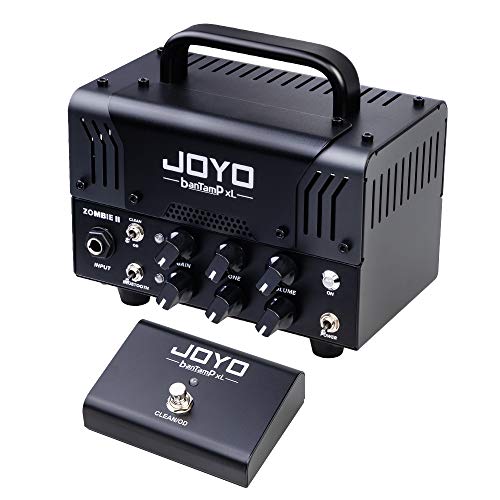

| Spec | Joyo Zombie-II BanTamp XL | Orange Micro Dark |
|---|---|---|
| Power output | 20W into an external cabinet, listing does not state RMS vs peak | 20 watts hybrid |
| Speaker | Not included, requires a separate speaker cabinet | Not published in listing |
| Amp models or channels | Two channels, Clean and Distortion, each with independent Volume, Gain, and Tone | Not published in listing |
| Effects | No built-in effects, studio-grade FX loop for external effects | Not published in listing |
| Inputs and outputs | Guitar input, FX loop send/return, headphone output with cabinet emulation, exact connector types not fully listed | Speaker output (8 to 16 ohms), headphone out with CabSim, instrument input implied but not listed |
| Headphone and line out | Headphone output with integrated speaker cabinet emulation | Headphone out with CabSim circuit |
| Bluetooth and app | Bluetooth for streaming audio, no companion app mentioned | Not published in listing |
| Weight | Not published in listing | Not published in listing |
| Dimensions | Not published in listing | Not published in listing |
| Included accessories | Not published in listing, listing mentions a dedicated footswitch but does not confirm if included | Carrying handle |
Amp Models and Tone
The Joyo Zombie-II BanTamp XL gives you two channels, Clean and Distortion, and each channel has its own Volume, Gain, and Tone control. That means you can set the clean channel to a bright low gain sound and the distortion channel to a saturated lead tone without sharing a single EQ. The Orange Micro Dark does not publish channel or amp model details in its listing. However, its listed pros and cons describe a single channel only. Its control set is limited to Gain, Shape, and Volume, which is a more streamlined approach.
Both heads rely on a 12AX7 tube in the preamp section and a solid state power amp. The Joyo listing highlights that the tube adds warmth and harmonic richness. The Orange listing describes the sound as Orange voiced gain, which suggests a familiar British flavored distortion. Because each product has a different tone shaping control, the experience will not be identical. The Joyo uses a dedicated Tone knob on each channel, while the Orange uses a Shape control that adjusts the midrange contour.
Neither product lists digital amp models or built in presets. The Joyo is closer to a traditional two channel amp, while the Orange is a single channel platform with a specific voicing. If you need a footswitchable clean and dirty sound from the amp itself, the Joyo has the advantage on paper. If you prefer to set one core gain tone and drive it with pedals, the Orange remains a viable minimalist option.
Effects and Features
The Joyo Zombie-II BanTamp XL has no built in effects, but it includes a studio grade FX loop for external effects. This loop lets you place time based effects like delay and reverb after the preamp for a cleaner signal path. The Orange Micro Dark has no onboard effects and no effects loop according to its listing. This means any external effects must run in front of the amp, which can work for drive and modulation but is less ideal for delay and reverb with high gain settings.
Both amps include a headphone output that uses cabinet emulation. The Joyo listing describes a headphone output with integrated speaker cabinet emulation. The Orange listing calls its feature a headphone out with CabSim circuit. These are functionally similar and let you practice silently without a physical cabinet. Neither amp has built in modulation, delay, or reverb, so if you want those sounds you will need external pedals regardless of which head you choose.
The Joyo adds one feature the Orange lacks: Bluetooth for streaming audio. This lets you play along with backing tracks or lesson material through the amp. The Orange has no Bluetooth, no USB, and no companion app. Neither amp offers an app for editing or saving settings. For players who want a simple all analog signal path, the Orange may feel more direct. For players who want wireless audio streaming, the Joyo is the only option between these two.
Power, Speaker and Volume
Both products are 20 watt hybrid amp heads. The Joyo Zombie-II BanTamp XL lists 20W output into an external cabinet, and the listing does not state whether this is RMS or peak. The Orange Micro Dark is listed as 20 watts hybrid without further detail on measurement. Neither amp includes a built in speaker. The Joyo listing explicitly says speaker not included. The Orange listing does not publish a speaker spec, but its cons note that it requires an external cab or headphones.
For speaker connections, the Orange lists a speaker output rated for 8 to 16 ohm cabinets. The Joyo listing does not publish an impedance range, only that it can drive a range of external cabinets. This missing specification makes it harder to confirm which cabinets the Joyo can safely use. If you already own a 16 ohm cabinet, the Orange compatibility is clearly stated. With the Joyo, you would need to check the manual or manufacturer documentation, which is not included in the listing.
Volume potential is similar because both are rated at the same wattage. A 20 watt head can usually produce enough volume for home practice, recording, and small gigs when paired with an efficient cabinet. However, the actual loudness depends on the external cabinet sensitivity, and neither listing provides speaker efficiency data. Both amps can be used at headphone level with their cab emulated outputs, which avoids the need for a cabinet at low volume.
Build and Portability
Neither listing publishes weight or dimensions for these amp heads. The Joyo Zombie-II BanTamp XL is described as compact in its listed pros, but without dimensions this is hard to verify against the Orange. The Orange Micro Dark is also described as compact and includes a carrying handle. That handle is the only included accessory specifically mentioned in either listing besides the Joyo mention of a dedicated footswitch that is not confirmed in the box.
Because both products are amp heads rather than combos, they share the same general form factor: a small chassis meant to sit on top of a cabinet or on a desk. The Joyo listing does not state the enclosure material. The Orange listing does not state the enclosure material. The Orange carrying handle suggests easy transport for a grab and go head. The Joyo may be similarly portable, but the absence of weight and dimensions means a buyer cannot compare size and heft from the listings alone.
Build quality beyond the listed features is unknown. Both list a 12AX7 tube, which implies some care with tube mounting, but neither listing details the chassis thickness or component quality. The Orange name carries a reputation for roadworthy simplicity, but this specific listing does not publish additional build details. The Joyo has no published build notes beyond its hybrid tube design. If portability is a deciding factor, the lack of measurements is a limitation for both.
Connectivity and Apps
The Joyo Zombie-II BanTamp XL has a guitar input, an FX loop send and return, a headphone output with cabinet emulation, and Bluetooth for streaming audio. The exact connector types are not fully listed, so the size and format of the headphone jack and FX loop jacks are not confirmed. The Orange Micro Dark lists a speaker output for 8 to 16 ohm cabinets, a headphone out with CabSim, and an instrument input that is implied but not listed. It has no effects loop send or return.
Bluetooth is a clear connectivity difference. The Joyo supports audio streaming but does not mention a companion app for control or editing. The Orange has no Bluetooth, no USB, and no app support. Neither amp offers computer connectivity for recording or firmware updates based on the listings. The headphone outputs on both amps double as practice and recording outputs, but neither listing mentions a balanced line out or direct out beyond the headphone jack.
For live use with a speaker cabinet, the Orange has an explicitly rated speaker output. The Joyo says it can drive an external cabinet but omits the impedance range. This does not mean the Joyo lacks connectivity, just that the listing does not publish enough detail. For players who plan to connect to a wide range of cabinets, the Orange spec is more reassuring. For players who want a headphone practice amp plus Bluetooth streaming, the Joyo has the more flexible feature set.
Setup and Daily Use
Setup is similar for both heads. You need to connect a speaker cabinet or use the headphone output. The Joyo gives you two channels with independent Volume, Gain, and Tone, so daily use might involve setting each channel once and then switching between them. The listing mentions a dedicated footswitch but does not confirm whether one is included in the box. Without that confirmation, you may need to buy a footswitch separately to change channels hands free.
The Orange Micro Dark has a simpler setup. You set Gain, Shape, and Volume and you play. There is no channel switching and no effects loop to manage. The carrying handle makes it easy to move the head between a desk and a cabinet. The Orange headphone out with CabSim is ready for silent practice as soon as you plug in headphones. No Bluetooth pairing or app setup is required.
Daily use with pedals differs. The Joyo FX loop gives you a dedicated place for time based effects after the preamp. The Orange forces all pedals into the front of the amp, which can push the preamp harder and may make some delay and reverb effects sound more distorted. If your daily routine includes a pedalboard with delay, reverb, and modulation, the Joyo loop is a practical advantage. If your board is just overdrive and boost, the Orange front end design is less of a limitation.
Home Practice Versus Stage
At home, both amps can work well through headphones. The Joyo has a headphone output with integrated cabinet emulation, and the Orange has a headphone out with CabSim. The Joyo adds Bluetooth, so you can stream a backing track and play along without an additional audio interface. The Orange lacks Bluetooth, so streaming requires a separate device into a mixer or using an audio cable into a different input, which the amp does not provide. For silent practice, both are functional, but the Joyo is more convenient for play along use.
For small stage use, both heads need an external cabinet. The Joyo has two channels, which allows a clean and a distorted sound at the stomp of a switch if you have the footswitch. The FX loop also lets you run delay and reverb after the preamp, a more stage friendly arrangement. The Orange is single channel, so you would need to use pedals to create a clean and dirty contrast, and you have no effects loop for time based effects. This is not a dealbreaker for many gigs, but it requires more work from your pedalboard.
Neither amp has a built in speaker, so neither can be used alone at a rehearsal without a cabinet. The 20 watt power sections should be adequate for small rooms and quiet stages when paired with a suitable cab, but exact headroom depends on the speaker. For bedroom practice, headphone outputs are the simplest option. For recording, the headphone outs with cab simulation might be acceptable for demos, but neither listing mentions a dedicated balanced output, so studio integration would rely on those headphone jacks or a microphone on a cabinet.
The Deciding Question
The central question between these two heads is whether you need the extra connectivity and channel separation of the Joyo or the simpler Orange voiced character of the Micro Dark. The Joyo offers two channels, an FX loop, and Bluetooth streaming. The Orange offers a single channel, no loop, no Bluetooth, but includes a carrying handle and a clear 8 to 16 ohm speaker spec. Both are hybrid 20 watt heads with a 12AX7 preamp and headphone based cabinet simulation.
If your existing rig already includes a speaker cabinet and a pedalboard, the Joyo is likely the more flexible platform. You can run time based effects in the loop, set a dedicated clean channel, and stream audio over Bluetooth. The Orange is better if you want a minimal setup with fewer controls and you like the Orange gain character. The Shape control is a different approach to tone than the Joyo Tone knob, and some players may prefer that single knob voicing.
Both products leave out weight and dimensions, which makes portability claims hard to verify. Neither product is an all in one combo. If you are not prepared to buy or already own a separate cabinet, then neither head will work by itself. The decision comes down to whether the Joyo feature set or the Orange control philosophy matches your needs.
Who Should Buy Which
Choose the Joyo Zombie-II BanTamp XL if you want a compact two channel amp head for use with an external cabinet. Its independent clean and distortion channels, plus studio grade FX loop, make it a strong candidate for a pedalboard based rig. The Bluetooth streaming is a bonus for practice and lessons. You should be comfortable with the fact that it has no built in effects and that the listing does not confirm footswitch inclusion or speaker impedance.
Choose the Orange Micro Dark if you want a straightforward single channel amp head with the Orange gain sound. Its Gain, Shape, and Volume layout is easy to dial in. The headphone out with CabSim works well for silent practice, and the included carrying handle makes it convenient to move. This amp suits players who already have an 8 to 16 ohm cabinet and do not need built in effects, Bluetooth, or an FX loop.
If you need a self contained combo with built in effects and an integrated speaker, neither product fits. Both require an external cabinet or headphones. The listings do not state weight and dimensions, so if exact size and weight are critical, you may need to seek additional manufacturer documentation. For everyone else, the choice is between Joyo flexibility and Orange simplicity.
Joyo Zombie-II BanTamp XL
Pros
- Hybrid tube preamp with 12AX7 adds warmth and harmonic richness
- Two independent channels with separate volume, gain, and tone controls
- Compact 20W head can drive a range of external cabinets
- Built-in Bluetooth for streaming backing tracks and lessons
- Headphone output with cabinet emulation for silent practice
- Studio-grade FX loop works well with time-based effects
Cons
- No built-in effects, so players need external pedals for delay, reverb, or chorus
- Requires a separate speaker cabinet, adding cost and bulk versus a combo
- No companion app for editing or saving settings
- Key specifications like weight and dimensions are not published
- The included footswitch is not explicitly confirmed in the box
Orange Micro Dark
Pros
- Compact amp head with carrying handle
- Hybrid tube preamp with 12AX7 for Orange voiced gain
- Headphone out with CabSim for silent practice
- Simple gain, shape, and volume control set
- Speaker output works with common 8 to 16 ohm cabinets
Cons
- No built in speaker cabinet; requires external cab or headphones
- No onboard effects, Bluetooth, USB, or app support
- Weight and dimensions not published in listing
- Single channel only; no multiple amp models
- No effects loop or balanced direct output
Who Should Buy Each
Joyo Zombie-II BanTamp XL
- Players who already own a speaker cabinet or want to build a mini amp rig
- Guitarists who rely on a pedalboard and want a neutral clean channel plus a high-gain distortion channel
- Recording musicians who need a compact hybrid tube amp with an FX loop and headphone out
- Anyone looking for a budget-friendly tube-preamp amp head with Bluetooth practice features
Orange Micro Dark
- Players who already own an 8 or 16 ohm guitar cabinet
- Home players wanting a small tube preamp head for headphone practice
- Fans of Orange's dark and mid forward gain character
- Budget conscious buyers who prefer simple analog controls
Quick Decision Guide
| If you need two separate channels with independent volume, gain, and tone controls | Choose Joyo Zombie-II BanTamp XL |
| If you want a studio grade FX loop for delay and reverb pedals | Choose Joyo Zombie-II BanTamp XL |
| If you want Bluetooth streaming for backing tracks and lessons | Choose Joyo Zombie-II BanTamp XL |
| If you prefer a single channel amp with a simple Gain, Shape, and Volume control set | Choose Orange Micro Dark |
| If you want a carrying handle and a clearly rated 8 to 16 ohm speaker output | Choose Orange Micro Dark |
FAQ
About This Comparison
Mandrillis Team
The Mandrillis editorial team researches and compares audio and music gear using manufacturer documentation, verified specs and real buyer feedback, so you can make a confident purchase without wading through marketing claims.
Read our full research methodology.
We may earn a commission at no extra cost to you.