Mosen MDP-110 vs Eastar EUP-100
Quick Verdict
Choose the Mosen MDP-110 if you want the largest sound library, 128 note polyphony, dual headphone jacks, and audio input in a budget furniture piano. Choose the Eastar EUP-100 if you prefer a clearer triple pedal, included headphone, wireless MIDI, and recording features for app based practice. Both have 88 weighted keys and unknown speaker and weight specifications. The Mosen has more voices and rhythms but an unclear pedal bundle. The Eastar has only 13 voices and unknown polyphony but a stronger starter accessory set. Buyers who rely on onboard speakers or need portability should request missing specs or look elsewhere.
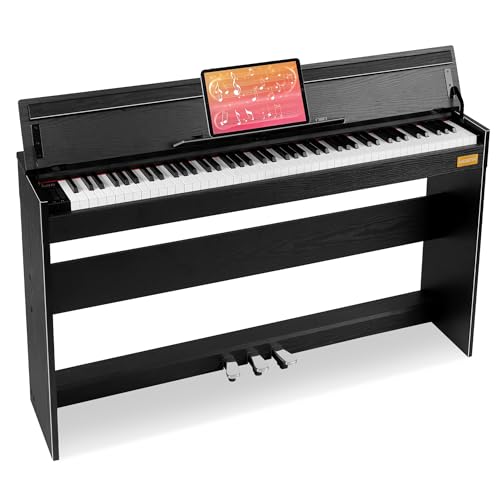

| Spec | Mosen MDP-110 | Eastar EUP-100 |
|---|---|---|
| Keys | 88 full size, fully weighted graded hammer action | 88 |
| Key action | Graded hammer action with velocity sensitivity | Weighted hammer action |
| Polyphony | 128 | Not published in listing |
| Sounds | 380 voices, 128 rhythms | 13 voices |
| Speakers | Not published in listing | Not published in listing |
| Connectivity | USB MIDI, audio input, dual headphone jacks | Wireless MIDI, MIDI IN/OUT, headphone output |
| Bluetooth | Not published in listing | Not published in listing |
| Pedals included | Sustain pedal listed; listing title also says triple pedal | Triple pedal |
| Weight | Not published in listing | Not published in listing |
| Included accessories | Wooden stand, integrated dust cover, power adapter, sustain pedal, music stand, assembly instructions | Cover, headphone, piano stickers, triple pedal |
Key Action
Both models offer 88 full size keys with weighted hammer action. The Mosen MDP-110 explicitly describes its action as fully weighted graded hammer action with velocity sensitivity. The Eastar EUP-100 describes its action as weighted hammer action, but the listing does not mention graded weighting or velocity sensitivity in the same detail. Both actions aim to mimic an acoustic piano, but the Mosen provides a more specific graded hammer description.
Graded hammer action typically means lower keys have a heavier touch and higher keys have a lighter touch, but the Mosen listing does not publish weight gradient values. Eastar does not state whether its hammer action is graded or uniform across all keys. Neither listing states the number of sensors per key, so touch response precision cannot be compared from the published material.
In the breakdown scores, the Mosen receives 22 out of 30 for key action while the Eastar receives 21 out of 30. This one point difference reflects the more detailed graded hammer specification on the Mosen. Buyers who prioritize a graded feel may lean toward the Mosen, but both remain budget weighted actions with unknown long term durability.
Piano Sound and Speakers
The Mosen MDP-110 offers 380 voices and 128 rhythms, along with 128 note polyphony. The Eastar EUP-100 offers 13 voices and does not publish a polyphony figure in the listing. This is a major difference in onboard sound variety. The Mosen provides a much larger palette of instruments and backing rhythms, while the Eastar is limited to a small core set of sounds.
Polyphony matters for sustained notes and layered sounds. The Mosen's published 128 note polyphony is a standard figure for modern budget pianos and helps prevent note dropout during complex passages. Eastar's polyphony is not stated, so buyers cannot evaluate how many simultaneous notes it can sustain. This missing spec makes the Eastar's sound engine harder to assess.
Neither listing publishes speaker wattage, driver size, or amplifier output. This means the projected sound volume and quality cannot be compared from the supplied facts. Both pianos have speakers built into their furniture style cabinets, but the listing does not state the details. Buyers who rely on onboard speakers should verify these numbers before buying, or plan to use headphones.
Features and Modes
The Mosen MDP-110 includes 380 voices, 128 rhythms, USB MIDI, audio input, and dual headphone jacks. It does not list recording or accompaniment features in the supplied pros and cons, aside from the rhythm library. The Eastar EUP-100 includes wireless MIDI, MIDI IN/OUT, recording and accompaniment features for practice, and a triple pedal. These feature sets are quite different.
Mosen's large voice and rhythm count gives a beginner many timbres and backing patterns to explore. Its audio input allows playing along with music from a phone or tablet through the piano's speakers or headphones. Dual headphone jacks let two people listen quietly at the same time. Eastar counters with wireless MIDI and recording features, which help connect to apps and track practice progress.
Eastar's recording and accompaniment features are specifically listed as pros for practice, while Mosen's listing does not call out recording. However, Mosen's 128 rhythms may serve as practice accompaniments. The Eastar has only 13 voices, so its recording feature will work with a much smaller sound set. Buyers should decide whether more sounds or better app and recording features matter more.
Build, Design and Portability
Both are furniture style digital pianos designed to remain in one room rather than travel to gigs. The Mosen MDP-110 includes a wooden stand and an integrated dust cover that becomes a desk when closed. The Eastar EUP-100 has a desk style wood finish and a more traditional home cabinet look. Neither listing publishes weight or dimensions.
The integrated dust cover on the Mosen is a practical feature for compact living spaces because it protects the keys and provides a flat work surface. Eastar does not list an integrated dust cover, but it includes a separate cover accessory. The Mosen's build score is 6 out of 10, while the Eastar's build score is 7 out of 10, suggesting a slight edge for the Eastar cabinet in the editorial scoring.
Portability is impossible to compare because neither listing states the weight or dimensions. Furniture style digital pianos often have wooden cabinets and full size weighted keybeds that add weight, but this cannot be confirmed from the supplied facts. Buyers who need to move the piano frequently should ask the seller for these details or consider a portable stage piano instead.
Connectivity
The Mosen MDP-110 provides USB MIDI for connecting to computers or mobile devices, along with an audio input for playing external audio through the piano. It also has dual headphone jacks. The listing does not state Bluetooth audio or Bluetooth MIDI, and the cons explicitly say no Bluetooth. It also lacks a line output, offering only headphone output for sound.
The Eastar EUP-100 includes wireless MIDI, standard MIDI IN and MIDI OUT ports, and a headphone output. The listing does not mention USB MIDI or USB audio. It has no audio input listed. The wireless MIDI feature allows cable free connection to apps and devices, while MIDI IN/OUT supports older external gear.
For app based learning, the Mosen uses a USB MIDI connection, which is common and reliable. The Eastar offers both wireless MIDI and wired MIDI ports, which may appeal to users who want flexibility or need to connect to hardware not equipped with USB. Neither model lists Bluetooth audio, so playing music wirelessly from a phone is not supported on either listing. Dual headphone jacks are a Mosen advantage for two listeners, while Eastar lists a single headphone output.
Setup and Accessories
The Mosen MDP-110 ships with a wooden stand, integrated dust cover, power adapter, sustain pedal, music stand, and assembly instructions. The listing title mentions a triple pedal, but the accessory list says sustain pedal, creating uncertainty about the exact pedal bundle. Buyers should verify which pedal set is actually included before purchase.
The Eastar EUP-100 includes a cover, a headphone, piano stickers, and a triple pedal. The listing does not mention a separate music stand, but the desk style cabinet likely includes one. Because the triple pedal is clearly listed as included, Eastar offers a clearer pedal configuration than the Mosen. The included headphone and piano stickers are helpful extras for a first time buyer.
Setup for both will require some assembly, especially the wooden stand for the Mosen. The Mosen includes assembly instructions, while the Eastar listing does not mention assembly instructions. The Eastar's desk style cabinet may arrive partially assembled or as a single furniture unit, but the listing does not state this. Overall, Eastar's accessory bundle is more complete for immediate practice, while Mosen's integrated dust cover is a unique space saving extra.
Daily Use
For daily practice at home, both pianos offer 88 weighted keys and a furniture style footprint. The Mosen MDP-110 benefits from its dual headphone jacks, which let a student and teacher or two family members practice quietly. Its audio input allows a phone or tablet to play along through the piano, making practice tracks easy to hear.
The Eastar EUP-100 includes a headphone, triple pedal, and piano stickers, which support a complete beginner routine right out of the box. Its wireless MIDI and recording features allow a player to connect to educational apps and record practice sessions for review. The 13 voice sound set covers the core piano, electric piano, and organ sounds, but lacks the variety of the Mosen.
Without published speaker specifications, the room filling volume of either piano is unknown. Both models support headphone practice, which is often essential in shared spaces. The Mosen's larger voice library and rhythms may keep practice sessions more engaging over time, while the Eastar's recording features help track progress. Neither has a published battery option, so both are intended for home use near an outlet.
The Deciding Question
The deciding question between these two models is whether you value a larger sound library, graded hammer detail, and dual headphone output, or a clearer accessory bundle, wireless MIDI, and recording features. The Mosen MDP-110 leads on published polyphony, voice count, and audio input. The Eastar EUP-100 leads on triple pedal clarity, included headphone, wireless MIDI, and recording.
Both pianos have unknown speaker specifications and unknown weight, so neither can be confidently recommended for buyers who need loud onboard sound or easy portability. The Mosen also has an unclear pedal inclusion, which introduces risk. The Eastar has unknown polyphony, which makes its sound engine harder to evaluate.
If you plan to use headphones most of the time and enjoy exploring many sounds, the Mosen looks stronger on paper. If you want a complete starter bundle with a clear triple pedal and app connection without USB, the Eastar is a practical choice. Neither is a premium instrument, but both are budget home pianos with honest feature sets.
Who Should Buy Which
Buy the Mosen MDP-110 if you are a beginner or casual player who wants a budget furniture style 88 key weighted piano with a very large sound library, 128 note polyphony, dual headphone jacks, and audio input for play along. You should be comfortable with unknown speaker output and weight, and verify the pedal bundle before purchase.
Buy the Eastar EUP-100 if you are a beginner who values a complete starter package with a triple pedal, headphone, piano stickers, wireless MIDI, and recording features. You should be okay with only 13 voices and unknown polyphony, and plan to use the piano mostly at home for practice rather than performance.
Avoid both if you need a portable stage piano, a proven premium action, published speaker and amplifier specifications, or Bluetooth audio. These are home digital pianos aimed at budget conscious buyers. The right choice depends on which published strengths align with your daily practice setup.
Mosen MDP-110
Pros
- 88 fully weighted graded hammer action keys
- 128 note polyphony and 380 voices
- USB MIDI and audio input for apps and play along
- Dual headphone jacks for quiet practice
- Wooden stand with dust cover that becomes a desk
- Budget friendly with 1 year warranty
Cons
- Speaker wattage and driver size not published
- Weight and dimensions not published
- Pedal bundle is unclear (title says triple, bullets say sustain)
- No Bluetooth audio or MIDI
- No line output, only headphone jack
Eastar EUP-100
Pros
- Weighted hammer action across 88 keys
- Large accessory bundle for a budget piano
- Wireless MIDI and MIDI IN/OUT for app connection
- Triple pedal included
- Desk style wood finish with home furniture look
- Recording and accompaniment features for practice
Cons
- Polyphony and speaker specifications not published
- No published weight or dimensions
- No Bluetooth audio or USB audio in the listing
- Limited to 13 voices
- Sound quality cannot be assessed from listing alone
Who Should Buy Each
Mosen MDP-110
- Beginners who want a full size weighted piano for home practice
- Apartment dwellers who need quiet headphone playing and a dual use desk
- Families that want a variety of sounds and rhythms for casual playing
- Buyers who use USB MIDI learning apps but do not need Bluetooth
Eastar EUP-100
- Beginners and returning players who need a full size weighted action
- Home users who want a wood finish piano that doubles as a desk
- Gift buyers looking for a budget home digital piano with accessories
- Students who want to connect to educational apps through MIDI
Quick Decision Guide
| If you want the largest onboard sound library and rhythm variety | Choose Mosen MDP-110 |
| If you want a clear triple pedal and complete starter accessory bundle | Choose Eastar EUP-100 |
| If you need dual headphone jacks for quiet duet practice | Choose Mosen MDP-110 |
| If you need wireless MIDI and standard MIDI IN/OUT for apps and external gear | Choose Eastar EUP-100 |
| If you need published speaker wattage and driver specifications | Choose Neither, because both listings omit these details |
FAQ
About This Comparison
Mandrillis Team
The Mandrillis editorial team researches and compares audio and music gear using manufacturer documentation, verified specs and real buyer feedback, so you can make a confident purchase without wading through marketing claims.
Read our full research methodology.
We may earn a commission at no extra cost to you.