Sonos Arc Ultra Soundbar vs Sennheiser AMBEO
Quick Verdict
The Sonos Arc Ultra Soundbar and the Sennheiser AMBEO are both premium single bar soundbars aiming for a full home theater sound field, with the Arc Ultra scoring 88 and the AMBEO scoring 86. The Arc Ultra offers wide Dolby Atmos channel coverage, AI driven Speech Enhancement for dialogue, and a clear expansion path through optional Sonos Sub and Era 300 speakers. The AMBEO scores higher for sound quality alone and supports more formats, including DTS:X and MPEG-H, plus a claimed deep bass response without an external subwoofer. Choose the Arc Ultra if you want Sonos ecosystem expansion and dialogue clarity. Choose the AMBEO if you want the strongest single bar sound and the broadest format support.

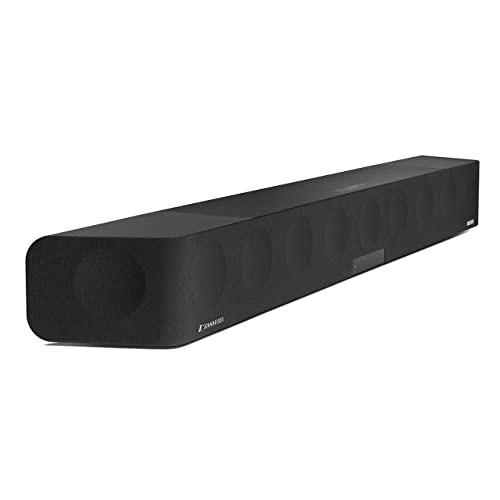
| Spec | Sonos Arc Ultra Soundbar | Sennheiser AMBEO |
|---|---|---|
| Channels | 9.1.4 | 5.1.4 |
| Drivers | Not published in listing | Five dedicated tweeters described; total driver count and bass driver size not published in listing |
| Power | Not published in listing | Not published in listing |
| Subwoofer | No separate subwoofer included; compatible with optional Sonos Sub models | No included external subwoofer; internal bass with 30Hz claim; mono subwoofer pre-out for optional wired Sennheiser Ambeo Subwoofer |
| Dolby Atmos and DTS | Dolby Atmos yes; DTS and DTS:X not stated in listing | Dolby Atmos, DTS:X, MPEG-H |
| HDMI eARC and inputs | One HDMI eARC port; no additional HDMI inputs stated | Not published in listing |
| Wireless and streaming | WiFi, Bluetooth, Apple AirPlay 2, Spotify Connect, Sonos multi-room | Wi-Fi, Bluetooth, Chromecast built-in, AirPlay 2, Spotify Connect, Tidal Connect |
| Dimensions | Not published in listing | Not published in listing |
| Remote and app | Sonos app, TV remote control, touch controls, Sonos Voice Control, Alexa | Remote control included; companion app not specified in listing |
| Included accessories | Not published in listing | Calibration microphone, remote control, owner's manual |
Sound Quality
The Sennheiser AMBEO scores 29 out of 30 for sound quality, slightly ahead of the Sonos Arc Ultra Soundbar at 27 out of 30. Both are premium single bar soundbars that aim to deliver a full home theater sound field from one enclosure rather than a full speaker system. That two point gap is small enough that either bar should satisfy most everyday listeners.
The Sonos Arc Ultra listing highlights AI driven Speech Enhancement for clear dialogue and Trueplay tuning that adjusts sound to the room. The Sennheiser AMBEO listing highlights room calibration tuned with Fraunhofer technology and an integrated upmix that adapts stereo and other content for its channel layout.
The AMBEO also claims deep bass down to 30Hz without an external subwoofer, built around five dedicated tweeters described in the listing. The Arc Ultra does not state a bass extension figure, relying instead on compatibility with optional Sonos Sub models for deeper low end.
Drivers, Power and Room Fit
Neither listing publishes exact driver counts or power output for either soundbar. The Sonos Arc Ultra is described as having multiple drivers including up firing units, and the Sennheiser AMBEO listing specifically calls out five dedicated tweeters.
In terms of channel layout, the Arc Ultra is built around nine main channels, one subwoofer channel, and four height channels for its Dolby Atmos presentation. The AMBEO is built around five main channels, one subwoofer channel, and four height channels, a smaller main channel count paired with its own claimed deep bass.
For room fit, the Arc Ultra scores 13 out of 15 for design and TV fit, while the AMBEO scores 11 out of 15 in the same category. Neither listing publishes dimensions, so buyers should confirm physical size against their TV stand or wall mount before buying.
Features and Connectivity
The Arc Ultra supports Dolby Atmos, though the listing does not state DTS or DTS:X support. The AMBEO supports Dolby Atmos, DTS:X, and MPEG-H, giving it the broader stated format support of the two. That gap matters mainly for buyers who already own discs or streaming sources encoded in DTS formats.
Both soundbars offer strong wireless streaming. The Arc Ultra lists Wi-Fi, Bluetooth, Apple AirPlay 2, Spotify Connect, and Sonos multi-room audio. The AMBEO lists Wi-Fi, Bluetooth, Chromecast built in, AirPlay 2, Spotify Connect, and Tidal Connect, adding Chromecast and Tidal Connect that the Arc Ultra listing does not mention. Buyers who already subscribe to Tidal may find that extra support meaningful day to day.
For connectivity scoring, the Arc Ultra earns 13 out of 15 and the AMBEO earns 12 out of 15. The Arc Ultra lists one HDMI eARC port with no additional HDMI inputs stated, while the AMBEO listing does not publish HDMI eARC or input details at all.
Build, Design and Finish
Design and TV fit favors the Arc Ultra, scoring 13 out of 15 against the AMBEO's 11 out of 15. Neither listing publishes dimensions or weight for either soundbar, so exact footprint should be confirmed separately. A quick measurement of your TV stand or shelf is worth doing before ordering either model.
The Arc Ultra is designed to work alongside optional Sonos Sub models and Era 300 speakers for an expandable surround system, according to its listing. The AMBEO is designed as a more self contained single unit, with an optional wired Sennheiser Ambeo Subwoofer for extra bass rather than a full expandable ecosystem.
Both are single bar designs meant to sit below or in front of a television. Buyers who plan to expand later with additional speakers may find the Arc Ultra's ecosystem approach more useful than the AMBEO's more self contained design.
Setup and Placement
The Arc Ultra connects with a single HDMI eARC cable, which the listing presents as a simple setup step. Trueplay tuning then adjusts the sound profile to the room automatically, based on the listing's description.
The AMBEO listing describes room calibration tuned with Fraunhofer technology, which serves a similar purpose of adapting the sound to the room. The listing does not state exactly how that calibration process is triggered or performed day to day.
Neither listing confirms a full set of HDMI inputs or passthrough behavior. Buyers with several connected devices should confirm compatibility with their specific television and source equipment before final placement, since a single eARC port on the Arc Ultra may require a switch or an eARC capable television. Taking stock of every source device beforehand avoids an awkward surprise during setup.
Daily Use
For daily use, the Arc Ultra adds AI driven Speech Enhancement specifically for dialogue clarity, which should help with everyday TV and streaming content. The AMBEO relies on its channel layout and calibration rather than a named dialogue feature in the listing. Households that watch a lot of dialogue heavy shows may notice the Arc Ultra's dedicated feature more often.
Music streaming is well covered on both soundbars. The Arc Ultra offers Spotify Connect and AirPlay 2 alongside Sonos multi-room, while the AMBEO adds Tidal Connect and Chromecast on top of Spotify Connect and AirPlay 2, giving slightly broader app based streaming support.
For voice control, the Arc Ultra listing mentions Sonos Voice Control and Alexa support. The AMBEO listing does not specify voice assistant support, which may matter for buyers who rely on voice commands for daily playback.
Who Should Buy It
The Sonos Arc Ultra Soundbar is best for TV and movie listeners who want a single bar with wide channel based Atmos and clear dialogue. It especially suits buyers already invested in the Sonos ecosystem and planning to add speakers over time.
The Sennheiser AMBEO is best for buyers who want a single premium soundbar with claimed deep bass and immersive Dolby Atmos and DTS:X support. It fits well for anyone not ready to add a separate subwoofer right away but who still wants a full feeling sound field.
Buyers who value DTS:X and MPEG-H format support, or who want five dedicated tweeters for treble detail, may lean toward the AMBEO. Buyers who want Sonos ecosystem expansion may lean toward the Arc Ultra instead.
The Deciding Question
The deciding question is whether format support and ecosystem expansion matter more to you than a slightly higher sound quality score. The AMBEO scores higher for sound quality and supports DTS:X and MPEG-H, formats the Arc Ultra listing does not confirm.
The Arc Ultra answers a different need, offering AI driven Speech Enhancement, Trueplay room tuning, and a clear expansion path through optional Sonos Sub and Era 300 speakers. If you expect to build out a full surround system over time, that ecosystem matters more than a small score gap.
If you want the single best sounding bar on paper and do not need expansion, the AMBEO's higher sound quality score and broader format support make it the stronger pick for now. That advantage narrows for anyone who already owns Sonos speakers and values a single connected ecosystem over a marginal sound quality gain.
Who Should Buy Which
Buy the Sonos Arc Ultra Soundbar if you want wide Dolby Atmos channel coverage and clear dialogue through Speech Enhancement. It also makes sense if you want a path to expand later with Sonos Sub and Era 300 speakers.
Buy the Sennheiser AMBEO if you want the highest sound quality score in this pair and broader stated format support, including DTS:X and MPEG-H. Its claimed deep bass response also means you can skip a subwoofer purchase for now.
The Arc Ultra scores 88 overall against the AMBEO's 86, a close result that comes down to connectivity, design, and ecosystem fit. Neither soundbar is a clear overall winner, so matching the bar to your existing devices and plans is the better guide.
Sonos Arc Ultra Soundbar
Pros
- 9.1.4 Dolby Atmos channels for immersive sound.
- AI driven Speech Enhancement for clear dialogue.
- Broad streaming including AirPlay 2 and Spotify Connect.
- Trueplay tuning adjusts sound to room.
- Works with Sonos Sub and Era 300 for expandable surround.
- Single cable HDMI eARC setup.
Cons
- No separate subwoofer included.
- DTS support not stated.
- Driver sizes and power not published.
- Only one HDMI input, passthrough not specified.
- Upper mid-range price for a soundbar without a sub.
Sennheiser AMBEO
Pros
- 5.1.4 channel layout with Dolby Atmos, DTS:X, and MPEG-H support
- Deep 30Hz bass claim without an external subwoofer
- Room calibration tuned with Fraunhofer technology
- Integrated upmix for stereo and 5.1 content
- Strong wireless streaming: Wi-Fi, Bluetooth, Chromecast, AirPlay 2, Spotify Connect, Tidal Connect
- Five dedicated tweeters described for studio-grade treble and precise midrange
Cons
- No included external subwoofer
- Optional Sennheiser Ambeo Subwoofer is wired only, not wireless
- HDMI eARC and input details are not published in the listing
- Power output and physical dimensions are not published in the listing
- Companion app and voice assistant support are not specified in the listing
Who Should Buy Each
Sonos Arc Ultra Soundbar
- Existing Sonos multi-room users who want to add a TV bar.
- Apartment or living room users who prefer no separate subwoofer.
- Listeners who prioritize dialogue clarity and Atmos from one unit.
- Streamers who use AirPlay 2, Spotify Connect, or Bluetooth often.
Sennheiser AMBEO
- Buyers who want a one-piece premium Atmos and DTS:X soundbar
- Listeners who prioritize room calibration and upmixing of legacy content
- Streaming households that use Chromecast, AirPlay 2, Spotify Connect, or Tidal Connect
- Buyers comfortable with upper mid-range pricing and optional wired subwoofer expansion
Quick Decision Guide
| If you want the widest stated surround format support including DTS:X and MPEG-H | Choose Sennheiser AMBEO |
| If you already use Sonos speakers and want an easy expansion path | Choose Sonos Arc Ultra Soundbar |
| If you want an AI driven dialogue clarity feature built into the bar | Choose Sonos Arc Ultra Soundbar |
| If you want the single highest sound quality score without buying a subwoofer | Choose Sennheiser AMBEO |
| If you want Chromecast built in and Tidal Connect streaming support | Choose Sennheiser AMBEO |
FAQ
About This Comparison
Mandrillis Team
The Mandrillis editorial team researches and compares audio and music gear using manufacturer documentation, verified specs and real buyer feedback, so you can make a confident purchase without wading through marketing claims.
Read our full research methodology.
We may earn a commission at no extra cost to you.