Yamaha FS800 vs Guild OM-340
Quick Verdict
The Yamaha FS800 is the stronger choice for buyers who value specification transparency, with its published solid Sitka spruce top, nato back and sides, rosewood fingerboard, and diecast tuners. It scores slightly higher overall and in most categories. The Guild OM-340 is a good alternative if you prefer an open pore satin natural finish and a classic Orchestra body, and you do not mind that many tonewoods and hardware details are unpublished. Both are acoustic only, so neither includes electronics or a cutaway. For most informed buyers, the Yamaha FS800 provides more certainty on paper.

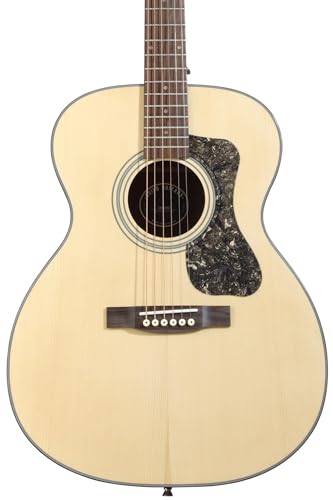
| Spec | Yamaha FS800 | Guild OM-340 |
|---|---|---|
| Body shape | Concert | Orchestra (OM) |
| Top | Solid Sitka spruce | Solid top construction, wood species not published in listing |
| Back and sides | Nato | Not published in listing |
| Neck and fingerboard | Neck wood not published in listing; rosewood fingerboard | Not published in listing |
| Scale length | Not published in listing | Not published in listing |
| Nut width | Not published in listing | Not published in listing |
| Electronics | Not published in listing | Not published in listing |
| Tuners | Diecast tuners | Not published in listing |
| Finish | Not published in listing | Open pore satin finish in natural color with black binding and black tortoise pickguard |
| Included accessories | Not published in listing | Not published in listing |
Body, Neck and Playability
The Yamaha FS800 is listed as having a Concert body, while the Guild OM-340 is listed as an Orchestra body. Both body names indicate a smaller than dreadnought design, which typically improves comfort for seated playing and fingerstyle. Neither listing provides actual body dimensions, so the exact size difference is not published.
The Yamaha FS800 includes a rosewood fingerboard, but the neck wood is not published in the listing. The Guild OM-340 does not publish any neck or fingerboard materials. Both listings also omit scale length and nut width, which are important for playability. Without those numbers, a direct comparison of fret spacing and string tension is impossible.
In the playability category, Yamaha scores 24 out of 30, while Guild scores 22 out of 30. The two point difference gives Yamaha a slight edge on paper, but the missing dimensional data for both models means the reason for that difference is not fully explained by the listings.
Tone and Projection
The Yamaha FS800 uses a solid Sitka spruce top, a widely respected tonewood known for clarity and dynamic range. Its back and sides are nato, a durable hardwood. The Guild OM-340 has a solid top, but the wood species is not published, and the back and side woods are also unpublished. This makes the Guild's tonal contribution from body woods harder to assess from the listing.
Both body shapes are smaller than a dreadnought, which generally leads to less bass and more midrange focus. The Yamaha's nato back and sides may contribute to a balanced tone, but no frequency data is provided. The Guild's open pore satin finish is listed as a pro that may enhance resonance, though that is a claim from the listing rather than a measured result.
For tone, Yamaha earns 20 out of 25, while Guild earns 19 out of 25. The one point difference is small and may relate to the known Sitka spruce top on the Yamaha versus the unspecified solid top on the Guild. Both guitars are acoustic only, so their natural acoustic voice is the sole tonal output.
Hardware and Electronics
Neither guitar includes onboard electronics according to the listings. Yamaha's cons state no onboard electronics for direct amplification, and Guild's cons also note no electronics included, which may limit stage use. This makes both guitars purely acoustic instruments, simplifying maintenance and keeping the design clean but requiring external amplification for performance.
Yamaha is specified with diecast tuners and an adjustable truss rod. Diecast tuners are typically reliable and hold tuning well. The Guild OM-340 does not publish its tuner type, so tuning hardware cannot be compared. The adjustable truss rod on the Yamaha is a practical feature for future neck adjustments.
In the hardware and electronics category, Yamaha scores 7 out of 10, while Guild scores 6 out of 10. Yamaha's one point advantage likely comes from the published diecast tuners and adjustable truss rod, which add specification certainty. Guild's lack of published hardware details lowers its score because buyers cannot evaluate what they are getting.
Build Quality and Finish
The Yamaha FS800 lists solid Sitka spruce for the top, nato for back and sides, and rosewood for the fingerboard and bridge. These specified materials help a buyer anticipate durability and tone. The finish type for Yamaha is not published, so the exterior coating remains unknown. No included accessories are listed for the Yamaha.
The Guild OM-340 is specified with an open pore satin finish in natural color, with black binding and a black tortoise pickguard. This finish is thin and may allow the wood to vibrate more freely, though that is not measured here. Guild does not publish the top wood species, back and side woods, neck, or fingerboard materials, which limits assessment of build quality.
For build and materials, Yamaha earns 11 out of 15, while Guild earns 10 out of 15. The one point difference is likely because Yamaha provides more complete material information, even though its finish is unknown. Guild's open pore satin finish is a positive attribute, but the many unspecified materials hold its score back.
Setup Out of the Box
Neither the Yamaha FS800 nor the Guild OM-340 listing includes any information about factory setup, action height, neck relief, or string gauge. This is common for acoustic guitars in this price range, as setups can vary from one instrument to another. Buyers should not expect a specific low action or particular string feel based on these listings.
Because no setup details are provided, a new guitar from either model may require a professional setup to suit the player's preferences. The adjustable truss rod on the Yamaha, mentioned in its pros, may allow easier neck adjustments, but the Guild's truss rod status is not published. Both guitars likely include a truss rod as modern acoustics do, but that cannot be confirmed for the Guild from its listing.
There is no separate scoring category for setup in the product breakdowns, but setup quality can affect overall playability. Both guitars score reasonably well in playability overall, with Yamaha at 24 and Guild at 22, but that does not isolate setup from other factors. Buyers should plan for a potential setup cost or adjustment time.
Daily Use and Practice
The Yamaha FS800's compact concert body is listed as a pro for comfortable seated practice. The Guild OM-340's classic Orchestra body shape is also listed as offering a comfortable playing position. Both guitars are smaller than a dreadnought, which can reduce fatigue during long practice sessions. Neither listing provides dimensions, so the exact feel cannot be compared directly.
Both guitars are acoustic only, which means no batteries, preamps, or controls to maintain. Yamaha specifically notes a simple acoustic only design with no preamp battery upkeep. Guild also has no electronics, so both are plug-free and ready to play straight out of the case. This simplicity can be a significant advantage for daily practice.
Yamaha's diecast tuners are a positive for keeping the guitar in tune during extended practice sessions. Guild's tuner type is not published, so tuning stability cannot be assessed from the listing. The open pore satin finish on the Guild may have a slightly textured feel, but that does not affect daily usability.
Versatility and Styles
Both guitars are suited to fingerstyle, practice, and songwriting according to their best_for descriptions. Yamaha's solid spruce top and concert body make it a candidate for fingerstyle and lighter strumming. Guild's solid top and OM shape are also suited for fingerstyle, but the lack of specified tonewoods makes style predictions less certain.
Neither guitar has a cutaway, so upper fret access is limited. Yamaha specifically lists no cutaway for upper fret access, and Guild does not mention a cutaway, implying none. Both lack electronics, so they are not ideal for stage use without external amplification. Yamaha's small body may lack deep bass for aggressive strumming, according to its cons. Guild's cons do not mention bass but confirm no electronics for stage use.
Both guitars receive 7 out of 10 for versatility. They are similar in that they are acoustic only, have no cutaway, and are geared toward practice and songwriting rather than stage performance. This score suggests they are adequate for general home use but not highly flexible for all playing situations.
The Deciding Question
The main tradeoff is specification transparency versus a known finish and look. The Yamaha FS800 offers a very transparent specification: solid Sitka spruce top, nato back and sides, rosewood fingerboard, diecast tuners, and an adjustable truss rod. The Guild OM-340 offers a known open pore satin finish, a classic black binding and tortoise pickguard, and a solid top, but leaves most tonewoods and hardware unpublished.
Overall, Yamaha FS800 scores 76 out of 100, while Guild OM-340 scores 72. The four point difference is not huge, but it reflects Yamaha's more complete data and slightly higher category scores in playability, tone, build, and hardware. Guild does have a slightly higher value score of 8 versus Yamaha's 7, which may appeal to buyers who prioritize price to feature ratio despite missing specs.
If you need to know exactly what woods and hardware you are getting, Yamaha is the safer choice. If you are drawn to the Guild's open pore satin natural finish and do not mind some missing specification details, the Guild could be a fine acoustic. Both are acoustic only and similar in body size, so the decision likely hinges on these transparency and finish preferences.
Who Should Buy Which
The Yamaha FS800 is best for players who want a lower mid-range solid top acoustic with a comfortable concert body for fingerstyle, practice, and songwriting, exactly as its best_for states. It is also ideal for those who value published materials like solid Sitka spruce, nato, rosewood, and diecast tuners. Players who want a known quantity with a simple acoustic design should choose Yamaha.
The Guild OM-340 is best for players looking for a comfortable solid top acoustic at a lower mid-range price who do not mind some missing specification details, per its best_for. It suits those who like the Orchestra body shape and the open pore satin natural finish with black binding and tortoise pickguard. If you trust the Guild name and do not need electronics or full spec transparency, this guitar could work.
Avoid the Yamaha if you need built in amplification, a cutaway, or deep dreadnought bass for loud unamplified group playing, as its avoid_if states. Avoid the Guild if you need a stage ready acoustic with electronics or a guitar with fully documented tonewoods and hardware, per its avoid_if. These exclusions help narrow the choice quickly and clearly.
Yamaha FS800
Pros
- Solid Sitka spruce top at a lower mid-range price
- Compact concert body for comfortable seated practice
- Rosewood fingerboard and bridge
- Diecast tuners and adjustable truss rod
- Simple acoustic only design with no preamp battery upkeep
Cons
- Scale length and nut width not published in listing
- Neck wood and finish type not specified
- No onboard electronics for direct amplification
- Small body may lack deep bass for aggressive strumming
- No cutaway for upper fret access
Guild OM-340
Pros
- Solid top construction supports clear, balanced tone
- Open pore satin finish may enhance resonance
- Classic Orchestra body shape offers comfortable playing position
- Black binding and tortoise pickguard provide a traditional look
- Lower mid-range price tier for a solid top acoustic
Cons
- Most tonewoods and hardware details are not published in listing
- No electronics included, which may limit stage use
- Limited specification transparency can make comparison difficult
- No included accessories listed, such as a case or strap
- Neck dimensions and scale length are unknown
Who Should Buy Each
Yamaha FS800
- Beginners stepping up to a solid top acoustic
- Fingerstyle and singer songwriter players
- Smaller framed players who find dreadnoughts bulky
- Acoustic purists who record with a microphone
Guild OM-340
- Beginner to intermediate players wanting a solid top upgrade
- Fingerstyle players who like an Orchestra body shape
- Buyers who prioritize an open pore satin finish and understated natural look
- Players who value a lower mid-range solid top guitar from an established brand
Quick Decision Guide
| If you prioritize specification transparency, including known top wood, back and side woods, fingerboard material, and tuner type | Choose Yamaha FS800 |
| If you prefer an open pore satin finish in natural color with black binding and a black tortoise pickguard | Choose Guild OM-340 |
| If you want a guitar with an adjustable truss rod listed as a feature for neck adjustments | Choose Yamaha FS800 |
| If you are comfortable with unspecified tonewoods and hardware as long as the guitar has a solid top at a lower mid-range price | Choose Guild OM-340 |
| If you specifically want a compact concert body for comfortable seated practice and fingerstyle | Choose Yamaha FS800 |
FAQ
About This Comparison
Mandrillis Team
The Mandrillis editorial team researches and compares audio and music gear using manufacturer documentation, verified specs and real buyer feedback, so you can make a confident purchase without wading through marketing claims.
Read our full research methodology.
We may earn a commission at no extra cost to you.