Yamaha P-525 vs Kawai CA701
Quick Verdict
The Yamaha P-525 is the better choice for serious pianists who want a portable slab with wooden keys, two concert grand samples, VRM, binaural sampling, and complete Bluetooth and USB connectivity. Its 48.5 pound weight and optional triple pedal are the main tradeoffs. The Kawai CA701 is the better choice for a permanent home console with Grand Feel III wooden action, three pedals included, and Kawai's SK-EX sound. It earns the same overall score of 93, but the listing leaves some specs unpublished. Choose P-525 for portability and documented features; choose CA701 for a fixed furniture instrument with built-in pedals.

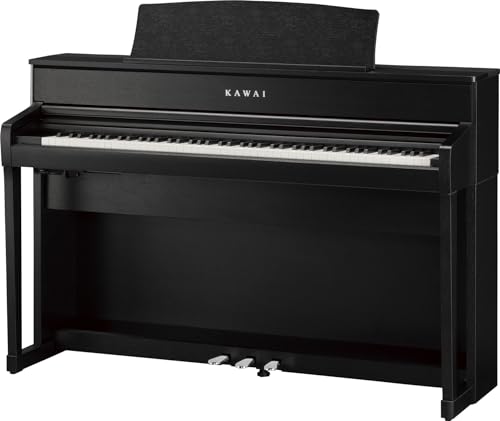
| Spec | Yamaha P-525 | Kawai CA701 |
|---|---|---|
| Key Action | GrandTouch-S with wooden white keys and synthetic ivory tops | Grade-weighted wooden-key hammer action; Kawai specifies Grand Feel III |
| Sound Engine | Yamaha CFX and Bosendorfer Imperial with VRM and Grand Expression Modeling | Kawai SK-EX sampling and rendering per Kawai |
| Voices | Not published in listing | Not published in listing |
| Polyphony | 256 notes | 256 notes |
| Speakers | Built-in two-way stereo | Built-in |
| Bluetooth | Audio and MIDI | Not published in listing; Kawai specifies MIDI and audio |
| USB | USB audio and MIDI | USB to Host and Device |
| Pedals | Sustain footswitch included; LP-1 triple pedal optional | 3 pedals, Grand Feel Pedal System |
| Weight | 48.5 lb (22 kg) per listing | Not published in listing |
| Form Factor | Flagship portable | Flagship-tier concert console |
Key Action
The Yamaha P-525 uses the GrandTouch-S action with wooden white keys and synthetic ivory tops. The listing specifies this is a flagship portable design, so the action is built into a slab that weighs 48.5 pounds. GrandTouch-S includes escapement, which mimics the feel of a grand piano key. This action scores 30 in the key action category.
The Kawai CA701 uses Kawai's Grand Feel III wooden-key hammer action, as specified by Kawai. The listing describes it as grade-weighted with wooden keys. It is a console instrument, so the action sits in a fixed cabinet. The CA701 also scores 30 in the key action category.
The main difference is form factor. The Yamaha puts a wooden-key action into a portable slab, while the Kawai places its wooden action in a console. The Yamaha publishes synthetic ivory tops, while the Kawai listing does not state key surface material. If portability matters, the P-525 is the only choice.
Piano Sound and Speakers
The Yamaha P-525 offers two concert grand pianos: the Yamaha CFX and the Bosendorfer Imperial. The sound engine includes VRM and Grand Expression Modeling, with 256-note polyphony. The listing also confirms binaural sampling for headphones. Speakers are built-in two-way stereo.
The Kawai CA701 uses Kawai SK-EX sampling and rendering, with 256-note polyphony. The listing states the sound engine is Kawai's concert grand sampling. Speakers are built-in, but the listing does not publish speaker power or driver configuration. Kawai specifies onboard effects.
Both models have 256-note polyphony. The Yamaha provides two named grand pianos and VRM, which is a clear specification. The Kawai provides one named concert grand, the SK-EX, but does not publish details like binaural sampling or speaker output. For headphone practice, the P-525's binaural sampling is a documented advantage. The Yamaha's two-way stereo speakers are a published configuration, while Kawai simply says built-in.
Features and Modes
The Yamaha P-525 lists Bluetooth audio and MIDI, USB audio and MIDI, and line outputs. A sustain footswitch is included, and the LP-1 triple pedal is optional. The voice count is not published in the listing. The sound engine includes VRM and Grand Expression Modeling.
The Kawai CA701 lists USB to Host and Device, and includes three pedals with the Grand Feel Pedal System. Kawai specifies Bluetooth MIDI and audio, but the listing does not publish Bluetooth. Onboard effects are confirmed. The voice count is not published in the listing.
Yamaha has more published connectivity features, including line outputs and explicit USB audio. Kawai includes a full three-pedal system, which the Yamaha does not unless you buy the optional LP-1. For players who want a complete pedal experience out of the box, the Kawai has an advantage. For those who want documented wireless and audio connectivity, the Yamaha is stronger.
Build, Design and Portability
The Yamaha P-525 is a flagship portable. It weighs 48.5 pounds per the listing. The build score is 7, reflecting the tradeoff of portability versus a heavier slab. It can be placed on a stand and moved when needed.
The Kawai CA701 is a flagship-tier concert console. The listing does not publish weight, but the console design implies a fixed piece of furniture. Its build score is 10. It includes a cabinet and built-in pedals.
If you need an instrument that can be moved between rooms or taken to a venue, the P-525 is the only option. The CA701 is meant to stay in one place. The Yamaha's 48.5 pounds is heavy for a portable, so it is not a gigging keyboard in the lightweight sense, but it is still movable. The Kawai's cabinet includes the pedals, so no separate pedal unit is needed.
Connectivity
The Yamaha P-525 has Bluetooth audio and MIDI, USB audio and MIDI, and line outputs. This is a complete connectivity suite for a portable digital piano. A sustain footswitch is included, and the LP-1 triple pedal is optional.
The Kawai CA701 has USB to Host and Device. The listing does not publish Bluetooth, but Kawai specifies MIDI and audio Bluetooth, so it likely has wireless connectivity. Three pedals are built in. The listing does not mention line outputs.
For recording to a computer or tablet, both offer USB. The Yamaha explicitly states USB audio and MIDI, while the Kawai lists USB to Host and Device, which usually includes audio and MIDI but the listing does not confirm audio. Yamaha's line outputs are a published feature for connecting to external speakers or an interface. If you rely on Bluetooth for apps, Yamaha's specification is clearer.
Setup and Accessories
The Yamaha P-525 includes a sustain footswitch, which is enough for basic playing. A stand and the LP-1 triple pedal are optional. The listing does not include a bench. Setup involves placing the 48.5 pound slab on a stand and connecting the sustain pedal.
The Kawai CA701 includes three pedals built into the console, with the Grand Feel Pedal System. Setup is simply placing the console in the room. The listing does not include a bench. The console comes as one piece, so there is no separate stand or pedal unit to install.
The Kawai is easier to set up because pedals are already integrated and there is no heavy slab to lift onto a stand. The Yamaha requires more assembly if you want the full piano experience, but the included sustain pedal covers most playing. Neither model includes a bench, so budget for that separately.
Daily Use
The Yamaha P-525 is a serious practice instrument in a portable body. The GrandTouch-S action feels close to a Clavinova, with wooden white keys and escapement. The built-in two-way stereo speakers are fine for home use, and binaural sampling makes headphone practice immersive. Bluetooth audio and MIDI allow app connection for lessons or recording.
The Kawai CA701 is a dedicated home instrument with a fixed cabinet and three pedals. Its Grand Feel III action and console height create an acoustic-like playing position. The built-in speakers are not detailed, but the cabinet likely supports a full sound. USB to Host and Device allow connection to a computer.
For daily practice, the Kawai may feel more like an acoustic piano because of the cabinet and pedals. The Yamaha requires a stand and optional triple pedal for that experience, but it offers portability. If you often practice with headphones, the P-525's binaural sampling is a strong reason to choose it. The CA701 is better if you can play without headphones in a dedicated space.
The Deciding Question
The deciding question is portability versus permanence. The Yamaha P-525 delivers wooden-key action, two grand pianos, and full connectivity in a 48.5 pound slab. The Kawai CA701 delivers Grand Feel III action, three pedals, and a console cabinet.
Both models score 93 overall from the listing. The Yamaha is better on published connectivity and portability. The Kawai is better on build and included pedals. Several Kawai specs are unpublished, so the listing gives less certainty.
Ask yourself whether the instrument will move. If yes, choose the P-525. If no, and you want a fixed home piano with integrated pedals, choose the CA701. The Yamaha's 48.5 pound weight means it is portable but not light. The Kawai's weight is not published, but as a console it will stay where you place it. If you have a permanent space, the Kawai is the more integrated choice. If you need flexibility, the Yamaha is the one to buy.
Who Should Buy Which
Buy the Yamaha P-525 if you want serious piano action and sound in a portable format. It suits advanced players who need to move the instrument occasionally or set it up in a smaller space. The documented Bluetooth, USB audio, and binaural sampling are compelling for tech-savvy pianists.
Buy the Kawai CA701 if you want a permanent furniture console with Kawai's Grand Feel III wooden keys and three pedals included. It suits a dedicated music room or living space. The SK-EX sampling and onboard effects support serious classical practice and performance.
If your budget is tight, consider lower models from each brand, but within this head-to-head, the choice is clear. For portability and documented features, pick the Yamaha. For a fixed home instrument with integrated pedals, pick the Kawai. The P-525 gives a Clavinova-like experience without legs, while the CA701 gives an acoustic upright feel in a console.
Yamaha P-525
Pros
- GrandTouch-S wooden-key action with escapement in a portable
- Two concert grands, the CFX and Bosendorfer Imperial, with full VRM
- Binaural sampling for headphones
- Bluetooth audio and MIDI, USB audio and line outputs
Cons
- Heavy at 48.5 pounds
- Priced close to a mid-range console
- Three-pedal unit and stand are extra
Kawai CA701
Pros
- Wooden-key action with 256-note polyphony
- Grand Feel Pedal System confirmed
- Onboard effects and Kawai's concert grand sampling
- The CA console pianists aim for below the soundboard models
Cons
- Voice count, speaker power and Bluetooth not stated on the listing
- Flagship-tier price
- No bench on the listing
Who Should Buy Each
Yamaha P-525
- You practice on acoustic grands and want a portable that feels like one
- You mostly play on headphones and want binaural sampling
- You want the Bosendorfer as well as the CFX
Kawai CA701
- You want the longest wooden keys Kawai makes below the soundboard models
- 256-note polyphony and the Grand Feel pedals matter
- You practice on acoustic grands and want a console that feels like one
Quick Decision Guide
| If you need to move the piano between rooms or venues | Choose Yamaha P-525 |
| If you want three pedals included and a console cabinet | Choose Kawai CA701 |
| If you want published Bluetooth audio and MIDI plus USB audio | Choose Yamaha P-525 |
| If you want a fixed home instrument with wooden Grand Feel III action and no setup | Choose Kawai CA701 |
| If you want two concert grand samples with VRM and binaural sampling for headphones | Choose Yamaha P-525 |
FAQ
About This Comparison
Mandrillis Team
The Mandrillis editorial team researches and compares audio and music gear using manufacturer documentation, verified specs and real buyer feedback, so you can make a confident purchase without wading through marketing claims.
Read our full research methodology.
We may earn a commission at no extra cost to you.