Drums & Percussion Review
Yuewo 22 Inch Handpan Drum Review: Full Size D Minor Starter Kit
The Yuewo 22 Inch Handpan Drum is a nine note D minor steel hand drum sold as a complete kit with a stand, soft bag, mallet and cleaning cloth. This review reads the published specification to weigh its nitrided steel build, its note layout and the gaps in the listing against what a mid-range handpan buyer needs.
Our Verdict
Research Score 64/100On paper the Yuewo 22 Inch Handpan Drum offers the right fundamentals for a first instrument: nitrided and heat treated steel, a coherent nine note D minor layout, a protected rim and a complete accessory set with stand and bag. The common scale makes every beginner lesson fit, and the mid-range tier is fair for a full size drum. The weaknesses are all about documentation. No weight, no reference pitch, no tuning tolerance in cents and no maker credit leave real questions, and the inconsistent note count in the title does not inspire confidence. Buy it as an accessible entry point with realistic expectations, keep it clean and cool, and check it with a tuner. Experienced players should save for a documented instrument.
Editorial research score based on published specifications and documented features, not a customer rating or lab test.

Yuewo
Yuewo 22 Inch Handpan Drum
Best for: Curious beginners and meditation or classroom users who want a full size D minor handpan with a stand and bag at a mid-range price.
Skip it if: You need a documented reference pitch, a published weight or a known maker, because the listing provides none of those.
Check Price on AmazonWe may earn a commission at no extra cost to you.
Listing verified: October 2026
Who Should Buy It
Buy it if
- First time handpan buyers who want a complete kit
- Yoga, meditation and sound bath facilitators who need an easy D minor voice
- Music teachers who want a hand played melodic drum for a classroom
- Street and festival performers who need the stand and bag included
Skip it if
- You already play and need concert grade tuning with a published tolerance
- You want a 432 Hz instrument and the listing cannot confirm the reference pitch
- You need to know the weight before committing to travel with it
Key Specifications
| Type | Handpan, steel hand drum with a center note and eight surrounding tone fields |
| Size | 22 inch diameter |
| Materials | Nitrided steel (described as nitrogen steel) formed from two deep-drawn half-shells, heat treated, with a protective plastic coating on the rim |
| Tuning | D minor, nine notes: D3 center with A3, Bb3, C4, D4, E4, F4, G4 and A4; each note checked with a tuner according to the listing |
| Finish | Not published in listing |
| Weight | Not published in listing |
| Included accessories | Soft carrying bag, mallet, portable stand, cleaning cloth |
| Made in | Not published in listing |
| Skill level | Beginner to intermediate |
| Notes | The listing title mentions 9/10 notes but the detailed description lists nine notes; the reference pitch (440 or 432 Hz) is not stated |
Overview
The Yuewo 22 Inch Handpan Drum is a mid-range steel hand drum in D minor, sold as a kit with a soft bag, a mallet, a folding stand and a cleaning cloth. The product listing labels it with a 9/10 note tag, but the detailed description lists nine notes: a central D3 and eight tone fields around it. This review works only from that published material.
Handpans sit in a different place from djembes or cajons. They are melodic instruments first, built so that a player with no training can tap out consonant phrases because every note belongs to one scale. The D minor family is the most common choice for a first instrument, and this model follows that convention.
Yuewo is not a workshop name that handpan players will recognize, and the listing offers no information about who tunes the instruments or where they are made. That matters because handpan quality lives in the tuning, not in the shape. The sections below separate what the specification confirms from what remains unknown.
Sound and Tone
The published scale runs D3 in the center, then A3, Bb3, C4, D4, E4, F4, G4 and A4 around the rim. That is the classic Kurd style D minor layout: a low tonic, a fifth, and a stepwise run up through the octave that lets a player move between adjacent fields without landing on a dissonant interval.
The maker describes a sound that is softer and warmer than a stick played steel drum, with harp and bell like qualities depending on technique. On paper each note has been checked with a tuner, with what the listing calls minimum possible fluctuations. No tolerance in cents is given, so that claim cannot be compared against a workshop built instrument.
Two things the listing does not state are the reference pitch and the harmonic content of each tone field. Serious players care whether the octave and the compound fifth above each fundamental are tuned in, because that is what gives a handpan its singing sustain. Buyers report that instruments at this tier vary, so expectations should stay modest.
Build and Materials
The shell is described as heavy-duty nitrogen steel, which in handpan language means nitrided steel: sheet steel treated with nitrogen to harden the surface and slow corrosion. The two halves are deep drawn into a convex lens shape, joined with a hollow interior, and heat treated before tuning. Those are the right ingredients for a durable shell.
A protective plastic coating runs around the rim where the two half-shells meet. On many handpans that seam is left as bare or glued metal, so the coating is a practical touch that protects the edge from knocks during transport and keeps a sharp lip away from the forearm.
The specification stops short of a weight, a shell thickness or a note on finish, and it does not name a country of manufacture. Mid-range handpans from anonymous factories can be well made, but the lack of a tuner credit means the buyer is trusting the description rather than a reputation.
Playability and Technique
A handpan is played with the pads of the fingers and the heel of the hand rather than with sticks, although a mallet is included for softer, more sustained tones. The listing suggests resting the drum on crossed legs, which is the traditional seated position, and a stand is supplied for players who prefer a chair or want to stand.
The nine note layout is forgiving. Because the tone fields are arranged in a zigzag, a simple alternating left and right pattern climbs the scale, and a beginner can produce a coherent phrase within minutes. The 22 inch diameter also gives each tone field more room than on compact 18 or 20 inch instruments, which helps accuracy.
What the specification cannot tell you is how the fields respond to dynamics. A well tuned handpan opens up when struck gently and chokes when hit hard, and a player learns to live in that gentle range. Buyers report that lower cost instruments can need a firmer touch to speak clearly, which affects phrasing.
- Nine notes: D3 center plus A3, Bb3, C4, D4, E4, F4, G4 and A4
- Played seated on the lap or on the included stand
- Finger and palm technique with an optional mallet
- Zigzag field layout suits alternating hand patterns
- 22 inch diameter gives larger target areas per note
Versatility and Styles
D minor handpans are built for ambient, meditative and folk influenced playing, and the listing leans into exactly those uses: meditation, classrooms, children exploring music, street performance and gatherings. The instrument does not modulate, so it pairs best with other instruments that can stay in D minor or its relative F major.
Within that boundary a nine note drum is surprisingly expressive. Players layer ostinato patterns on the low fields with melody on the upper ones, add ghost notes on the shell, and use the center dome for a bass pulse. Those techniques carry across any handpan, so skills learned here transfer to a higher grade instrument later.
It is less suitable for ensemble work with brass or guitar unless the reference pitch is confirmed, because a drum tuned to 432 Hz will sound flat against a band tuned to 440 Hz. The listing does not say which standard this drum follows, and that is a question worth asking before purchase.
Portability and Care
The kit ships with a soft handpan bag, which the listing says keeps dust off and makes the drum easier to store and carry. A soft bag protects against scratches but not against drops, so the rim coating does more to protect the instrument in practice. The weight is not published, which matters for anyone who plans to carry it far.
Care for nitrided steel is straightforward but not optional. The cleaning cloth is there to wipe off finger oils after each session, because sweat and humidity are what start surface rust even on treated steel. A light coat of a neutral protective oil every few weeks is the usual advice among handpan owners.
Heat is the other enemy. Leaving a steel handpan in a hot car can shift the tuning, and the listing makes no claim about heat stability. Storing it in the bag indoors, away from direct sun, is the routine any owner should adopt from day one.
Setup and Daily Use
There is no assembly beyond unfolding the stand and placing the drum on it. The stand is described only as portable, with no height range or load rating given, so taller players may find it sits low. On the lap, the drum rests on crossed legs with the center dome facing up and the rim free to vibrate.
Daily use is simple: a few minutes of tapping each field to warm up the ear, then patterns. Because every note belongs to the same scale, there is no wrong note in the usual sense, which is why these drums work so well in classrooms and therapy settings. The included mallet adds a softer timbre for slow, sustained passages.
A tuner app is a useful companion. Checking each field against the published pitches once a month reveals whether the tuning is drifting, and it answers the reference pitch question that the listing leaves open. If the fundamentals read consistently flat of 440 Hz, the drum is most likely a 432 Hz instrument.
Who Should Buy It
This drum suits a first time handpan buyer who wants a full size instrument with everything needed to start, at a mid-range price. The included stand, bag and mallet remove the small purchases that usually follow a handpan, and the common D minor scale means every online lesson and play along will fit.
Facilitators who use sound in yoga, meditation or group therapy will find the warm, consonant layout useful, and the scale is undemanding enough for a non-musician to lead a session with it. Teachers will appreciate that children can explore it without producing harsh clashes.
It is a weaker fit for players who already own a handpan and want an upgrade. Those buyers will want a published tolerance in cents, a known tuner and a documented reference pitch, none of which this listing provides. The honest position is that this is an entry instrument, not a studio one.
Alternatives Worth Considering
A Meinl Sonic Energy tongue drum is the obvious lower cost alternative for anyone who mainly wants a meditative, consonant sound and does not need the full handpan playing surface. Tongue drums are smaller, hold tuning well and tolerate rough handling, though they lack the open, shimmering sustain of a true handpan.
On the other side, instruments from established handpan workshops cost several times more but come with documented tuning, often a recording of the exact drum, and a maker who will retune it. For a player who already knows the instrument, that documentation is worth the premium.
Within the same anonymous factory tier, buyers can compare note count and included accessories. Ten note drums add a high field for more melodic range, and some kits include a hard case rather than a soft bag. The Yuewo kit is competitive on accessories but not on documentation.
Verdict
The Yuewo 22 Inch Handpan Drum brings together nitrided and heat treated steel, a coherent nine note D minor layout, a protected rim and a complete set of accessories. For a first instrument at a mid-range price, that package is reasonable and the familiar scale makes learning easy.
The score reflects what is unknown as much as what is stated. The missing weight, reference pitch, tuning tolerance and maker credit leave real questions, and the inconsistent note count in the title does not help. A buyer should treat the tuning claim as a promise rather than a specification.
Treat it as an accessible entry point into handpan playing with realistic expectations, use the cloth after every session, keep it out of the heat, and plan to check it with a tuner. Players who already know they want a long term instrument should look at documented makers instead.
Strengths and Limitations
Strengths
- Nine note D minor layout covers the most common handpan scale family
- Nitrided and heat treated steel is the right material story for rust resistance
- Stand, bag, mallet and cleaning cloth are all included
- Protective rim coating guards the seam against knocks
- 22 inch diameter gives larger tone fields than compact handpans
Limitations
- Weight is not published
- Reference pitch is not stated
- Title says 9/10 notes while the detail lists nine, which is confusing
- No information on the maker, the country of origin or the tuner
How We Scored It
Scores reflect published specifications, documented features and value against the alternatives below. They are editorial research scores, not laboratory measurements.
Alternatives to Consider

Tama Dyna-Sync Double Drum Pedal
Intermediate and advanced drummers who want a direct-drive double pedal from a major hardware maker and are comfortable confirming the specifications the listing omits.
Read the Tama Dyna-Sync Double Drum Pedal review →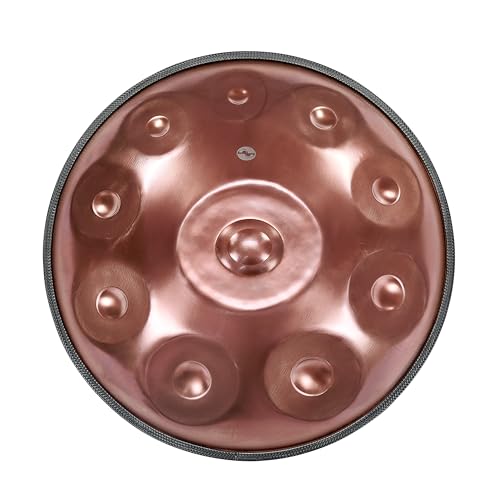
EmaxRC 10-Note Steel Tongue Drum
A curious beginner or meditation practitioner who wants a full size D minor handpan at a mid-range tier and accepts that the maker is unproven.
Read the EmaxRC 10-Note Steel Tongue Drum review →Questions Buyers Ask
Yuewo 22 Inch Handpan Drum
See the current listing, price and included accessories.
About This Review
Mandrillis Team
The Mandrillis editorial team researches and compares audio and music gear using manufacturer documentation, verified specs and real buyer feedback, so you can make a confident purchase without wading through marketing claims.
Read our full research methodology.