Instruments Review
Behringer 1027 Review: Vintage Step Sequencer
The Behringer Clocked Sequential Control Module 1027 is listed as a Legendary 2500 Series 8-position step sequencer for Eurorack. The feature bullets describe a quad VCA module, creating confusion. Key specs are not published. This review examines what the listing does and does not tell you.
Our Verdict
Research Score 55/100This module's concept is compelling for Eurorack users who want a vintage-style step sequencer. The 8-position design could be useful, and Behringer's budget pricing is attractive. However, the listing's contradictory feature bullets and missing specifications make it impossible to recommend confidently. Key details such as power, connectivity, and actual controls are absent. The product page seems to describe a quad VCA instead of a sequencer. Until the listing is corrected, buyers should look for alternatives or seek a manual. The score reflects the incomplete information rather than the module's true capabilities.
Editorial research score based on published specifications and documented features, not a customer rating or lab test.

Behringer
Behringer Clocked Sequential Control Module 1027
Best for: Modular synth users seeking a vintage-style 8-position step sequencer in Eurorack format.
Skip it if: You need a traditional MIDI keyboard controller with bundled software and DAW integration.
Check Price on AmazonWe may earn a commission at no extra cost to you.
Listing verified: October 2026
Who Should Buy It
Buy it if
- Eurorack users building a 2500-inspired system
- Musicians looking for a hardware step sequencer
- Budget-conscious modular enthusiasts
- Those comfortable with unclear documentation
Skip it if
- Keyboard players needing velocity-sensitive keys
- Users expecting plug-and-play DAW control
- Buyers who need full published specifications
Key Specifications
| Keys | Not published in listing |
| Key type | Not published in listing |
| Pads | Not published in listing |
| Knobs and faders | Listing mentions manual Level controls, CV attenuators, and adjustable VCA response curve, but these appear to describe a quad VCA module rather than the 1027 sequencer |
| DAW integration | Not published in listing |
| Bundled software | Not published in listing |
| Connectivity | Not published in listing |
| Power | Not published in listing |
| Weight | Not published in listing |
| Included accessories | Not published in listing |
Overview
Behringer positions the Clocked Sequential Control Module 1027 as a Legendary 2500 Series 8-Position Step Sequencer Module for Eurorack. The product listing frames it as a modular synthesizer component rather than a conventional MIDI keyboard controller. This distinction is important for buyers who expect keys, pads, or DAW transport controls. The module appears aimed at users building a Eurorack system with a vintage-inspired architecture.
The title clearly identifies an 8-position step sequencer, which suggests a hardware CV sequencer capable of producing eight discrete control voltage stages. Such modules are used to create repeating melodic or modulation patterns in a modular synth. The listing does not provide a traditional keyboard interface, so the concept is centered on step programming rather than performance keys.
However, the product page contains a notable contradiction. The feature bullets describe an ultra-low noise quad VCA and mixer module with manual level controls, CV attenuators, and adjustable response curves. This description does not match an 8-position step sequencer. The mismatch raises questions about the accuracy of the listing and the actual features of the 1027 module.
Keys, Pads and Feel
This module does not include traditional piano-style keys, velocity-sensitive pads, or a keybed. The listing does not publish any specifications for key count, key type, aftertouch, or pad layout. Buyers looking for a playable instrument with black and white keys should consider a dedicated MIDI keyboard controller such as models from Akai, Arturia, or Novation.
The 8-position step sequencer concept implies some form of step selection, which could involve switches, buttons, or touch points. However, the listing does not describe the physical step controls, their size, spacing, or tactile response. The feature bullets instead reference manual Level controls and CV attenuators, which are rotary controls typically found on a mixer or VCA module.
The feel of any knobs, buttons, or switches on the module cannot be assessed from the listing. There is no mention of build materials for the faceplate or control caps. Buyers who prioritize in-person feel will find the published information insufficient. Without user reports or a manual, the daily tactile experience remains unknown.
Knobs, Faders and DAW Integration
The feature bullets list several control elements that would be useful on a modular mixer or VCA. These include manual Level controls for independent mixing, dedicated CV attenuators with dual LEDs for monitoring bipolar CV signals, and an adjustable VCA response curve from linear to exponential. The mention of dual LEDs is helpful for visual feedback of CV polarity. However, these controls may not belong to the 1027 sequencer described in the title.
The listing does not mention faders, sliders, or a dedicated fader bank. Many step sequencers use sliders for per-step voltage, but that is not stated here. The exact number of knobs, their positions, and their functions cannot be confirmed. If the title is correct, the module likely includes controls for step selection, clock input, and sequence length, but those are absent from the feature text.
DAW integration is not mentioned anywhere. There is no reference to USB MIDI, class-compliant operation, control surface software, or DAW transport. As a Eurorack module, the 1027 is intended for analog-style CV sequencing within a modular system, not for controlling a computer-based DAW. Users who need tight integration with Ableton Live, Logic Pro, or similar software should look for a dedicated MIDI controller instead.
Software, Sounds and Features
The listing does not include any bundled software, virtual instruments, or sound libraries. This is expected for a Eurorack module, which functions as a hardware processor or control source rather than a software controller. Buyers should not anticipate a download code for a DAW or synth plugin. The module is meant to be used within a modular context with patch cables.
The main feature described in the title is an 8-position step sequencer. This implies the ability to generate a sequence of control voltages across eight discrete steps, which can be used to pitch oscillators, modulate filters, or trigger envelopes. The listing also mentions manual Level controls and CV attenuators, but these appear in bullets that may describe a different product. The adjustable VCA response curve from linear to exponential is a notable feature for audio dynamics, though its relevance to the 1027 is unclear.
Because no software or sound engine is included, the module does not produce sound on its own. It would need to be paired with other Eurorack modules such as oscillators, filters, and VCAs. This is standard for modular systems but may be a surprise for buyers new to Eurorack. The listing does not mention any internal sounds, presets, or sample content.
- Legendary 2500 Series inspired design
- 8-position step sequencer architecture
- Manual Level controls for mixing
- Dedicated CV attenuators with bipolar LEDs
- Adjustable VCA response curve from linear to exponential
Build, Design and Portability
The listing does not state the module's physical dimensions, HP width, depth, weight, or faceplate material. Eurorack modules are generally built to fit standard Eurorack cases and use aluminum faceplates, but that is not confirmed here. The lack of size and weight specifications makes it hard to evaluate portability or case compatibility.
Behringer modules are typically budget oriented and use a consistent design language with black faceplates and clear labeling. The mention of a legendary 2500 series heritage suggests a vintage aesthetic, perhaps with cream or black knobs. However, the listing does not include product photos or a description of the front panel layout. The actual design could vary from the buyer's expectation.
Build quality cannot be assessed from the current information. No user reviews are cited, and the listing does not mention the type of jacks, potentiometers, or switches used. Potential buyers should check community forums or retailer pages with additional photos and specifications. Portability is less of a concern for rack-mounted modules, but the module's depth must fit the intended case.
Connectivity and Power
The listing does not publish input and output jack details, such as the number of CV outputs, gate outputs, clock inputs, or audio connections. As a Eurorack module, it likely uses 3.5mm mono patch cables and a standard Eurorack power connector, but this is not stated. The absence of any USB or MIDI ports is implied by the lack of mention, but cannot be confirmed.
Power consumption is not provided. Eurorack users need to know the current draw on the +12V and -12V rails to ensure the case power supply can handle the module. The listing does not mention whether the module requires a 5V rail or a standard 16-pin ribbon cable. This missing power information is a serious gap for practical installation.
The module is described as part of the 2500 series, which may share common connectivity with other modules in that line. However, the product page does not say this. Buyers should contact the manufacturer or a dealer to confirm power and patch points before purchasing. Without this information, the module's integration into an existing Eurorack system is uncertain.
Setup and Daily Use
Installing a Eurorack module typically involves screwing it into a rack, connecting the power ribbon cable with correct orientation, and patching audio and CV signals with patch cables. The listing does not provide any setup instructions or warning about power cable orientation. Experienced modular users will know the standard precautions, but beginners may find the lack of guidance frustrating.
If the module is indeed an 8-position step sequencer, daily use would involve setting the clock rate, selecting steps, and tuning the output CV for each step. The listed manual Level controls and CV attenuators would require regular adjustment if they are part of the module. However, because the feature bullets conflict with the title, the actual daily workflow remains unclear.
The module would be used alongside other Eurorack modules, so users should be comfortable with patching and signal flow. There is no software editor or screen, so all programming would be done on the physical controls. The listing does not mention any memory or preset storage, so sequences would likely need to be recreated each session. This is standard for many analog-style sequencers but not confirmed.
Who Should Buy It
This module may suit modular synthesizer enthusiasts who are building a system inspired by the vintage 2500 series. The 8-position step sequencer concept is attractive for creating melodic loops, basslines, and modulation patterns. Budget-conscious buyers who trust Behringer's reputation for affordable Eurorack modules might consider the 1027 if the actual specifications align with their needs.
It is not appropriate for keyboard players, beatmakers, or producers who need a traditional MIDI keyboard controller with velocity-sensitive keys, drum pads, and fader banks for DAW control. The module does not include keys, pads, or software, and the listing provides no DAW integration details. Buyers in that category should look at entry-level controllers from well-known MIDI brands.
Users who are willing to research the module's true feature set, perhaps by downloading the manual or reading community discussions, may find a useful sequencer. However, the listing's contradictory information is a red flag. Only those comfortable with ambiguity and potential returns should proceed.
Alternatives Worth Considering
Several alternatives exist for different workflows. A dedicated MIDI keyboard controller from a brand like Akai, Arturia, or Novation would provide a keybed, pads, and immediate DAW integration right out of the box. These controllers typically include bundled software and are designed for computer-based music production.
For modular users, a standalone hardware sequencer with clearly published specifications might be a safer choice than the 1027. Other Eurorack step sequencers from established manufacturers often come with detailed manuals, known power consumption, and consistent product descriptions. Comparing the 1027 to those options is difficult because of the missing data.
The listing's conflicting feature bullets suggest that the product page may be inaccurate. Buyers should look for a corrected listing or a different retailer that provides consistent information. In the absence of reliable specs, the 1027 is hard to recommend over alternatives with transparent documentation.
Verdict
The Behringer Clocked Sequential Control Module 1027 appears to be an intriguing Eurorack step sequencer with a legendary 2500 series heritage. The title suggests an 8-position sequencer, which could be a useful addition to a modular system. However, the feature bullets describe a quad VCA and mixer, creating a fundamental mismatch that undermines confidence.
Several critical specifications are not published, including dimensions, power consumption, connectivity, and the actual front panel controls. Without these details, evaluating the module's build quality, daily usability, and value is impossible. The lack of DAW integration and software further limits its appeal for MIDI keyboard controller buyers.
The score reflects the incomplete and contradictory listing rather than the module's true potential. While the concept is promising, the product page leaves too many questions unanswered. Buyers should approach with caution, seek additional information, and consider alternatives with clearer documentation. For those needing a reliable MIDI keyboard controller, this module is not the right choice.
Strengths and Limitations
Strengths
- Legendary 2500 series heritage implied
- 8-position step sequencer design
- Manual Level controls listed
- CV attenuators with bipolar LEDs listed
- Adjustable VCA response curve
- Eurorack format for modular integration
Limitations
- Feature bullets appear to describe a different product
- Key specifications are not published
- No DAW integration or software mentioned
- Unclear power and connectivity details
- No documentation of build materials or weight
How We Scored It
Scores reflect published specifications, documented features and value against the alternatives below. They are editorial research scores, not laboratory measurements.
Alternatives to Consider

Fender Studio Motion 16 MIDI Controller
Beatmakers, finger drummers, and songwriters who want a pad first controller with Fender Studio Pro and broad DAW compatibility.
Read the Fender Studio Motion 16 MIDI Controller review →
Akai LPD8 Portable Production Pad Nearly
Portable beat making and sample triggering in a laptop based studio setup.
Read the Akai LPD8 Portable Production Pad Nearly review →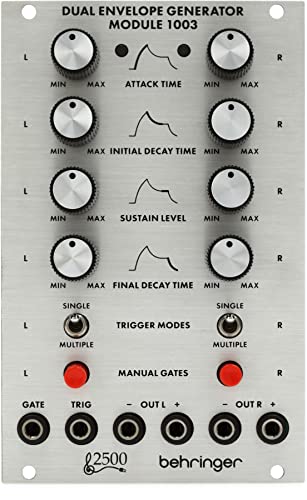
Behringer 1003 Dual Envelope Generator Module
Eurorack users who need a basic dual envelope generator with inverted outputs and compact width.
Read the Behringer 1003 Dual Envelope Generator Module review →Questions Buyers Ask
Behringer Clocked Sequential Control Module 1027
See the current listing, price and included accessories.
About This Review
Mandrillis Team
The Mandrillis editorial team researches and compares audio and music gear using manufacturer documentation, verified specs and real buyer feedback, so you can make a confident purchase without wading through marketing claims.
Read our full research methodology.