Instruments Review
Behringer EDGE Review: Analog Percussion, Deep Patching
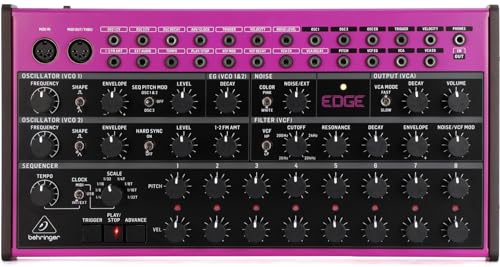
The Behringer EDGE is a semi-modular analog percussion synthesizer built around white and pink noise sources, an envelope generator, and a 15 by 10 I/O patch matrix. A compact 2 x 8-step sequencer and MIDI priority selection round out a focused, modular minded percussion tool.
Our Verdict
Research Score 61/100The Behringer EDGE is a focused instrument rather than a general purpose drum machine, built around analog noise sources, an envelope generator and an unusually deep 15 by 10 I/O patch matrix for its size. That patching depth is the clearest selling point, giving modular minded buyers real flexibility to route percussion voices in unconventional ways. The dual 8-step sequencer is modest rather than expansive, and several basics, including keyboard layout, power and weight, are not published. For a buyer who specifically wants a dedicated analog percussion voice to patch into a larger modular or MIDI rig, the EDGE earns a reasonable recommendation at its budget tier price, provided a full drum machine feature set is not the goal.
Editorial research score based on published specifications and documented features, not a customer rating or lab test.
Behringer
Behringer EDGE
Best for: A modular minded percussionist or sound designer who wants a dedicated analog noise and envelope based percussion voice with deep patch matrix routing, rather than a full drum machine.
Skip it if: You need a full featured drum machine with many simultaneous voices, longer sequences or a built in keyboard, since this is a focused semi-modular percussion synthesizer with a compact.
Check Price on AmazonWe may earn a commission at no extra cost to you.
Listing verified: November 2026
Who Should Buy It
Buy it if
- Eurorack and semi-modular owners who want a dedicated analog percussion voice with deep patch routing
- Sound designers who want white and pink noise sources shaped by an envelope generator for custom drum tones
- Producers who want a compact dual 8-step sequencer for layering short percussion patterns
- MIDI rig owners who want channel and voice priority selection for predictable behavior alongside other gear
Skip it if
- You need a full drum machine with many simultaneous drum voices and longer sequences
- You need a built in keyboard or pads for direct finger triggering
- You want published power and weight specifications before ordering
Key Specifications
| Type | Analog semi-modular percussion synthesizer |
| Synthesis | Pure analog percussion synthesis with white and pink noise sources shaped by an envelope generator |
| Polyphony | Not published in listing; as a percussion synthesizer it is designed around drum style voices rather than melodic chordal polyphony |
| Keys or pads | Not published in listing |
| Sequencer | 2 x 8-step sequencer |
| Effects | Not published in listing beyond envelope generator based shaping |
| Connectivity | 15 x 10 I/O patch matrix for internal and external patching, plus MIDI channel and voice priority selection |
| Power | Not published in listing |
| Weight | Not published in listing |
| Included accessories | Not published in listing |
Overview
Note on naming: the source listing title described this product with a long descriptive phrase rather than a clean model name; this review uses Behringer EDGE, the actual product name behind that listing, since the longer phrase reads as a parsing artifact rather than the instrument's real identity.
The Behringer EDGE is described in its listing as an analog semi-modular percussion synthesizer, built around white and pink noise sources, an envelope generator and an unusually deep 15 by 10 I/O patch matrix. Rather than competing with a full drum machine on voice count or pattern length, it leans into patching flexibility as its main differentiator.
A compact 2 x 8-step sequencer and MIDI channel and voice priority selection round out the confirmed feature set. Beyond those points, the listing leaves several typical specifications, including keyboard layout, power and weight, unpublished.
Sound Engine and Tone
At the heart of the Behringer EDGE sit white and pink noise sources, which are the classic building blocks of analog percussion synthesis, covering everything from bright, sizzling hi hat and snare style textures to warmer, rounder tones depending on which noise color and filtering is used. Shaping those noise sources through a dedicated envelope generator is what turns a static noise source into a believable percussive hit.
Because the EDGE is purpose built for percussion rather than melodic playing, its tonal range should be judged against that goal rather than against a general purpose synthesizer. Buyers expecting a wide range of melodic oscillator waveforms, the kind found on an instrument like the Behringer CAT covered elsewhere in this category, should recalibrate expectations toward drum and noise based sound design instead.
The 15 by 10 I/O patch matrix extends the sound engine well beyond its default noise and envelope path, since internal signal points can be rerouted in combinations the fixed internal wiring would never allow. That patching depth is where a percussion synthesizer like this can start producing genuinely unusual, non standard drum tones rather than predictable kick and snare sounds.
Feeding the envelope generator's output back into a filter cutoff point, if the matrix allows that kind of routing, is the type of experiment that turns a basic noise burst into a pitched, resonant hit, which is the sort of discovery a deep patch matrix is specifically built to encourage.
in-person Control and Workflow
The listing does not break down an exact knob and switch count beyond the envelope generator and the patch matrix itself, but a patch matrix of this size implies a workflow built around physical patching as much as knob turning. Buyers report that percussion synthesizers with deep patch matrices reward a slower, more exploratory approach, where unusual drum tones emerge from patching experiments rather than from a quick preset browse.
The envelope generator is the primary shaping tool described in the listing, controlling how quickly a noise burst rises and decays, which is the single most important parameter in making a noise source sound like a recognizable percussion hit rather than static. Getting comfortable with envelope shaping is likely the fastest way to get usable sounds out of the EDGE before diving deeper into the patch matrix.
Because no keyboard or pad layout is published, triggering sounds directly by hand is not clearly supported, which points toward a workflow driven primarily by the sequencer or external MIDI and gate triggers rather than live manual playing in the traditional sense.
That sequencer and trigger driven approach is common among semi-modular percussion voices, where the creative work happens mostly in patching and envelope shaping rather than in playing technique, so buyers should set expectations accordingly rather than comparing it to a pad controller style instrument.
Sequencer, Effects and Features
The dual 8-step sequencer gives the EDGE two independent short rhythmic lanes, which is enough for layering two related but distinct percussion patterns, such as a kick style pulse against a shorter accent pattern. It is a more modest sequencer than a dedicated drum machine's typical pattern length, which fits the EDGE's identity as a focused voice rather than a complete rhythm section.
Built in effects beyond the envelope generator are not described in the listing, so any additional processing, reverb or distortion would need to come from outboard gear or the patch matrix itself, routed through compatible external modules if the buyer has them.
The dual sequencer lanes can also be used against each other rather than in simple parallel, with one lane triggering a main hit and the second lane triggering a shorter accent slightly offset in time, which is a common technique for adding texture to an otherwise simple noise based percussion voice.
- White and pink noise sources
- Dedicated envelope generator for shaping hits
- 15 x 10 I/O patch matrix
- 2 x 8-step sequencer
- MIDI channel and voice priority selection
Build, Design and Portability
Weight, dimensions and chassis materials are not published in the listing, so this review cannot confirm how portable or heavy the Behringer EDGE is in practice. Buyers planning a Eurorack case or a specific rack layout should budget time to confirm those figures with Behringer before ordering.
As a semi-modular percussion synthesizer, the EDGE is likely designed to live inside a larger patching environment rather than stand alone on a desk, which fits with its deep I/O matrix being the centerpiece of the design rather than a self contained performance surface.
Connectivity, MIDI and Sync
The 15 by 10 I/O patch matrix is the standout connectivity feature here, offering far more routing flexibility than a typical fixed signal path synthesizer. That matrix size suggests a genuinely deep set of internal and external patch points available to a modular minded user.
MIDI channel and voice priority selection is also confirmed, which helps the EDGE behave predictably when it is just one of several MIDI controlled instruments in a larger rig, reducing the chance of note or trigger conflicts when multiple devices share a MIDI connection.
Setup and Daily Use
A typical session likely starts with selecting a noise color, white or pink, then shaping it with the envelope generator before committing a basic rhythm to the 2 x 8-step sequencer. From there, the patch matrix becomes the main tool for pushing the sound beyond a standard noise based percussion hit into something more unusual.
Because MIDI channel and voice priority selection are available, the EDGE can realistically sit inside a larger MIDI synced percussion rig, triggered alongside other drum voices rather than only running its own internal sequencer in isolation.
A player who settles on a favorite patch configuration can keep returning to it as a reliable starting point, then vary the envelope and matrix routing slightly from session to session, which builds familiarity with the instrument without ever making it feel repetitive.
Who Should Buy It
The Behringer EDGE suits modular minded percussionists and sound designers who want a dedicated analog noise and envelope based percussion voice, with deep patch matrix routing as the main creative outlet. It rewards players who enjoy building sounds from fundamentals rather than browsing presets.
It is a weaker fit for buyers who want a complete drum machine with many simultaneous voices and longer sequences, or who need a keyboard for direct finger triggering, since neither is clearly supported by this listing.
Eurorack users specifically filling a percussion gap in an otherwise melodic modular system are another strong match, since the EDGE's patch matrix and MIDI priority selection make it comparatively easy to fold into a system built around other manufacturers' modules.
Alternatives Worth Considering
Buyers who want a fuller drum machine experience with classic modeled drum tones and a longer sequencer could look toward the Roland AIRA T-8, covered elsewhere in this category, which bundles multiple TR drum voices and a deeper sequencer in one unit.
Players who want melodic rather than percussion focused analog synthesis, but still want a semi-modular patching experience, might compare the EDGE against the Behringer Model D, keeping in mind the two instruments are built for very different roles in a rig.
Verdict
The Behringer EDGE delivers a focused, modular minded take on analog percussion synthesis, built around noise sources, an envelope generator and an unusually deep patch matrix rather than trying to be a complete drum machine.
Its compact dual 8-step sequencer and several unpublished specifications, including weight and keyboard layout, keep expectations realistic, but for a buyer who specifically wants deep patching on a dedicated percussion voice, the EDGE is a reasonable budget tier pick.
Strengths and Limitations
Strengths
- 15 by 10 I/O patch matrix gives genuinely flexible internal and external routing for a percussion focused instrument
- White and pink noise sources cover both bright, sizzling percussion and warmer, rounder textures
- Dedicated envelope generator allows real shaping of each hit rather than fixed, static percussion tones
- Dual 8-step sequencer supports two independent short rhythmic patterns running at once
- MIDI channel and voice priority selection help it behave predictably inside a larger MIDI rig
Limitations
- No keyboard or pad layout is published for triggering sounds directly by hand
- Only two 8-step sequencer lanes, which is modest next to a full drum machine's pattern length
- Power, weight and physical dimensions are not stated in the listing
- Built in effects beyond envelope shaping are not described
How We Scored It
Scores reflect published specifications, documented features and value against the alternatives below. They are editorial research scores, not laboratory measurements.
Alternatives to Consider

Yamaha Genos 76-Key
Solo performers, worship players and songwriters who want a self-contained arranger workstation with a flagship piano Voice, realistic drums and touch screen control.
Read the Yamaha Genos 76-Key review →
Yamaha Montage M8X 88-Key
Professional keyboardists, composers and producers who want a weighted 88-key flagship synthesizer with per-note pressure expression and a software twin for DAW recall.
Read the Yamaha Montage M8X 88-Key review →
Yamaha Montage8 88-key
Sound designers, producers and keyboardists who want sampled realism and FM character in one 88-key workstation with physical faders and a modulation sequencer.
Read the Yamaha Montage8 88-key review →Questions Buyers Ask
Behringer EDGE
See the current listing, price and included accessories.
About This Review
Mandrillis Team
The Mandrillis editorial team researches and compares audio and music gear using manufacturer documentation, verified specs and real buyer feedback, so you can make a confident purchase without wading through marketing claims.
Read our full research methodology.