Instruments Review
Behringer TD-3-MO-SR Review: Modded Bass Line Deep Dive
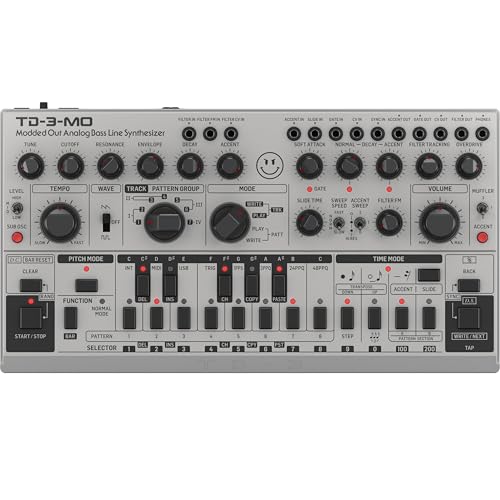
The Behringer TD-3-MO-SR is a Modded Out analog bass line synthesizer with a pure VCO, VCF and VCA signal path, a four pole resonant filter and a seven track step sequencer storing 250 patterns per track, though connectivity and power details are not published.
Our Verdict
Research Score 65/100The Behringer TD-3-MO-SR earns its reputation from a pure analog signal path and a four pole filter with cutoff, resonance, envelope, decay and accent controls, the same ingredients that defined the acid bass sound for decades. Its seven track sequencer with 250 patterns per track is a genuinely deep workflow feature that goes beyond a single pattern lane. On paper this is a focused, capable bass line module for producers who already know what they want from the format. The gaps are real: connectivity, power and physical dimensions are not published, so confirm MIDI, USB and poly chain support before ordering. For buyers comfortable filling in those blanks, the confirmed analog core and sequencer depth justify a place in a bass heavy studio.
Editorial research score based on published specifications and documented features, not a customer rating or lab test.
Behringer
Behringer TD-3-MO-SR
Best for: A bass line and acid music producer who wants an analog signal path with a deep multi track sequencer and does not mind confirming connectivity separately.
Skip it if: You need confirmed MIDI, USB or power specifications in writing before you buy, since none of those details appear in the published listing.
Check Price on AmazonWe may earn a commission at no extra cost to you.
Listing verified: November 2026
Who Should Buy It
Buy it if
- Acid and electro producers building a dedicated bass line voice
- Sequencer focused musicians who want seven pattern tracks per bank
- Modular and semi modular users adding an analog bass module to a rig
- Buyers who already know the TD-3 family and want the modded variant
Skip it if
- You require full connectivity specifications confirmed in writing before ordering
- You need a keyboard or pad surface rather than a tabletop module
- You want built in effects such as delay or reverb included
Key Specifications
| Type | Modded Out analog bass line synthesizer module |
| Synthesis | Pure analog signal path with VCO, VCF and VCA stages; sawtooth and square waveform VCO with transistor wave shaping circuitry |
| Polyphony | Not published in listing; bass line machines in this format are generally built for one voice at a time |
| Keys or pads | Not published in listing; this is a tabletop module rather than a keyboard instrument |
| Sequencer | 16-step sequencer with 7 tracks, each able to store 250 user patterns |
| Effects | Not published in listing |
| Connectivity | Not published in listing |
| Power | Not published in listing |
| Weight | Not published in listing |
| Included accessories | Not published in listing |
Overview
Behringer TD-3-MO-SR is positioned as the Modded Out edition of the TD-3 bass line format, a tabletop module built around a pure analog signal path rather than a digital emulation. Behringer describes it as carrying the most legendary modifications that producers have historically applied to this style of bass synthesizer, bundled into the stock unit instead of being left to aftermarket circuit work.
The published feature list confirms an analog VCO, VCF and VCA chain, a sawtooth and square waveform oscillator with transistor wave shaping, a four pole low pass resonant filter with five dedicated controls, and a sequencer built around seven tracks with 250 stored patterns in each. Those five points are the entirety of what the listing states, so this review treats everything else as unconfirmed rather than guessing at numbers that were never published.
No connectivity, power or physical dimension figures appear anywhere in the listing data. That gap matters for a tabletop module, since buyers typically want to know how it reaches a mixer, a DAW or other gear before committing to a purchase, and this review flags that gap rather than filling it with assumptions.
Sound Engine and Tone
At the core of this module is a genuinely analog voltage controlled oscillator, filter and amplifier chain, the same basic architecture that defined the acid bass genre long before digital modeling existed. The oscillator offers sawtooth and square waveforms shaped through transistor circuitry, which the listing frames as part of the legendary modifications that separate the Modded Out edition from a plain reissue.
The four pole low pass resonant filter is the part of the design most responsible for the squelchy, vocal quality associated with this category of bass synthesizer. With cutoff, resonance, envelope, decay and accent controls all confirmed, the filter section offers meaningful sound shaping on its own, independent of any sequencer pattern running underneath it.
Because no effects processing is mentioned anywhere in the specification, any saturation, distortion or ambience beyond the analog signal path itself would need to come from outboard gear. Producers who want a raw, unprocessed bass voice as the foundation of a track will find that straightforward; producers expecting built in grit beyond the filter should plan for an external pedal or plugin.
in-person Control and Workflow
Five confirmed filter parameters, cutoff, resonance, envelope, decay and accent, give a player direct access to the elements that make this style of synthesizer expressive in real time. Buyers report that this is the section where most of the character gets dialed in during a jam, rather than through the oscillator itself.
Beyond the filter section, the listing does not describe additional performance controls such as a step entry keyboard, dedicated mute buttons or a display, so the physical layout of the front panel remains largely unconfirmed. Producers familiar with this general format can reasonably expect step buttons tied to the sequencer, but that detail is not stated here.
Workflow on a module like this tends to center on programming a pattern, then performing live tweaks to the filter while the sequencer runs. With no automation or modulation routing confirmed beyond the filter controls themselves, expressive playing largely comes down to manual knob movement during playback.
Sequencer, Effects and Features
The sequencer is the single richest confirmed feature on this module. Seven tracks, each holding 250 user patterns, is a substantial amount of pattern storage for a bass line format that historically shipped with a single sequence lane. That capacity supports building out full arrangements of variations without needing an external sequencer to manage song structure.
No information is given about step count conventions beyond the sixteen step framing in the product name, nor about swing, randomization or per step parameter locks. Producers used to more modern grooveboxes should not assume those features are present simply because they are common elsewhere in the category.
Effects are entirely unconfirmed. There is no mention of distortion, delay, reverb or overdrive anywhere in the specification, which is notable given that some siblings in this product family are marketed with onboard distortion. Treat this unit as effects free until a buyer confirms otherwise.
- Pure analog VCO, VCF and VCA signal path
- Sawtooth and square waveform VCO with transistor wave shaping
- Four pole low pass resonant filter with five controls
- Seven track sequencer with 250 patterns per track
Build, Design and Portability
Weight, chassis material and overall dimensions are not published in the listing, so nothing here can be stated with confidence about the physical build. The Modded Out branding implies a refined version of an established bass line chassis, but refinement claims are about internal circuitry and features rather than the enclosure.
Tabletop bass line modules of this general type are usually compact enough to sit on a desk beside other gear, though this review cannot confirm that for this specific unit without published measurements. Buyers who need to plan rack space or a travel case should request dimensions before ordering.
On paper, the emphasis of this product sits squarely on the analog signal path and the sequencer rather than on physical design claims, since the listing makes no statement about finish, knob type or panel material.
Connectivity, MIDI and Sync
No connectivity specifications are published for this unit. There is no confirmed mention of MIDI, USB, audio outputs, clock sync or poly chaining anywhere in the available data, which is an unusually large gap for a sequencer based instrument that most studios will want to integrate with other gear.
Buyers planning to sync this module to a DAW, a drum machine or other hardware should treat connectivity as an open question rather than an assumption, and should confirm the physical jacks and protocols directly with the seller before building a studio plan around it.
Given how central synchronization is to a sequencer heavy workflow, this is the single biggest piece of missing information in the listing, and it directly caps how confidently this module can be recommended for an integrated rig.
Setup and Daily Use
With connectivity unconfirmed, a reasonable setup plan starts conservatively: power on the unit, program a pattern across the seven available tracks, and use the filter controls to shape the bass tone while the sequence plays. On paper that core loop, pattern plus filter performance, is where this module is strongest.
Daily use would likely revolve around building up a library of patterns across the 250 slots per track, since that scale of storage rewards treating the sequencer as a composition tool rather than a quick sketchpad. Producers who work in longer sessions stand to benefit most from that pattern depth.
Firmware updates, software companions and backup procedures are not described anywhere in the listing, so plan to research those separately if they matter to your workflow. The published material focuses entirely on the analog circuit and the sequencer, not on software ecosystem details. Producers moving an existing project between studios should also budget time to recreate sequences manually until a backup method is confirmed.
Who Should Buy It
Behringer TD-3-MO-SR suits acid and electro producers who want a dedicated analog bass voice with a sequencer deep enough to carry an entire track's bass line without external pattern management. The combination of a classic filter section and seven tracks of pattern storage is squarely aimed at that audience.
It also fits modular and semi modular users who want to add a focused analog bass module to a larger rig, as well as anyone already familiar with the broader TD-3 family who specifically wants the modded variant rather than a standard reissue.
It is a weaker fit for anyone who needs confirmed specifications in hand before buying, since the published listing leaves connectivity, power and dimensions open, which some buyers will find too uncertain for a considered purchase.
Alternatives Worth Considering
Within the same general bass line category, other modules in the TD-3 line trade some of the Modded Out extras for simpler, better documented listings, which may suit buyers who prioritize certainty over added features. Those simpler listings often spell out connectivity and sequencer step counts in more detail, which can matter more than extra pattern storage for a buyer planning a tightly integrated rig.
Producers who want a fuller semi modular experience with patch points for external modulation might look toward other analog bass and lead synthesizers in the Behringer catalog, accepting a different workflow in exchange for more routing flexibility.
For a broader palette beyond pure analog bass tone, a small digital or hybrid groovebox can add melodic voices and effects that this module does not claim to offer, at the cost of a less purely analog signal path.
Verdict
Behringer TD-3-MO-SR delivers a confirmed, pure analog signal path with a well specified filter section and an unusually deep sequencer for its category, seven tracks and 250 patterns each. That is a genuinely strong foundation for bass line and acid production on its own terms.
The listing leaves connectivity, power and physical dimensions unanswered, which is the clearest reason to pause before buying on specification alone. Confirm those details directly, and this module is a reasonable pick for a producer who already wants what the analog core and sequencer provide.
Strengths and Limitations
Strengths
- Pure analog VCO, VCF and VCA signal path built for classic bass line tone
- Four pole low pass filter with dedicated cutoff, resonance, envelope, decay and accent controls
- Sawtooth and square waveform oscillator with transistor wave shaping circuitry
- Multi track step sequencer with seven tracks and 250 stored patterns per track
- Modded Out branding signals extra refinement over a standard bass line reissue
Limitations
- Connectivity, power supply and physical dimensions are not published in the listing
- No effects processing is confirmed anywhere in the available specification
- Polyphony and keyboard input are not stated, so exact voicing behavior is unverified
- Buyers must confirm MIDI, USB and poly chain details independently before ordering
How We Scored It
Scores reflect published specifications, documented features and value against the alternatives below. They are editorial research scores, not laboratory measurements.
Alternatives to Consider

Yamaha Genos 76-Key
Solo performers, worship players and songwriters who want a self-contained arranger workstation with a flagship piano Voice, realistic drums and touch screen control.
Read the Yamaha Genos 76-Key review →
Yamaha Montage M8X 88-Key
Professional keyboardists, composers and producers who want a weighted 88-key flagship synthesizer with per-note pressure expression and a software twin for DAW recall.
Read the Yamaha Montage M8X 88-Key review →
Yamaha Montage8 88-key
Sound designers, producers and keyboardists who want sampled realism and FM character in one 88-key workstation with physical faders and a modulation sequencer.
Read the Yamaha Montage8 88-key review →Questions Buyers Ask
Behringer TD-3-MO-SR
See the current listing, price and included accessories.
About This Review
Mandrillis Team
The Mandrillis editorial team researches and compares audio and music gear using manufacturer documentation, verified specs and real buyer feedback, so you can make a confident purchase without wading through marketing claims.
Read our full research methodology.