Instruments Review
Donner KB-32M MIDI Review: Magnetic Docking Keys for Beginners
The Donner KB-32M MIDI is a budget 32-key controller with spring-loaded synth-action keys, three sensitivity levels, an OLED display, USB-MIDI and standard MIDI ports and a Snap2Connect magnetic dock for Donner ESSENTIAL synths. This review covers what the listing confirms and the pads, knobs and power details it leaves out.
Our Verdict
Research Score 60/100The Donner KB-32M MIDI is a budget 32-key controller with one distinctive trick: a Snap2Connect magnetic link that docks it to Donner ESSENTIAL synths such as the L1 without cables or extra power. The listing confirms spring-loaded synth-action keys with three sensitivity levels, an OLED display, USB-MIDI and standard MIDI ports and a Cubase LE and Melodics bundle. It does not publish pads, knobs, faders, pitch and modulation controls, power source, weight or accessories, and the MIDI port type is unspecified. It scores 60 out of 100. Owners of a compatible Donner synth and display-minded beginners get a sensible compact keyboard, while producers who need pads and knobs will find better value in established hybrid controllers.
Editorial research score based on published specifications and documented features, not a customer rating or lab test.

Donner
Donner KB-32M MIDI
Best for: Owners of a Donner ESSENTIAL series synth and beginners who want a compact, readable 32-key controller with a DAW and lesson bundle at a budget price.
Skip it if: You need pads for drums, knobs for sound shaping or confirmed pitch and modulation controls, since none of those are published in the listing.
Check Price on AmazonWe may earn a commission at no extra cost to you.
Listing verified: October 2026
Who Should Buy It
Buy it if
- Donner L1 or other ESSENTIAL synth owners who want a docking keyboard
- Beginners who want more than 25 keys without a bigger footprint
- Players who value an OLED display over blind button combinations
- Anyone starting with Cubase LE and structured practice lessons
Skip it if
- You finger-drum and need pads
- You want hardware knobs or faders for plugin control
- You need a controller with documented DAW transport integration
Key Specifications
| Keys | 32 keys |
| Key type | Spring-loaded synth-action keys with three sensitivity levels; key size not published in listing |
| Pads | Not published in listing; none described |
| Knobs and faders | Not published in listing; none described, settings adjusted via SHIFT key combinations |
| DAW integration | Not published in listing; standard USB-MIDI class compatibility implied |
| Bundled software | Cubase LE, Melodics and additional titles the listing does not name |
| Connectivity | USB-MIDI, standard MIDI, Snap2Connect magnetic link to ESSENTIAL series synths such as the L1; computer and smartphone compatible |
| Power | Not published in listing; S2C link described as needing no extra power |
| Weight | Not published in listing |
| Included accessories | Not published in listing |
Overview
The Donner KB-32M MIDI is a 32-key portable controller built around one idea that sets it apart from the crowd: a magnetic Snap2Connect system that docks it to Donner's ESSENTIAL series synthesizers, such as the L1, without cables or a separate power supply. Beyond that, the listing describes spring-loaded synth-action keys, an OLED display, USB-MIDI and standard MIDI ports and a software bundle. It sits in the budget tier.
Thirty-two keys is a less common count than 25 or 37, and it gives a little over two and a half octaves. That extra range over a 25-key unit matters for two-handed sketching, while the footprint stays small enough for a backpack. Donner frames the KB-32M as both a desktop controller and a keyboard dock for a specific hardware synth line.
This is an editorial research review based on the product listing. The published information is brief and leaves several standard controller specifications unstated, including pads, knobs, pitch and modulation controls, power, weight and included accessories. Where a feature is not stated, it is treated as unknown rather than assumed.
Keys, Pads and Feel
The keyboard is a 32-key spring-loaded synth-action design. Donner describes a better tactile feel and faster rebound than a conventional budget action, and the listing states three levels of sensitivity customization so the response curve can be matched to a light or heavy touch. Three selectable curves is a useful inclusion at this tier, because fixed-response mini keyboards often feel either too eager or too stiff.
Key size is not published. The portable framing and the docking concept with a compact synth suggest slim or mini keys, but the listing never says mini, slim or full-size, so buyers should not assume one or the other. Aftertouch is not mentioned and should be assumed absent.
There are no pads described anywhere in the listing. That makes the KB-32M a pure keyboard controller rather than a hybrid keys-and-pads unit like the Akai MPK Mini MK3 or Arturia MiniLab 3, and anyone who programs drums by finger will need a separate pad device or will have to play drums on the keys.
Knobs, Faders and DAW Integration
The listing does not describe any knobs, faders or wheels. Settings are adjusted through SHIFT key combinations with visual feedback on the OLED display, which is how many minimal controllers handle octave shifts, transpose, MIDI channel and velocity curve selection. It keeps the panel clean but means real-time parameter control from the hardware is limited.
Pitch bend and modulation controls are not published. Many slim 32-key controllers use touch strips or small wheels for these, and the KB-32M may have them, but the listing is silent, so a buyer who depends on expressive bends should verify before purchase. The same applies to a sustain pedal jack.
DAW integration is not documented beyond generic compatibility. The KB-32M should appear as a class-compliant USB-MIDI device in any DAW, and the bundled Cubase LE gives an obvious starting point, but no scripted transport control or automatic parameter mapping is mentioned. That is a step behind the Novation Launchkey Mini or Native Instruments Komplete Kontrol M32, both of which lean heavily on host integration.
Software, Sounds and Features
The KB-32M has no internal sounds, which is standard for a controller. Its value as an instrument therefore depends on the software bundle and on whatever synth it is docked to. Cubase LE and Melodics are named, and the listing refers to more titles without listing them.
Cubase LE is a capable entry-level DAW that covers recording, MIDI editing and mixing, and Melodics is a subscription practice platform that turns keyboard drills into a game-like lesson flow. For a beginner the pairing covers both making and learning. How long the Melodics access runs and what the unnamed extras are is not stated.
The standout feature is Snap2Connect. According to the listing, the magnetic link instantly interfaces the KB-32M with ESSENTIAL synths without cables or extra power, turning a desktop module into a self-contained keyboard synth. Owners of a Donner L1 or similar module get a tidy integrated instrument, while everyone else can treat the feature as inert.
- 32 spring-loaded synth-action keys with three sensitivity levels
- Snap2Connect magnetic docking to ESSENTIAL series synths
- OLED display with SHIFT key combinations
- USB-MIDI and standard MIDI ports
- Cubase LE and Melodics included
- No pads, knobs or faders described
Build, Design and Portability
Donner calls the KB-32M portable, and a 32-key board with no knob panel should be narrow and light enough for a laptop bag. Weight and dimensions are not published, so there is no figure to compare with 25-key or 37-key rivals.
Construction materials are not stated. Budget controllers in this class are overwhelmingly plastic, and nothing in the listing suggests metal, so a plastic shell with plastic keys is the reasonable expectation. The magnetic docking hardware implies some care in the chassis design, because alignment has to be repeatable for the connection to work reliably.
The OLED display is a genuine convenience on a small controller. Rather than counting blind button presses to change octave or channel, the player sees the current setting, which reduces mistakes on stage or in a dim studio. It also makes the SHIFT-based menu workable without a manual at hand.
Connectivity and Power
Two MIDI paths are published: USB-MIDI for computers and smartphones, and standard MIDI for hardware. The listing does not specify whether the standard MIDI port is a five-pin DIN or a 3.5 mm TRS jack, so cable requirements are unknown until the manual clarifies.
Smartphone compatibility is stated directly, which suggests class-compliant operation with mobile music apps, though the exact phone platforms and any required adapters are not named. The third connection is the Snap2Connect magnetic interface, which the listing describes as linking the KB-32M to a compatible synth with no cables and no extra power.
Power is otherwise not published. USB bus power is the norm for a 32-key controller and would be expected when connected to a computer. The phrase without extra power in the S2C description indicates the docked pair shares a supply, but which unit provides it and whether the KB-32M has any battery option are not stated.
Setup and Daily Use
Computer setup should be as simple as plugging in over USB and choosing the KB-32M in the DAW's MIDI input list. With no knobs or pads to map, there is very little configuration to do beyond selecting a velocity curve from the three offered and setting an octave range.
For the docking use case, the daily routine is even shorter: snap the controller to the synth and play. That is the scenario the listing is built around, and it is where the KB-32M offers something a generic controller cannot. The OLED display keeps settings visible in either mode.
The limits show up when a session needs more than notes. Without published knobs, faders, pads or transport controls, every filter sweep, level change and record punch has to be done with the mouse or on the synth itself. Beginners may not mind, but producers who like to work away from the screen will notice.
Who Should Buy It
The clearest buyer is someone who owns or plans to buy a Donner ESSENTIAL series synth such as the L1. Snap2Connect turns the pair into a compact keyboard instrument with no cable clutter, and no other controller offers that specific pairing.
It also fits beginners who want a slightly wider keyboard than a 25-key unit, a display they can read and a DAW and lesson bundle to get started, all at a budget price. The three velocity curves help the keys suit different hands.
Producers who rely on pads for drums or on knobs for sound shaping should look elsewhere, because neither is published here. The same applies to anyone needing documented pitch and modulation controls or a scripted DAW workflow.
Alternatives Worth Considering
The Akai MPK Mini MK3 and Arturia MiniLab 3 both give up seven keys compared with the KB-32M but add pads, knobs and, in the MiniLab's case, faders and a broad software instrument bundle. For general production either is the more flexible desk controller.
The Native Instruments Komplete Kontrol M32 is the closest match in key count and slim format. It trades the docking trick for tight integration with its own software platform and a set of touch-sensitive knobs, which makes it the better pick for plugin-heavy workflows.
Buyers who want a bigger, more complete controller should consider the Nektar Impact LX or M-Audio Oxygen Pro families, which bring full-size keys, pads, faders and transport controls with documented DAW support. They are larger and cost more, and none of them dock magnetically to a synth.
Verdict
The Donner KB-32M MIDI is a focused, budget-tier 32-key controller whose defining feature is the Snap2Connect magnetic link to Donner's ESSENTIAL synths. Spring-loaded synth-action keys with three sensitivity levels, an OLED display, USB-MIDI and standard MIDI ports and a Cubase LE and Melodics bundle round out a sensible core.
What is missing is just as clear. No pads, knobs, faders, pitch or modulation controls, sustain input, power details, weight or accessories are published, and the standard MIDI port type is unspecified. Some of these may exist and simply go unlisted, but a buyer cannot know that from the listing.
It earns 60 out of 100. For owners of a compatible Donner synth it is close to a must-have accessory, and for beginners who want a readable display and a bit more range than 25 keys it is a reasonable budget entry. For anyone else, controllers with pads and knobs at similar prices offer more.
Strengths and Limitations
Strengths
- Snap2Connect magnetic docking to Donner ESSENTIAL synths
- 32 keys give more range than typical 25-key compacts
- Three selectable velocity sensitivity levels
- OLED display makes settings visible
- USB-MIDI plus standard MIDI output
- Cubase LE and Melodics included
Limitations
- No pads, knobs or faders published
- Pitch and modulation controls not stated
- Power source, weight and accessories unpublished
- MIDI port type not specified
- Docking feature only benefits owners of specific Donner synths
How We Scored It
Scores reflect published specifications, documented features and value against the alternatives below. They are editorial research scores, not laboratory measurements.
Alternatives to Consider

PreSonus ATOM
Beat makers and Studio One users who want a full-size pressure-sensitive pad controller with real DAW editing commands and a complete software bundle at a budget price.
Read the PreSonus ATOM review →
Vangoa MIDI
Absolute beginners, vloggers and content creators on a fixed budget who want a tiny USB-powered keyboard with pads and a few controls and are willing to consult the guides for details.
Read the Vangoa MIDI review →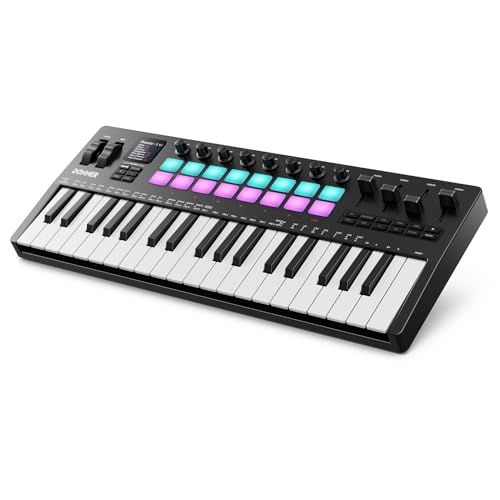
Donner STARRYKEY-37 PLAY MIDI
Beginners and mobile producers who want one budget keyboard that plays on its own, teaches the basics and later doubles as a pad and fader controller for a DAW.
Read the Donner STARRYKEY-37 PLAY MIDI review →Questions Buyers Ask
Donner KB-32M MIDI
See the current listing, price and included accessories.
About This Review
Mandrillis Team
The Mandrillis editorial team researches and compares audio and music gear using manufacturer documentation, verified specs and real buyer feedback, so you can make a confident purchase without wading through marketing claims.
Read our full research methodology.