Instruments Review
Roland A-49-WH 49-Key MIDI Review: Full-Size Keys, Bus Powered
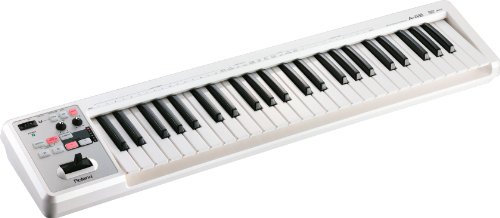
The Roland A-49-WH 49-Key MIDI controller puts 49 full-size velocity-sensitive synth-action keys, two knobs, two switches and a D-BEAM sensor into a lightweight white chassis that runs on USB bus power alone. This research review covers what the listing confirms, what it leaves out, and who the keys-first design actually suits.
Our Verdict
Research Score 72/100The Roland A-49-WH 49-Key MIDI controller is a keys-first instrument for players who value a proper full-size keybed over a wall of controls. The listing confirms 49 velocity-sensitive synth-action keys, two knobs, two switches, Roland's D-BEAM infrared controller and USB bus power in a lightweight, compact white case. What it does not confirm matters too: there are no pads or faders, DAW integration and bundled software are not published, and weight, dimensions and extra ports are left unstated. In the lower mid-range tier that adds up to 72 out of 100, a dependable choice for pianists moving into software and a poor fit for producers who want hardware mixing and finger drumming.
Editorial research score based on published specifications and documented features, not a customer rating or lab test.
Roland
Roland A-49-WH 49-Key MIDI
Best for: Players who want a slim, bus-powered 49-key controller with proper full-size keys for playing parts rather than a pad and fader surface for mixing.
Skip it if: You need pads, faders or published DAW integration, or you must confirm weight, pedal inputs and software before buying.
Check Price on AmazonWe may earn a commission at no extra cost to you.
Listing verified: October 2026
Who Should Buy It
Buy it if
- Keyboard players who prioritize full-size keys over controls
- Laptop producers who want a controller that runs on USB power alone
- Buyers who want a white controller for a light-themed desk
- Students who need a simple, reliable keyboard for software instruments
Skip it if
- You finger drum and need velocity pads
- You want eight or more encoders for synth editing
- You want a bundled DAW or sound library in the box
Key Specifications
| Keys | 49 full-size keys |
| Key type | Velocity-sensitive synth action |
| Pads | None listed |
| Knobs and faders | Two knobs, two switches and a D-BEAM controller; no faders listed |
| DAW integration | Not published in listing |
| Bundled software | Not published in listing |
| Connectivity | USB (bus powered); other ports not published in listing |
| Power | USB bus power, no AC adapter required |
| Weight | Not published in listing, described as lightweight |
| Included accessories | Not published in listing |
Overview
The Roland A-49-WH 49-Key MIDI controller is a slim, white, four-octave keyboard that trades mixer-style controls for a quality set of full-size keys. It sits in the lower mid-range tier and runs entirely on USB bus power. The product listing pitches it as portable, easy to use and expressive.
Roland built the A-49 around a simple idea: give the player a keyboard that feels right, add just enough control for basic parameter tweaks, and keep the footprint small. Two knobs, two switches and the D-BEAM infrared controller handle real-time control. There are no pads and no faders.
This review is editorial research based on the published listing. Roland does not publish the weight, the full port list, any DAW script or bundled software in that listing, so those items are marked as not published rather than filled in from assumptions.
Keys, Pads and Feel
The 49 keys are full size and velocity sensitive, with a synth action that the listing describes as delivering expressive and dynamic playing. Full-size keys matter for anyone with piano training, because mini keys compress hand positions and make fast runs awkward. Four octaves is enough for two-handed playing of most parts.
Synth action means a light spring return rather than a weighted hammer, which suits organ, synth lead and pad work. Roland controllers in this family have a reputation among buyers for a consistent, even response across the keybed, though the listing itself does not describe the mechanism in detail. Aftertouch is not mentioned.
There are no pads. Drum programming on the A-49-WH happens on the keys, which works for melodic drum parts but is less tactile than the velocity pads on an Akai MPK Mini MK3 or a Novation Launchkey Mini. The D-BEAM adds a different kind of expression by reading hand movement above the panel.
Knobs, Faders and DAW Integration
Two assignable knobs and two switches make up the physical control set, and the listing names them alongside the D-BEAM as providing control over parameters and effects. That is enough for a filter cutoff, a resonance sweep and a couple of toggles, and not enough to run a mixer. No faders are published.
The D-BEAM is a Roland signature: an infrared sensor that turns hand distance into a continuous controller. Waving a hand over it can sweep a filter or bend pitch without touching a knob, which is useful on stage and a fun performance gesture. It is also the one control here that no reference controller in this class offers.
DAW integration is not published. The A-49 relies on standard MIDI messages, so it should work with any DAW that accepts a class-compliant USB device, but there is no stated script for transport or mixer control. Compared with the deep DAW mapping on the Native Instruments Komplete Kontrol M32, the A-49-WH is a plain MIDI keyboard.
Software, Sounds and Features
The listing does not publish any bundled software. There is no DAW license, no sound library and no plug-in bundle described, which is unusual against competitors that lead with a software stack. Budget accordingly if you do not already own a DAW.
The product listing calls the interface user friendly with straightforward controls for quick integration into a music workflow. On a controller this stripped back, that means setting up the two knobs, the two switches and the D-BEAM, and little else. There is no onboard sound engine, so the A-49-WH is silent without a computer.
Any deeper assignment of the controls through editor software is not mentioned in the listing, so treat that as unconfirmed. Customization beyond the front panel should be checked in the manual before you count on it for a live set.
- Two assignable knobs and two switches
- D-BEAM infrared controller for gestural control
- Lightweight, compact construction for easy transport
- Standard USB MIDI operation with any software
- No bundled software published in the listing
Build, Design and Portability
Lightweight and compact construction is published, and the white finish gives this version a cleaner look than the usual black controller. The A-49 series has a slim profile with the control section set to the left of the keys, which keeps the depth close to that of the keybed itself. Exact dimensions are not published.
Weight is not published either, which is a gap for a controller sold on portability. A 49-key unit with full-size keys is longer than a 25-key mini controller, so it will need a bag rather than a backpack pocket. Buyers describing this series tend to call it easy to carry to a rehearsal.
Build materials are not described in the listing, so the shell material is unconfirmed. A white finish will show scuffs more readily than black, which is worth knowing if it will travel often. The light weight also means it can shift on a desk during energetic playing unless placed on a mat.
Connectivity and Power
USB bus power is the headline connection: plug one cable into a computer and the keyboard powers up and sends MIDI, with no adapter to carry or lose. The listing stresses the reduction in cable clutter, which is real for a laptop setup. USB class compliance is not spelled out in the listing.
Other ports are not published. A sustain pedal jack, an expression input and a MIDI output are common on controllers this size and would make the A-49-WH more useful with hardware synths, but the listing does not confirm any of them. Check the manual if you plan to drive outboard gear.
Power draw and whether it works with a tablet over a camera adapter are also not stated. For a laptop and DAW setup, bus power is all you need. For a tablet rig, confirm the power budget before buying.
Setup and Daily Use
Setup on paper is one cable. Connect the USB lead, open a DAW, pick the keyboard as a MIDI input and play. The absence of a bundled DAW script means there is no installer to run, which some buyers prefer and others see as a missed convenience.
Day to day, the A-49-WH behaves like a playing surface. Assign the two knobs once to the parameters you touch most, keep the switches for sustain or a toggle, and use the D-BEAM for sweeps. Because there are no faders or pads, hand position rarely leaves the keys.
The simplicity has a cost. Mixing, clip launching and drum programming all stay on the mouse and keyboard, so producers who want to move those tasks onto hardware will outgrow it. Players who only want to perform parts into software will not.
Who Should Buy It
Pianists and keyboard players moving into software production are the clear audience. Full-size velocity-sensitive keys across four octaves and a bus-powered design give them a familiar surface that works anywhere a laptop does. The white finish is a bonus for anyone with a light-themed desk.
Students and educators will also appreciate the plain interface. There is little to misconfigure, and the D-BEAM gives a visual, gestural control that is easy to demonstrate in a classroom. The lower mid-range price tier is reasonable for a Roland keybed.
Beatmakers, live electronic performers and anyone who needs a hardware mixer section should skip it. The M-Audio Oxygen Pro and the Nektar Impact LX both pair full-size keys with pads and faders, and either will suit a control-heavy workflow better than the A-49-WH.
Alternatives Worth Considering
The M-Audio Oxygen Pro is the most direct alternative, adding pads, faders and DAW presets to a similar key count, at the cost of a bulkier unit. The Nektar Impact LX offers a comparable mix with strong DAW integration for popular hosts.
If portability matters more than full-size keys, the Akai MPK Mini MK3, Arturia MiniLab 3 and Novation Launchkey Mini all shrink into a backpack and include pads and encoders, though their mini keys suit a different player. The Native Instruments Komplete Kontrol M32 sits between them with a compact keybed and deep software control.
Within Roland's range, the same controller in black is sold as the A-49-BK and shares the specification. Choose by finish and by the price on the day, since the hardware is the same on paper.
Verdict
The Roland A-49-WH 49-Key MIDI controller earns its place by doing one thing well: giving you 49 full-size, velocity-sensitive synth-action keys in a lightweight, bus-powered case. Two knobs, two switches and the D-BEAM provide a modest layer of real-time control without cluttering the panel.
The gaps are honest ones. No pads, no faders, no published DAW script, no bundled software, and no stated weight or extra ports. That keeps the score at 72 out of 100 for a lower mid-range controller from a well-known brand.
For a player who wants keys first and a quiet white controller on the desk, it is a solid choice. For a producer who needs a hardware mixer and drum pads, it is the wrong tool, and one of the alternatives above will fit better.
Strengths and Limitations
Strengths
- 49 full-size velocity-sensitive synth-action keys
- USB bus power with no adapter needed
- Two knobs, two switches and a D-BEAM controller
- Lightweight, compact chassis in a white finish
- Simple interface that maps quickly to software
Limitations
- No pads or faders
- DAW scripts and bundled software not published
- Weight, dimensions and extra ports not stated
- Aftertouch is not mentioned
How We Scored It
Scores reflect published specifications, documented features and value against the alternatives below. They are editorial research scores, not laboratory measurements.
Alternatives to Consider

Behringer X-TOUCH Universal Surface
Home and project studios that want nine motorized faders and protocol-based control across DAWs, with Ethernet connectivity as a bonus.
Read the Behringer X-TOUCH Universal Surface review →
Behringer X-TOUCH
Producers and mix engineers who want motorized faders and a bank of rotaries under their hands for DAW mixing, instrument control and live automation without a large console footprint.
Read the Behringer X-TOUCH review →
Roland A-49-BK 49-Key MIDI
Keyboard players who want a slim, serious 49-key keybed with a few real-time controls and a single USB cable, not a pad and fader workstation.
Read the Roland A-49-BK 49-Key MIDI review →Questions Buyers Ask
Roland A-49-WH 49-Key MIDI
See the current listing, price and included accessories.
About This Review
Mandrillis Team
The Mandrillis editorial team researches and compares audio and music gear using manufacturer documentation, verified specs and real buyer feedback, so you can make a confident purchase without wading through marketing claims.
Read our full research methodology.