Speakers Review
Edifier MR4 Review: Budget Studio Monitor
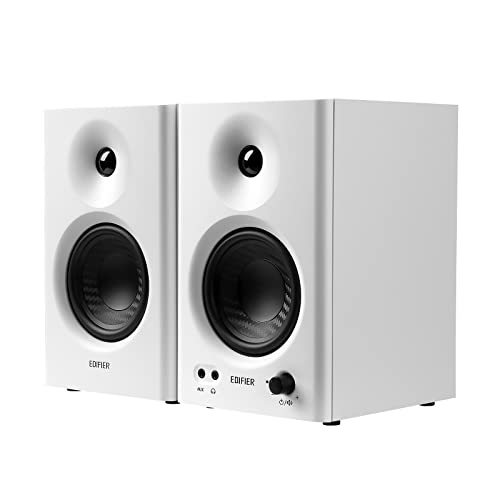
The Edifier MR4 is an active near field studio monitor built around a one inch silk dome tweeter and a four inch composite woofer. The listing highlights a near flat response for music creation, dual monitor and music modes, and flexible wired inputs. It omits power and frequency response figures, so buyers should evaluate it as a budget desktop monitor.
Our Verdict
Research Score 73/100The Edifier MR4 looks like a sensible budget choice for desktop production and critical listening. Its one inch silk dome tweeter, four inch composite woofer, and MDF cabinet point toward a balanced near field presentation, and the dual mode switch adds flexibility for casual listening. The wired input set, front headphone output, and separate high and low frequency controls make it practical for small studios and computer desks. However, the listing leaves out power, sensitivity, frequency response, dimensions, and weight, which makes an objective assessment harder. Buyers who need Bluetooth, deep bass, or a fully specified monitor should look elsewhere. For the price tier, this is a reasonable powered monitor when used within its near field limits.
Editorial research score based on published specifications and documented features, not a customer rating or lab test.
Edifier
Edifier MR4
Best for: Budget minded desktop producers and listeners who want an active near field monitor with wired inputs and tonal controls.
Skip it if: You need wireless streaming, deep low bass, or a speaker with fully published power and frequency response specifications.
Check Price on AmazonWe may earn a commission at no extra cost to you.
Listing verified: October 2026
Who Should Buy It
Buy it if
- Budget home studio owners who want a flat reference monitor
- Desktop listeners with a mixer, audio interface, or computer output
- Users who prefer front panel controls and a headphone output
Skip it if
- You require Bluetooth or Wi-Fi streaming
- You want strong sub bass without adding a subwoofer
- You need detailed acoustic measurements before buying
Key Specifications
| Type | Active near-field powered bookshelf studio monitor |
| Drivers | 1-inch silk dome tweeter, 4-inch composite woofer |
| Power or sensitivity | Not published in listing |
| Frequency response | Not published in listing |
| Inputs and connectivity | 1/4-inch balanced TRS input, unbalanced RCA input, unbalanced AUX input, front headphone output |
| Bluetooth and streaming | Not published in listing |
| Dimensions | Not published in listing |
| Weight | Not published in listing |
| Finish | MDF wooden structure; exact finish not published in listing |
| Included accessories | Not published in listing |
Overview
The Edifier MR4 is a compact active near field studio monitor aimed at music creators and desktop listeners. The listing describes it as a powered bookshelf speaker with a one inch silk dome tweeter and a four inch composite woofer. It sits in the budget tier, making it an entry point for users who want a flat reference sound without a separate amplifier. This review is based on the published listing details rather than in-person testing.
The product listing positions the MR4 as a true studio monitor with a near flat response curve. It also includes a music mode for relaxed everyday listening. The cabinet uses MDF to reduce resonance. Important specifications such as wattage, sensitivity, frequency response, dimensions, and weight are not published, so the evaluation below focuses on the listed features and reasonable expectations for a near field monitor.
Sound Quality
On paper, the Edifier MR4 should offer a clear and balanced presentation. The one inch silk dome tweeter is intended to deliver smooth highs without aggressive edge, and the four inch composite woofer handles the midrange and upper bass. The listing emphasizes a near flat responsive curve, which suggests monitor mode is tuned for accuracy rather than exaggerated lows or sparkle.
The MDF wooden structure is mentioned as a way to reduce resonance and let the drivers reveal the true sound. This matters most in a near field setup, where the listener sits close to the speaker and hears more direct sound than room reflections. Without a published frequency response, buyers cannot know how deep the MR4 plays, but a four inch woofer in a compact cabinet typically favors midrange clarity over deep bass.
The dual mode design gives the speaker two characters. Monitor mode is described as the accurate setting for music production, while music mode is tuned for daily enjoyment. This kind of switch can make the speaker more versatile than a single tuning curve. It also helps less technical users avoid complex equalizer adjustments if they just want a more relaxed sound.
Drivers, Power and Room Fit
The driver complement consists of a one inch silk dome tweeter and a four inch composite woofer. This is a common configuration for small powered monitors and desktop bookshelf speakers. The four inch woofer is unlikely to move enough air for powerful low bass, but it can handle vocals, guitars, keyboards, and many electronic tracks at moderate near field levels.
Power output and sensitivity are not published in the listing. That omission makes it hard to estimate maximum volume or how well the MR4 will fill a room. Because the speaker is marketed as a near field monitor, it is best judged for use on a desk, studio meter bridge, or small mixing space. Larger rooms or home theater use would likely require a bigger speaker or a subwoofer.
Room fit is also affected by the unknown dimensions and weight. The MR4 appears compact from its product photos, but without exact measurements, buyers should verify that it fits their desk or stands. Near field monitors are designed to be placed close to the listener, so room acoustics matter less than in far field listening. Still, some wall distance and a stable surface generally help compact monitors perform cleanly.
Features and Connectivity
The MR4 includes a practical wired input set. A balanced quarter inch TRS input accepts professional line level signals from mixers and audio interfaces. RCA and AUX inputs cover consumer sources such as computers, tablets, and media players. A front headphone output makes it easy to switch to private listening without unplugging the speakers.
The listing does not mention Bluetooth or any wireless streaming. That omission is important for buyers who expect to send audio from a phone without a cable. The MR4 is wired only, which can be an advantage in a studio for low latency and reliable connections. It also avoids the compression and pairing issues that sometimes affect wireless speakers.
Two adjustment knobs let users fine tune high and low frequencies separately. The front panel knob controls volume and switches between monitor and music modes. This layout keeps everyday controls accessible while leaving tuning controls available for setup. The front headphone output adds convenience for late night work or quick checks.
- 1/4-inch balanced TRS input for mixers and audio interfaces
- Unbalanced RCA input for consumer audio devices
- Unbalanced AUX input for phones and tablets
- Front headphone output for private monitoring
- Separate high and low frequency adjustment knobs
- Front panel volume and sound mode control
Build, Design and Finish
The MR4 uses an MDF wooden structure, which the listing says helps reduce resonance and reveal true sound. MDF is a common cabinet material in bookshelf and studio monitors because it is dense and less lively than thin plastic. The listing does not specify the exact outer finish, though the model suffix WT often indicates a white cabinet.
The front panel appears to hold the main controls and likely the headphone output, based on the listing details. The overall footprint is compact, following the near field monitor category. Without published dimensions and weight, build quality can only be judged on the listed materials and general Edifier design conventions.
The included accessories are not listed. Buyers should confirm whether a power cable, interconnect cable, or any isolation pads are in the box. This is more of a practical note than a performance concern, but it affects initial setup. The speaker is active, so there is no need to buy a separate amplifier.
Setup and Placement
Setup is straightforward for an active speaker. Each speaker receives power, and the user connects a source to one of the available inputs. The balanced TRS input is well suited to audio interfaces, while RCA or AUX can accept a computer, tablet, or phone with the appropriate cable. No external amplifier or receiver is required.
Placement should follow near field conventions. The MR4 works best on a desk or stands at ear height, with the listener seated a few feet away. The front panel volume and mode controls are easy to reach, which helps in a compact setup. Since dimensions are not published, buyers should leave a little extra room for cable clearance behind the cabinet.
The high and low frequency controls can help compensate for desk reflections or room brightness. For example, a slight high frequency reduction may smooth out a reflective desktop, while a small low frequency boost might fill in thin sound. These adjustments are limited and cannot replace proper placement or room treatment, but they add useful flexibility.
Daily Use
In daily use, the MR4 should behave like a compact powered monitor. The front volume knob makes level changes quick, and the mode switch lets a user alternate between flat monitor playback and a more casual music curve. This is practical for someone who records or edits during the day and then listens for enjoyment without changing speakers.
The front headphone output is a useful touch. Instead of reaching behind a computer or interface, the listener can plug headphones directly into the speaker. The separate high and low frequency knobs are less likely to be adjusted daily, but they remain available for source changes or a different desk arrangement.
The lack of a remote is expected at this tier but still worth noting. All control happens on the speaker itself. The wired only operation also means a phone or tablet must use a cable or an adapter unless the source already has a headphone output. For desktop and studio use this is rarely a problem, but it may be inconvenient for casual living room streaming.
Who Should Buy It
The Edifier MR4 is best suited to budget minded home studio owners, podcasters, and content creators who want an active monitor with a balanced presentation. It fits small desks and editing stations where near field listening is the norm. The balanced TRS input makes it compatible with basic audio interfaces and mixers.
It is also a reasonable choice for desktop listeners who prefer a more neutral sound than typical multimedia speakers. The dual mode switch adds flexibility for casual listening, and the front headphone output is convenient for shared spaces. Buyers who are comfortable with wired connections and do not need deep bass will find the most value here.
Alternatives Worth Considering
Edifier's own R1280DB is a common alternative for buyers who want Bluetooth and a remote control in a similar budget bookshelf format. The R1280DB is not a studio monitor, so its tuning may be more consumer friendly. It includes wireless connectivity that the MR4 lacks.
The Klipsch R-51M is a passive bookshelf speaker that requires an amplifier or receiver. It tends to have a livelier and more forward sound than a near flat studio monitor. Buyers who already own an amp and want a traditional hi-fi presentation may prefer it, but it is not an active speaker.
The ELAC Debut 2.0 B5.2 is another passive bookshelf option with a reputation for smooth and balanced sound. It sits in a different category because it needs external amplification and is not marketed as a studio monitor. Those with a small integrated amp may find it more resolving, but the MR4 remains simpler for desktop use.
Verdict
The Edifier MR4 is a focused budget monitor that makes sense for near field listening and basic music production. The listed driver configuration and MDF cabinet point toward a clear, balanced sound, and the dual mode switch adds useful flexibility. Wired inputs and a front headphone output make it practical for small desks and studio spaces.
The main weakness is the missing set of published specifications. Power, frequency response, dimensions, and weight would help buyers compare the MR4 with other monitors more confidently. If you can accept wired only operation and moderate bass from a four inch woofer, the MR4 is a sensible budget powered speaker for desktop use.
Strengths and Limitations
Strengths
- Near flat monitor tuning for analytical listening
- Separate high and low frequency controls
- Multiple wired inputs including balanced TRS
- Front headphone output for private monitoring
- Dual mode switch for monitor or music playback
- Compact MDF cabinet helps reduce resonance
Limitations
- No Bluetooth or streaming in the listing
- Power, sensitivity, and frequency response are not published
- Four inch woofer limits deep bass output
- No remote or published included accessories
- Exact finish and dimensions are unclear
How We Scored It
Scores reflect published specifications, documented features and value against the alternatives below. They are editorial research scores, not laboratory measurements.
Alternatives to Consider

Marshall Willen II
The Marshall Willen II is best for someone who wants a rugged, strap-mountable portable speaker for outdoor use with long battery life and hands-free calls.
Read the Marshall Willen II review →
Pyle Powered Bookshelf Speaker
Budget-conscious buyers wanting compact powered bookshelf speakers with flexible inputs for nearfield or small room use.
Read the Pyle Powered Bookshelf Speaker review →
Edifier QR30
A compact desk or gaming setup that wants Bluetooth multipoint, wired fallback, and RGB lighting without a separate amplifier.
Read the Edifier QR30 review →Questions Buyers Ask
Edifier MR4
See the current listing, price and included accessories.
About This Review
Mandrillis Team
The Mandrillis editorial team researches and compares audio and music gear using manufacturer documentation, verified specs and real buyer feedback, so you can make a confident purchase without wading through marketing claims.
Read our full research methodology.