Speakers Review
Fluance Reference Performance 3-Way Review: Floorstanding Bass Power
The Fluance Reference Performance 3-Way is a passive floorstanding speaker that puts an 8-inch down-firing subwoofer into each cabinet. The listing highlights a 3-way driver layout, woven fiber midrange, and silk dome tweeter, but leaves out sensitivity and power handling. This review looks at what the published specs suggest for music and home theater use.
Our Verdict
Research Score 73/100The Fluance Reference Performance 3-Way reads like a thoughtful attempt to deliver deep bass and clear midrange from a floorstanding cabinet without the bulk of separate subwoofers. The down-firing 8-inch drivers, 3-way configuration, and braced cabinet are all sensible engineering choices. However, the listing leaves meaningful blanks, especially sensitivity and power handling. That missing data makes it hard to know how much amplifier you need and how loud these will play before distortion. Buyers who already have a solid receiver and can accommodate an unknown cabinet size may find the value compelling at a mid-range price. Everyone else should ask the seller for the full spec sheet before buying. On paper, the design appears capable of room-filling sound with strong low frequency output, but the lack of published measurements keeps this from an unreserved recommendation.
Editorial research score based on published specifications and documented features, not a customer rating or lab test.

Fluance
Fluance Reference Performance 3-Way
Best for: A buyer who wants a floorstanding speaker with deep bass from built-in down-firing subwoofers and already owns a capable amplifier or receiver.
Skip it if: You need a self-powered speaker, built-in wireless streaming, or published sensitivity and power handling numbers before buying.
Check Price on AmazonWe may earn a commission at no extra cost to you.
Listing verified: October 2026
Who Should Buy It
Buy it if
- Listeners who want floorstanding speakers with dedicated subwoofers but limited floor space
- Home theater owners who already have an AV receiver and want front left and right channels with strong low end
- Two-channel music fans who like a fuller range sound from a passive speaker pair
- Buyers who prefer a walnut finish and mid-range pricing over compact bookshelf models
Skip it if
- You do not want to buy a separate amplifier or receiver
- You require Bluetooth, Wi-Fi, or app-based streaming built into the speaker
- You need exact power handling, sensitivity, dimensions, and weight before deciding
Key Specifications
| Type | Floorstanding loudspeaker, passive |
| Drivers | 3-way design; down-firing 8-inch subwoofers; woven fiber midrange drivers; silk dome neodymium tweeters; midrange and tweeter sizes not published in listing |
| Power or sensitivity | Not published in listing |
| Frequency response | 35 Hz to 25 kHz (per listing) |
| Inputs and connectivity | Not published in listing; passive design requires external amplification |
| Bluetooth and streaming | None, passive speaker |
| Dimensions | Not published in listing |
| Weight | Not published in listing |
| Finish | Walnut (per listing title) |
| Included accessories | Not published in listing |
Overview
Fluance positions the Reference Performance 3-Way as a floorstanding loudspeaker for two-channel music and home theater use. The product listing emphasizes a 3-way driver layout with dedicated down-firing 8-inch subwoofers in each cabinet. That is an uncommon approach at this price tier, as most passive floorstanding speakers rely on a single woofer or a rear port to produce low end.
The listing uses phrases like room-filling music and immersive home audio but does not publish several key specifications. There is no sensitivity rating, no power handling number, no impedance, and no cabinet dimensions or weight. For a speaker that must be paired with an external amplifier, those omissions make informed buying difficult.
What stands out from the available data is the combination of a woven fiber midrange driver, a silk dome neodymium tweeter, and dual rear ports. The down-firing subwoofer design promises deep bass without increasing the speaker footprint. Buyers in a mid-range budget who already own an AV receiver or stereo amplifier may see this as a practical floorstanding option.
Sound Quality
On paper, the 3-way configuration should give the Fluance Reference Performance 3-Way an advantage over typical two-way floorstanding speakers. By dedicating a driver to the midrange, the speaker can reduce the workload on the woofer and tweeter, which often leads to clearer vocals and less strain during complex passages. The listing describes the woven fiber midrange as providing vibrational damping and optimal linear movement, which suggests a focus on low distortion.
The silk dome neodymium tweeter is described as producing crisp, natural highs with spacious off-axis dispersion. That is a common design goal for a soft dome tweeter, and it usually results in a forgiving sweet spot. The listing does not give a crossover frequency or driver sizes for the midrange and tweeter, so the specific blend between drivers remains unknown.
Low frequency response is rated down to 35 Hz. That is respectable for a floorstanding speaker, especially one with an integrated 8-inch subwoofer per cabinet. The down-firing orientation can help load the room more evenly than a front-firing woofer, but actual in-room bass will depend on placement and the room itself. Without sensitivity or power handling data, it is hard to predict how cleanly the speaker will play at high volumes.
Buyers who have heard Fluance speakers often describe a warm, full sound with strong bass presence. The dual rear ports are likely tuned to reinforce the low end while the down-firing subwoofer handles the deepest notes. However, the listing does not provide distortion measurements or a recommended amplifier power range, so those impressions cannot be confirmed from the published data alone.
Drivers, Power and Room Fit
The most distinctive driver feature is the down-firing 8-inch subwoofer built into the bottom of each cabinet. This design lets the speaker produce deep bass while keeping a relatively slim front profile. Floorstanding speakers with built-in powered subwoofers are not new, but a passive design with a down-firing subwoofer still requires an external amplifier to drive all drivers together.
The 3-way layout means there is a separate midrange driver between the woofer and tweeter. The listing calls it a woven fiber driver, which is often chosen for stiffness and damping. The tweeter is a silk dome with a neodymium magnet, a combination that typically offers smooth high frequencies and good dispersion. Exact driver sizes beyond the 8-inch subwoofer are not published.
Power handling and sensitivity are not given. That is a significant gap because a speaker with low sensitivity may need a powerful amplifier to reach satisfying volume levels, while a speaker with high sensitivity can work with modest receivers. The down-firing subwoofer places additional demands on the amplifier because low frequencies require more power to reproduce cleanly.
Room fit is also hard to judge without dimensions or weight. The listing title says each cabinet contains an 8-inch subwoofer, so the speaker is unlikely to be small. The down-firing driver needs a few inches of clearance above the floor, and dual rear ports mean the speaker should not be placed directly against a wall. Buyers should plan for at least a foot of breathing room from the back wall and enough floor space for a stable placement.
Build, Design and Finish
The cabinet engineering is described as meticulous, with rigid internal bracing to avoid unwanted resonance. That is a good sign for a speaker that must handle strong low frequency output from a down-firing subwoofer. Bracing helps keep the cabinet from vibrating and coloring the midrange. The listing also mentions dual rear ports, which suggests a bass reflex design tuned for low frequency extension.
The finish is listed as walnut. The product title says Walnut/Pair, which likely means the walnut finish is applied to both speakers in the pair. There is no information about the cabinet material, thickness, or grille design. The down-firing subwoofer implies a base or plinth may be part of the design, but no details are given.
Without dimensions and weight, it is hard to assess the physical presence of these speakers. Floorstanding speakers with 8-inch subwoofers are typically taller than bookshelf models and may weigh 30 pounds or more each, but that is speculation. The listing leaves out the exact height, width, depth, and weight, which makes it difficult to plan placement or ensure the speakers will fit through doorways.
The minimalist footprint claim from the listing suggests the cabinet is not overly wide, likely because the subwoofer fires downward instead of taking up front baffle space. The dual rear ports may require some clearance from the wall, but the overall look is probably clean and furniture-like in walnut.
Setup and Placement
Setting up the Fluance Reference Performance 3-Way starts with connecting speaker wire from an amplifier or receiver. Because the speaker is passive, the buyer needs to provide all amplification. The listing does not state the type of binding posts used, so buyers should expect standard speaker wire connections but cannot confirm whether they are banana plug compatible or spring clips.
Placement will require careful attention to the down-firing subwoofer and rear ports. The speakers should not be pushed flat against a wall, because the rear ports need space to breathe. A distance of at least 12 to 18 inches from the back wall is a reasonable starting point, though the listing gives no specific guidance. The down-firing driver also needs clearance above the floor, which is usually built into the cabinet design.
For stereo listening, the speakers should be placed equidistant from the main listening position, with a slight toe-in toward the listener. For home theater use, they can serve as front left and right channels. The wide off-axis dispersion of the silk dome tweeter may reduce the need for perfect toe-in, but no exact dispersion angle is published.
Because sensitivity and power handling are unknown, matching an amplifier is a guessing game. A receiver with at least 50 to 80 watts per channel into 8 ohms is a common starting point for floorstanding speakers, but that is general knowledge, not based on this listing. Buyers should ask the seller or manufacturer for the full specification sheet before buying an amplifier.
Daily Use
In daily use, the Fluance Reference Performance 3-Way should behave like a conventional passive floorstanding speaker. Once connected to an amplifier, it will play whatever the source provides. There are no built-in controls, no remote, no room correction, and no app. All tone shaping and volume control happen at the amplifier or receiver.
The down-firing subwoofer may produce a different bass character than a front-firing woofer. Down-firing designs tend to distribute low frequencies more evenly around the room, which can reduce boomy peaks and make bass less localized. However, the actual result depends on the floor type and room size. Thick carpet can absorb some low frequency energy, while hardwood or tile may reflect more.
Because the speaker has dual rear ports, listeners should avoid placing items directly behind the ports. The ports move air at low frequencies, and blocking them will change the tuning and reduce bass output. The cabinet bracing should keep the enclosure quiet during loud passages, but that is based on the listing claim rather than a in-person report.
Maintenance is minimal for a passive speaker. A dry cloth can remove dust from the cabinet and drivers. The down-firing subwoofer may collect dust on its cone over time, but the listing gives no advice on cleaning. Buyers should avoid vacuuming the drivers directly and keep liquids away from the cabinet.
Who Should Buy It
The Fluance Reference Performance 3-Way is best for someone who already owns a stereo amplifier or AV receiver and wants floorstanding speakers with strong low frequency output. The built-in down-firing subwoofers remove the need for a separate subwoofer box, which can save floor space in smaller rooms. This makes the speaker appealing for apartment dwellers or living rooms where a dedicated subwoofer would be too bulky.
Home theater fans who want front left and right channels that can play deep bass without separate subwoofers may also find this design useful. A pair of these speakers could handle the low frequency effects in many movies, though a dedicated powered subwoofer still offers more control. The 3-way layout should keep dialogue clear, assuming the midrange driver performs as described.
Buyers who like the look of a walnut floorstanding speaker and prefer a mid-range price over a high-end audiophile model are a natural fit. The listing does not claim to be a reference studio monitor, so casual listeners and movie watchers may get more value than critical mix engineers.
Alternatives Worth Considering
If the missing specifications are a concern, the ELAC Debut 2.0 B5.2 is a well-known bookshelf speaker with published specs and a similar budget to mid-range price. It does not have a built-in subwoofer, but it offers a clear upgrade path when paired with a good amplifier. The Polk Audio T50 is another floorstanding speaker in a comparable price tier that often includes published sensitivity and frequency response.
For buyers who want wireless streaming and built-in amplification, the Edifier R1280DB is a powered bookshelf speaker with Bluetooth and optical inputs. It cannot match the low frequency extension of the Fluance because it lacks a dedicated subwoofer, but it is much simpler to set up. The JBL Flip 6 and Bose SoundLink Flex are portable Bluetooth speakers with completely different use cases, but they show how easy wireless listening can be.
For a more traditional passive floorstanding speaker with known specs, the Klipsch R-51M is actually a bookshelf model, but it shows the value of published sensitivity. The SVS SB-1000 Pro is a powered subwoofer that could be paired with small bookshelf speakers to achieve deep bass without buying large floorstanding towers. That combination often costs more but gives more flexibility.
None of these alternatives perfectly match the Fluance Reference Performance 3-Way on paper, because very few passive floorstanding speakers include down-firing subwoofers. The closest comparison is likely a traditional three-way floorstanding speaker from a brand like ELAC or Polk, but the Fluance listing leaves too many blanks to make a direct spec comparison.
Verdict
The Fluance Reference Performance 3-Way presents an interesting concept: a passive floorstanding speaker with a built-in down-firing subwoofer and a 3-way driver array. The listed frequency response down to 35 Hz and the braced cabinet suggest a speaker that can deliver satisfying bass and clear midrange for most music and movies. The silk dome tweeter and woven fiber midrange are sensible choices at this price point.
However, the lack of published sensitivity, power handling, impedance, dimensions, and weight is a serious drawback. A speaker cannot be evaluated properly without knowing how much power it needs or how large it is. Buyers who want to pair it with an existing receiver may find the amplifier matching process frustrating.
For the right buyer, someone who already owns a solid receiver and has room for large floorstanding speakers, the Fluance Reference Performance 3-Way could be a smart way to get deep bass without a separate subwoofer. The mid-range price makes it accessible, but the unknown specifications keep it from being an easy recommendation for everyone. The score reflects the solid design ideas and the missing data.
Strengths and Limitations
Strengths
- Dedicated down-firing 8-inch subwoofers for deep bass without a wide cabinet
- 3-way design gives the midrange its own driver for clearer vocals and instruments
- Woven fiber midrange drivers aim for controlled breakup and linear movement
- Silk dome neodymium tweeters promise smooth highs and wide off-axis dispersion
- Rigid internal bracing and dual rear ports are listed to reduce resonance
- Mid-range price tier for a floorstanding speaker with built-in subwoofers
Limitations
- No power handling or sensitivity rating published, making amplifier matching harder
- No dimensions or weight listed, so room planning is uncertain
- Passive design requires a separate amplifier or receiver
- No Bluetooth, streaming, or powered inputs
- Midrange and tweeter driver sizes are not specified
How We Scored It
Scores reflect published specifications, documented features and value against the alternatives below. They are editorial research scores, not laboratory measurements.
Alternatives to Consider

Definitive Technology CS-9060
Home theater owners who want a center channel with built-in powered bass and clear dialogue reproduction.
Read the Definitive Technology CS-9060 review →
Q Acoustics 3060s Active
Small to medium rooms where a slim, wall friendly subwoofer is needed for music and movie bass without visual bulk.
Read the Q Acoustics 3060s Active review →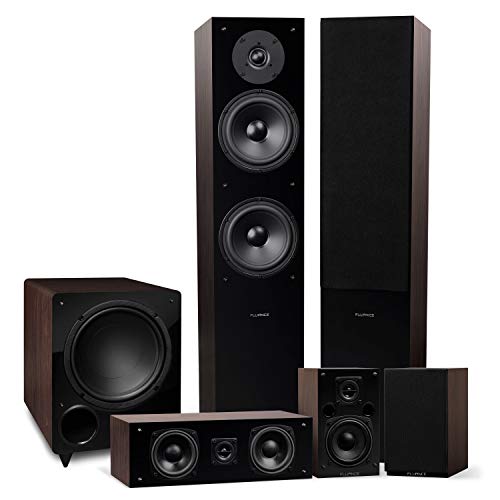
Fluance Elite Definition Channel Speaker
Movie and music listeners who want a matched 5.1 passive speaker package with floorstanding front channels and a dedicated powered subwoofer in a mid-range budget.
Read the Fluance Elite Definition Channel Speaker review →Questions Buyers Ask
Fluance Reference Performance 3-Way
See the current listing, price and included accessories.
About This Review
Mandrillis Team
The Mandrillis editorial team researches and compares audio and music gear using manufacturer documentation, verified specs and real buyer feedback, so you can make a confident purchase without wading through marketing claims.
Read our full research methodology.