Speakers Review
JBL PartyBox 330 Review: Portable Party Power
The JBL PartyBox 330 is a mid-range portable party speaker built around 280 watts of output, dual 6.5-inch woofers, twin dome tweeters, and an adaptive lightshow. The listing highlights up to 18 hours of battery life, IPX4 splash resistance, Auracast pairing, and a telescopic handle with wheels for moving the speaker between spaces.
Our Verdict
Research Score 80/100The JBL PartyBox 330 reads as a purpose-built party speaker that prioritizes output, battery stamina, and ease of transport. The published 280-watt system with dual 6.5-inch woofers and 25mm tweeters should deliver the chest-thumping bass and clear projection the listing promises, while the IPX4 rating and 18-hour battery cover outdoor use. Auracast linking, the JBL One app, and EasySing mic compatibility add flexibility for larger gatherings and karaoke. The lack of published frequency response, dimensions, and weight makes careful evaluation harder, and the backup battery and mics are separate purchases. Still, for hosts who need a movable, splash-resistant speaker with strong output and lightshow appeal, the PartyBox 330 is a compelling mid-range option.
Editorial research score based on published specifications and documented features, not a customer rating or lab test.

JBL
JBL PartyBox 330
Best for: Parties, karaoke nights, and outdoor gatherings where high volume, long battery life, and splash resistance matter.
Skip it if: You need a compact, reference-tuned speaker for critical listening or a fixed indoor setup with published frequency response and room integration details.
Check Price on AmazonWe may earn a commission at no extra cost to you.
Listing verified: October 2026
Who Should Buy It
Buy it if
- Hosts who want a portable party speaker with strong bass and clear highs
- Karaoke fans who may add JBL EasySing mics later
- Anyone who moves a speaker between rooms, patios, or gatherings and values wheels and a handle
- Outdoor users who want splash resistance and long battery life
Skip it if
- You need a bookshelf or floorstanding speaker with a published frequency response for analytical listening
- You want a compact Bluetooth speaker that fits in a backpack
- You prefer to avoid app-based controls and lightshows and want a simpler wired speaker
Key Specifications
| Type | Portable party speaker |
| Drivers | Dual 6.5-inch woofers; twin 25mm PEN dome tweeters |
| Power or sensitivity | 280 watts (total system power as stated in listing) |
| Frequency response | Not published in listing |
| Inputs and connectivity | EasySing mic compatibility (mics sold separately); Auracast pairing; JBL One app control |
| Bluetooth and streaming | Auracast streaming and multi-speaker pairing; Bluetooth version not published in listing |
| Dimensions | Not published in listing |
| Weight | Not published in listing |
| Finish | Black |
| Included accessories | Not published in listing |
Overview
JBL markets the PartyBox 330 as a portable party speaker built around a 280-watt amplifier, dual 6.5-inch woofers, and twin 25mm PEN dome tweeters. The product listing positions it in the mid-range tier, aimed at gatherings rather than desktop or bookshelf listening. On paper, the speaker combines high output with battery power, an adaptive lightshow, and a rolling transport design, which separates it from typical home stereo speakers.
The main pitch is convenience and presence. The listing highlights up to 18 hours of playtime, IPX4 splash resistance, and Auracast pairing for linking multiple PartyBox units or compatible JBL speakers. A telescopic handle and wide wheels are included for moving the speaker between rooms or outside. The JBL One app provides remote control of music and lighting from across the dance floor.
For buyers familiar with powered bookshelf speakers or soundbars, the PartyBox 330 is a different category. It is not described as a neutral monitor, and the listing does not publish a frequency response curve or a flat listening mode. Instead, the focus is on chest-hitting bass, clear high frequencies, and visual energy. That makes it a candidate for parties, karaoke, and outdoor events rather than analytical listening.
Sound Quality
The published driver array consists of two 6.5-inch woofers handling low frequencies and two 25mm PEN dome tweeters covering the highs. The listing claims 280 watts of total system power, which suggests the speaker can reach high volumes in medium-to-large spaces. On paper, the dual woofer arrangement should provide stronger bass than a single small driver, while the dome tweeters aim to keep vocals and cymbals clear even when music is loud.
JBL describes two processing features that shape sound in real time. AI Sound Boost reads the music and predicts driver movement to maximize bass and volume while reducing distortion, which could help the speaker stay composed at party levels. Smart EQ mode automatically adjusts the tonal balance based on whether the content is music or speech, keeping instruments full and voices crisp without manual changes.
Because the frequency response is not published in the listing, buyers cannot assess how deep the bass extends or how flat the midrange is. The listing also does not specify a sound mode for critical listening. Without in-person measurements, the tonal character remains an open question, but the feature set strongly suggests a lively, bass-forward presentation intended for energetic music rather than studio accuracy.
Drivers, Power and Room Fit
The PartyBox 330 uses a two-way configuration with dual 6.5-inch woofers and twin 25mm PEN dome tweeters. The listing states 280 watts of output, which is substantial for a portable speaker and should fill a living room, patio, or small outdoor gathering. The dual woofers are larger than those in many compact portable speakers, so the physical design points toward deeper bass and more sound pressure.
Room fit is aided by the telescopic handle and wide wheels, which make it practical to move the speaker to different locations. The listing does not publish dimensions or weight, so buyers cannot know exactly how much floor space it will occupy or how heavy it is to lift. Still, the presence of wheels and a handle indicates that JBL expects the speaker to be rolled rather than carried for long distances.
Because the speaker is powered and portable, it does not require a separate amplifier or receiver, which simplifies room placement. The lack of published dispersion or frequency response data means that buyers should plan for a party-oriented sound rather than a precise soundstage. For large rooms, a single PartyBox 330 may be enough, but the Auracast feature allows two units to be paired for a wider stereo image or more even coverage.
Features and Connectivity
The JBL One app is a central part of the PartyBox 330 experience. The listing says you can control the speaker from anywhere in the party, changing songs or adjusting the lightshow from the dance floor. The app also appears to handle firmware updates, and the listing specifically advises updating the speaker before first use. This app-based control adds convenience for hosts who do not want to return to the speaker to manage playback.
The speaker supports Auracast, which allows two PartyBox 330 units to be paired for stereo sound or linked with a larger group of JBL Auracast-enabled speakers. This makes it easier to scale sound to a bigger crowd. The listing also notes compatibility with JBL EasySing Mics, sold separately, for karaoke. The EasySing system includes AI vocal removal to reduce lead vocals from songs, turning them into karaoke tracks without extra setup.
- JBL One app for remote music and lightshow control
- Auracast pairing for stereo or multi-speaker setups
- EasySing mic compatibility for karaoke
- Adaptive beat-synced lightshow with ripple trails and strobes
- IPX4 splash-proof rating
- Fast charge and optional backup battery
Build, Design and Finish
The PartyBox 330 is finished in black and built around a rolling cabinet with a locking telescopic handle and wide wheels. The IPX4 splash-proof rating means it can handle light rain or splashes, which is useful for outdoor parties. The listing does not describe the cabinet material, grille, or internal bracing, so the long-term durability and resonance control are unknown.
The design is clearly party-focused, with an adaptive lightshow built into the front panel. The listing describes sweeping ripple light trails and punchy strobes that sync to the beat, with multiple patterns available through the app. This visual element is a major part of the product identity and not something found on typical bookshelf or floorstanding speakers.
Because dimensions and weight are not published, it is hard to judge how portable the speaker really is. The wheels and handle help with rolling, but lifting it into a car or up stairs may still require effort. The black finish should blend into most rooms, while the lightshow keeps it from being a purely utilitarian piece of gear.
Setup and Placement
Initial setup should be straightforward for most users. The listing instructs buyers to download the JBL One app and update the PartyBox before first use, which suggests that firmware updates unlock or improve features. After that, you can connect a phone or other source via Auracast or the app, and the speaker is ready to play.
Placement is flexible because the speaker is self-powered and can be rolled to different spots. The upright design and rear wheels suggest it is meant to sit on the floor, angled upward or facing the crowd. The listing does not provide guidance on toe-in, wall distance, or room correction, which reinforces that this is a party speaker rather than a studio monitor.
For karaoke, the EasySing mic plugs directly into the speaker, so the unit should be placed near the performers but not so close that the microphones cause feedback. Outdoor use is possible thanks to the IPX4 rating, but the speaker still needs to be protected from heavy rain or submersion. The battery and wheels make it easy to move between a living room, garage, or backyard.
Daily Use
On a day-to-day basis, the PartyBox 330 functions as a battery-powered sound system with app-based control. The up to 18 hours of playtime is a strong figure for long events, and the fast charge feature can add two hours of music from a 10-minute charge. The optional backup battery, sold separately, extends runtime for all-day use, though buyers should factor in that extra cost.
The adaptive lightshow can run in multiple patterns, and the app lets you adjust it remotely. For speech or podcasts, Smart EQ mode automatically changes the tuning to keep voices clear, which is useful if the speaker doubles as a presentation or karaoke PA. The listing does not mention a built-in microphone for speakerphone calls, so the focus remains on playback and party features.
Karaoke is a major daily-use scenario. With JBL EasySing Mics, the AI vocal removal feature can reduce lead vocals from songs, making it easy to set up impromptu performances. The mic compatibility is plug-and-play according to the listing, with no extra setup. The splash-proof design also means the speaker can stay outside during a light drizzle, though it is not fully waterproof.
Who Should Buy It
The PartyBox 330 is best for hosts who want a movable, high-output speaker for parties, karaoke, and outdoor gatherings. It suits buyers who value long battery life, splash resistance, and an attention-grabbing lightshow more than flat frequency response. The rolling design is practical for people who frequently move a speaker between rooms, patios, or tailgate setups.
It is less appropriate for buyers who want a compact Bluetooth speaker for a backpack or a desktop. The large drivers and wheels indicate a floor-standing portable design, not a pocketable travel speaker. Critical listeners who need a neutral sound signature, published measurements, or precise imaging should look at powered bookshelf monitors or passive speakers with an amplifier instead.
For karaoke fans, the EasySing compatibility is a strong reason to choose this over a plain portable speaker. The AI vocal removal feature reduces the need to find instrumental versions of songs. However, the mics are sold separately, so the total cost increases if karaoke is a priority.
Alternatives Worth Considering
If you want a more traditional home speaker for music and TV, powered bookshelf options from Edifier or passive models like the ELAC Debut 2.0 B5.2 or Klipsch R-51M provide a more neutral, placement-friendly design. Those speakers do not include batteries, wheels, or lightshows, but they are generally better suited to critical listening in a fixed room.
For buyers who want a small portable speaker for travel or everyday carry, the JBL Flip 6 or Bose SoundLink Flex offer a much smaller footprint and simpler operation. They cannot match the PartyBox 330's output or bass, but they fit in a bag and are easier to grab for a day trip. The PartyBox 330 is a different class of portable with a focus on group listening.
If deep bass for a home theater or music system is the priority, a dedicated subwoofer like the SVS SB-1000 Pro adds low-frequency extension to existing speakers. That is a wired, non-portable component, so it does not replace a party speaker, but it addresses a different need. For large parties where one speaker is not enough, the Auracast feature allows pairing two PartyBox 330 units, which may be more cost-effective than moving to a larger PA system.
Verdict
The JBL PartyBox 330 is a focused product that knows its audience. The published specs point to a loud, bass-forward portable speaker with strong battery life, splash resistance, and party-friendly features like the adaptive lightshow and Auracast pairing. The 280-watt rating, dual 6.5-inch woofers, and twin dome tweeters suggest enough output for medium and large gatherings, while the wheels and handle make it easier to move than a typical floorstanding speaker.
The main drawbacks are the missing details. Frequency response, dimensions, and weight are not published in the listing, so buyers cannot fully assess sound quality or portability. The backup battery and EasySing mics are extra purchases, and the Bluetooth version is not specified. Still, for someone who wants a self-contained party system with app control, karaoke compatibility, and a durable splash-proof build, the PartyBox 330 offers a strong mid-range package on paper.
Strengths and Limitations
Strengths
- 280-watt output with dual 6.5-inch woofers and 25mm tweeters
- Up to 18 hours of playtime and quick charge support
- IPX4 splash-proof rating for outdoor use
- Adaptive beat-synced lightshow with multiple patterns
- Auracast pairing for stereo or multi-speaker setups
- Telescopic handle and large wheels for easy transport
Limitations
- Frequency response not published in listing
- Dimensions and weight not stated, making space planning harder
- Backup battery and EasySing mics sold separately
- Bluetooth version not published
How We Scored It
Scores reflect published specifications, documented features and value against the alternatives below. They are editorial research scores, not laboratory measurements.
Alternatives to Consider

Kanto YU6WALNUT
Vinyl and streaming users who want a compact powered bookshelf pair with a built in phono preamp and aptX Bluetooth.
Read the Kanto YU6WALNUT review →
Q Acoustics 3020c
Buyers who want a clean, passive bookshelf speaker pair for stereo or home theater with a mid-range budget and an existing amplifier.
Read the Q Acoustics 3020c review →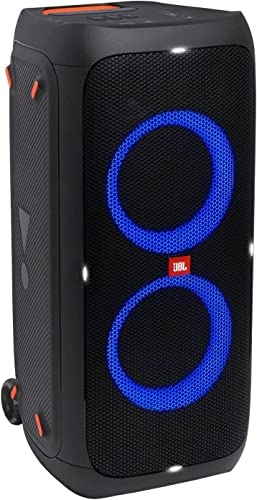
JBL Partybox 310
Buyers who want a portable, high output party speaker with a light show, battery operation, and karaoke features for indoor or outdoor gatherings.
Read the JBL Partybox 310 review →Questions Buyers Ask
JBL PartyBox 330
See the current listing, price and included accessories.
About This Review
Mandrillis Team
The Mandrillis editorial team researches and compares audio and music gear using manufacturer documentation, verified specs and real buyer feedback, so you can make a confident purchase without wading through marketing claims.
Read our full research methodology.