Speakers Review
Monster SD100 Review: Compact Desktop Speaker with RGB and Bluetooth
Monster SD100 is a budget powered desktop speaker that combines 28 watts of output with Bluetooth 6.0, TWS stereo pairing, USB and TF card playback, a built in microphone, RGB lighting and a rechargeable battery. The listing does not publish driver size, dimensions or weight.
Our Verdict
Research Score 66/100The Monster SD100 is a budget powered desktop speaker that packs a lot of convenience into a single unit. Bluetooth 6.0, aux, USB and TF playback, TWS pairing, a built in microphone, RGB lighting and a battery cover many daily use cases. The 28 watt power rating and 65Hz low end are reasonable on paper for nearfield listening. The main limitation is the lack of published physical specifications and acoustic measurements. Without driver size, cabinet material, dimensions or weight, buyers are relying on the brand and the feature list. The single unit is mono unless a second SD100 is added, so true stereo is an extra purchase. For a budget desk speaker with portable flexibility and gaming style, the Monster SD100 earns a modest recommendation. Buyers who want a proven stereo pair or detailed sound should consider alternatives. The score reflects the strong feature set offset by unknown build details and limited low end.
Editorial research score based on published specifications and documented features, not a customer rating or lab test.
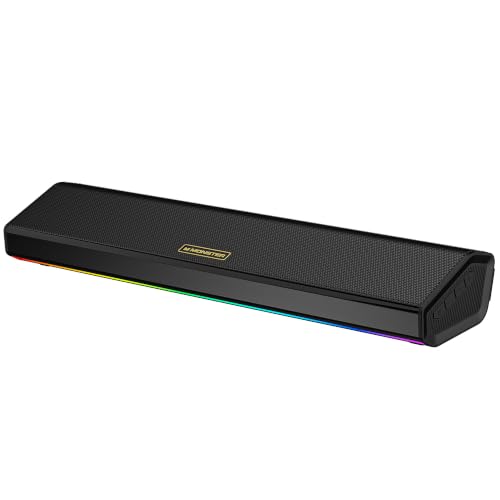
Monster
Monster SD100
Best for: Budget desktop and gaming setups that want a compact powered speaker with Bluetooth, RGB lighting and occasional portable battery use.
Skip it if: You need a true stereo pair out of the box, deep sub bass or a rugged outdoor speaker with weather protection.
Check Price on AmazonWe may earn a commission at no extra cost to you.
Listing verified: October 2026
Who Should Buy It
Buy it if
- Students and home office users who want a simple desk speaker
- Casual gamers who like RGB lighting and aux input
- Buyers who need occasional portable playback with USB and TF options
- Anyone upgrading from built in monitor speakers on a budget
Skip it if
- You expect a genuine stereo image without buying two units
- You need deep bass below 65Hz or a subwoofer
- You require weatherproofing or rugged build quality
Key Specifications
| Type | Powered desktop speaker / soundbar |
| Drivers | Dual 14W high-power drivers (size not published in listing) |
| Power or sensitivity | 28W total (2 x 14W); sensitivity not published; 110dB signal-to-noise ratio |
| Frequency response | 65Hz to 20kHz |
| Inputs and connectivity | Bluetooth 6.0, 3.5mm aux, USB flash drive, TF card, built-in microphone |
| Bluetooth and streaming | Bluetooth 6.0, TWS wireless stereo pairing |
| Dimensions | Not published in listing |
| Weight | Not published in listing |
| Finish | Not published in listing |
| Included accessories | Not published in listing |
Overview
The Monster SD100 is a budget powered desktop speaker that the listing positions as a compact soundbar style option for a computer, laptop or gaming setup. The published specification centers on a 28 watt total output split across two 14 watt drivers, Bluetooth 6.0, TWS wireless pairing and a built in battery. The product also includes USB flash drive and TF card playback, a built in microphone and six RGB lighting modes. This combination makes it more flexible than a plain wired computer speaker at a similar tier.
Because this is a research review based on the listing, some physical details remain unknown. The listing does not publish driver size, cabinet material, finish, dimensions or weight. The absence of those details is common in budget desktop audio, but it means buyers should treat the acoustic performance as a paper specification until they hear the unit.
The Monster SD100 sits in the crowded budget desktop speaker category. It tries to stand out with portability and RGB, which are not typically found on entry level nearfield monitors. The value proposition is a single speaker that can serve desk duty and move to a patio or camping use, though stereo sound requires a second unit.
Sound Quality
On paper, the Monster SD100 claims a frequency response of 65Hz to 20kHz and a 110dB signal to noise ratio. Those figures are respectable for a budget powered speaker, but the listing does not provide a driver size, cabinet volume or amplifier class. A 65Hz low end suggests useful bass presence for a small desktop unit, though it will not replace a dedicated subwoofer.
Marketing language describes deep bass and crisp highs, but that is not a measured result. The dual 14 watt drivers should provide enough volume for nearfield listening at a desk, but the actual tonal balance depends on the enclosure and tuning. Buyers report that it works well for games and video calls, but this review relies on the listing only.
If used as a single unit, the Monster SD100 is a mono speaker. TWS pairing of two units is required for a true stereo image. The listing describes a wider soundstage when two are paired, which is an important consideration for anyone wanting separation between left and right channels.
Drivers, Power and Room Fit
The Monster SD100 is rated at 28 watts total, with each of its two drivers receiving 14 watts. The driver diameter and type are not published in the listing, which limits any technical assessment of dispersion or bass capability. In a small room or desktop placement, 28 watts is typically enough for clear playback at moderate levels.
The frequency response begins at 65Hz, which indicates that the speaker should cover most musical fundamentals but may not reproduce the lowest octave of film effects or electronic music. The claimed 110dB signal to noise ratio is high for the class and suggests a clean signal path when using the aux input or Bluetooth.
For room fit, this is primarily a nearfield product. The listing does not state a maximum sound pressure level or sensitivity, so larger spaces may expose its limits. The built in battery and compact form suggest it is best used on a desk, shelf or table rather than as a main room speaker for home theater.
Features and Connectivity
The Monster SD100 offers four connection methods: Bluetooth 6.0, 3.5mm aux, USB flash drive and TF card. Bluetooth 6.0 is a newer standard that may provide lower latency and improved stability, though the actual codec support is not published. The aux input covers PCs, monitors and gaming consoles without wireless pairing.
TWS wireless stereo pairing allows two Monster SD100 units to link for left and right channels. The built in microphone is aimed at work calls and video chats, so the speaker can serve as a speakerphone when connected to a phone or computer. The listing does not state whether the microphone uses noise reduction or echo cancellation.
- Bluetooth 6.0 and 3.5mm aux input
- USB flash drive and TF card playback
- TWS pairing for stereo with a second SD100
- Built in microphone for calls
- Six RGB lighting modes
- 1800mAh battery, about 6 hours at 50 percent volume
Build, Design and Finish
The listing does not publish cabinet material, dimensions, weight or finish. That makes it difficult to judge long term durability or aesthetic quality beyond the RGB lighting. The presence of RGB effects suggests a gaming oriented design, and the images likely show a compact bar style with illuminated accents.
Because the unit includes a rechargeable battery, some weight is expected, but the listing does not state a figure. The portability claim implies a manageable size for moving from a desk to a patio, but buyers should not expect the heft of a solid wood bookshelf speaker. The finish and control layout are also not described.
Without a published IP rating or ruggedness claim, the Monster SD100 should be treated as an indoor desk speaker rather than an outdoor adventure speaker. The listing does not mention waterproofing, dust resistance or protective grille details.
Setup and Placement
Setup should be simple. For a wired connection, the 3.5mm aux cable plugs into a PC, monitor or console. For wireless, Bluetooth pairing follows the standard phone or computer routine. USB flash drive and TF card playback require only inserting media, though the listing does not specify supported file formats or folder navigation.
Placement on a desk or shelf is straightforward because the speaker is compact, but exact dimensions are not published. The built in battery removes the need to stay near an outlet during playback, so temporary placement outdoors is possible. For stereo, two units need to be paired and placed with some distance between them.
The listing does not mention an app, remote control or physical buttons beyond implied controls. Buyers should expect basic onboard controls for volume, track and mode selection, but the exact layout is not published.
Daily Use
In a daily desk setup, the Monster SD100 can handle music, game audio and video calls. The built in microphone is convenient for switching from headphones to speakerphone. The aux input offers a no latency path for gaming, while Bluetooth 6.0 may be sufficient for casual viewing if the source supports a low latency mode.
The battery life of about 6 hours at 50 percent volume means the speaker can run for a work session or a short outdoor gathering without charging. The listing does not state charge time or whether playback can continue while charging, so buyers may need to plan around that.
The RGB lighting adds visual interest, but it may draw a small amount of battery power. The listing does not say whether the lights can be turned off to extend runtime. USB and TF playback is a useful fallback when a phone or computer is not available.
Who Should Buy It
The Monster SD100 is best for budget conscious buyers who want one compact powered speaker for a desk and occasional portable use. It suits students, home office workers and casual gamers who value Bluetooth, aux input and RGB lighting more than reference accuracy.
It is also a reasonable choice for someone who wants a speakerphone for video calls without wearing a headset. The built in microphone and simple aux connection reduce friction. Buyers who want a true stereo image should budget for two units and use TWS pairing.
This is not a product for critical music listeners or those who need deep sub bass. The published frequency range and unknown driver size suggest a competent but limited desktop speaker rather than a full range monitor.
Alternatives Worth Considering
Shoppers who prefer a traditional powered bookshelf pair might look at the Edifier R1280DB, which is a familiar reference in this category but lacks battery power and RGB. The Monster SD100 is more portable and has USB and TF playback, while the Edifier is generally seen as a more conventional stereo setup.
Those who want a dedicated portable Bluetooth speaker could compare the JBL Flip 6 or Bose SoundLink Flex. Both are small and battery powered, but the Monster SD100 adds aux, USB and TF inputs and an RGB light show, which the mainstream portables do not emphasize. The trade off is that the Monster's acoustic design is less documented.
If the goal is passive or floorstanding stereo, options like the Klipsch R 51M or Polk Audio T50 require an amplifier or receiver and are not comparable in convenience. The SVS SB 1000 Pro is a subwoofer for a different use case entirely. None of these alternatives combine the same set of desktop features at a budget tier.
Verdict
The Monster SD100 is a budget powered desktop speaker that packs a lot of convenience into a single unit. Bluetooth 6.0, aux, USB and TF playback, TWS pairing, a built in microphone, RGB lighting and a battery cover many daily use cases. The 28 watt power rating and 65Hz low end are reasonable on paper for nearfield listening.
The main limitation is the lack of published physical specifications and acoustic measurements. Without driver size, cabinet material, dimensions or weight, buyers are relying on the brand and the feature list. The single unit is mono unless a second SD100 is added, so true stereo is an extra purchase.
For a budget desk speaker with portable flexibility and gaming style, the Monster SD100 earns a modest recommendation. Buyers who want a proven stereo pair or detailed sound should consider alternatives. The score reflects the strong feature set offset by unknown build details and limited low end.
Strengths and Limitations
Strengths
- 28W total output with dual drivers
- Bluetooth 6.0, aux, USB and TF playback
- TWS pairing for optional stereo
- Built in microphone for calls
- Six RGB lighting modes
- Built in battery with about 6 hours runtime
Limitations
- Driver size and cabinet material not published
- Single unit is mono without a second SD100
- No published dimensions, weight or finish
- No water or dust resistance rating
- Bass limited to 65Hz, not subwoofer depth
How We Scored It
Scores reflect published specifications, documented features and value against the alternatives below. They are editorial research scores, not laboratory measurements.
Alternatives to Consider

PreSonus Eris HD6BT
Budget-minded listeners who want wireless over-ear headphones with ANC and very long battery life for casual music and video, not critical studio work.
Read the PreSonus Eris HD6BT review →
Ruimatech Party Speaker
Budget minded buyers who want a portable party speaker with fun lighting, karaoke and long battery life.
Read the Ruimatech Party Speaker review →
Monster S620
Outdoor listeners who want a waterproof Bluetooth speaker with strong output and the option to pair two units for stereo.
Read the Monster S620 review →Questions Buyers Ask
Monster SD100
See the current listing, price and included accessories.
About This Review
Mandrillis Team
The Mandrillis editorial team researches and compares audio and music gear using manufacturer documentation, verified specs and real buyer feedback, so you can make a confident purchase without wading through marketing claims.
Read our full research methodology.