Speakers Review
SVS 3000 Review: Compact Dual 8 Inch Subwoofer
The SVS 3000 packs dual opposing 8-inch drivers and an 800 watt RMS Sledge amplifier into a sealed 10-inch cabinet. The listing highlights a 50 MHz DSP and smartphone app for crossover, EQ, and room gain control. This review evaluates the published specifications, design details, and likely fit for compact audio setups.
Our Verdict
Research Score 84/100The SVS 3000 is a compact sealed subwoofer that focuses on high power and app-driven tuning rather than publishing a complete set of acoustic measurements. Dual opposing 8-inch drivers and an 800 watt RMS amplifier suggest strong output for a cabinet this size, while the 50 MHz DSP and three-band parametric EQ offer meaningful room correction. Because frequency response, physical inputs, and weight are not published in listing, buyers must tolerate some unknowns. For small to medium rooms where space is tight and controlled bass is valued, the SVS 3000 is a convincing mid-range option. Listeners who demand full specification transparency or ported low-end extension should look elsewhere.
Editorial research score based on published specifications and documented features, not a customer rating or lab test.

SVS
SVS 3000
Best for: Compact setups that need high-output subwoofer bass extension with app-based tuning.
Skip it if: You need a subwoofer with published physical inputs, frequency response, or a larger driver array for very large rooms.
Check Price on AmazonWe may earn a commission at no extra cost to you.
Listing verified: October 2026
Who Should Buy It
Buy it if
- Small to medium room listeners wanting deep bass from a compact cabinet
- Users who like app-based crossover, EQ, and room gain control
- Home theater and music listeners who accept sealed subwoofer transient behavior
- Buyers who prioritize a clean piano gloss white finish
Skip it if
- You need a ported subwoofer with extremely low tuning for the largest spaces
- You require published dimensions, weight, or connection details before buying
- You prefer physical controls over smartphone app adjustment
Key Specifications
| Type | Active sealed subwoofer |
| Drivers | Dual opposing 8-inch SVS drivers |
| Power or sensitivity | 800 watt RMS, 2,500 plus watt peak power Sledge STA-800D2 amplifier |
| Frequency response | Not published in listing |
| Inputs and connectivity | Not published in listing; smartphone app control described |
| Bluetooth and streaming | Smartphone app control, wireless protocol not published in listing; no audio streaming |
| Dimensions | Compact 10-inch cabinet; exact dimensions not published in listing |
| Weight | Not published in listing |
| Finish | Piano Gloss White |
| Included accessories | Not published in listing |
Overview
The SVS 3000 is a compact active subwoofer built around dual opposing 8-inch drivers and a sealed cabinet. The listing positions it as a way to get substantial low-frequency output from a cabinet roughly 10 inches wide. Piano Gloss White is the finish named in the product title, which suggests a clean, reflective look for mixed-use rooms. Because this review relies on published listing data, some acoustic specifications remain unstated.
The key published hardware includes an 800 watt RMS Sledge STA-800D2 amplifier with discrete MOSFET output. SVS also lists a 50 MHz Analog Devices DSP as the processing engine for custom frequency response curves. These elements point to a design that prioritizes amplifier control and app-driven tuning over raw cone area. On paper, the SVS 3000 is a compact powered subwoofer for listeners who want deeper bass without a full-size tower or large ported box.
Sound Quality
A sealed subwoofer with dual opposing 8-inch drivers should deliver tight, quick transients when the amplifier and DSP are well matched. The opposing driver layout cancels mechanical energy, which reduces cabinet movement and can keep low-frequency output cleaner at higher volumes. The listing emphasizes crisp, musical transients and slam, but no frequency response graph is provided. Without a published low-frequency extension figure, the exact depth of output cannot be verified from this listing.
The 50 MHz Analog Devices DSP allows custom response curves, which matters because room boundaries often create peaks and nulls in bass. A three-band parametric EQ in the companion app means users can cut a room mode or add a gentle lift around a weak area. This level of adjustment is not common in budget subwoofers. The published app control also includes room gain compensation, which can address boundary reinforcement when the sub is placed near a wall or corner.
Overall, the on-paper sound profile leans toward controlled, articulate bass rather than the exaggerated rumble of a large ported design. SVS does not publish a sensitivity rating or maximum output level, so buyers should treat the power figure as an indicator of headroom rather than a guarantee of room-filling volume. In a small to medium room, the dual 8-inch drivers should be enough for most music and movie demands, but a very large open space may still call for a larger subwoofer.
Drivers, Power and Room Fit
The driver array is the most distinctive part of this product. Two 8-inch SVS drivers are mounted in an opposing configuration inside a sealed 10-inch cabinet. This approach lets the subwoofer generate more radiating area than a single 8-inch driver while keeping the external footprint compact. The listing describes extra-thick MDF side baffles and rigid internal bracing, which are intended to reduce resonance and keep the box motionless during peak playback.
Power is supplied by an 800 watt RMS Sledge STA-800D2 amplifier with a claimed 2,500 plus watt peak power rating. Discrete MOSFET output stages are mentioned, which typically provide stable current delivery for difficult low-impedance loads. The combination of high amplifier power and a sealed alignment should produce clean output down to whatever low-frequency limit the DSP allows, but the listing does not state that limit. Room fit is helped by the compact width, but exact dimensions beyond the 10-inch cabinet description are not published.
For a subwoofer, room fit also depends on placement flexibility and boundary gain. Sealed cabinets are often easier to place near walls than ported boxes because they roll off more gently and have no port turbulence. The SVS 3000 should work on a side wall, in a corner, or next to a media console, assuming the physical depth is manageable. However, the listing does not publish weight, so buyers should confirm that a shelf or stand can support the unit if floor placement is not possible.
Features and Connectivity
The most notable feature is the SVS Subwoofer DSP smartphone app. According to the listing, the app provides volume control, crossover adjustment, a three-band parametric EQ, polarity, room gain, and custom preset profiles. Those presets are said to be optimized for music, movies, gaming, and more. Having these tools in an app means the subwoofer can be set up without reaching behind the cabinet, which is a meaningful convenience for a compact sealed design.
The listing does not publish the physical input panel layout, so it is unclear whether the SVS 3000 offers speaker-level inputs, line-level RCA, XLR, or a wireless receiver. The smartphone app implies some form of wireless communication, but the listing does not name a Bluetooth or Wi-Fi protocol. There is no mention of streaming audio, and this product is not a portable speaker. Buyers should treat it as a powered subwoofer that will likely connect to an AV receiver or integrated amplifier through a standard subwoofer output, though the exact connection type remains unpublished.
- 800 watt RMS, 2,500 plus watt peak power Sledge STA-800D2 amplifier
- 50 MHz Analog Devices DSP with custom frequency response curves
- Smartphone app with parametric EQ, crossover, polarity, and room gain
- Custom presets for music, movies, gaming, and more
- Sealed dual opposing 8-inch driver configuration
Build, Design and Finish
SVS uses extra-thick MDF side baffles and rigid internal bracing, according to the listing. These materials are intended to create a resonance-free environment that remains motionless at peak playback levels. The sealed cabinet design reduces the size and removes the need for a port tube, which often simplifies internal air management. The Piano Gloss White finish is the only finish named in this listing, and it gives the subwoofer a high-contrast look that can blend with light-colored rooms or stand out as a design accent.
A gloss finish can show fingerprints and dust more readily than matte black woodgrain, so owners may need to wipe it down regularly. The listing does not mention any protective coating or included cleaning cloth. There is no published weight, but the dense MDF and large amplifier heat sink likely add heft. Buyers who plan to move the subwoofer often should note that gloss finishes can be more prone to micro-scratches if handled roughly.
The overall build approach seems focused on rigidity and cabinet quietness rather than maximum output per cubic foot. The dual opposing driver layout reduces vibration, which allows a lighter internal structure than a single forward-firing driver would need. Still, SVS has a reputation for well-braced enclosures, and the listing calls out specific construction details that align with that reputation.
Setup and Placement
Setup appears to center on the companion smartphone app. The listing says that all adjustments can be made from the favorite seat, which implies that the subwoofer pairs with a phone or tablet through an unpublished wireless method. A typical setup flow would involve connecting the subwoofer to a power source and the source component, then using the app to set volume, crossover, and phase. However, the listing does not detail the physical wiring steps or whether the app provides an automatic room correction routine.
Placement is made easier by the compact 10-inch cabinet dimension. Sealed subwoofers often tolerate corner placement better than ported designs, though corner placement will still increase bass output and may require the app's room gain control. Because exact height, width, and depth are not published, buyers should plan for a cube-like enclosure that may be deeper than a typical bookshelf speaker. The lack of published weight also means that wall mounting is not something this listing supports.
For best results, a subwoofer should be placed where the bass response is most even across the listening area. The app's parametric EQ can help address a peak or null once the subwoofer is located. Users may need to run test tones and adjust the three-band EQ by ear, which is more involved than an automated room correction system. The listing does not describe any included microphone or calibration tool.
Daily Use
Daily operation likely revolves around the app for volume and preset changes. The listing says presets are available for music, movies, gaming, and more, so a user could switch between a music curve with tighter bass and a movie curve with more low-frequency energy. Because the physical controls are not published, the app may be the only way to access advanced settings like polarity or room gain. This is convenient if the phone is nearby but less convenient if the phone battery dies or the app is unavailable.
The sealed cabinet and dual opposing drivers should remain stable during loud movie scenes, which matters for households with hard floors. The listing claims the design stays motionless even at peak playback levels, so the subwoofer is unlikely to rattle across a wood floor. The piano gloss white finish may require occasional dusting to look its best, but otherwise day-to-day use should be simple. One unknown is whether the subwoofer has a standby mode or signal sensing auto-on, as the listing does not mention any such feature.
Owners who prefer a physical volume knob or a wired remote may find the app-dependent control limiting. The listing does not describe a front or rear panel layout, so there is no way to know if basic power and phase switches are accessible on the cabinet. For a mid-range subwoofer, app control is a modern convenience, but it can be a small drawback for users who want instantaneous adjustment without a phone.
Who Should Buy It
The SVS 3000 is best suited to listeners who want strong, controlled bass from a subwoofer that can fit into a tight space. Its compact 10-inch cabinet and sealed dual 8-inch driver layout make sense for small to medium rooms where a large ported box would be intrusive. Buyers who already use a smartphone for music and streaming will likely appreciate the app-based parameter control and custom presets.
Home theater owners who need subwoofer output for movie effects without dominating the room should consider it. The 800 watt RMS amplifier suggests enough headroom for dynamic peaks in moderate spaces. The piano gloss white finish also suits living rooms with light decor, while the sealed alignment is a good match for music listeners who care about transient speed. Buyers who demand a complete published specification sheet should proceed with caution.
Alternatives Worth Considering
Within the same brand, the SVS SB-1000 Pro is a larger sealed subwoofer that may offer more published specifications and a different driver size. It is a natural step up for buyers who want a known low-frequency extension figure and are willing to give up some space. Those who want a ported design for deeper, room-shaking output may look at other SVS models or competing ported subwoofers, but the listing does not publish enough to compare exact numbers.
Speakers like the Polk Audio T50 floorstanding model or the Edifier R1280DB powered bookshelf speaker are not subwoofers, so they will not replace the dedicated low-frequency channel the SVS 3000 provides. The Klipsch R-51M and ELAC Debut 2.0 B5.2 are passive bookshelf options that would need an amplifier and likely a subwoofer for full-range music. Portable speakers such as the JBL Flip 6 or Bose SoundLink Flex are entirely different categories and should not be considered for home theater bass. For a compact powered subwoofer with app tuning, the SVS 3000 is a focused alternative to larger sealed or ported boxes.
Verdict
The SVS 3000 makes a strong on-paper case for a compact, app-controlled subwoofer. Dual opposing 8-inch drivers, an 800 watt RMS amplifier, and a 50 MHz DSP are serious specifications for a cabinet this small. The sealed design and rigid bracing point toward clean, articulate bass rather than boomy low-end, and the piano gloss white finish adds a premium visual touch. But the listing leaves out frequency response, physical inputs, weight, and exact dimensions, so some buying decisions must be made with incomplete information.
At a mid-range price tier, the SVS 3000 competes with larger subwoofers that may publish more complete performance data. Its value depends on how much weight a buyer places on compact size, app-based DSP, and brand reputation. For small to medium rooms, it is likely to deliver satisfying output without taking up a large footprint. Listeners who demand full specification transparency or maximum extension for very large spaces may prefer a larger ported subwoofer or a more thoroughly documented sealed model.
Strengths and Limitations
Strengths
- Dual opposing 8-inch drivers in a compact sealed cabinet
- 800 watt RMS Sledge STA-800D2 amplifier with high peak power
- 50 MHz Analog Devices DSP for custom response curves
- Smartphone app with parametric EQ, crossover, and room gain
- Extra-thick MDF side baffles and rigid internal bracing
- Piano gloss white finish for a clean look
Limitations
- Exact frequency response not published in listing
- Physical inputs and weight not published in listing
- Smartphone app may be needed for advanced tuning
- Mid-range price tier without published room-fill data
- No published included accessories
How We Scored It
Scores reflect published specifications, documented features and value against the alternatives below. They are editorial research scores, not laboratory measurements.
Alternatives to Consider

ELAC Debut Reference B6.2
Buyers who want a visually distinctive passive bookshelf speaker with a claimed refinement of the ELAC Debut formula.
Read the ELAC Debut Reference B6.2 review →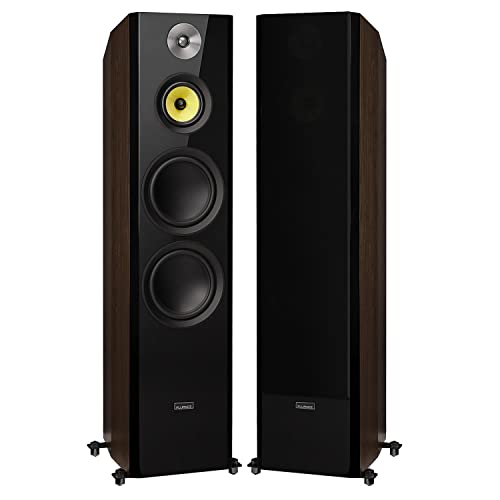
Fluance Signature 3-Way
Stereo music and home theater listeners with an amplifier who want a passive three-way tower with dual woofers and a walnut finish.
Read the Fluance Signature 3-Way review →
SVS SB-2000 Pro DSP
Buyers who want a compact, app-tunable sealed subwoofer for music and home theater, according to the published power and driver details.
Read the SVS SB-2000 Pro DSP review →Questions Buyers Ask
SVS 3000
See the current listing, price and included accessories.
About This Review
Mandrillis Team
The Mandrillis editorial team researches and compares audio and music gear using manufacturer documentation, verified specs and real buyer feedback, so you can make a confident purchase without wading through marketing claims.
Read our full research methodology.