Studio Gear Review
ADAM Audio A7V Review: DSP Monitor With Four Band Room EQ
The ADAM Audio A7V in white is a DSP based studio monitor with an HPS waveguide, a mineral stone fiber woofer and four bands of room adaptation EQ offering more than 100 tuning options. This review examines what the product listing states, what it leaves unsaid, and who the monitor realistically suits.
Our Verdict
Research Score 83/100The ADAM Audio A7V presents a clear engineering story even though its listing is short on numbers. The HPS waveguide promises wide horizontal and tight vertical dispersion, the mineral stone fiber woofer is designed for high output with low distortion, and the DSP based electronics bring four bands of room adaptation EQ with more than 100 combinations. That toolkit is aimed at serious mixing in imperfect rooms. The problem is everything the listing omits: woofer size, tweeter type, amplifier power, frequency response, inputs, dimensions and weight are all absent. Buyers who confirm those details from the manufacturer will likely find a capable mid-range monitor. Buyers who rely on the listing alone are asked to trust the brand rather than the data.
Editorial research score based on published specifications and documented features, not a customer rating or lab test.

ADAM Audio
ADAM Audio A7V
Best for: Mix engineers and producers who want a DSP equipped monitor with real room adaptation controls and are willing to confirm the missing specifications elsewhere.
Skip it if: You need the full specification published before buying or you want an analog only monitor with no DSP in the signal path.
Check Price on AmazonWe may earn a commission at no extra cost to you.
Listing verified: October 2026
Who Should Buy It
Buy it if
- Producers working in untreated or awkward rooms who need adjustable EQ
- Mix engineers who value controlled dispersion for a stable sweet spot
- Studio owners who want a white monitor to match a light workspace
- Buyers upgrading from entry level monitors toward a professional tier
Skip it if
- You cannot find the woofer size, power and response figures and need them to decide
- You distrust DSP in a monitoring chain
- Your budget only stretches to one unit and you need a stereo pair
Key Specifications
| Type | Active studio monitor with DSP based electronics and HPS waveguide, white finish, sold as a single unit |
| Woofer | A Series woofer made from a baked blend of mineral stone fibers; diameter not published in listing |
| Tweeter | Not published in listing (mounted in an HPS waveguide) |
| Power | Not published in listing |
| Frequency response | Not published in listing |
| Inputs | Not published in listing |
| Room controls | Four bands of room adaptation EQ (Bass, Desk, Presence, Treble) in predefined steps, more than 100 tuning options |
| Dimensions | Not published in listing |
| Weight | Not published in listing |
| Included accessories | Not published in listing |
Overview
The ADAM Audio A7V is the white finish version of the A Series monitor from ADAM Audio, and the listing presents it as a single unit rather than a pair. The product listing is brief and conceptual, concentrating on four design ideas: the HPS waveguide, the mineral stone fiber woofer, DSP based electronics and a four band room adaptation EQ. It reads as a summary of a design philosophy rather than a specification sheet.
That approach leaves a reviewer with a lot to say about how the monitor is meant to work and very little to say about measurable figures. The listing does not state the woofer diameter, the tweeter type, the amplifier power, the frequency response, the inputs, the dimensions or the weight. Each of those gaps is noted in the relevant section below rather than filled with assumptions.
What the listing does establish is intent. This is a monitor built around controlled dispersion, a stiff and light woofer cone and digital tuning, aimed at people who mix in rooms that are not acoustically perfect. At a mid-range price tier for a single unit, it sits toward the upper end of what project studios typically spend.
Accuracy and Sound Signature
The listing describes the HPS waveguide, short for high frequency propagation system, as a way of dispersing sound with controlled consistency: broad in the horizontal axis and tightly focused in the vertical plane. In practice that means two people sitting side by side at a desk hear a similar tonal balance, while reflections from the desk surface and ceiling are reduced because less high frequency energy is aimed at them. Those reflections are a major cause of smeared imaging in small rooms.
The woofer is built from a blend of mineral stone fibers baked together, which the listing says creates a lightweight but highly stable cone. Stiffness and low mass are the two properties that let a cone start and stop quickly, and the stated result is high output with low distortion and a clean low end. The listing does not publish how low that low end extends.
Because the electronics are DSP based, the crossover and the voicing are set digitally. The listing argues that this provides greater tuning precision and better predictability than analog only speakers, and that logic holds: digital filters do not drift with component tolerances. Buyers report that DSP controlled monitors from this brand tend to sound detailed and even, though with no published response figures the listing offers nothing numerical to back the impression.
Drivers, Amplification and Power
The woofer material is the one driver detail the listing commits to. A Series woofers use a unique blend of mineral stone fibers baked into a cone, which ADAM Audio positions as a lightweight, stable alternative to paper, polypropylene or woven composites. A material that resists flexing at high excursion keeps the midrange clean when the monitor is pushed, which is the stated goal of high output with low distortion.
The woofer diameter is not published in the listing, and neither is the tweeter type. The HPS waveguide is named, which tells us how the tweeter's output is shaped, but not what kind of tweeter sits inside it. The listing also does not state whether the monitor is a two-way or a three-way design.
Amplifier power is not published either. The listing says only that the electronics are DSP based and that this delivers tuning precision and predictability, so there is no wattage, no amplifier class and no maximum sound pressure figure to quote. Readers should obtain the full specification from the manufacturer before comparing the ADAM Audio A7V to monitors that publish those numbers.
Room Fit, Placement and Controls
Room adaptation is where this listing is most specific. Four bands of equalization are provided: Bass, Desk, Presence and Treble, each adjustable in predefined steps, with more than 100 possible combinations in total. The listing explicitly ties these controls to the acoustic problems that come from speaker placement, such as bass build up near walls and the comb filtering that a desk surface causes.
The Desk band is the standout because it targets a problem most monitors ignore. A monitor sitting on or just above a desk suffers a dip and a bump in the lower midrange as the direct sound and the desk reflection combine, and a filter designed for that region can tame the effect without touching the rest of the response. The Presence and Treble bands handle brightness and air, while Bass addresses boundary gain.
Controlled vertical dispersion from the HPS waveguide reduces the desk and ceiling reflections in the first place, so the EQ has less to fix. The listing does not publish dimensions, so planning the physical fit on a desk or on stands requires outside data, and it does not mention whether the EQ is set with physical switches, a menu or software.
- Four EQ bands: Bass, Desk, Presence and Treble
- Each band adjustable in predefined steps
- More than 100 tuning combinations in total
- HPS waveguide reduces desk and ceiling reflections
- Dimensions not published, so check desk fit separately
Build, Design and Finish
The white finish is the single cosmetic detail the listing specifies, and it is the reason this variant exists alongside the standard dark version. A white cabinet suits bright studios, home offices and content production rooms where black boxes look heavy on camera. Beyond the color, the listing does not describe the cabinet material, the port arrangement or the front panel layout.
Build quality has to be inferred from the engineering choices. A baked mineral fiber cone, a machined waveguide and a DSP controlled amplifier section are not the ingredients of a budget product, and they imply a monitor assembled to tighter tolerances than entry level designs. The listing offers no statement about the enclosure, bracing or hardware.
Weight and dimensions are not published, which matters for anyone planning stands, wall mounts or a shelf. Treat the physical specification as unknown until the manufacturer data sheet is consulted.
Connectivity and Inputs
The listing does not publish the input types on the ADAM Audio A7V. There is no mention of XLR, TRS, RCA or any digital connection, and no statement about network control or a software application for the DSP. This is a surprising omission for a monitor whose main selling point is its electronics.
Given that the design is DSP based, the DSP must receive signal from some analog or digital input and convert it internally, but the listing does not say which inputs exist. Buyers connecting from an audio interface over balanced cable, or from a digital source, should verify compatibility before purchase.
Connectivity scores suffer here not because the monitor is necessarily limited but because the listing gives nothing to assess. A buyer who needs a specific connection type has no way to confirm it from the product listing alone.
Setup and Daily Use
Setting up a DSP monitor with four band room EQ is a different experience from unboxing a monitor with a single high frequency trim. The sensible sequence is to position the monitors, play familiar material, then work through the Bass, Desk, Presence and Treble bands one at a time. The predefined steps keep the process from becoming an endless hunt, and the number of combinations means most desks and walls can be accounted for.
Once tuned, the appeal of DSP is that the settings stay put. Analog potentiometers drift and get knocked, while digital settings return the same curve every session. Buyers report that this consistency is one of the practical advantages of monitors in this class, especially in shared rooms where more than one person uses the system.
ADAM Audio's listing does not mention a power switch location, standby behavior, included cables or a quick start guide. Those practical details, along with the inputs, are among the things to check in the full documentation.
Who Should Buy It
The monitor suits mix engineers and producers who work in real rooms with desks, nearby walls and uneven treatment, and who want tools to compensate rather than a monitor that assumes an ideal space. The four band EQ with a dedicated Desk band is tailor made for the near wall, desk mounted setups that most project studios actually use.
It also suits people who value a stable stereo image across the width of a desk. The HPS waveguide's broad horizontal and narrow vertical pattern is designed so that moving the chair a little or inviting a collaborator to sit beside you does not collapse the balance. Content producers who want a white monitor for an on camera studio are a natural fit as well.
It is a poor match for anyone who needs the specification in writing before committing. With woofer size, power, response and inputs all unpublished in the listing, this is a purchase that depends on the brand's reputation and on data gathered elsewhere.
Alternatives Worth Considering
Within the same brand, the Adam Audio T5V is the budget friendly entry point, trading the DSP and mineral fiber woofer for a simpler analog design at a lower tier. Buyers who like the ADAM Audio dispersion approach but do not need the room EQ will find it a sensible starting point.
Across brands, the Kali Audio LP-6 is a popular mid-range monitor known for publishing detailed boundary EQ guidance, and the Yamaha HS5 remains the common reference for a plain, unflattering presentation. The JBL 305P MkII offers a waveguide at an entry price tier. None of these matches the four band DSP EQ described here, but each publishes its basic specification openly.
Buyers who want DSP room correction may also look at monitors that pair with a measurement microphone and software for automatic calibration. The ADAM Audio A7V takes a manual, predefined step approach instead, which some engineers prefer because it keeps them in control of the curve.
Verdict
The ADAM Audio A7V is defined by four strong ideas: controlled dispersion from the HPS waveguide, a stiff and light mineral stone fiber woofer, DSP based electronics and a four band room adaptation EQ with more than 100 combinations. For mixers fighting desks and walls, that combination is exactly the right set of tools, and it places the monitor in the serious mid-range tier rather than among entry level boxes.
The score reflects a listing that tells the story but withholds the numbers. Woofer size, tweeter type, power, frequency response, inputs, dimensions and weight are all unpublished, and a buyer deserves those facts before spending at this tier on a single unit. If the manufacturer's full specification confirms what the design implies, the ADAM Audio A7V is a compelling choice. Until then, it is a strong concept with a thin listing.
Strengths and Limitations
Strengths
- HPS waveguide for broad horizontal and tight vertical dispersion
- Mineral stone fiber woofer designed for high output with low distortion
- DSP based electronics for tuning precision and predictability
- Four band room adaptation EQ with more than 100 combinations
- White finish option for lighter studio decor
Limitations
- Woofer size, tweeter type and amplifier power are not published in the listing
- Frequency response is not published
- Input types are not published
- Dimensions and weight are not published
- Sold individually, so a stereo pair doubles the outlay
How We Scored It
Scores reflect published specifications, documented features and value against the alternatives below. They are editorial research scores, not laboratory measurements.
Alternatives to Consider

Yamaha HS7 100-Watt 6.5"
Producers who want the well known Yamaha HS7 monitor sound extended by a matched 8 inch subwoofer with phase and cutoff controls.
Read the Yamaha HS7 100-Watt 6.5" review →
KRK S12.4 S12 4 12"
Producers with a medium or large studio who want a 12 inch Kevlar subwoofer that reaches 26 Hz and can be bypassed with a footswitch for mix checks.
Read the KRK S12.4 S12 4 12" review →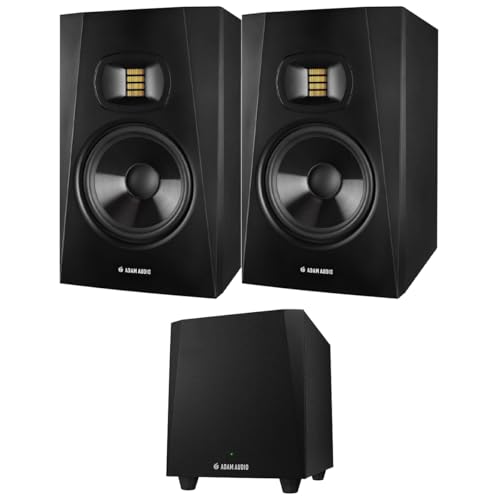
ADAM Audio T-Series T7V 7"
Producers and broadcast editors who want a complete 2.1 nearfield system with a ribbon tweeter and a published response in one box.
Read the ADAM Audio T-Series T7V 7" review →Questions Buyers Ask
ADAM Audio A7V
See the current listing, price and included accessories.
About This Review
Mandrillis Team
The Mandrillis editorial team researches and compares audio and music gear using manufacturer documentation, verified specs and real buyer feedback, so you can make a confident purchase without wading through marketing claims.
Read our full research methodology.