Studio Gear Review
Behringer XENYX QX1832USB 18-Input 3/2-Bus Review: Subgroups and Klark Teknik FX
The Behringer XENYX QX1832USB 18-Input 3/2-Bus pairs six phantom-powered XENYX preamps and six one-knob compressors with subgroup routing, a Klark Teknik effects processor with an LCD, a wireless-ready option and a USB audio interface. This research review weighs those published features against the USB, output and software details the listing does not state.
Our Verdict
Research Score 74/100The Behringer XENYX QX1832USB 18-Input 3/2-Bus offers more live-sound capability than most desks in its lower mid-range tier. The listing confirms six phantom-powered XENYX mic preamps, six one-knob compressors with control LEDs, three subgroups plus the main bus, a Klark Teknik effects processor with an LCD, dual parameters, tap tempo and storable settings, a wireless-ready option and a USB audio interface. What it does not confirm is the USB resolution, the output and aux send complement, monitoring provisions or any bundled software. For a small band, worship team or school that wants compression on every mic and a stereo recording feed, it is a sound buy; studio-focused users should choose a dedicated interface instead.
Editorial research score based on published specifications and documented features, not a customer rating or lab test.
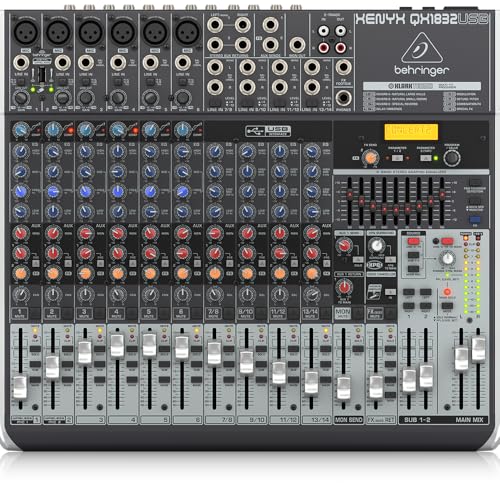
Behringer
Behringer XENYX QX1832USB 18-Input 3/2-Bus
Best for: Small bands, worship teams and schools that need six compressed mic channels, subgroup routing and a Klark Teknik effects engine with a basic USB recording path at a lower mid-range.
Skip it if: You need confirmed multitrack USB recording, documented monitor sends or a bundled DAW, because the listing publishes none of those details.
Check Price on AmazonWe may earn a commission at no extra cost to you.
Listing verified: October 2026
Who Should Buy It
Buy it if
- Bands with up to six vocal and instrument mics that want compression on every mic channel
- Churches and schools that benefit from subgroup faders and tap-tempo effects
- Round-table podcasters who need several compressed mic inputs and a USB feed
- Presenters who plan to add a Behringer digital wireless microphone later
Skip it if
- You record every channel separately over USB
- You need a confirmed number of aux sends for stage monitors
- You want a DAW license included with the purchase
Key Specifications
| Type | 18-input, 3/2-bus analog mixer with USB audio interface and Klark Teknik multi-FX |
| Inputs | 18 inputs including 6 XENYX mic preamps (remaining line and stereo input layout not published in listing) |
| Outputs | 3/2-bus architecture (output connectors and count not published in listing) |
| Preamps | 6 phantom-powered XENYX mic preamps (gain range not published in listing) |
| Resolution | Not published in listing |
| Phantom power | Yes, on the 6 XENYX mic preamps (voltage and switching not published in listing) |
| Connection | USB audio interface (connector type and channel count not published in listing); wireless-ready for an optional Behringer digital wireless system, not included |
| Monitoring | Not published in listing |
| Bundled software | Not published in listing |
| Included accessories | Not published in listing |
Overview
The Behringer XENYX QX1832USB 18-Input 3/2-Bus is a mid-sized analog mixer that bundles six mic preamps, six one-knob compressors, a Klark Teknik effects processor and a USB audio interface into one desk. The 3/2-bus layout means three subgroup paths plus the main stereo bus, which is the structure small bands and churches use to group drums or vocals under one fader.
Behringer prices this desk in the lower mid-range tier, where it undercuts comparable Yamaha and Mackie boards while offering more channels than most of them. The listing leans on the phrases ultra-low noise and high headroom, both of which describe the XENYX preamp design rather than a published measurement.
This is a research review built from the product listing. Important details such as USB resolution, output connectors and bundled software are not published, so the sections below separate what the listing confirms from what a buyer must check in the manual.
Preamps and Sound Quality
Six XENYX mic preamps carry phantom power, and the listing compares them to stand-alone boutique preamps. That is marketing language, but the XENYX design has a long track record on budget and lower mid-range desks, and it is generally regarded as clean enough for live vocals, acoustic instruments and podcast voices. Gain range and equivalent input noise are not published.
Each of the six mic channels also gets a studio-grade compressor with a single knob and a control LED. One-knob compression is a convenience feature rather than a precision tool: it sets threshold and ratio together, so the LED becomes the main way to see how hard the circuit is working. For singers who drift toward the mic and away again, it is a worthwhile safety net.
EQ is not described in the listing for this model, which is unusual because Behringer usually highlights its British-style EQ on XENYX desks. Buyers should assume a channel EQ is present but not count on a specific band layout or a sweepable mid until they have seen the manual. On paper the preamp and compressor package is competitive with the Yamaha MG10XU's D-PRE and one-knob compressor combination, with two more mic channels.
Inputs, Outputs and Routing
Eighteen inputs is a generous count for the tier. Six of them are mic preamps, and the remainder are line or stereo inputs by implication, though the listing does not break down how many stereo pairs or how many quarter-inch versus RCA connections are included. That matters for keyboard players and DJs who need to know how many stereo sources fit.
The 3/2-bus structure provides subgroup routing in addition to the main mix, which is the main reason to choose this desk over a simpler 2-bus board. Subgroups let an engineer pull a whole drum kit or a backing vocal section down with one fader. Aux send count, which determines how many separate monitor mixes are possible, is not stated.
The output side is thin in the listing. Main output connector type, control room outputs, headphone jacks and tape or recording outputs are all unpublished. For a desk aimed at live use, the lack of confirmed monitor and main output details is the biggest hole in the published description.
Features, Monitoring and Software
The Klark Teknik FX processor is the standout feature. It has an LCD display, dual adjustable parameters per effect, a tap function for syncing delays to tempo and storable user settings. Klark Teknik is a respected name in live sound processing, and having its engine on board puts this desk ahead of boards that rely on a fixed list of unnamed presets.
The wireless-ready design is a less common inclusion. The listing describes readiness for a Behringer digital wireless system that is sold separately, which could let a presenter or singer go cable-free without an external receiver taking up a channel. The specific wireless model and frequency band are not named.
Monitoring and software are both unpublished. No headphone output, control room section or bundled DAW is mentioned, so the USB interface should be treated as a bare recording and playback path until the manual says otherwise. Compared with dedicated interfaces that ship with a DAW license, that is a notable omission.
- Klark Teknik multi-FX processor with LCD display
- Dual parameters, tap function and storable user settings
- Six one-knob compressors with control LEDs
- Wireless-ready for an optional Behringer digital wireless system
- USB audio interface for recording and playback
Build, Design and Controls
The listing calls the desk premium but offers no construction details: chassis material, weight, dimensions and fader length are all absent. Behringer's XENYX desks in this size class have typically used a metal chassis with plastic side panels, but nothing in the published description confirms that for the QX1832USB.
Control-wise, the one-knob compressors with LEDs and the LCD on the effects section are confirmed. That LCD is a real usability gain over effects selectors that rely on a printed legend, because it shows the effect name and both parameters at a glance. Channel mute buttons, PFL solo buttons and fader type are not described.
An 18-input desk occupies meaningful desk or rack space. Without published dimensions, buyers planning a fixed installation or a flight case should source the footprint from the manual before ordering.
Connectivity, Drivers and Latency
The USB audio interface is confirmed but undocumented. Bit depth, sample rate and whether the USB path carries only the stereo main mix or individual channels are not stated. Behringer desks of this generation have usually sent a stereo feed over USB, and buyers wanting multitrack recording should assume this is a stereo interface until proven otherwise.
Driver requirements and latency figures are not published. For streaming a service, a rehearsal or a podcast as a stereo mix, latency on a mixer-style interface is rarely a problem, because monitoring happens in the analog domain before the USB conversion. Tracking through computer plugins is a different story and is not a use this listing promises.
The optional wireless connection is a second connectivity path that most rivals do not offer. It only works with the brand's own digital wireless system, which adds cost and a second purchase decision.
Setup and Daily Use
Setup is conventional analog mixing: connect mics to the six preamps, enable phantom power for condensers, assign channels to subgroups, dial in a compressor per vocal and pick an effect on the LCD. The USB connection then sends the mix to a computer for recording or streaming.
In weekly use, the one-knob compressors and the tap-tempo delay are the features that save the most time. A volunteer operator at a church or school can set a compressor by watching the LED and tap a delay in time with the band without touching a menu. Storable user settings on the effects engine mean the preferred reverb comes back each week.
The unknowns in daily use are the monitor paths. With no published aux send count or headphone output, it is impossible to say from the listing how many musicians can receive their own mix, which is a question every band should answer before buying.
Who Should Buy It
Small to mid-sized bands, worship teams, schools and community theaters that need six mic channels with compression and a respectable effects engine at a lower mid-range price are the natural buyers. The subgroup routing and the Klark Teknik processor make it more capable than a simple 10-channel desk.
Podcasters recording several voices in one room also fit, since six compressed mic channels and a USB feed cover a round-table show. Streamers who want to add a wireless microphone later can use the wireless-ready option instead of adding another box.
Anyone who needs multitrack USB recording, confirmed monitor sends or a bundled DAW should look elsewhere or wait for documentation. The listing does not state those features, and the price advantage disappears if a separate interface is needed.
Alternatives Worth Considering
The Yamaha MG10XU offers D-PRE preamps, one-knob compressors and SPX effects in a metal chassis, but with fewer mic channels and no subgroups. It is the pick for buyers who value a documented noise specification over channel count.
Within Behringer's own line, the XENYX X2442USB adds a fourth subgroup and more inputs, while the QX2222USB trades subgroups for eight mic preamps. Buyers choosing between them should decide whether more mic channels or more bus routing matters for their stage.
For a studio that mainly records one or two sources, a Focusrite Scarlett 2i2 or a PreSonus AudioBox is a simpler purchase with published specifications and software. Neither replaces a live mixing desk, though.
Verdict
The Behringer XENYX QX1832USB 18-Input 3/2-Bus delivers an unusually complete live-sound feature set for its tier: six phantom-powered preamps, six compressors, subgroup routing, a Klark Teknik effects engine with an LCD, a wireless-ready option and a USB interface. Few desks at this price put all of that on one surface.
The listing's silence on USB resolution, outputs, monitoring and software keeps it from scoring higher. Those are all answerable from the manual, but they should be answered before purchase rather than after.
As a live desk for a small band or a church that also wants a basic recording path, it is a sensible lower mid-range buy. As a studio interface, it is not the right tool.
Strengths and Limitations
Strengths
- Six phantom-powered XENYX mic preamps
- Six one-knob compressors with control LEDs
- Klark Teknik effects with LCD, tap function and user presets
- 3/2-bus routing with subgroups
- Wireless-ready for an optional digital wireless system
- USB audio interface built in
Limitations
- USB resolution and channel count are not published
- Output and aux send details are missing from the listing
- No bundled software is mentioned
- Wireless option requires a separately sold Behringer system
How We Scored It
Scores reflect published specifications, documented features and value against the alternatives below. They are editorial research scores, not laboratory measurements.
Alternatives to Consider

Mackie ProFX10 GO
Mobile performers, buskers, event hosts and streamers who need a compact analog desk with effects, Bluetooth and a USB-C recording path that keeps working without a wall outlet.
Read the Mackie ProFX10 GO review →
Yamaha DBR10 700-Watt
Solo performers, DJs, presenters and small events that want a single powered speaker with enough SPL for a modest room and a two-channel mixer built into the back panel.
Read the Yamaha DBR10 700-Watt review →
Behringer XENYX X2442USB 24-Input 4/2-Bus
Churches, schools, rehearsal spaces and full bands that need 24 inputs with subgroup routing, compression and Klark Teknik effects on an analog desk at a lower mid-range price.
Read the Behringer XENYX X2442USB 24-Input 4/2-Bus review →Questions Buyers Ask
Behringer XENYX QX1832USB 18-Input 3/2-Bus
See the current listing, price and included accessories.
About This Review
Mandrillis Team
The Mandrillis editorial team researches and compares audio and music gear using manufacturer documentation, verified specs and real buyer feedback, so you can make a confident purchase without wading through marketing claims.
Read our full research methodology.