Studio Gear Review
Mackie Onyx Review: 16-Channel Analog Board With Multi-Track USB
The Mackie Onyx pairs a 16-channel analog mixing surface with 24-bit / 96 kHz multi-track USB recording, direct-to-SD stereo capture and Bluetooth streaming on a channel strip. This research review weighs the published preamp gain, Perkins EQ and effects engine against the specifications the listing leaves out, so you know what is confirmed before you buy.
Our Verdict
Research Score 79/100On paper the Mackie Onyx is one of the more complete analog mixers in the mid-range tier, because it folds multi-track USB recording, SD card capture and Bluetooth into a 16-channel desk with 60 dB Onyx preamps and a sweepable British style EQ. The listing is strong on headline features but quiet on the details that matter for a purchase decision, including the number of mic channels, phantom power, outputs and monitoring. If you want one analog board that also records a full session, it deserves a close look. If you need confirmed output routing or a documented preamp count, verify those specifics first.
Editorial research score based on published specifications and documented features, not a customer rating or lab test.

Mackie
Mackie Onyx
Best for: Bands, small venues and houses of worship that want to mix a room and capture a multi-track recording from the same 16-channel analog board.
Skip it if: You only need a stereo USB feed or a handful of inputs, because a smaller and cheaper board covers that job with less to carry.
Check Price on AmazonWe may earn a commission at no extra cost to you.
Listing verified: October 2026
Who Should Buy It
Buy it if
- Working bands that want every channel recorded separately for later mixing
- Small venues and churches that need an analog surface with a recording path built in
- Rehearsal spaces that want SD card capture without opening a laptop
- Content creators who want Bluetooth playback on a real channel strip
Skip it if
- You need a documented count of mic preamps before committing
- You mix fewer than eight sources and never record multi-track
- You want a digital mixer with scene recall and tablet control
Key Specifications
| Type | 16-channel analog mixer with multi-track USB recording |
| Inputs | 16 channels (mic versus line split not published in listing) |
| Outputs | Not published in listing |
| Preamps | Onyx mic preamps, up to 60 dB of gain (count not published in listing) |
| Resolution | 24-bit / 96 kHz multi-track over USB |
| Phantom power | Not published in listing |
| Connection | USB to Mac or PC, SD card slot for stereo recording and playback, Bluetooth streaming |
| Monitoring | Not published in listing |
| Bundled software | Not published in listing |
| Included accessories | Not published in listing |
Overview
The Mackie Onyx is a 16-channel analog mixer that the listing describes as a premium board with multi-track USB recording built in. That combination places it in a specific niche, because most analog mixers in this channel count send only a stereo mix to a computer, while the Mackie Onyx promises every channel as its own track. The listing also adds direct-to-SD stereo recording and playback, so the board can capture a show with no computer connected at all.
Mackie positions the Onyx line as a step above its ProFX boards, and the published feature set supports that framing. The mic preamps are the Onyx design with up to 60 dB of gain, the EQ is the Perkins British style circuit with a sweepable midrange, and the effects engine lets the user adjust reverbs and delays rather than pick from fixed presets. Bluetooth streaming arrives on a channel strip, which means a phone source gets the same fader, EQ and routing as a microphone.
This is an editorial research review built from the product listing and from general knowledge of how analog mixers with USB recording work. It does not involve any direct use of the board. Where the listing is silent, such as output counts, phantom power or headphone monitoring, this review says so plainly rather than filling the gap with a guess.
Preamps and Sound Quality
The published specification for the mic preamps is up to 60 dB of gain, which is a useful figure for anyone planning to use dynamic microphones on quiet sources. Broadcast style dynamics and ribbon microphones are gain hungry, and 60 dB gives the operator enough reach to bring those signals to a healthy level without pushing the fader to the top. Mackie has used the Onyx preamp name across its higher tier products for years, and the listing calls the design award-winning, though it does not publish noise or distortion figures.
What the listing does not state is how many of the 16 channels carry a mic preamp. Many boards in this class split the count between mono mic channels and stereo line pairs, so a 16-channel label can mean anywhere from eight to twelve preamps in practice. Buyers who plan to mic a full drum kit plus several vocalists should confirm that count before relying on the Mackie Onyx for the job.
The EQ is the other half of the sound story. A sweepable midrange lets the operator choose the frequency being cut or boosted rather than accepting a fixed center point, which is the single most useful tool for taming a boxy vocal or carving space between guitars. Paired with a high gain preamp, this EQ layout gives the board more shaping power than the fixed three-band sections found on entry level mixers, at least as far as the published description goes.
Inputs, Outputs and Routing
Sixteen channels is the headline input figure, and the recording path captures them as separate tracks over USB at 24-bit resolution and a 96 kHz sample rate. That sample rate is higher than many competing mixers offer on their USB stage, and it gives engineers more headroom for pitch shifting and time stretching in post-production. The listing does not break down how those 16 channels are divided between mono and stereo inputs.
Output routing is where the listing falls short. It does not state the number of main outputs, whether aux or monitor sends are present, or what connector types are used. For a board aimed at live use, the count of aux sends determines how many separate stage monitor mixes can be built, so this is not a trivial omission. Prospective buyers should treat the output complement as unverified until they see a rear panel diagram.
The SD card slot adds a second recording path independent of the USB connection. The published description limits SD capture to stereo, which suits a quick board mix of a rehearsal or a sermon, while the full multi-track goes to a computer. Playback from the card is also supported, so walk-in music or backing tracks can run from the mixer itself without a phone or laptop in the chain.
Features, Monitoring and Software
The onboard digital effect engine is described as robust and user-customizable, with reverbs and delays called out by name. Customizable in this context typically means the operator can adjust decay time, pre-delay or delay repeats rather than scrolling through fixed presets, which makes the effects more usable across different rooms and tempos. The listing does not publish the number of effect algorithms or whether settings can be stored.
Bluetooth streaming is routed directly to a channel strip, which is a more flexible design than feeding wireless audio into a dedicated return. On a channel strip the source has a fader, EQ and access to the same sends as any other input, so a phone playing break music can be EQed for the room and sent to monitors if needed.
Monitoring provisions and bundled software are not stated in the listing. There is no mention of a headphone output, a control room section, or a DAW license, and there is no description of a dedicated driver utility. Those gaps do not mean the features are absent, but they cannot be confirmed from the published data and this review treats them as unknown.
- 24-bit / 96 kHz multi-track recording to Mac or PC over USB
- Stereo recording and playback to SD card without a computer
- User-customizable reverbs and delays in the onboard effects engine
- Bluetooth streaming assigned to a channel strip
- Perkins British style EQ with sweepable midrange on the channel strips
Build, Design and Controls
The listing calls the Mackie Onyx a premium analog mixer but does not describe the chassis material, the weight or the dimensions. Mackie's recent mixer lines have used steel chassis construction, yet that cannot be confirmed for this specific model from the published data, so buyers planning rack or case mounting should check the physical specification separately.
On the control surface, the published feature set points to a traditional analog layout with per-channel gain, a sweepable mid EQ and a dedicated effects section. The presence of a Bluetooth channel and an SD slot suggests added buttons and a small display for transport control, though the listing does not describe the user interface in detail. The absence of a stated fader type or length is another gap worth noting for anyone who mixes by feel.
Connectivity, Drivers and Latency
The USB connection carries multi-track audio to Mac and PC, and the listing specifies 24-bit at 96 kHz for that path. It does not name the USB connector type, the USB generation, or whether the computer return feed is stereo or multi-channel. Multi-channel return would allow a laptop to send click tracks and backing stems to separate channels, which is valuable for bands using playback.
Driver details are absent from the published description. Mac users can usually rely on class compliant operation for mixers of this type, while Windows users typically need a manufacturer driver for stable multi-channel operation and low buffer sizes. Because the listing does not publish latency figures or driver information, this review cannot rate round-trip performance beyond noting that the 96 kHz rate is a point in its favor.
Bluetooth and the SD slot round out the connectivity picture. Bluetooth version and codec are not published, and the SD slot's supported card formats and file types are not described. For most users these details matter less than the USB path, but anyone planning long unattended recordings to card should confirm the file size and capacity limits.
Setup and Daily Use
For a band or venue, daily use revolves around arriving, plugging in and recording without ceremony. The SD card path is the simplest workflow, because a stereo board mix can be captured by pressing record on the mixer itself. When a full multi-track is wanted, a single USB cable to a laptop running any multi-track DAW should pick up all 16 channels, with driver installation likely required on Windows.
The Bluetooth channel strip is a practical convenience in rehearsal rooms, where someone always wants to reference a track from a phone. Because the stream has its own fader and EQ, there is no need to patch a cable or sacrifice a line input. Buyers should still plan for the learning curve of a customizable effects engine, because adjustable parameters take a little longer to dial in than one-button presets.
Who Should Buy It
The clearest customer is a band that plays regularly and wants to turn each show into a multi-track session for later mixing or live album use. The Mackie Onyx promises exactly that from an analog surface, which keeps the live mixing experience familiar while the recording happens quietly in the background. Churches and community halls that record every service share the same need.
Rehearsal studios and small production rooms also fit. The 60 dB preamps, sweepable EQ and 96 kHz capture give those rooms more than a basic board would, and the SD slot handles quick reference recordings without a computer. Streamers who only need two or four inputs will find the channel count excessive, and they should look at compact interfaces instead.
Alternatives Worth Considering
Within Mackie's own range, the ProFX16v3 offers 16 channels with Onyx preamps and USB recording in a more affordable package, though its effects are preset based rather than customizable and it does not list SD card capture. Buyers who want multi-track recording but can live without onboard SD and Bluetooth may find that board covers their needs at a lower tier.
Yamaha's MG16XU is the other obvious comparison. It brings D-PRE preamps, one-knob compressors and SPX effects to a 16-input analog format with USB, and it adds a metal chassis that the Yamaha listing explicitly describes. Its USB stage is a stereo path in the published description, so engineers who need separate tracks per channel will still lean toward the Mackie Onyx.
For anyone open to a digital workflow, a tablet-controlled mixer such as the Behringer X AIR XR18 gives per-channel USB recording and scene recall from a stage box, with the tradeoff that there are no physical faders. The Mackie Onyx remains the choice for operators who want knobs and faders under their hands with recording as a bonus rather than a shift in workflow.
Verdict
Judged on what the listing publishes, the Mackie Onyx is a strong mid-range analog mixer with a recording feature set that few boards in this format match. Multi-track USB at 24-bit / 96 kHz, SD card capture, Bluetooth on a channel strip and a customizable effects engine make a coherent package for groups that mix live and record at the same time.
The missing specifications are the reason the score is not higher. Without a published preamp count, phantom power statement, output list or monitoring description, buyers are asked to trust a brand name for details that matter on a stage. Confirm those points and the Mackie Onyx becomes an easy recommendation for its intended audience.
Strengths and Limitations
Strengths
- Multi-track USB recording at 24-bit / 96 kHz
- Stereo recording and playback direct to SD card without a computer
- Onyx preamps with up to 60 dB of gain
- Perkins British style EQ with a sweepable midrange
- Bluetooth streaming lands on a channel strip, not a hidden aux path
- Customizable onboard reverbs and delays
Limitations
- Listing does not state how many mic preamps the 16 channels include
- Phantom power, output complement and headphone monitoring are not published
- No bundled software or accessories are named in the listing
- Mid-range price asks more than simpler 16-channel analog boards
How We Scored It
Scores reflect published specifications, documented features and value against the alternatives below. They are editorial research scores, not laboratory measurements.
Alternatives to Consider

Yamaha EMX5 12-input
Community groups, schools, worship teams and solo performers who want one box that mixes 12 inputs and powers a pair of passive speakers without a separate amplifier rack.
Read the Yamaha EMX5 12-input review →
Yamaha DXR10MKII
Bands, DJs and venues that want a compact powered speaker with high output and onboard DSP, used as a main or a monitor with a separate mixer.
Read the Yamaha DXR10MKII review →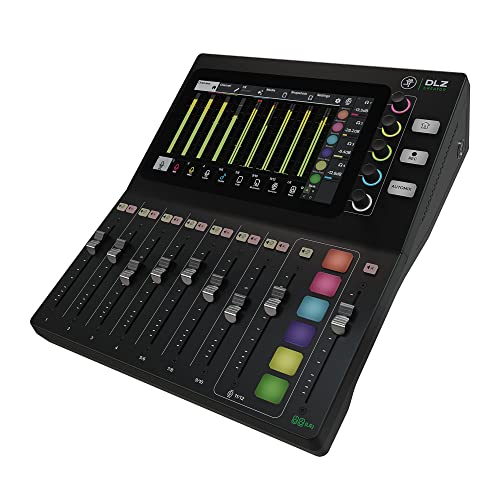
Mackie DLZ
Podcasters and streamers of any experience level who want a touchscreen mixer that manages levels automatically for up to four voices and records to SD card or USB-C.
Read the Mackie DLZ review →Questions Buyers Ask
Mackie Onyx
See the current listing, price and included accessories.
About This Review
Mandrillis Team
The Mandrillis editorial team researches and compares audio and music gear using manufacturer documentation, verified specs and real buyer feedback, so you can make a confident purchase without wading through marketing claims.
Read our full research methodology.