Studio Gear Review
Sennheiser XSW 1-835 Review: Dual Wireless With One-Button Setup
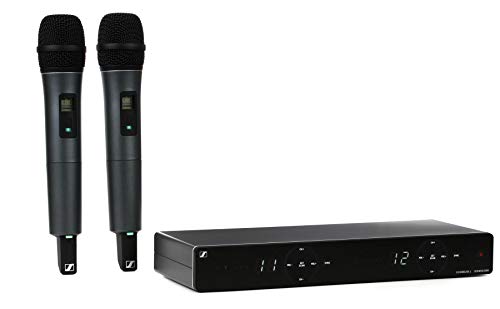
The Sennheiser XSW 1-835 bundles two e835 handheld transmitters with a 10-channel dual receiver that scans and syncs with one button. This review examines what the listing confirms about setup, diversity reception and operating range, where it stays silent on band and battery figures, and who should buy this mid-range system.
Our Verdict
Research Score 76/100The Sennheiser XSW 1-835 is a sensible dual wireless system for singers, speakers and presenters who value simplicity. The e835 capsules give it a respected stage vocal sound, one-button scanning and synchronization remove the usual setup friction, and internal diversity antennas keep the receiver tidy while reducing dropouts. Up to 10 systems can run together, which suits small venues and productions. The listing omits the frequency band, range, battery life, receiver outputs and polar pattern, so buyers must verify the regional variant and read the manual before ordering. For worship teams, schools and duos in a compatible region, it is a dependable mid-range choice.
Editorial research score based on published specifications and documented features, not a customer rating or lab test.
Sennheiser
Sennheiser XSW 1-835
Best for: Worship teams, schools and gigging duos who want two wireless e835 vocal channels with the simplest possible setup.
Skip it if: You need published range and band figures before buying, or you operate outdoors in freezing conditions.
Check Price on AmazonWe may earn a commission at no extra cost to you.
Listing verified: October 2026
Who Should Buy It
Buy it if
- Houses of worship running two vocal or speaking channels
- Schools and community venues with volunteer operators
- Duos and small bands who prefer the e835 sound
- Event companies needing quick setup for presenters
Skip it if
- You cannot confirm the frequency variant is legal in your region
- You need more than 10 simultaneous channels
- A wired pair of e835 microphones would serve your static vocalists
Key Specifications
| Type | Dual-channel UHF wireless handheld system with e835 capsules and a 10-channel receiver |
| Polar pattern | Not published in listing |
| Frequency response | Not published in listing |
| Connection | Wireless UHF to a 10-channel dual receiver with internal diversity antennas; frequency band and receiver outputs not published in listing |
| Phantom power | Not published in listing |
| Max SPL or sensitivity | Not published in listing |
| Controls | 1-button scanning and synchronization, icon-based indicators |
| Mount and stand | Not published in listing |
| Weight | Not published in listing |
| Included accessories | Not published in listing |
Overview
The Sennheiser XSW 1-835 is a dual-channel wireless microphone system that packages two handheld transmitters with e835 capsules and a 10-channel receiver. The listing positions it for singing, speaking and presenting, which is a fair summary of where entry-level professional wireless gets used. It arrives in black and sits in the mid-range price tier.
Sennheiser's XS Wireless 1 series is the company's simplest professional line, designed so that a volunteer or a bandleader can get a clean signal without reading a frequency chart. The listing emphasizes one-button scanning and synchronization, icon-based indicators and internal diversity antennas. Each of those choices trades a little flexibility for a lot of ease.
What the listing does not supply is almost as important as what it does. There is no published frequency band, range figure, battery life, output connector list or capsule polar pattern. This review flags each gap where it matters, because a wireless purchase depends on local spectrum rules as much as on sound.
Sound Quality
The e835 capsule is the sonic heart of this system and the reason many buyers choose it over cheaper no-name wireless. Sennheiser markets the e835 as a stage vocal capsule in its evolution series, and the listing summarizes the result simply as great sound. The capsule is generally described by users as having a clear, slightly forward midrange that sits well in a live mix.
Compared with the Shure SM58 that dominates the category, buyers report the e835 as a touch brighter and more open on top, with a little less of the thick low-mid bump when a singer works close. Neither is better in absolute terms, and plenty of singers have a strong preference one way or the other. The listing does not publish a frequency response for the capsule or the system, so no curve is quoted here.
The wireless link itself should be sonically transparent for stage use. UHF systems in this class generally use companding to fit the audio into the radio channel, and the listing does not describe whether this is an analog or digital transmission scheme. For speech and sung vocals through a PA, the e835 character comes through and the link rarely draws attention to itself.
Pickup Pattern and Noise Handling
The listing does not state the polar pattern of the e835 capsule, so the spec field here reads Not published in listing. Handheld stage vocal capsules of this kind are almost always directional, and the e835 is commonly described as a cardioid design, but treat that as context rather than a published fact for this offer. A directional capsule rejects monitor wedges behind the microphone and improves gain before feedback.
Handling noise matters on a wireless handheld because the performer is holding the transmitter, battery and capsule as one unit. Sennheiser's evolution handhelds are generally regarded as well damped, and buyers report few complaints about thumps when switching hands. Nothing in the listing quantifies this, so it remains a reputation rather than a specification.
On the radio side, the listing highlights internal diversity receiver antennas. Diversity reception uses two antennas and picks the stronger signal moment by moment, which reduces dropouts as a performer moves around a stage. Keeping the antennas internal gives a cleaner appearance at the cost of being unable to relocate or upgrade them.
Build Quality
Housing materials, dimensions and weight are not published in the listing, so the physical description here stays general. The XSW 1 handhelds follow the standard Sennheiser evolution shape, with a grille over the capsule and a body that houses the battery compartment. The receiver is a compact unit with internal antennas and icon-based indicators on the front panel.
The one firm environmental figure in the listing is the operating temperature range of 0 to 40 degrees Celsius, or 32 to 104 degrees Fahrenheit. That covers almost all indoor venues and most outdoor summer events, but a winter outdoor ceremony or a tent in freezing weather falls outside the stated range. Cold also shortens battery life in any wireless transmitter.
Battery type and battery life are not published in the listing, which is a notable omission for a product category defined by batteries. Sennheiser's XSW handhelds have generally run on AA cells, but confirm this in the manual. Buyers should also budget for a padded case, since none is listed.
- Dual-channel receiver with internal diversity antennas
- Two handheld transmitters with e835 capsules
- Operating temperature 0 to 40 C per the listing
- Housing materials and weight not published in listing
- Battery type and life not published in listing
Connectivity and Setup
Setup is the strongest argument for this system. The listing describes 1-button scanning and synchronization, meaning the receiver scans for a clear frequency and then syncs the handheld to it with a single press. Icon-based indicators replace text menus, so a presenter who has never used wireless can read battery and signal status at a glance.
The receiver is described as a 10-channel unit, and the listing says up to 10 systems can be used simultaneously. That is enough for a small theater production or a multi-speaker panel, though real-world capacity depends on local spectrum congestion. The frequency band is not published in the listing, so buyers must confirm that the variant they order is legal where they perform.
Receiver output connectors and transmission range are not published in the listing. Most dual receivers in this class offer balanced outputs for a mixer and sometimes an unbalanced option for a powered speaker, but confirm before buying cables. Without a published range figure, plan for the receiver to be in line of sight with the performers.
Features, Controls and Extras
The listing's feature set is deliberately short: one-button scan and sync, icon indicators, internal diversity antennas and 10-channel capacity. There is no mention of a rackmount kit, a mobile app or network control. For many buyers that absence is a feature, since there is less to configure and less to go wrong.
Transmitter controls such as mute switches, gain settings or lockable power buttons are not described in the listing. Sennheiser handhelds in this line have generally offered a simple power control and a status light, which is appropriate for guest speakers. Check the manual if a lockable mute is essential for your use.
Included accessories are not published in the listing. A dual system of this kind normally ships with a power supply and microphone clips, but neither is confirmed here. Factor in a case, spare batteries and possibly stands when comparing total cost against competing packages.
Use Cases: Vocals, Streaming, Podcasting and Instruments
Singing is the headline use, and two handheld channels suit a lead and backing vocalist, a duo, or two worship leaders sharing a stage. The e835 capsule handles close-miked vocals through a PA with the clarity Sennheiser's evolution line is known for. The dual receiver keeps both channels in one compact box.
Speaking and presenting are the second pillar the listing names. Conference rooms, lecture halls, community meetings and ceremonies all benefit from a handheld that can be passed between speakers without cables. One-button sync means a second presenter can be set up quickly if a replacement transmitter is on hand.
Streaming and podcasting are not the intended use, and a wired microphone such as the Shure MV7 or a USB model like the Samson Q2U is simpler for a desk. Instrument use is limited to what a handheld vocal capsule does reasonably, such as a harmonica or an announcer's cue. Buyers wanting instrument wireless should look at bodypack systems.
Who Should Buy It
Houses of worship, schools, small event companies and gigging duos who want two wireless vocal channels with minimal setup effort are the natural buyers. The Sennheiser capsule gives the system an edge over generic wireless packages, and the one-button workflow keeps volunteers comfortable. Buyers who already like the e835 sound will feel at home.
The lack of published range, band and battery figures means this is not a blind purchase. Confirm the frequency variant for your country and read the manual before committing. Those who need outdoor winter operation or more than 10 simultaneous channels should look at a higher series.
Alternatives Worth Considering
The Shure BLX288/SM58 dual system is the direct rival, offering two SM58 handhelds and a dual receiver at a similar mid-range tier. Its listing publishes range, battery life and band, which this Sennheiser listing does not. Choose by capsule preference and by which brand's published figures you can verify for your region.
Sennheiser's own XSW 1-825 dual system uses the e825 capsule, generally positioned a step below the e835, at a lower cost. For buyers who want a rack-mountable receiver with external antennas, the XSW 2 series adds a metal housing and tunable frequencies. The XSW 1-835 sits in the middle of that ladder.
If wireless is optional, two wired e835 microphones and cables deliver the same capsule sound for far less money and with no batteries to manage. That option suits a static vocalist or a lectern. Wireless pays off when performers move or when cables are a hazard in an aisle.
Verdict
The Sennheiser XSW 1-835 is an approachable dual wireless system that leans on a respected capsule and a one-button workflow. For singers, speakers and presenters who want two channels without a learning curve, it does the job with a sound many engineers prefer to the generic alternatives. The internal diversity receiver and 10-channel capacity are sensible for small venues.
Hard numbers are scarce in the listing, with no band, range, battery life, outputs or polar pattern stated. That does not make the product worse, but it does make verification essential before ordering. Buyers who confirm the frequency variant and accept the limited feature set will get a dependable mid-range system.
Strengths and Limitations
Strengths
- e835 capsules from Sennheiser's evolution vocal series
- One-button scanning and synchronization
- Internal diversity antennas for a tidy receiver
- Up to 10 systems simultaneously
- Icon-based indicators suit non-technical users
Limitations
- Frequency band, range and battery life not published in listing
- Polar pattern and receiver outputs not stated
- Internal antennas cannot be relocated or upgraded
- No case or accessories confirmed
How We Scored It
Scores reflect published specifications, documented features and value against the alternatives below. They are editorial research scores, not laboratory measurements.
Alternatives to Consider

Shure J11
Bands, churches and event companies in regions where 596 to 620 MHz is authorized who need two dependable SM58 wireless channels.
Read the Shure J11 review →
Shure BLX288/SM58 Dual Vocal
Bands, worship teams and event companies that need two dependable wireless SM58 vocal channels in one simple package.
Read the Shure BLX288/SM58 Dual Vocal review →
Sennheiser EW-D 835-S
Venues and performers stepping up from analog wireless who want a clean digital handheld with app-based setup.
Read the Sennheiser EW-D 835-S review →Questions Buyers Ask
Sennheiser XSW 1-835
See the current listing, price and included accessories.
About This Review
Mandrillis Team
The Mandrillis editorial team researches and compares audio and music gear using manufacturer documentation, verified specs and real buyer feedback, so you can make a confident purchase without wading through marketing claims.
Read our full research methodology.