Behringer X AIR XR18 18-Channel vs Fender Quantum LT 16
Quick Verdict
The Behringer X AIR XR18 18-Channel scores 84 and the Fender Quantum LT 16 scores 83, and the right pick depends on scale rather than a clear overall winner. Choose the Behringer X AIR XR18 18-Channel if you are mixing a live band, church or small venue with many microphones at once, using 16 named preamps and remote tablet control with no physical faders. Choose the Fender Quantum LT 16 if you are running a hybrid studio or multi-mic tracking room that wants eight high-gain preamps, MIDI and CV-capable outputs, and a bundled DAW license in one USB-C interface. The Behringer wins on channel count and live mixing flexibility, while the Fender wins on gain headroom and studio software bundle.

| Spec | Behringer X AIR XR18 18-Channel | Fender Quantum LT 16 |
|---|---|---|
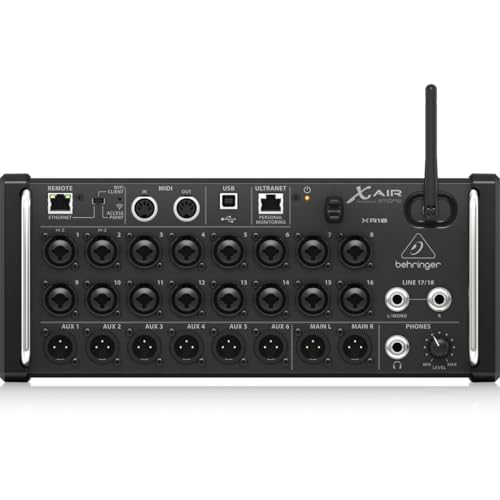
| Type | 18-channel, 12-bus digital rack mixer controlled from iPad or Android tablets | 16-in, 8-out USB-C audio interface with standalone mixer and mic preamp modes |
| Inputs | 18 inputs including 16 Midas-designed programmable mic preamps | 16 inputs: six front-panel XLR/TRS combo inputs and eight rear-panel TRS line inputs with selectable +4 dBu / -10 dBV (the remaining inputs are not itemized in the listing) |
| Outputs | Main: 2 x XLR (aux outputs not published in listing) | 8 outputs: balanced TRS, DC-coupled for CV use, plus a headphone output and 5-pin MIDI out |
| Preamps | 16 Midas-designed, fully programmable mic preamps (gain figure not published in listing) | Eight MAX-HD mic preamps with up to +75 dB of gain |
| Resolution | Not published in listing | Not published in listing |
| Phantom power | Not published in listing | Not published in listing |
| Connection | Integrated tri-mode Wi-Fi router plus 18 x 18 bidirectional USB audio interface | USB-C to Mac or PC, 5-pin MIDI in and out |
| Monitoring | Not published in listing | Balanced TRS outputs and a high-headroom headphone amp (number of headphone outputs not published in listing) |
| Bundled software | Tablet control app implied by the listing but not named | Fender Studio Pro perpetual license with Mustang and Rumble amp plug-ins, plus the Fender Amp and FX Pack in the Fender Studio app on registration |
| Included accessories | Not published in listing | Not published in listing |
Sound Quality
The Fender Quantum LT 16 scores 26 out of 30 for preamps and sound quality, built around eight MAX-HD mic preamps with up to 75 dB of gain. The Behringer X AIR XR18 18-Channel scores 25 out of 30 in the same category, with 16 Midas-designed, fully programmable mic preamps, though the listing does not publish a specific gain figure for them.
Both products are really about capturing and routing microphones rather than generating sound themselves. The Behringer X AIR XR18 18-Channel is a digital rack mixer controlling 18 inputs, while the Fender Quantum LT 16 is a USB-C audio interface built around its MAX-HD preamp design. Neither listing publishes a resolution or sample rate figure, which limits how far a raw sound quality comparison can go.
On preamp count alone, the Behringer X AIR XR18 18-Channel offers twice as many named preamps as the Fender Quantum LT 16's eight. On published gain headroom, the Fender Quantum LT 16's stated 75 dB figure is more specific than anything the Behringer X AIR XR18 18-Channel's listing confirms for its own preamps.
Pickup Pattern and Noise Handling
Neither product has a pickup pattern of its own, since a mixer and an audio interface are agnostic to whatever microphone is plugged into them, and polar pattern belongs to the microphone rather than the preamp. What can be compared instead is noise handling through preamp design, where the Behringer X AIR XR18 18-Channel's 16 Midas-designed preamps and the Fender Quantum LT 16's eight MAX-HD preamps each aim to keep noise low at high gain.
The Fender Quantum LT 16's published 75 dB of gain suggests headroom for quiet sources like ribbon microphones or distant instruments, though the listing does not state its noise floor or phantom power status, which matters for noise handling with condenser microphones. The Behringer X AIR XR18 18-Channel's listing also leaves out phantom power and resolution, so a true noise floor comparison is not possible from the given facts.
For a buyer tracking many sources at once, the Behringer X AIR XR18 18-Channel's larger channel count spreads noise handling across more preamps simultaneously. For a buyer who needs very high gain on a small number of quiet sources, the Fender Quantum LT 16's named 75 dB figure on its eight preamps is the more specific published number.
Build Quality
The Behringer X AIR XR18 18-Channel scores 11 out of 15 for build and design, housed in a rack format that the listing describes as staying on stage while the engineer mixes remotely from a tablet. The Fender Quantum LT 16 scores 10 out of 15, though the listing's own input count raises a question, since it describes eight preamps but only six combo jacks on the front panel.
Neither listing publishes a chassis material, weight or full dimension set for its product. The Behringer X AIR XR18 18-Channel's rack mount design suggests a build intended for permanent installation in a venue, while the Fender Quantum LT 16's desktop-oriented USB-C interface suggests a build intended for a studio desk.
The unexplained gap between the Fender Quantum LT 16's eight stated preamps and its six visible combo jacks is a real question mark for build confidence, since the listing does not clarify where the other two preamps connect. The Behringer X AIR XR18 18-Channel's listing does not raise a similar internal contradiction, even though it also leaves out some physical details.
Connectivity and Setup
The Behringer X AIR XR18 18-Channel scores 9 out of 10 for connectivity and latency, built around an integrated tri-mode Wi-Fi router and an 18 by 18 bidirectional USB audio interface for per-channel recording and playback. The Fender Quantum LT 16 scores 8 out of 10, connecting over USB-C to a computer with 5-pin MIDI in and out for additional gear.
Setup differs significantly between the two. The Behringer X AIR XR18 18-Channel is controlled entirely from an iPad or Android tablet, since the listing confirms there are no physical faders at all. The Fender Quantum LT 16 can run standalone in Mixer Mode or Mic Pre Mode without a computer, or connect over USB-C for full DAW integration.
Wireless reliability is a known concern for tablet-controlled mixers like the Behringer X AIR XR18 18-Channel, especially in crowded venues with heavy Wi-Fi traffic. The Fender Quantum LT 16 avoids that specific risk by relying on a wired USB-C connection, though its 5-pin MIDI and DC-coupled outputs add their own setup considerations for modular synth users.
Features, Controls and Extras
The Behringer X AIR XR18 18-Channel scores 14 out of 15 for features and software, offering 12 buses on its 18-channel frame and Dugan-style auto-mixing noted for a firmware update. The Fender Quantum LT 16 scores 13 out of 15, bundling a perpetual Fender Studio Pro DAW license with Mustang and Rumble amp plugins, plus the Fender Amp and FX Pack available in the Fender Studio app on registration.
A notable caveat for the Behringer X AIR XR18 18-Channel is that its auto-mixing feature was listed as a future firmware feature rather than a shipping one at the time of the listing, so buyers should not assume it works out of the box. The Fender Quantum LT 16's software bundle, by contrast, is described as included immediately through registration.
Extra features also differ by purpose. The Behringer X AIR XR18 18-Channel's per-channel USB recording and remote tablet control suit live sound work. The Fender Quantum LT 16's DC-coupled outputs for modular synth control and loopback for streaming suit a hybrid studio working across recording, synthesis and content creation.
Use Cases: Vocals, Streaming, Podcasting and Instruments
The Behringer X AIR XR18 18-Channel suits bands, churches and small venues that want per-channel USB recording and remote mixing from a tablet with 16 recallable preamps, according to its own best fit description, which covers vocals and instruments across a live band setting. The Fender Quantum LT 16 suits hybrid studios and multi-mic tracking rooms that want eight high-gain preamps and fourteen line inputs in one USB-C interface with a DAW included.
For podcasting and streaming specifically, the Fender Quantum LT 16's loopback feature is named directly in the listing as supporting streaming and content creation, something the Behringer X AIR XR18 18-Channel's listing does not mention for itself. For live vocal and instrument mixing across many channels at once, the Behringer X AIR XR18 18-Channel's 18-channel frame and remote tablet control are built specifically for that larger scale job.
Instrument use cases also diverge, since the Fender Quantum LT 16's DC-coupled outputs support modular synth control voltage, a capability the Behringer X AIR XR18 18-Channel's listing does not describe. A home studio mixing vocals, podcasts and modular synths would lean toward the Fender Quantum LT 16, while a band or venue mixing many live channels would lean toward the Behringer X AIR XR18 18-Channel.
Who Should Buy It
The Behringer X AIR XR18 18-Channel is best for bands, churches and small venues that want per-channel USB recording, remote mixing from a tablet and 16 recallable preamps in a rack unit that lives on stage, per its own best fit description. Avoid it if physical faders and knobs are required, since the listing describes a tablet-controlled mixer with no built-in control surface.
The Fender Quantum LT 16 is best for hybrid studios and multi-mic tracking rooms that want eight high-gain preamps, fourteen line inputs, MIDI and CV-capable outputs in one USB-C interface with a DAW included, according to its own best fit description. Avoid it if only one or two sources are typically recorded at a desk, since a compact two-input interface would cost less and leave the extra inputs and standalone modes unused.
The Behringer X AIR XR18 18-Channel scores 84 against the Fender Quantum LT 16's 83, a narrow gap that reflects two genuinely different tools built for different scales of recording and mixing work rather than a direct rivalry. Either one is a strong pick once matched to the right scale of session.
The Deciding Question
The deciding question is how many microphones need to be captured at once and whether the mix is live or studio based. A live band, church or small venue mixing many channels at once points toward the Behringer X AIR XR18 18-Channel's larger frame and remote tablet control.
A hybrid studio or multi-mic tracking room that needs high gain headroom, MIDI and CV outputs, and a bundled DAW points toward the Fender Quantum LT 16 instead. The unexplained gap between the Fender's eight preamps and six visible jacks is worth confirming directly before committing to it for a specific session.
Who Should Buy Which
Buy the Behringer X AIR XR18 18-Channel if the job is mixing a live band, church service or small venue with many microphones running through a rack unit controlled remotely from a tablet. Its 16 named preamps and 12 buses suit that larger, live focused scale.
Buy the Fender Quantum LT 16 if the job is studio tracking with a smaller number of sources that need high gain, standalone operation, and modular synth or MIDI connectivity. Its bundled Fender Studio Pro license adds real software value on top of the hardware.
With scores of 84 and 83, the small gap should not drive the decision nearly as much as channel count and live versus studio use. Pick the Behringer X AIR XR18 18-Channel for scale, or the Fender Quantum LT 16 for gain headroom and software.
Behringer X AIR XR18 18-Channel
Pros
- 16 Midas-designed preamps with remote-programmable gain
- 18 x 18 bidirectional USB interface for per-channel recording and playback
- Built-in tri-mode Wi-Fi router removes the need for an external access point
- 12 buses on an 18-channel frame for monitors and subgroups
- Rack format keeps the mixer on stage while the engineer mixes from anywhere
- Dugan-style auto-mixing noted for a firmware update
Cons
- No physical faders, every adjustment happens on a tablet
- Resolution, phantom power and aux output count are not published
- Wi-Fi reliability in crowded venues is a known concern for tablet mixers
- Auto-mixing was listed as a future firmware feature, not a shipping one
Fender Quantum LT 16
Pros
- Eight mic preamps with a published +75 dB gain figure
- Sixteen inputs and eight outputs at a lower mid-range price
- Standalone Mixer Mode and Mic Pre Mode work without a computer
- DC-coupled outputs for modular synth control plus 5-pin MIDI
- Loopback for streaming and content creation
- Perpetual Fender Studio Pro DAW license included
Cons
- Bit depth and sample rate are not published
- Phantom power is not stated despite eight mic preamps
- The listing counts eight preamps but describes only six combo jacks
- No digital expansion such as optical input is mentioned
- Chassis construction and weight are not published
Who Should Buy Each
Behringer X AIR XR18 18-Channel
- Bands that mix their own monitors from the stage on phones or tablets
- Churches that want scene recall so each service starts from a saved mix
- Small studios that need an 18 x 18 interface and a live mixer in one box
- Engineers who want to walk the room while adjusting the mix
Fender Quantum LT 16
- Producers with outboard synths and hardware who need many line inputs
- Drum recordists and small bands tracking eight microphones at once
- Modular synth users who want DC-coupled outputs for CV
- Streamers and educators who use loopback or the standalone mixer mode
Quick Decision Guide
| If you are mixing a live band or venue with many microphones at once | Choose Behringer X AIR XR18 18-Channel |
| If you want a USB-C interface with a bundled DAW for a hybrid studio | Choose Fender Quantum LT 16 |
| If you want remote tablet control with no physical faders needed | Choose Behringer X AIR XR18 18-Channel |
| If you want DC-coupled outputs for modular synth control voltage | Choose Fender Quantum LT 16 |
| If you need the most named mic preamps for multi-channel live recording | Choose Behringer X AIR XR18 18-Channel |
FAQ
About This Comparison
Mandrillis Team
The Mandrillis editorial team researches and compares audio and music gear using manufacturer documentation, verified specs and real buyer feedback, so you can make a confident purchase without wading through marketing claims.
Read our full research methodology.
We may earn a commission at no extra cost to you.