Studio Gear Review
Behringer X AIR XR18 18-Channel Review: Tablet Mixing With Midas Preamps
The Behringer X AIR XR18 18-Channel is a digital rack mixer with 16 programmable Midas-designed preamps, 12 buses, a built-in tri-mode Wi-Fi router and an 18 x 18 USB audio interface, all controlled from an iPad or Android tablet. This research review covers the published feature set, the tablet workflow and the specifications the listing leaves unstated.
Our Verdict
Research Score 84/100The Behringer X AIR XR18 18-Channel changed what a mid-range live mixer could be, and the listing captures why: 16 Midas-designed preamps with programmable gain, 12 buses, a built-in Wi-Fi router and an 18 x 18 USB interface in a rack box that stays on stage while the mix happens on a tablet. For bands, churches and small venues that want scene recall and per-channel recording, few products at this tier compete. The costs are the absence of physical controls and reliance on wireless, and the listing does not publish resolution, phantom power or aux output count. For operators comfortable with a tablet, it is a top recommendation in its class.
Editorial research score based on published specifications and documented features, not a customer rating or lab test.
Behringer
Behringer X AIR XR18 18-Channel
Best for: Bands, churches and small venues that want per-channel USB recording, remote mixing from a tablet and 16 recallable preamps in a rack unit that lives on stage.
Skip it if: You or your volunteers need physical faders and knobs, because the listing describes a tablet-controlled mixer with no built-in control surface.
Check Price on AmazonWe may earn a commission at no extra cost to you.
Listing verified: October 2026
Who Should Buy It
Buy it if
- Bands that mix their own monitors from the stage on phones or tablets
- Churches that want scene recall so each service starts from a saved mix
- Small studios that need an 18 x 18 interface and a live mixer in one box
- Engineers who want to walk the room while adjusting the mix
Skip it if
- You want a traditional console with faders under your hands
- Your venue has heavy Wi-Fi congestion and you cannot run a wired network
- You need a confirmed phantom power and resolution specification before buying
Key Specifications
| Type | 18-channel, 12-bus digital rack mixer controlled from iPad or Android tablets |
| Inputs | 18 inputs including 16 Midas-designed programmable mic preamps |
| Outputs | Main: 2 x XLR (aux outputs not published in listing) |
| Preamps | 16 Midas-designed, fully programmable mic preamps (gain figure not published in listing) |
| Resolution | Not published in listing |
| Phantom power | Not published in listing |
| Connection | Integrated tri-mode Wi-Fi router plus 18 x 18 bidirectional USB audio interface |
| Monitoring | Not published in listing |
| Bundled software | Tablet control app implied by the listing but not named |
| Included accessories | Not published in listing |
Overview
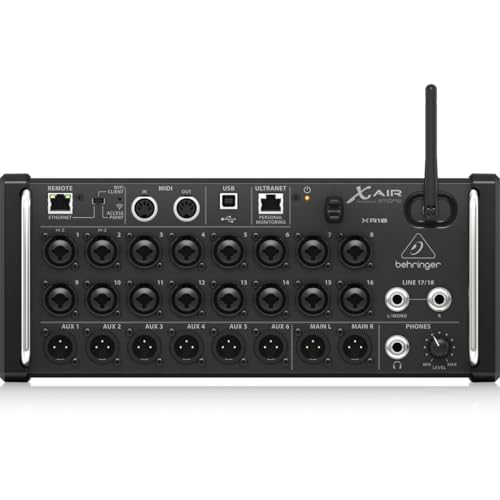
The Behringer X AIR XR18 18-Channel is a digital mixer in a stage box format, and the listing describes it as an 18-input, 12-bus unit controlled from iPad or Android tablets. There is no fader surface. The mixer sits in a rack on stage, microphones plug straight into it, and the engineer adjusts everything from a tablet connected over the built-in Wi-Fi router. That arrangement removes the multicore snake and lets the mix happen from anywhere in the room.
The feature list reads like a shrunken version of Behringer's larger X32 console. Sixteen Midas-designed preamps with remotely programmable gain, an 18 x 18 bidirectional USB interface, and a tri-mode Wi-Fi router are all built in, and the listing notes a Dugan-style auto-mixing function arriving by firmware. Main outputs are a pair of XLR connectors.
This review is a research piece built from the product listing and general knowledge of tablet-controlled digital mixers. It involves no direct operation of the unit. Resolution, phantom power, aux output count and the control app are not detailed in the listing, and this review treats each as unconfirmed.
Preamps and Sound Quality
The preamps are the published strong suit. The listing credits them to Midas, the British console maker that Behringer's parent company owns, and describes them as award-winning and fully programmable. Programmable gain means the preamp level is set digitally from the tablet and stored with a scene, so every service or set can start with gain structure already in place.
The listing claims audiophile sound quality but publishes no gain range, noise figure or distortion specification. Buyers report the Midas-designed preamps in the X AIR line as clean and quiet for live work, and the design has a good reputation among engineers who have used the larger consoles, though this review cannot verify tonal character. Phantom power is not stated in the listing, which is an important check for anyone using condenser microphones.
Because the mixer is digital, EQ, dynamics and effects are all processed internally and configured from the app rather than fixed on a channel strip. The listing does not enumerate the processing per channel, but a 12-bus digital mixer in this class typically offers a parametric EQ, a gate and a compressor on every input, which is far more processing than any analog board at the same price.
Inputs, Outputs and Routing
Eighteen inputs break down as 16 mic preamps plus two further inputs, which usually serve as a stereo line pair for playback or a submix. On the output side, the listing confirms two XLR main outputs and twelve buses, but it does not publish the number of physical aux outputs. Twelve buses typically feed six aux outputs plus internal effects and subgroups, though that allocation is not confirmed.
The 18 x 18 USB interface is the routing feature that matters most for recording. Every input can be sent to a computer as its own track, and 18 channels can return from the computer for virtual soundcheck or backing tracks. Virtual soundcheck, where the band's recorded tracks are played back through the mixer to tune the room before they arrive, is one of the biggest workflow upgrades a digital mixer offers.
The rack format changes how routing is planned. Because the mixer lives on stage, monitor outputs run short cables to wedges or in-ear transmitters, and the main outputs run to the PA. There is no front-of-house snake, which saves setup time and reduces cable cost for mobile acts.
Features, Monitoring and Software
Tablet control is the central feature. The listing specifies iPad and Android compatibility, and the control app, while not named in the published text, provides the fader screen, EQ, dynamics and routing views that replace a physical surface. Band members can also run a personal monitor mix app on their phones, which removes a common source of stage frustration.
Scene recall is the practical payoff of a digital mixer. Every gain setting, EQ curve, effect and bus mix is stored and recalled, so a church can load a saved service template and a band can recall a venue-specific mix. The listing mentions Dugan-style auto-mixing as a future firmware feature, which would automatically share gain among open microphones in panel discussions and conferences.
The Behringer X AIR XR18 18-Channel does not list a headphone output or a monitoring section, and the listing does not describe the onboard effects engines or the recording app. Buyers should confirm those details through the manual, because the published description focuses on the headline hardware.
- Control from iPad or Android tablets over built-in Wi-Fi
- 16 Midas-designed preamps with remotely programmable gain
- 18 x 18 bidirectional USB audio interface
- 12 buses for monitors, subgroups and effects
- Dugan-style auto-mixing noted as a future firmware feature
- Two XLR main outputs
Build, Design and Controls
The unit is a rack-mount stage box, and the listing does not publish its weight, rack height or chassis material. There are no faders or channel knobs on the box itself, only connectors, a few status indicators and the network ports. This means the physical design is secondary; the control surface is whatever tablet the operator brings.
That design has consequences. There is nothing to grab in an emergency without the tablet, so operators should keep a backup device and consider a wired Ethernet connection to a router for critical events. The upside is that the mixer can be mounted in a rack with wireless receivers and power conditioning, forming a compact rig that rolls into any venue.
Durability of the chassis cannot be judged from the published data. Rack units of this type are generally metal and designed for transport, and the connector panel layout with 16 combo inputs across the front is practical for quick patching on stage.
Connectivity, Drivers and Latency
Connectivity is the strongest area in the listing. The integrated tri-mode Wi-Fi router can create its own network, join an existing one, or connect over Ethernet, which removes the need for an external access point that most competing rack mixers require. The 18 x 18 USB interface handles recording and playback with a single cable to a computer.
Resolution over USB is not published, and neither is driver information. Mac operation is typically class compliant for mixers in this family, while Windows generally needs a manufacturer driver for stable multi-channel work. Latency figures are not stated, though in live use the mixer's own processing path handles monitoring, so computer latency only matters for virtual soundcheck and recording.
Wi-Fi reliability is the practical caveat with every tablet mixer. In venues crowded with phones and competing networks, the built-in router can struggle, and experienced operators often bring an external router or run Ethernet to a dedicated access point. The listing's tri-mode design supports both approaches, which is a point in its favor.
Setup and Daily Use
Setup involves racking the unit, connecting microphones and outputs, powering on and joining the mixer's network from a tablet. After the first gig, scene recall takes over and most of the work is loading a saved show and tweaking gains for the room. Programmable preamps mean the gain settings return with the scene, which is impossible on an analog desk.
Daily use depends on comfort with a touch screen. Mixing on glass is slower for quick multi-fader moves than a physical surface, but the ability to walk to the stage, adjust a monitor mix while standing next to the wedge, and then return to the back of the room is a significant advantage. Recording the show is a matter of connecting a laptop and arming 18 tracks.
Who Should Buy It
The Behringer X AIR XR18 18-Channel fits bands that mix themselves, churches with volunteer teams that benefit from saved scenes, and small venues that want remote mixing and per-channel recording in one rack unit. Studios that record bands live gain an 18 x 18 interface with Midas-designed preamps as a bonus.
Operators who need physical faders should look at an analog board or a digital console with a built-in surface. The same applies to anyone working in venues with hostile Wi-Fi conditions and no option of a wired network, or who prefers not to depend on a tablet battery during a show.
Alternatives Worth Considering
Among analog boards with recording, the Mackie ProFX16v3 lists Onyx preamps with 60 dB of gain, 24 effects and multi-track USB recording on a 16-channel surface with physical controls and no learning curve. It gives up scene recall, programmable gain and remote mixing, which is exactly the trade the XR18 asks buyers to consider.
The Yamaha MG16XU 16-Input 6-Bus is the traditionalist's pick, with D-PRE class-A preamps, one-knob compressors, SPX effects, a USB interface and a documented metal chassis. Its USB stage is not described as multi-track, so recording groups still lean toward the XR18.
Within the rack mixer category, the main competition comes from other tablet-controlled stage boxes that lack a built-in router or offer fewer preamps. The Behringer X AIR XR18 18-Channel stands out by bundling the router, 16 Midas-designed preamps and an 18 x 18 interface at a mid-range price, which is why it has become the reference unit for this format.
Verdict
On the published evidence, the Behringer X AIR XR18 18-Channel is the most capable mixer in this packet for groups that record and want recall. Sixteen programmable Midas-designed preamps, 12 buses, an 18 x 18 USB interface and a built-in Wi-Fi router form a package that analog boards cannot match at the price.
The score reflects a strong product with real tradeoffs: no physical controls, a dependence on wireless or a wired network, and unpublished resolution, phantom power and aux output details. Operators who accept tablet mixing will find it hard to beat in the mid-range tier.
Strengths and Limitations
Strengths
- 16 Midas-designed preamps with remote-programmable gain
- 18 x 18 bidirectional USB interface for per-channel recording and playback
- Built-in tri-mode Wi-Fi router removes the need for an external access point
- 12 buses on an 18-channel frame for monitors and subgroups
- Rack format keeps the mixer on stage while the engineer mixes from anywhere
- Dugan-style auto-mixing noted for a firmware update
Limitations
- No physical faders, every adjustment happens on a tablet
- Resolution, phantom power and aux output count are not published
- Wi-Fi reliability in crowded venues is a known concern for tablet mixers
- Auto-mixing was listed as a future firmware feature, not a shipping one
How We Scored It
Scores reflect published specifications, documented features and value against the alternatives below. They are editorial research scores, not laboratory measurements.
Alternatives to Consider

Fender Quantum LT 16
Hybrid studios and multi-mic tracking rooms that want eight high-gain preamps, fourteen line inputs, MIDI and CV-capable outputs in one USB-C interface with a DAW included.
Read the Fender Quantum LT 16 review →
Yamaha MG16 16-Input 6-Bus
Live sound operators who already own outboard effects and a recorder, and who want a tough analog desk with six buses and respected preamps at a lower price than the USB model.
Read the Yamaha MG16 16-Input 6-Bus review →
Behringer EURODESK SX2442FX
Bands, rehearsal studios and small venues that need many mic inputs, subgroups and onboard dual effects on an analog desk without a computer in the signal chain.
Read the Behringer EURODESK SX2442FX review →Questions Buyers Ask
Behringer X AIR XR18 18-Channel
See the current listing, price and included accessories.
About This Review
Mandrillis Team
The Mandrillis editorial team researches and compares audio and music gear using manufacturer documentation, verified specs and real buyer feedback, so you can make a confident purchase without wading through marketing claims.
Read our full research methodology.