Best Audio Interfaces for Home Recording in 2026
This guide is for anyone setting up a first or second home studio who needs a USB audio interface that records vocals, guitar and instruments cleanly without a steep learning curve. We compared inputs, preamp quality, resolution, MIDI, monitoring and software bundles across five interfaces between $95 and $225 to find the best overall, best value and best budget options.
Quick Answer
The best audio interface for home recording for most people is the Focusrite Scarlett 2i2 4th Gen because its Auto Gain and Clip Safe features remove the two most common beginner mistakes, its preamps are clean and quiet, and it works with every DAW. Choose the MOTU M2 if playback quality and metering matter more, or the PreSonus AudioBox USB 96 if you need two inputs for under $100.
Why You Can Trust This Guide
We compared products using verified manufacturer specifications, available manuals and documentation, retailer listings, owner feedback, and editorial research.
We focus on measurable differences such as performance, compatibility, usability, build quality, features, and value.
Mandrillis presents editorial research as editorial research, not as laboratory testing, unless physical testing was actually performed.
Read our full research methodology.
Quick Picks
Comparison Table
| Model | Inputs | Max Resolution | MIDI | Headphone Out | Best For | Main Advantage | Score |
|---|---|---|---|---|---|---|---|
| Focusrite Scarlett 2i2 (4th Gen) | 2 mic/line/instrument | 24-bit / 192 kHz | No | 1 x 1/4 inch | Singers, podcasters and guitarists who want the safest first interface | Auto Gain and Clip Safe stop ruined takes | 92/100 |
| MOTU M2 | 2 combo XLR/TRS | 24-bit / 192 kHz | Yes (in/out) | 1 x 1/4 inch | Producers who mix on headphones or monitors and want pro-grade conversion | Full-colour LCD meters on the front panel | 90/100 |
| Audient iD4 MkII | 1 mic (combo XLR/TRS) + 1 JFET instrument | 24-bit / 96 kHz | No | 2 (1/4 inch and 3.5 mm) | Solo vocalists and guitarists who want the best single preamp under $200 | Class-A console mic preamp taken from Audient's desks | 88/100 |
| Universal Audio Volt 2 | 2 combo XLR/TRS | 24-bit / 192 kHz | Yes (in/out) | 1 x 1/4 inch | Vocalists and guitarists who want a warmer, more coloured sound without plug-ins | Vintage mode emulates the UA 610 tube preamp | 86/100 |
| PreSonus AudioBox USB 96 | 2 combo XLR/TRS | 24-bit / 96 kHz | Yes (in/out) | 1 x 1/4 inch | Beginners on a tight budget who still want two inputs and a proper DAW | Cheapest route to two real mic preamps with phantom power | 80/100 |
#1. Focusrite Scarlett 2i2 (4th Gen) (Best Overall)

Mandrillis Research Score: 92/100
This is an editorial research score, not a customer rating or laboratory test score.
Who Should Buy It
- You record vocals or acoustic guitar alone and want gain set automatically
- You want an interface that works with every DAW and plenty of tutorials
- You plan to grow into a bigger Scarlett later and keep the same workflow
Skip It If
- You need to connect a MIDI keyboard by 5-pin DIN
- Two people need to monitor on headphones at once
Pros
- Auto Gain and Clip Safe stop ruined takes
- Air mode adds presence to vocals
- Very clean, quiet preamps for the money
- Huge community and driver support
Cons
- No MIDI ports
- Only one headphone output
Key Specs
Type: USB Audio Interface
Inputs: 2 mic/line/instrument
Preamps: 2 Focusrite Air-enabled mic preamps
Max Resolution: 24-bit / 192 kHz
Preamp Gain: 69 dB
MIDI: No
Power: USB-C bus powered
Headphone Out: 1 x 1/4 inch
Software: Hitmaker Expansion bundle
Why We Picked It
Auto Gain and Clip Safe make it the hardest interface here to get a bad take on, and the 4th Gen preamps are cleaner than the 3rd Gen at the same price.
Check Price on AmazonWe may earn a commission at no extra cost to you.
Last verified: October 2026
Why This Product Ranks Best Overall
#2. MOTU M2 (Best Sound Quality)

Mandrillis Research Score: 90/100
This is an editorial research score, not a customer rating or laboratory test score.
Who Should Buy It
- You want the best playback quality in this price range
- You stream or podcast and need loopback without extra software
- You like seeing real meters instead of a single halo LED
Skip It If
- You want automatic gain setting for solo recording
- You need two headphone outputs
Pros
- Full-colour LCD meters on the front panel
- ESS Sabre32 Ultra DAC with 120 dB dynamic range on the outputs
- Loopback for streaming and podcasts
- Very low round-trip latency
Cons
- Plastic end caps feel cheaper than the rest
- Driver updates are less frequent than Focusrite
Key Specs
Inputs: 2 combo XLR/TRS
Max Resolution: 24-bit / 192 kHz
Preamp Gain: 60 dB
MIDI: Yes (in/out)
Power: USB-C bus powered
Headphone Out: 1 x 1/4 inch
Software: Performer Lite, Ableton Live Lite
Why We Picked It
The ESS Sabre32 converter and real LCD metering give it the most accurate playback of the group, which matters most when you mix.
Check Price on AmazonWe may earn a commission at no extra cost to you.
Last verified: October 2026
Why This Product Ranks Best Sound Quality
#3. Audient iD4 MkII (Best Single Preamp)

Mandrillis Research Score: 88/100
This is an editorial research score, not a customer rating or laboratory test score.
Who Should Buy It
- You only ever record one microphone at a time
- You want a preamp with more headroom and character than entry-level boxes
- You and a collaborator both need headphones plugged in
Skip It If
- You record stereo pairs or a singer and a guitar mic together
- You must have 192 kHz for a specific client workflow
Pros
- Class-A console mic preamp taken from Audient's desks
- Two headphone outputs on a one-mic interface
- ScrollControl turns the big knob into a scroll wheel for plug-ins
- Audio loopback built in
Cons
- Only one mic input
- Tops out at 96 kHz
Key Specs
Inputs: 1 mic (combo XLR/TRS) + 1 JFET instrument
Max Resolution: 24-bit / 96 kHz
Preamp Gain: 58 dB
MIDI: No
Power: USB-C bus powered
Headphone Out: 2 (1/4 inch and 3.5 mm)
Software: ARC software bundle
Why We Picked It
One Class-A console preamp, a JFET instrument input and two headphone jacks is a smart feature set for anyone recording alone.
Check Price on AmazonWe may earn a commission at no extra cost to you.
Last verified: October 2026
Why This Product Ranks Best Single Preamp
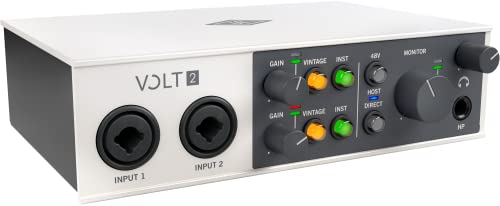
#4. Universal Audio Volt 2 (Best Vintage Character)
Mandrillis Research Score: 86/100
This is an editorial research score, not a customer rating or laboratory test score.
Who Should Buy It
- You like the sound of classic tube preamps on vocals
- You use a MIDI keyboard with a 5-pin cable
- You want a desk-friendly interface that looks and feels premium
Skip It If
- You record classical or acoustic sources where neutrality matters most
- You rely on high-impedance headphones that need serious drive
Pros
- Vintage mode emulates the UA 610 tube preamp
- MIDI in and out on a compact box
- Sturdy metal and wood-trim build
- Direct monitoring with one button
Cons
- Vintage mode is a one-size colour, not adjustable
- Headphone output is only moderately powerful
Key Specs
Inputs: 2 combo XLR/TRS
Max Resolution: 24-bit / 192 kHz
Preamp Gain: Not published
MIDI: Yes (in/out)
Power: USB-C bus powered
Headphone Out: 1 x 1/4 inch
Software: Included bundle (UA plug-ins and DAW trials)
Why We Picked It
Vintage mode gives a usable tube-style warmth on vocals without plug-ins, and it adds MIDI in and out.
Check Price on AmazonWe may earn a commission at no extra cost to you.
Last verified: October 2026
Why This Product Ranks Best Vintage Character
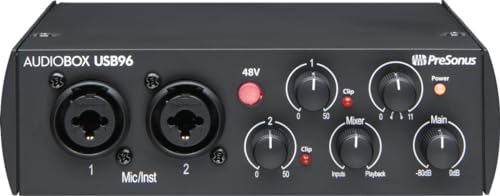
#5. PreSonus AudioBox USB 96 (Best Budget)
Mandrillis Research Score: 80/100
This is an editorial research score, not a customer rating or laboratory test score.
Who Should Buy It
- You want to start recording for under $100
- You need two inputs for a mic plus a guitar, or a stereo pair
- You like the idea of a full DAW included rather than a trial
Skip It If
- You own an SM7B or similar gain-hungry microphone
- You want the quietest possible preamps for soft vocals
Pros
- Cheapest route to two real mic preamps with phantom power
- MIDI in and out included
- Studio One Artist DAW in the box
- Steel chassis that survives a gig bag
Cons
- Preamps are noisier at high gain than the others here
- Older USB 2.0 Type-B connector
Key Specs
Inputs: 2 combo XLR/TRS
Max Resolution: 24-bit / 96 kHz
Preamp Gain: Not published
MIDI: Yes (in/out)
Power: USB bus powered
Headphone Out: 1 x 1/4 inch
Software: Studio One Artist
Why We Picked It
Two preamps, phantom power, MIDI and a full DAW for under $100 is the best starter package at this price.
Check Price on AmazonWe may earn a commission at no extra cost to you.
Last verified: October 2026
Why This Product Ranks Best Budget
Which One Should You Buy?
For most home recordists the Focusrite Scarlett 2i2 4th Gen is the safest buy because it makes clean recordings almost automatic. The MOTU M2 is the pick if you spend more time mixing than tracking, and the Audient iD4 MkII gives you the nicest single preamp of the group.
Buy the Scarlett 2i2 4th Gen if...
you record vocals or guitar on your own and want Auto Gain, Clip Safe and the widest tutorial support.
Buy the MOTU M2 if...
you mix a lot, want proper meters on the box, and care about converter quality on playback.
Buy the Audient iD4 MkII if...
you only ever record one microphone and want a console-grade preamp plus two headphone outputs.
Buy the UA Volt 2 if...
you want a warmer tube-style tone on vocals and need MIDI in and out.
Buy the AudioBox USB 96 if...
you need two inputs, MIDI and a full DAW for under $100.
Buying Guide
Inputs and Preamps
Each XLR input needs its own preamp. Two inputs cover a singer plus a guitar, or a stereo pair. The amount of clean gain (measured in dB) decides whether quiet dynamic mics sound hissy.
Bit Depth and Sample Rate
Every interface here records at 24-bit, which is what matters for headroom. 96 kHz versus 192 kHz makes no audible difference for home recording, so do not pay extra for it alone.
Direct Monitoring
Lets you hear your input straight from the interface with no delay. Essential for tracking vocals. All five interfaces offer it, some with a mono/stereo switch.
MIDI In/Out
Only needed if you own a keyboard or controller with 5-pin MIDI sockets. USB MIDI keyboards plug straight into your computer and skip the interface entirely.
Loopback
Routes computer audio back into your DAW or streaming app. Useful for podcasts, streaming and sampling. The MOTU M2 and Audient iD4 MkII include it in hardware.
Bus Power
All five run from the USB port with no wall adapter. On a laptop this also means they run on battery, which is handy for recording away from the desk.
How We Compared
- Input count, preamp gain and resolution checked against manufacturer documentation
- Monitoring, MIDI and loopback features mapped side by side
- Software bundles and driver support compared for Mac and Windows
- Verified buyer feedback reviewed for reliability and noise complaints
- No fake hands-on testing claims
FAQ
Related Guides

About This Guide
Mandrillis Team
The Mandrillis editorial team researches and compares audio and music gear using manufacturer documentation, verified specs and real buyer feedback, so you can make a confident purchase without wading through marketing claims.
Read our full research methodology.