Cordoba C5CE vs Takamine GC1
Quick Verdict
The Cordoba C5CE is the stronger all-around choice for most players seeking an acoustic-electric classical guitar. Its solid cedar top, soft cutaway, and Fishman Presys II preamp give it clear advantages in tone, upper-fret access, and amplified performance. The Takamine GC1 is a simpler, traditional non-cutaway classical with no electronics and an unspecified solid or laminate top, but it offers a lower midrange price and a rosewood fingerboard. Choose the Cordoba if you will plug in, want a published solid top, or need a cutaway. Choose the Takamine if you prefer a pure acoustic classical without a pickup and do not mind missing specifications. Both guitars omit scale length and nut width, so confirm comfort in person.
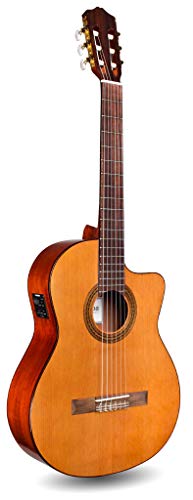

| Spec | Cordoba C5CE | Takamine GC1 |
|---|---|---|
| Body shape | Classical with soft cutaway | Classical |
| Top | Solid cedar | Spruce |
| Back and sides | Mahogany (solid vs laminate not specified) | Mahogany back, mahogany sides |
| Neck and fingerboard | Not published in listing | Mahogany neck, rosewood fingerboard |
| Scale length | Not published in listing | Not published in listing |
| Nut width | Not published in listing | Not published in listing |
| Electronics | Fishman Presys II preamp | None listed |
| Tuners | Not published in listing | Not published in listing |
| Finish | Glossy polyurethane (PU) | Gloss natural |
| Included accessories | Savarez strings (other accessories not published) | Not published in listing |
Body, Neck and Playability
The Cordoba C5CE is a classical body with a soft cutaway, while the Takamine GC1 uses a traditional classical shape without a cutaway. Both use nylon strings, which most players find comfortable, and both omit scale length and nut width from the listing. The Cordoba scores 24 out of 30 for playability, and the Takamine scores 22 out of 30, a narrow gap that likely reflects the Cordoba's cutaway and slightly higher published playability features.
The Cordoba's top is solid cedar, and its back and sides are mahogany, though the listing does not say whether the back and sides are solid or laminate. The Takamine lists a spruce top and mahogany back and sides, but again the listing does not specify solid versus laminate construction for the top. The Takamine does provide more neck detail, listing a mahogany neck and rosewood fingerboard, while the Cordoba's neck and fingerboard are not published. Because neither model lists scale length or nut width, buyers cannot compare string spacing or reach directly from the listings.
The Cordoba's soft cutaway should improve access to the upper frets for players who use that register. The Takamine's traditional non-cutaway body may appeal to classical purists but does not offer the same upper-fret reach. Without published neck dimensions, the difference in playability cannot be fully confirmed from the listing alone. Based only on the provided facts, the Cordoba has a slight edge in playability due to the cutaway and the higher subscore in this category.
Tone and Projection
On tone, the Cordoba C5CE carries a higher published score of 20 out of 25, while the Takamine GC1 scores 16 out of 25. The Cordoba's solid cedar top is called out in the listing for producing a warm, clear tone, and its mahogany back and sides are said to add depth and sustain. In contrast, the Takamine's spruce top and mahogany back and sides are described only as a traditional tonewood set, with no specific tonal adjectives provided in the listing.
The Cordoba's top is explicitly solid cedar, which may contribute to a more resonant and responsive sound, though this is an inference from the specification rather than a tested result. The Takamine listing does not say whether the spruce top is solid or laminate, so its acoustic response is harder to predict from the published data. Both guitars share mahogany back and sides, but the Cordoba's listing does not specify solid versus laminate there either.
Without direct listening, the difference in tone scores suggests the Cordoba has an advantage in this category. The stated warm and clear character of the cedar top gives it a specific selling point. The Takamine's spruce top is a common choice for classical guitars, but the lack of a solid top claim and the absence of tonal descriptors make its tone less defined on paper. Buyers who prioritize a published warm tone may lean toward the Cordoba.
Hardware and Electronics
The most obvious hardware difference is electronics. The Cordoba C5CE includes a Fishman Presys II preamp, which provides onboard amplification for stage and studio use. The Takamine GC1 lists no electronics, making it a purely acoustic classical guitar without a pickup or preamp. This single difference is likely the main reason the Cordoba scores 7 out of 10 in hardware and electronics while the Takamine scores 5 out of 10.
Neither listing publishes the tuner brand or specific hardware details for the tuning machines. The Cordoba's tuners are simply not published, and the Takamine's tuners are also not published. This omission makes it impossible to compare tuning stability or hardware quality from the listings. The Cordoba does not list any other hardware specifics beyond the preamp, and the Takamine lists only the electronics absence.
For amplified performance, the Cordoba is clearly the better choice because the Fishman Presys II is included. For players who do not need amplification, the Takamine's lack of electronics keeps the guitar simpler and possibly lighter, though that is not confirmed by the listing. Buyers who want to plug in should choose the Cordoba, while those who only play acoustically can consider the Takamine.
Build Quality and Finish
The Cordoba C5CE has a glossy polyurethane finish and includes handmade Spanish-style details such as an inlaid rosette and Pau Ferro binding. These aesthetic touches suggest careful construction and add visual appeal. The Takamine GC1 has a gloss natural finish and a mosaic rosette, which also contributes to its appearance but with fewer described custom details. In build and materials, the Cordoba scores 11 out of 15 and the Takamine scores 10 out of 15.
The Cordoba's listing specifies a solid cedar top, but the back and sides are only listed as mahogany without stating solid or laminate. The Takamine's listing specifies spruce top and mahogany back and sides, but does not say whether the top is solid or laminate. For both guitars, the lack of clarity on tonewood construction makes an exact build quality comparison difficult. The Takamine provides a rosewood fingerboard, while the Cordoba's fingerboard material is not published.
Neither listing mentions included accessories such as a gig bag or case, so buyers should expect to purchase those separately. The Cordoba does include Savarez strings, while the Takamine's included accessories are not published. On the basis of the published details, the Cordoba has a slight edge in build quality score, driven by the solid cedar top and the described handmade details.
Setup Out of the Box
Neither listing describes factory setup specifications such as action, neck relief, or string height. There is no information about whether the guitar arrives adjusted or requires professional setup, and neither model is said to include a setup card or measurement sheet. This is a common omission in product listings for guitars in this range, but it leaves buyers without a clear comparison.
The Cordoba's listing does state that Savarez strings are included, which means the guitar is likely strung with a known brand from the factory, but that does not confirm the setup quality. The Takamine's listing does not publish what strings are included or any setup measurements. Without that data, buyers cannot compare one model as having a better out-of-box setup.
Players who are particular about action and neck relief may need to plan for a setup after purchase for either guitar. The listed information does not give one model an advantage in this area. The only concrete difference is the mention of Savarez strings on the Cordoba, which some players may interpret as a signal of quality, but that is not a guarantee of setup accuracy.
Daily Use and Practice
For daily practice, both nylon string classical guitars are designed to be comfortable for beginners and fingerstyle players. The Cordoba C5CE's soft cutaway makes it easier to reach higher frets during practice sessions that include upper-position work. The Takamine GC1's traditional classical body has no cutaway, which may be perfectly fine for players who spend most time in first position but less convenient for upper-register exercises.
The Cordoba's Fishman Presys II preamp allows the player to connect to an amplifier or recording interface, which can be useful for practice with volume control or for playing along with tracks. The Takamine has no electronics, so daily practice remains purely acoustic. This simplicity may be an advantage for players who want an unplugged session without dealing with batteries or cables, though the preamp does not force anyone to use it.
Neither listing mentions a gig bag or case, so daily transport and storage will require an additional purchase for either guitar. The Cordoba includes Savarez strings, but the Takamine's string inclusion is not published. Players who practice in different rooms or take the guitar to lessons will need to factor in a case purchase regardless of choice.
Versatility and Styles
The Cordoba C5CE is the more versatile option on paper, with a versatility score of 8 out of 10 compared with the Takamine GC1's 7 out of 10. The Cordoba's built-in Fishman Presys II preamp and soft cutaway expand its use beyond the practice room to amplified performances and upper-fret work. The Takamine's lack of electronics limits it to purely acoustic settings unless an external pickup is added.
Both guitars are classical nylon string instruments, so they are best suited to classical, fingerstyle, Latin, and similar nylon string styles. The Cordoba's solid cedar top and mahogany back and sides are described as warm with depth, which may lend themselves to expressive fingerpicking. The Takamine's spruce and mahogany combination is traditional, but the listing does not provide style-specific strengths beyond the general classical voice.
For players who need a guitar that can go from couch to open mic, the Cordoba has the clear advantage due to the onboard preamp. The Takamine is better suited to home practice or casual playing where amplification is not needed. If a player later wants to amplify the Takamine, they would need to install a pickup or use a microphone, whereas the Cordoba is ready to plug in immediately.
The Deciding Question
The overall scores separate these two models clearly: the Cordoba C5CE earns 78 out of 100 while the Takamine GC1 earns 67 out of 100. The Cordoba wins nearly every subscore except the differences are modest: 24 vs 22 in playability, 20 vs 16 in tone, 11 vs 10 in build, 7 vs 5 in hardware, 8 vs 7 in versatility, and 8 vs 7 in value. These small margins add up to a larger gap when considered as a whole.
The deciding question for most buyers is whether the Cordoba's extra features justify the difference in score and likely price. The Cordoba provides a solid cedar top, a soft cutaway, and a Fishman Presys II preamp, none of which the Takamine offers. The Takamine counters with a spruce top, a rosewood fingerboard, and a simpler non-cutaway body without electronics at what the listing calls a lower midrange price point.
If a buyer needs built-in amplification, a published solid top, and upper-fret access, the Cordoba is the better fit. If a buyer prefers a traditional non-cutaway classical guitar and does not need electronics, the Takamine remains a reasonable option. The missing specifications on both listings, especially scale length and nut width, mean that personal comfort should be confirmed in person before purchase.
Who Should Buy Which
Choose the Cordoba C5CE if you are a player seeking a mid-range nylon string acoustic-electric with a solid cedar top, soft cutaway, and built-in electronics for practice and performance. It is well suited to fingerstyle and classical players who want a warm, clear tone and the flexibility to plug into an amplifier or interface. The Cordoba's handmade Spanish-style details also make it attractive to those who value visual craftsmanship.
Choose the Takamine GC1 if you are a student or casual player who wants a lower midrange classical guitar with a traditional nylon string voice and simple appointments. It fits players who do not need a pickup, a cutaway, or a published solid top, and who prefer a straightforward acoustic instrument from a known brand. The Takamine's rosewood fingerboard and gloss natural finish provide a familiar and visually appealing package.
Avoid the Cordoba if you need detailed neck dimensions, prefer a traditional non-cutaway classical without electronics, or want full clarity on whether the back and sides are solid. Avoid the Takamine if you need a pickup, a cutaway, published measurements, or a guaranteed solid top. Because both listings omit scale length and nut width, players with specific ergonomic preferences should try these guitars in person before deciding.
Cordoba C5CE
Pros
- Solid cedar top for warm, clear tone
- Mahogany back and sides add depth and sustain
- Soft cutaway improves upper-fret access
- Fishman Presys II preamp for stage and studio
- Nylon strings are comfortable for beginners
- Handmade Spanish-style details like inlaid rosette and Pau Ferro binding
Cons
- Scale length and nut width are not published
- Back and sides material type not specified
- Tuner brand and hardware details are not listed
- No included gig bag or case mentioned
Takamine GC1
Pros
- Traditional spruce and mahogany tonewood set
- Rosewood fingerboard adds familiar feel
- Gloss natural finish and mosaic rosette add visual appeal
- Lower midrange price from a known brand
- Nylon string classical design suits beginners and fingerstyle
- No electronics means simple, lightweight acoustic
Cons
- Listing does not specify solid versus laminate top
- No scale length or nut width published
- Tuner hardware and quality not listed
- No onboard electronics for amplified playing
- No included case or gig bag mentioned
Who Should Buy Each
Cordoba C5CE
- Beginning and intermediate classical guitarists
- Steel-string players wanting a softer nylon-string alternative
- Performers needing a stage-ready classical with electronics
- Buyers who value handmade Spanish-style appointments
Takamine GC1
- Beginning classical guitar students on a budget
- Steel string players curious about nylon string tone
- Casual fingerstyle and Latin music players
- Buyers who want a simple acoustic only classical guitar
Quick Decision Guide
| If you need built-in electronics for amplified performance | Choose Cordoba C5CE |
| If you prefer a traditional non-cutaway classical body without a pickup | Choose Takamine GC1 |
| If you want a top that is explicitly listed as solid wood | Choose Cordoba C5CE |
| If you want a rosewood fingerboard published in the listing | Choose Takamine GC1 |
| If you want a soft cutaway for upper-fret access | Choose Cordoba C5CE |
FAQ
About This Comparison
Mandrillis Team
The Mandrillis editorial team researches and compares audio and music gear using manufacturer documentation, verified specs and real buyer feedback, so you can make a confident purchase without wading through marketing claims.
Read our full research methodology.
We may earn a commission at no extra cost to you.