Denon AVR-X3900H vs Onkyo TXRZ70
Quick Verdict
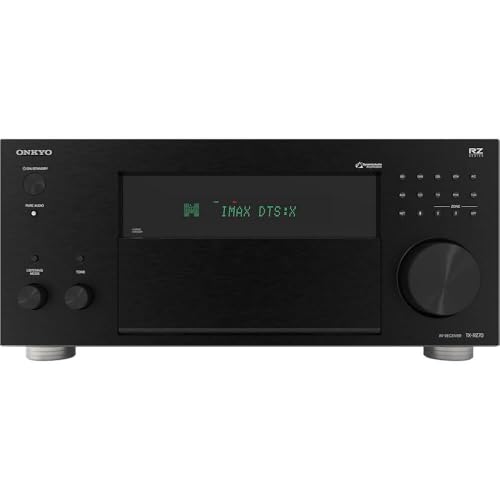
The Denon AVR-X3900H is a premium home theater AV receiver with 105 watts per channel, Dolby Atmos, DTS:X, Auro-3D and IMAX Enhanced support, Audyssey MultEQ XT32 room correction, and HEOS whole home audio. The Onkyo TXRZ70 is an 11 channel THX Certified Premium flagship receiver with 140 watts, ESS Sabre DACs, built-in Dirac Live Room Calibration, and IMAX Enhanced Mode. Choose the Denon if HEOS multiroom streaming and a simpler surround setup matter most. Choose the Onkyo if the highest channel count and built-in Dirac Live calibration matter most. Scored at 87 and 86, both are strong premium receivers with significant unpublished connectivity details.

| Spec | Denon AVR-X3900H | Onkyo TXRZ70 |
|---|---|---|
| Drive type | Not published in listing | Not published in listing |
| Cartridge | Not published in listing | Not published in listing |
| Platter | Not published in listing | Not published in listing |
| Tonearm | Not published in listing | Not published in listing |
| Speeds | Not published in listing | Not published in listing |
| Built-in preamp | Not published in listing | Not published in listing |
| Bluetooth and USB | Not published in listing | Not published in listing |
| Outputs | Not published in listing | Not published in listing |
| Dimensions and weight | Not published in listing | Not published in listing |
| Included accessories | Not published in listing | Not published in listing |
| Type | Premium home theater AV receiver for stereo, multichannel and immersive audio systems | 11 channel THX Certified Premium AV receiver, described as Onkyo's most powerful receiver at the time of listing |
| Power output | 105 watts per channel, per the listing | 140 watts, per the listing. The exact ohm load and distortion measurement conditions behind that figure are not stated |
| Channels | The listing does not state a single total channel count. It describes support for surround configurations up to 7.1.4 or 5.1.6, which implies a nine channel amplifier section built in | 11 channels per the listing, built to support discrete zones and multiple subwoofers in larger home theater layouts |
| Inputs and outputs | Connects a television, gaming consoles and streaming devices through what the listing calls a 4K and 8K ready HDMI hub. The listing does not give a port by port count of HDMI, analog or digital inputs | eARC functionality is confirmed. The listing does not give an HDMI input or output port count, or a count of analog and digital connectors |
| HDMI and video | Supports 4K and 8K video with Dolby Vision for color and contrast, plus built in upscaling for older sources. Variable Refresh Rate, Auto Low Latency Mode and AMD FreeSync support 4K at 120Hz gaming | eARC is supported, and IMAX Enhanced Mode is designed to reduce noise and grain for brighter, clearer pictures, with up to 26 percent more picture through a stretched aspect ratio. Specific video resolution support such as 4K or 8K is not stated |
| Wireless and streaming | Wi-Fi, Bluetooth and AirPlay 2 for wireless playback, with whole home audio through HEOS covering music, TV audio, sports and podcasts across HEOS enabled components | The listing mentions a host of built in options for streaming apps and smart home assistants without naming a specific protocol, app or assistant |
| Phono input | Not published in listing. No phono stage is described for this model | Not published in listing. No phono stage is described |
| Remote and app | Controlled through the HEOS app for streaming and multiroom functions, with web based control also described. No specific remote control hardware is detailed | Not published in listing. No specific control app or physical remote is named for this model |
Power and Sound Quality
The AVR-X3900H is rated at 105 watts per channel, per the listing, and supports Dolby Atmos, DTS:X, Auro-3D and IMAX Enhanced formats, with the listing not stating a single total channel count beyond describing support for configurations up to 7.1.4 or 5.1.6.
The TXRZ70 is rated at 140 watts, per the listing, across a confirmed 11 channels, with named ESS Sabre DACs cited for studio grade processing, though the exact ohm load and distortion measurement conditions behind the wattage figure are not stated anywhere in the published feature list.
On raw published wattage, the TXRZ70's 140 watts exceeds the AVR-X3900H's 105 watts, and its channel count is explicitly stated at 11 against the AVR-X3900H's implied nine channel section. In scoring, the TXRZ70 earns 28 of 30 on power and sound quality against the AVR-X3900H's 27 of 30, a single point apart despite the more substantial gap in their published wattage figures. Neither listing states the ohm load or distortion percentage behind those wattage numbers, so a direct lab comparison is not possible from the published facts alone.
Connectivity and Inputs
The AVR-X3900H connects a television, gaming consoles and streaming devices through what the listing calls a 4K and 8K ready HDMI hub, though it does not give a port by port count of HDMI, analog or digital inputs, leaving the exact number of simultaneous devices it can support unclear.
The TXRZ70 confirms eARC functionality but also does not give an HDMI input or output port count, or a count of analog and digital connectors, leaving both listings similarly incomplete on exact port numbers for buyers planning a specific rack of connected devices.
Neither receiver publishes a precise connector count, a real gap for buyers planning a multi-device home theater rack. On connectivity scoring, the AVR-X3900H earns 22 of 25 against the TXRZ70's 18 of 25, a notable gap despite both listings sharing similar documentation weaknesses. That four point difference is one of the larger category gaps in this comparison, and it likely reflects the AVR-X3900H naming more of its wireless features directly even without a port count.
Formats, Processing and Room Correction
The AVR-X3900H uses Audyssey MultEQ XT32 room correction with an optional Dirac Live upgrade path, meaning Dirac Live is not included by default but can be added.
The TXRZ70 includes Dirac Live Room Calibration Full Bandwidth built in by default, with a Dirac Live Bass Control upgrade path available on top of that, plus Klipsch Optimize Mode for automatic crossover matching with compatible speakers.
The TXRZ70 has the clearer advantage here, since Dirac Live comes built in rather than requiring an upgrade purchase as it does on the AVR-X3900H. On formats and processing, the TXRZ70 scores 15 of 15 against the AVR-X3900H's 14 of 15, a perfect mark that reflects just how complete its calibration and format support is considered relative to its own category maximum.
Features, Streaming and Apps
The AVR-X3900H confirms Wi-Fi, Bluetooth and AirPlay 2 for wireless playback, with whole home audio through HEOS covering music, TV audio, sports and podcasts across HEOS enabled components, controlled through the HEOS app.
The TXRZ70's listing mentions a host of built in options for streaming apps and smart home assistants without naming a specific protocol, app or assistant, a less detailed description than the AVR-X3900H's named HEOS ecosystem.
The AVR-X3900H is the more clearly documented product for streaming and multiroom features, with HEOS, AirPlay 2, Wi-Fi and Bluetooth all named directly. Both score 9 of 10 on features and apps despite that documentation gap on the TXRZ70's side, suggesting the unnamed smart home and streaming options are still considered broadly comparable in overall usefulness.
Build, Design and Controls
The AVR-X3900H's dimensions, weight and remote control hardware are not published in the listing, with control handled through the HEOS app and web based control.
The TXRZ70's dimensions, weight and remote control hardware are also not published, and no specific control app or physical remote is named for this model either.
Both listings share the same documentation gaps on physical build details. On build and design scoring, the AVR-X3900H earns 7 of 10 against the TXRZ70's 8 of 10, a narrow one point difference despite neither providing dimension or weight figures. Buyers planning a specific equipment rack or shelf should request exact dimensions from the seller before ordering either receiver.
Setup and Daily Use
Setting up the AVR-X3900H means running Audyssey MultEQ XT32 calibration for the room, connecting sources through its 4K and 8K ready HDMI hub, and configuring HEOS for whole home audio across compatible components throughout the house.
Setting up the TXRZ70 means running the built-in Dirac Live Room Calibration Full Bandwidth, optionally enabling Klipsch Optimize Mode if compatible speakers are present, and selecting from four THX listening modes covering cinema, gaming, music and surround EX depending on the content being played.
The TXRZ70's four named THX listening modes give it a more specifically documented daily use feature set for switching between content types, while the AVR-X3900H's daily use centers more on its HEOS multiroom app experience. Both value scores land at 8 of 10, suggesting each receiver is considered reasonably priced relative to its own confirmed feature set within the premium tier.
Who Should Buy It
The AVR-X3900H suits home theater owners who want immersive surround formats, 8K ready video, and whole home HEOS streaming in one receiver, based on its confirmed Dolby Atmos, DTS:X, Auro-3D and IMAX Enhanced support plus named HEOS ecosystem.
The TXRZ70 suits home theater builders who want a high channel count flagship receiver with named room correction and IMAX Enhanced picture processing, based on its confirmed 11 channels, 140 watts, and built-in Dirac Live calibration.
Neither suits a buyer who needs a turntable with a built-in phono stage, since no phono input is described for either the AVR-X3900H or the TXRZ70 in their respective listings. A separate phono preamp would be required regardless of which receiver is chosen for vinyl playback in the final system.
The Deciding Question
The deciding question is whether built-in Dirac Live calibration or a named whole home streaming ecosystem matters more. The TXRZ70 includes Dirac Live by default, while the AVR-X3900H requires an upgrade purchase for the same calibration system but offers HEOS natively across the whole house.
A second question is raw channel count and power. The TXRZ70's confirmed 11 channels and 140 watts exceed the AVR-X3900H's implied nine channel section and 105 watts, which matters for a buyer building a larger surround or multi-zone setup across several rooms.
Scores of 87 against 86 put the AVR-X3900H very slightly ahead overall, driven mainly by its stronger connectivity score and named HEOS features, while the TXRZ70 closes the gap with its higher power, channel count and included Dirac Live system. A one point overall difference is small enough that either receiver is a defensible centerpiece for a serious home theater build.
Who Should Buy Which
Buy the Denon AVR-X3900H if whole home HEOS audio, AirPlay 2, and a slightly more documented connectivity list matter most, and Dirac Live as an optional upgrade rather than a default inclusion is acceptable.
Buy the Onkyo TXRZ70 if the highest channel count and power figure, 11 channels and 140 watts, plus Dirac Live Room Calibration included by default and Klipsch Optimize Mode for compatible speakers matter most to the build.
A buyer already invested in HEOS-enabled speakers elsewhere in the home should lean toward the AVR-X3900H for ecosystem consistency, while a buyer building a large, dedicated home theater room from scratch should lean toward the TXRZ70's higher channel count and included calibration. Either way, confirming exact connector counts and dimensions with the seller remains an important step before finalizing either purchase for a specific room layout.
Denon AVR-X3900H
Pros
- 105 watts per channel stated directly in the listing
- Dolby Atmos, DTS:X, Auro-3D and IMAX Enhanced support
- Audyssey MultEQ XT32 room correction with an optional Dirac Live upgrade path
- 4K and 8K video with Dolby Vision plus VRR, ALLM and AMD FreeSync for gaming
- HEOS whole home audio for multiroom music and system control
Cons
- No stated total channel count or HDMI port count
- No phono input is described
- No dimensions or weight published
- No specific remote control hardware detailed
Onkyo TXRZ70
Pros
- 11 channels and 140 watts stated directly in the listing
- ESS Sabre DACs, THX Certification and eARC for studio grade processing
- Built in Dirac Live Room Calibration Full Bandwidth, with a Dirac Live Bass Control upgrade path
- IMAX Enhanced Mode for reduced noise, grain and a wider picture
- Klipsch Optimize Mode for automatic crossover matching with compatible speakers
- Four THX listening modes covering cinema, gaming, music and surround EX
Cons
- No HDMI port count or video resolution support figures are published
- No named streaming protocol, app or voice assistant is specified
- No phono input described
- No dimensions or weight published
Who Should Buy Each
Denon AVR-X3900H
- Home theater builders planning a 7.1.4 or 5.1.6 Dolby Atmos setup
- Buyers who already use HEOS components for multiroom audio
- Gamers who want 4K at 120Hz with VRR and ALLM on a receiver
- Households upgrading to an 8K capable television
Onkyo TXRZ70
- Buyers planning an 11 channel surround system with discrete zones and multiple subwoofers
- Owners of Klipsch Reference or Reference Premiere speakers who want automatic crossover matching
- Home theater fans who want Dirac Live Room Calibration Full Bandwidth built in
- Movie watchers who specifically want IMAX Enhanced Mode for picture quality
Quick Decision Guide
| If you want built-in Dirac Live room calibration without an upgrade purchase | Choose Onkyo TXRZ70 |
| If you want HEOS whole home audio with AirPlay 2 support | Choose Denon AVR-X3900H |
| If you want the highest confirmed channel count and power figure | Choose Onkyo TXRZ70 |
| If you want IMAX Enhanced support alongside Dolby Atmos and DTS:X | Choose Denon AVR-X3900H |
| If you own Klipsch speakers and want automatic crossover matching | Choose Onkyo TXRZ70 |
FAQ
About This Comparison
Mandrillis Team
The Mandrillis editorial team researches and compares audio and music gear using manufacturer documentation, verified specs and real buyer feedback, so you can make a confident purchase without wading through marketing claims.
Read our full research methodology.
We may earn a commission at no extra cost to you.