Roland FP-E50 vs Kawai ES520
Quick Verdict
The Roland FP-E50 is the better choice for singer-songwriters, worship musicians, and anyone who wants a full arranger with auto-accompaniment, over 1,000 voices, and a microphone input. Its PHA-4 Standard action with escapement also rates higher for key action. The Kawai ES520 is the better choice for players who want Kawai's 88-key sampled piano sound through a loud 40 watt Onkyo speaker system in a simpler portable. Its speaker output is the main advantage, and it earns a higher value score. Choose Roland for features and a complete bundle with stand, pedals, and bench. Choose Kawai for room-filling piano tone and a straightforward daily player.

| Spec | Roland FP-E50 | Kawai ES520 |
|---|---|---|
| Key Action | PHA-4 Standard with escapement and Ivory Feel | Responsive Hammer Compact II (RHC II) |
| Sound Engine | Roland ZEN-Core and SuperNATURAL Piano | Harmonic Imaging with 88-key sampling |
| Voices | Over 1,000 | 34 |
| Polyphony | 256 notes | 192 notes |
| Speakers | Built-in stereo | 40 W Onkyo stereo system |
| Bluetooth | Audio and MIDI | MIDI |
| USB | USB audio and MIDI | USB audio and MIDI |
| Pedals | KPD-70 three-pedal unit in this bundle | F-10H pedal included; F-302 triple pedal optional |
| Weight | 37.1 lb (17.1 kg) per listing | Not published reliably; listing figure may include packaging |
| Form Factor | Portable arranger piano; bundle adds KSFE-50 stand and bench | Mid-range portable with 40 W speakers |
Key Action
The Roland FP-E50 uses a PHA-4 Standard action with escapement and Ivory Feel. This action is rated 28 out of 30 in the listing breakdown. The Kawai ES520 uses a Responsive Hammer Compact II action, rated 25 out of 30. Both are hammer actions, but the Roland adds escapement for faster note repetition and Ivory Feel for a textured key surface. The Kawai listing does not mention escapement or Ivory Feel on the RHC II.
For players who prioritize a traditional acoustic piano feel, the Roland's higher score and listed escapement give it an edge. The Kawai RHC II is a compact hammer action that may feel lighter, but the listing does not specify weight or tactile details beyond the name. Those who already like Kawai's action may find the ES520 comfortable. However, based only on the published specs, the Roland action offers more explicit piano-focused features.
Piano Sound and Speakers
The Roland FP-E50 uses a ZEN-Core and SuperNATURAL Piano sound engine with over 1,000 voices and 256-note polyphony. The Kawai ES520 uses Harmonic Imaging with 88-key sampling, 34 voices, and 192-note polyphony. The listing scores Roland's piano sound at 22 out of 25 and Kawai's at 23 out of 25. So Kawai earns a slightly higher piano sound score, while Roland offers far more voices for synth and arranger use.
The speaker systems are a major difference. The Kawai ES520 has a 40 watt Onkyo stereo speaker system, which the listing describes as the loudest in a mid-range portable. The Roland FP-E50 has built-in stereo speakers, but the listing does not state wattage. Without a wattage figure, the Kawai's 40 watt rating is a concrete advantage for players who want room-filling sound without external monitors. The Roland may need external amplification for the same volume, but the listing does not specify.
Features and Modes
The Roland FP-E50 earns a perfect 15 out of 15 for features in the breakdown. It includes auto-accompaniment styles, a microphone input with vocal effects, and over 1,000 voices from its ZEN-Core synth engine. These arranger features make it a self-contained performance tool for singer-songwriters and worship players. The Kawai ES520 scores 13 out of 15 for features and offers 34 sounds with no listed arranger, microphone input, or vocal effects.
The Roland's feature set adds menu depth, which the listing's cons note can make operation more complex. The Kawai is simpler with a focused set of 34 voices, likely easier to navigate. Modes on the Roland include auto-accompaniment and microphone processing, while the Kawai does not list any mode beyond basic voice selection. For players who want extensive creative tools, the Roland is the clear choice. For those who prefer a straightforward piano, the Kawai's simpler interface may appeal.
Build, Design and Portability
The Roland FP-E50 weighs 37.1 pounds (17.1 kg) according to the listing. The Kawai ES520's weight is not published reliably, and the listing figure may include packaging, so a direct comparison is not possible. The Roland is described as a portable arranger piano, and the bundle adds a KSFE-50 stand and bench, increasing the total setup weight and footprint. The Kawai is described as a mid-range portable with 40 watt speakers, but without a confirmed weight, portability remains uncertain.
In the breakdown, the Kawai scores 9 out of 10 for build and portability, while the Roland scores 8 out of 10, suggesting the listing views the Kawai as slightly more portable. The Roland's cons mention it is heavier and deeper than the Casio PX-S3100, which is a slim arranger, but that comparison does not directly involve the Kawai. The Kawai's cons mention it is heavier than the ES120, so it is not the lightest Kawai either. Both are mid-range portable instruments with built-in speakers, and neither is the slimmest option in its class.
Connectivity
The Roland FP-E50 lists Bluetooth audio and MIDI, plus USB audio and MIDI. This means you can stream audio from a phone to the piano speakers wirelessly and use USB for computer recording. The Kawai ES520 lists Bluetooth MIDI and USB audio and MIDI, but Bluetooth audio is not stated on the listing. So the Roland adds wireless audio streaming, while the Kawai only has Bluetooth for MIDI. Both have USB audio, so wired computer connection is available on both.
The Roland also includes a microphone input, which is a connectivity feature for vocal performance. The Kawai does not list any microphone input. In the breakdown, Roland scores 10 out of 10 for connectivity, while Kawai scores 9 out of 10, reflecting the missing Bluetooth audio. For players who want to play along with songs wirelessly, the Roland is more flexible. For those who only need USB audio and Bluetooth MIDI, the Kawai still covers the basics.
Setup and Accessories
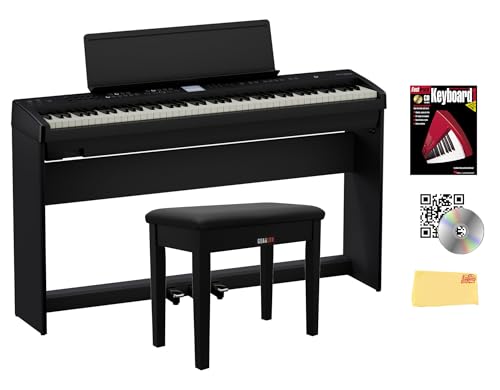
The Roland FP-E50 bundle includes a KSFE-50 stand, KPD-70 three-pedal unit, and a bench. This is a complete home setup out of the box. The Kawai ES520 includes an F-10H single pedal, with an F-302 triple pedal optional. No stand or bench is listed for the Kawai, so those accessories must be purchased separately if needed. The Roland bundle is heavier and more involved to assemble due to the stand and three-pedal unit.
The Kawai's simpler accessory set means quicker setup as a portable, placing the piano on any flat surface with the single pedal. The Roland's arranger features may require more initial configuration, as the cons note that arranger features add menu depth. Neither listing provides specific assembly time or instructions. Overall, the Roland gives you a ready-to-play furniture-style setup, while the Kawai is a portable unit that you accessorize as desired.
Daily Use
For daily piano practice, the Kawai ES520's 40 watt Onkyo speakers offer strong room-filling sound without external amplification. The Roland FP-E50's speaker wattage is not listed, so its standalone volume is harder to compare. The Roland's over 1,000 voices and arranger styles can make practice more engaging for players who like variety. Both actions are hammer actions suitable for piano technique, but the Roland's escapement may help with repetition.
For performance and songwriting, the Roland's microphone input, vocal effects, and auto-accompaniment styles make it a versatile all-in-one. The Kawai does not include these features, so a singer would need separate gear. However, the Kawai's simpler interface means less menu diving during a performance. Daily use depends on your main activity: pure piano practice favors the Kawai's speaker volume, while singing and arranging favors the Roland.
The Deciding Question
The core question is whether you need arranger features and a microphone input, or whether you want the strongest built-in speakers in a simple portable piano. The Roland FP-E50 offers the arranger, over 1,000 voices, and a complete bundle, but its value score is only 3 out of 10, likely due to the higher bundle price. The Kawai ES520 has a higher value score of 7 out of 10, with a loud 40 watt speaker system and Kawai's piano sampling, but no arranger or mic input.
Portability is also a factor, but the Kawai's weight is not published reliably, so a direct comparison is impossible. The Roland's known weight of 37.1 pounds is manageable but not ultralight. The Kawai scores slightly better on build and portability, but that is an editorial rating, not a measured spec. If you need to move the piano frequently, neither is the lightest option, but the Kawai may be the more portable based on its rating.
The deciding question is therefore: What matters more to you, the extra performance features of the Roland or the powerful speakers and piano focus of the Kawai? Answer that, and the choice becomes clear.
Who Should Buy Which
Buy the Roland FP-E50 if you are a singer-songwriter, worship player, or cover musician who needs auto-accompaniment styles, a microphone input with vocal effects, and a huge sound palette. The bundle with stand, three-pedal unit, and bench makes it a complete home instrument. It is also the better choice if you want Roland's PHA-4 Standard action with escapement. Avoid the Roland if you only need a piano or want the slimmest arranger.
Buy the Kawai ES520 if you want Kawai's 88-key sampled piano sound through a 40 watt Onkyo speaker system that can fill a living room or small venue. It is the choice for players who prefer a simpler interface with 34 focused sounds and want USB audio plus Bluetooth MIDI. Avoid the Kawai if you need an arranger, microphone input, or the nicer RHIII action found in the ES920.
Both models score 86 overall, but they serve different needs. Choose the one that matches your performance style and practice environment.
Roland FP-E50
Pros
- PHA-4 Standard action under an arranger engine
- ZEN-Core synth sounds plus SuperNATURAL pianos
- Microphone input with vocal effects and auto-accompaniment styles
- Bundle includes stand, three-pedal unit and bench
Cons
- Heavier and deeper than the Casio PX-S3100
- Arranger features add menu depth
- Bundle price is well above a bare FP-30X
Kawai ES520
Pros
- 40 watt Onkyo-designed speaker system, the loudest in a mid-range portable
- RHC II action and 34 sounds
- Bluetooth MIDI and USB audio
- Kawai's 88-key sampled grand with 192-note polyphony
Cons
- Bluetooth audio not stated on the listing
- Heavier than the ES120
- Costs close to the ES920
Who Should Buy Each
Roland FP-E50
- You sing while you play and want a mic input with effects
- You want ZEN-Core synth sounds and backing styles under real hammer keys
- You want the furniture bundle delivered as one purchase
Kawai ES520
- You play through the built-in speakers in a living room or at small gigs
- You want 34 sounds and USB audio recording
- You prefer RHC II's lighter touch to the ES920's RHIII
Quick Decision Guide
| If you need auto-accompaniment styles and a microphone input for singing or worship | Choose Roland FP-E50 |
| If you want the loudest built-in speakers in a mid-range portable for room-filling piano sound without external amplification | Choose Kawai ES520 |
| If you prefer a key action rated higher for escapement and ivory feel | Choose Roland FP-E50 |
| If you want a simpler interface with fewer voices and a focus on Kawai's acoustic piano sampling | Choose Kawai ES520 |
| If you want a complete home setup with stand, three-pedal unit, and bench included | Choose Roland FP-E50 |
FAQ
About This Comparison
Mandrillis Team
The Mandrillis editorial team researches and compares audio and music gear using manufacturer documentation, verified specs and real buyer feedback, so you can make a confident purchase without wading through marketing claims.
Read our full research methodology.
We may earn a commission at no extra cost to you.