Yamaha Grade Direct Drive Double vs Pearl P3002D
Quick Verdict
The Yamaha Grade Direct Drive Double and the Pearl P3002D both score 86 overall, making this one of the closest matchups in the category, and both are direct drive double bass drum pedals aimed at experienced players. The Yamaha offers one-handed quick-lock spring tension, dual-axis beater and footboard angle adjustment, and two interchangeable beater weights, while the Pearl counters with a convertible Duo-Deck footboard, beater stroke adjustment, and Ninja bearings at the pivot points. Choose the Yamaha if you want beater weight swapping and footboard precision indicators for repeatable settings across kits. Choose the Pearl if a footboard that converts between longboard and traditional shapes, or the backing of an established hardware brand, matters more to you.
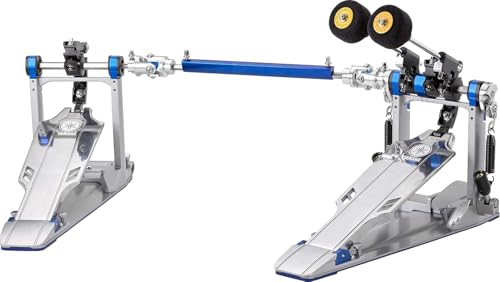

| Spec | Yamaha Grade Direct Drive Double | Pearl P3002D |
|---|---|---|
| Type | Double bass drum pedal, direct drive, with an optional belt drive mentioned in the listing | Eliminator Demon Drive double bass drum pedal with direct drive linkage |
| Size | Not published in listing | Duo-Deck longboard footboard; footboard length and overall dimensions not published in listing |
| Materials | Not published in listing (only the aluminum and brass beater weights are named) | Not published in listing |
| Tuning | One-handed quick-lock spring tension, dual-axis beater and footboard angle adjustment, independent footboard angle with precision indicators | Click lock spring tension and beater stroke adjustment; ranges not published in listing |
| Finish | Not published in listing | Not published in listing |
| Weight | Not published in listing | Not published in listing |
| Included accessories | 3 gram aluminum and 9 gram brass horseshoe beater weights; case or bag not stated | Control Core beaters; case, drum key and drive shaft details not mentioned in listing |
| Made in | Not published in listing | Not published in listing |
| Skill level | Advanced to professional | Intermediate to professional drummers |
| Notes | Listing model code DFP-9D. Reinforced sub-frame, spring roller with integrated bearings. | Ninja bearings at the pivot points; the Duo-Deck name refers to a footboard that can be configured as a longboard or a traditional shorter board |
Pads, Feel and Response
The Yamaha Grade Direct Drive Double uses a direct drive design with an optional belt drive mentioned in the listing, giving the player a choice between the faster, more immediate response of direct drive and the softer feel associated with belt drive, assuming the belt option is fitted. The listing names two beater weights, a 3 gram aluminum and a 9 gram brass horseshoe, letting a player change the feel and attack of each stroke without swapping the whole beater assembly. That weight swap is a quick, tool-light change compared with buying and fitting an entirely different beater model.
The Pearl P3002D is built around the Eliminator Demon Drive linkage, also a direct drive system, and leans on Ninja bearings at the pivot points to keep that linkage moving smoothly with less friction. Its Control Core beaters are described as designed for a focused attack, which is a different approach to tuning feel than the Yamaha's swappable weight system, relying on beater shape and construction rather than interchangeable mass. Both pedals share the same direct drive feel at their core, so the real difference in response comes down to how each brand chooses to let a player fine tune that base feel.
Drum Module and Sounds
Neither of these is an electronic pedal with its own sound module, since both are mechanical double bass drum pedals meant to strike an acoustic bass drum or a kick pad on an electronic kit. Tone and sound in either case come entirely from whatever bass drum or pad the pedal is paired with, not from the pedal itself, so neither listing publishes any sample library or kit count the way an electronic drum set would.
What each pedal does influence is how consistently the beater strikes the head, which affects the evenness of tone from hit to hit. The Yamaha's precision indicators and the Pearl's click lock spring tension both aim at that same goal of a repeatable, consistent strike, just through different adjustment mechanisms. A drummer switching between an acoustic kit and an electronic pad setup would carry either pedal's dialed in settings over just as easily, since the mechanism is independent of what is being struck.
Kick, Hi-Hat and Cymbal Pads
As double bass drum pedals, these products are themselves the kick side of the kit rather than pads to be struck by sticks, so there is no hi-hat or cymbal pad comparison to make here. The Yamaha's reinforced sub-frame is specifically built to resist the flex that the listing says weakens cheaper double pedals, which matters most when playing fast, repeated double kick patterns, since flex under load can throw off both timing and beater alignment over a long set.
The Pearl's Duo-Deck footboard can be configured as either a longboard or a traditional shorter board, which changes how the foot sits and travels across the pedal rather than changing anything about a drum head or cymbal. That convertible footboard is the single feature in this listing with no direct equivalent on the Yamaha, which does not mention a footboard shape option. A player who has tried both longboard and traditional footboards elsewhere and has a clear preference may find that single feature decisive on its own.
Practice Tools and Features
The Yamaha includes one-handed quick-lock spring tension that can be changed between songs, dual-axis beater and footboard angle adjustment, and footboard precision indicators that let a player copy settings from one pedal to a second pedal reliably. That combination of fast tension changes and repeatable indicators is aimed squarely at a player who wants to fine tune feel often and keep it consistent.
The Pearl includes click lock spring tension, beater stroke adjustment for tailoring power and speed, and the convertible Duo-Deck footboard already described. Both pedals support meaningful on the fly adjustment, but the Yamaha's precision indicators are the more specifically documented tool for repeating a setup exactly, while the Pearl's beater stroke adjustment is a distinct control the Yamaha's listing does not mention having.
Build, Rack and Footprint
The Yamaha's listing references a reinforced sub-frame and a spring roller with integrated bearings, both aimed at reducing flex and friction in the drivetrain, though the listing does not publish weight, footboard length, or frame material. Model code DFP-9D is named, which at least lets a buyer search for independent confirmation of those missing physical details.
The Pearl's listing names Ninja bearings at the pivot points for the same friction reducing purpose, and describes the Duo-Deck footboard's dual configuration, but it also does not publish weight, materials, or footboard length. Neither pedal's listing mentions a carrying case or bag, so buyers who need one for transport to gigs or lessons should plan to source one separately for either pedal.
Connectivity and Recording
Double bass drum pedals have no electronic connectivity or recording function of their own, so this category does not apply to either product in the way it would to an electronic drum module. Any recording of a performance using either pedal would happen through whatever kit, microphones, or electronic module the pedal is attached to, with the pedal itself contributing nothing beyond the mechanical strike.
The closest equivalent feature set here is each pedal's ability to be dialed in consistently session after session, since a drummer recording parts across multiple takes benefits from a pedal that returns to the same feel every time. Both the Yamaha's precision indicators and the Pearl's click lock tension serve that consistency goal in slightly different ways, and neither listing claims any advantage specific to studio recording over live performance use.
Setup and Daily Use
Day to day, the Yamaha rewards a player who likes to experiment, since the one-handed quick-lock tension and dual-axis adjustments make mid session changes fast, and the aluminum or brass beater weights can be swapped without tools beyond what is already built into the pedal. The listing calls out that it may offer too many adjustments for a first double pedal, which is a fair caution for a less experienced buyer.
The Pearl rewards a player who wants a specific footboard feel, since switching the Duo-Deck between longboard and traditional configurations changes the whole foot technique required, while beater stroke adjustment lets that same player dial in power separately from footboard shape. Its listing similarly notes that direct drive feel remains a specific taste not every drummer prefers, a caution that applies equally to the Yamaha's direct drive system.
The Deciding Question
The deciding question between the Yamaha Grade Direct Drive Double and the Pearl P3002D is which specific adjustment feature matters more to your playing: interchangeable beater weights with precision indicators for repeatable settings, or a convertible footboard shape with dedicated beater stroke adjustment. Both pedals tie at 86 overall and share the same breakdown scores across every category, so neither has a documented edge in sound, build, playability, versatility, portability, or value on paper.
If you want to change beater mass without swapping parts and copy a dialed in setting precisely to a second pedal, the Yamaha's named features answer that directly. If you want a footboard that can change shape entirely between longboard and traditional styles, backed by one of the most established names in drum hardware, the Pearl is the pedal built around that specific feature.
Who Should Buy Which
Choose the Yamaha Grade Direct Drive Double if you want swappable aluminum and brass beater weights, one-handed quick-lock spring tension, and footboard precision indicators for repeating settings across pedals or kits.
Choose the Pearl P3002D if you want a Duo-Deck footboard that converts between longboard and traditional configurations, dedicated beater stroke adjustment, and the reputation of an established drum hardware brand behind the Ninja bearing linkage.
Yamaha Grade Direct Drive Double
Pros
- Direct drive response with a belt drive option for a softer feel
- Beater weights in two masses let the player tune attack without changing beaters
- One-handed quick-lock spring tension that can be changed between songs
- Footboard precision indicators make settings repeatable across pedals
- Reinforced sub-frame addresses the flex that weakens cheaper double pedals
- Mid-range price tier for a flagship-level feature set
Cons
- Weight, footboard length and frame material are not published in the listing
- No case or bag is mentioned
- Unclear whether the belt drive ships in the box
- Too many adjustments for a first double pedal
Pearl P3002D
Pros
- Duo-Deck footboard offers longboard or traditional configuration
- Beater stroke adjustment tailors power and speed
- Click lock spring tension holds settings and allows repeatable changes
- Ninja bearings reduce friction at the pivots
- Control Core beaters are designed for a focused attack
- Backed by one of the most established names in drum hardware
Cons
- Weight, materials and footboard length are not published
- Direct drive feel is a specific taste
- No case is mentioned in the listing
- Upper mid-range price is significant for an occasional double pedal user
Who Should Buy Each
Yamaha Grade Direct Drive Double
- Metal, fusion and gospel drummers who need clean double strokes at high tempos
- Players who own other Yamaha pedals and want a consistent feel across kits
- Session and touring drummers who rebuild their setup often and need repeatable settings
- Drummers who want to tune attack with beater weights rather than swapping beaters
Pearl P3002D
- Drummers who like to fine tune stroke length, spring tension and footboard shape
- Metal, fusion and gospel players who need speed and consistency
- Players moving up from an entry level double pedal
- Touring drummers who value a long lived, serviceable design
Quick Decision Guide
| If you want interchangeable aluminum and brass beater weights | Choose Yamaha Grade Direct Drive Double |
| If you want a footboard that converts between longboard and traditional shapes | Choose Pearl P3002D |
| If you want footboard precision indicators to copy settings across two pedals exactly | Choose Yamaha Grade Direct Drive Double |
| If you want a dedicated beater stroke adjustment separate from spring tension | Choose Pearl P3002D |
| If this is your first double pedal and you want fewer adjustments to learn at once | Choose Pearl P3002D |
FAQ
About This Comparison
Mandrillis Team
The Mandrillis editorial team researches and compares audio and music gear using manufacturer documentation, verified specs and real buyer feedback, so you can make a confident purchase without wading through marketing claims.
Read our full research methodology.
We may earn a commission at no extra cost to you.