Yamaha P-525 vs Kawai ES920
Quick Verdict
Choose the Yamaha P-525 for the wooden GrandTouch-S action, two concert grands with full VRM and binaural sampling for headphones. Choose the Kawai ES920 for the RHIII action with let-off and counterweights, two grands sampled on every key, 2 x 20 W speakers, an OLED display and a lower price at ten pounds less. The Yamaha is the more acoustic-like keyboard and the deeper engine; the Kawai is the more complete and practical flagship portable.

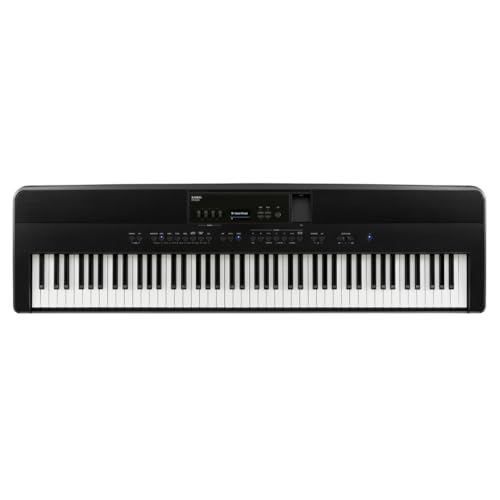
| Spec | Yamaha P-525 | Kawai ES920 |
|---|---|---|
| Key Action | GrandTouch-S with wooden white keys and synthetic ivory tops | Responsive Hammer III with let-off and counterweights |
| Sound Engine | Yamaha CFX and Bosendorfer Imperial with VRM and Grand Expression Modeling | Harmonic Imaging XL with 88-key sampling |
| Voices | Not published in listing | 38 |
| Polyphony | 256 notes | 256 notes |
| Speakers | Built-in two-way stereo | 2 x 20 W |
| Bluetooth | Audio and MIDI | Audio and MIDI |
| USB | USB audio and MIDI | USB audio and MIDI |
| Pedals | Sustain footswitch included; LP-1 triple pedal optional | F-10H pedal included; GFP-3 triple pedal optional |
| Weight | 48.5 lb (22 kg) per listing | 37.5 lb (17 kg) |
| Form Factor | Flagship portable | Portable with OLED display |
Two Flagship Portables
Both are the tops of their makers' portable ranges with 256-note polyphony, Bluetooth audio and MIDI, USB audio, line outputs and full-depth actions. The Yamaha weighs 48.5 pounds and the Kawai 37.5. The Yamaha costs more at the listings we checked. Everything that follows is a comparison of two excellent instruments with different priorities: Yamaha's keys and engine against Kawai's balance of action, speakers and display.
Action
GrandTouch-S uses wooden white keys with synthetic ivory tops, escapement and counterweights, and it is the heavier, more grand-like keyboard, closer to an acoustic than any other portable we have reviewed except the Yamaha CP88. RHIII has three sensors, let-off and counterweights on a long pivot with Ivory Touch surfaces, and it is a console-grade action that is only a step behind in mass and leverage. Pianists who practice on acoustic grands tend to prefer the Yamaha; players who find heavy actions tiring prefer the Kawai.
Sound
The Yamaha runs the CFX and Bosendorfer Imperial through full Virtual Resonance Modeling and Grand Expression Modeling, with binaural sampling of the CFX that makes headphone practice three-dimensional. The Kawai samples the SK-EX and EX on all 88 keys with Harmonic Imaging XL resonance and the Virtual Technician for voicing. The Yamaha's engine is the deeper of the two in modeling; the Kawai's grands are warmer and many listeners prefer them. Both have 256-note polyphony.
On headphones the Yamaha's binaural sampling is a genuine advantage. Through speakers the Kawai's 2 x 20 W system is stronger than the Yamaha's two-way pair.
Display, Panel and Apps
The Kawai has an OLED display on the panel that shows sounds, settings and the Virtual Technician; the Yamaha has a button panel and relies on the Smart Pianist app over Bluetooth MIDI for its Piano Room. Both apps are good; the Kawai is the easier instrument to operate without a tablet.
Connectivity
Both have Bluetooth audio and MIDI, USB audio and MIDI, quarter-inch line outputs, two headphone jacks and a port for a three-pedal unit. The Kawai adds a USB port for flash-drive audio recording. Neither lacks anything a home or performing pianist needs.
Weight, Stands and Pedals
The Yamaha's 48.5 pounds against the Kawai's 37.5 is the practical difference: the Kawai is a one-person lift onto a stand and travels in a standard case; the Yamaha is a piano you place. Both include a basic pedal; Yamaha's L-515 stand with the LP-1 unit and Kawai's HM-5 stand with the GFP-3 unit convert either into a console.
Value
The Kawai is cheaper, lighter, louder and has a display, with an action only a step behind the Yamaha's. The Yamaha's premium buys wooden keys, the two-grand VRM engine and binaural sampling. For a pianist who will practice on headphones and values touch above all, the Yamaha justifies its price; for everyone else the Kawai is the more sensible flagship.
What a Complete Setup Costs
Neither flagship is complete out of the box for a home pianist. The Yamaha ships with a footswitch and the Kawai with a basic pedal, so a half-damper pedal or a three-pedal unit is the first purchase on either. Yamaha's L-515 stand with the LP-1 unit and Kawai's HM-5 stand with the GFP-3 unit each add soft and sostenuto pedals and turn the portable into a slim console. Priced together, the complete Yamaha setup stays more expensive than the complete Kawai setup by roughly the same margin as the pianos alone, so the accessories do not change the value picture.
Headphones matter more here than on any other pair we compare. The Yamaha's binaural CFX sampling was designed for them and sounds flat through cheap closed-back pairs; the Kawai's SK-EX rewards an open-back pair too. Budget for a good set before the stand.
Practice Tools and Learning
Both pianos connect to lesson apps over Bluetooth MIDI without a cable. The Yamaha's Smart Pianist app puts a full on-screen panel, the Piano Room and Audio to Score chord charts on a tablet; the Kawai's PianoRemote app adds the Virtual Technician and a lesson library with Alfred, Burgmuller and Czerny pieces built into the piano. Both have Duo or Four Hands modes that split the keyboard into two equal ranges for teacher and student, and both have two headphone jacks so the lesson can be silent. The Kawai's onboard recorder writes audio to a USB flash drive, which the Yamaha cannot do without a computer.
Long-Term Ownership
Both are instruments owners keep for a decade. The Yamaha's GrandTouch-S action does not become a limit for any player short of a conservatory pianist, and the usual reason an owner moves on is the wish for a full cabinet and the larger speaker systems of the Clavinova CLP range, which share its engine. The Kawai's RHIII action and SK-EX sampling likewise hold up at advanced level, and the step up within Kawai is the CA series with wooden Grand Feel keys. Both hold resale value well because they are the reference portables of their makers. If you expect to move house or gig, the Kawai's lighter weight is the practical long-term advantage; if the piano will sit in one room on headphones, the Yamaha's binaural engine is the one you will still appreciate in year ten.
The Deciding Question
Ask where the piano will be played most. If the answer is on headphones at night in a flat, the Yamaha's binaural sampling and wooden action make it the instrument you will reach for every evening, and its weight stops mattering once it sits on a stand. If the answer is through speakers in a living room, carried to a rehearsal once a month, or set up on a stage, the Kawai's lighter weight, stronger speakers, display and flash-drive recording make daily life easier and the price saved buys a good stand and pedal unit. Pianists who audition both usually come away preferring the Yamaha's keys and the Kawai's convenience, which is why this pairing has no wrong answer.
Who Should Buy Which
Buy the Yamaha P-525 if wooden keys and the deepest piano engine matter more than weight and price. Buy the Kawai ES920 if you want a flagship portable that is lighter, louder, cheaper and easier to operate, with an action that pianists respect. Audition both if you can; the choice is between two of the best portables made.
Yamaha P-525
Pros
- GrandTouch-S wooden-key action with escapement in a portable
- Two concert grands, the CFX and Bosendorfer Imperial, with full VRM
- Binaural sampling for headphones
- Bluetooth audio and MIDI, USB audio and line outputs
Cons
- Heavy at 48.5 pounds
- Priced close to a mid-range console
- Three-pedal unit and stand are extra
Kawai ES920
Pros
- RHIII action with let-off, triple sensors and counterweights
- Harmonic Imaging XL with SK-EX and EX grands sampled across all 88 keys
- 2 x 20 W speakers, the most powerful in a portable at this price
- Bluetooth audio and MIDI plus USB audio and an OLED display
Cons
- Heavy at 37.5 pounds
- Costs roughly double the ES120
- Plain, utilitarian styling
Who Should Buy Each
Yamaha P-525
- You practice on acoustic grands and want a portable that feels like one
- You mostly play on headphones and want binaural sampling
- You want the Bosendorfer as well as the CFX
Kawai ES920
- You want let-off, counterweights and a long pivot in a portable
- You perform and need strong onboard speakers and line outs
- You record over USB audio and use the Virtual Technician
Quick Decision Guide
| If wooden keys and the deepest engine matter most | Choose Yamaha P-525 |
| If weight, speakers and a display matter | Choose Kawai ES920 |
| If you practice mostly on headphones | Choose Yamaha P-525 |
| If price per feature matters | Choose Kawai ES920 |
| If you want flash-drive recording | Choose Kawai ES920 |
FAQ
About This Comparison
Mandrillis Team
The Mandrillis editorial team researches and compares audio and music gear using manufacturer documentation, verified specs and real buyer feedback, so you can make a confident purchase without wading through marketing claims.
Read our full research methodology.
We may earn a commission at no extra cost to you.