Drums & Percussion Review
Roland TD-11 Review: Behavior Modeling Module Without the Pads
The Roland TD-11 is a V-Drums sound module sold on its own, with 50 drum kits, 190 instruments and Behavior Modeling that shapes how each sound responds to the player. The listing adds COACH and QUICK REC functions and a box of mounting hardware and cables. This review covers the module as a standalone purchase.
Our Verdict
Research Score 69/100The Roland TD-11 is a mid-range module whose published strengths are its sound engine and its practice tools. Behavior Modeling, 50 kits and 190 instruments with tuning, muffling, snare buzz, strainer, tone color, volume and pan control give a player real sculpting power, and COACH plus QUICK REC cover daily practice without an app. The listing is weaker on hardware: trigger input count, output panel and explicit USB details are missing, with USB only implied by the driver on the included CD-ROM. The accessory list is unusually complete, including an AC adaptor, connection cable, wing bolts and mounting plate. For a V-Drums owner replacing or upgrading a module, it is a dependable choice once the input count is confirmed.
Editorial research score based on published specifications and documented features, not a customer rating or lab test.

Roland
Roland TD-11
Best for: Owners of a compatible V-Drums pad set who want a replacement or upgrade module with natural-sounding kits and built-in coaching.
Skip it if: You need a complete kit, or you want trigger input count and outputs confirmed on paper before buying.
Check Price on AmazonWe may earn a commission at no extra cost to you.
Listing verified: October 2026
Who Should Buy It
Buy it if
- V-Drums owners replacing a failed or older module
- Players upgrading an entry module to Behavior Modeling sounds
- Students who want COACH exercises and quick recording built in
Skip it if
- You do not already own compatible pads
- You need a published trigger input count for a large kit
- You want deep multi-effects and large user kit memory
Key Specifications
| Pad type | Not included; sound module only |
| Number of pads | None included; trigger input count not published in listing |
| Module and kits | TD-11 module with 50 drum kits and 190 instruments |
| Kick pedal and pad | Not included |
| Hi-hat type | Not included; hi-hat controller support not detailed in listing |
| Cymbal pads | Not included |
| Connectivity | USB implied by the included USB driver; audio outputs and MIDI not itemized in listing |
| Practice features | COACH function and QUICK REC; play-along audio song on the included CD-ROM |
| Footprint | Not published in listing |
| Included accessories | Owner's manual CD-ROM with play-along audio song and USB driver, AC adaptor, special connection cable, two M5 x 10 wing bolts, sound module mounting plate |
Overview
The Roland TD-11 is a drum sound module from the V-Drums line, listed on its own without pads, rack or pedals. It is the brain that a pad set plugs into, and buyers typically come to a standalone module listing because an existing module has failed or because they want to upgrade the sounds behind pads they already own.
The published specification focuses on the sound engine and practice tools. Behavior Modeling and new sensing technology are credited with a natural, expressive response, the library runs to 50 drum kits and 190 instruments with a set of per-instrument parameters, and COACH and QUICK REC functions support practice at home or school.
Hardware details are thinner. The listing does not state the number of trigger inputs, the output configuration or MIDI ports, and USB is only implied by the driver on the included CD-ROM. What it does list in full is the accessory bundle, which includes an AC adaptor, a special connection cable, two wing bolts and a module mounting plate.
Pads, Feel and Response
No pads come with the TD-11, so feel depends on what a buyer connects. The module's part in that is trigger handling, and the listing's claim of new sensing technology points to the module's ability to read velocity and position from compatible pads accurately.
Behavior Modeling is the more interesting claim for feel. According to the listing it models the instrument's distinctive behavior and how it responds to the performer, producing sounds that evolve organically in real time. In practice that means a snare played softly at the edge should sound different from a rimshot at the center, which is what makes an electronic kit feel like a drum rather than a sample player.
Which pads unlock that response is not stated. Positional sensing and multi-zone articulation need pads that support them, and the listing does not name compatible pad models or say how many trigger inputs are available, so owners of older V-Drums pads or third-party pads should confirm compatibility before buying.
Drum Module and Sounds
The library is 50 drum kits built from 190 instruments. That is a modest count beside modules boasting many hundreds of sounds, but Roland's approach puts the emphasis on how each instrument behaves rather than how many there are, and 190 instruments with deep parameters can cover more musical ground than a thousand static samples.
Those parameters are itemized in the listing: tuning, muffling, snare buzz, strainer, tone color, volume and pan. Snare buzz and strainer in particular are details most modules at this tier ignore, and they let a player dial in the sympathetic rattle and the snare-off sound of a real drum.
Not published are effects such as reverb, ambience or multi-effects, user kit memory, polyphony and sample resolution. Compared with a Roland TD-17KVX module, the TD-11 is the simpler engine, and buyers who want to layer effects or import their own samples should look higher in the range.
Kick, Hi-Hat and Cymbal Pads
None of these pads is included, and the listing does not describe the trigger inputs that would receive them. The number of inputs decides how large a kit the module can run, whether a second crash or a fourth tom can be added, and whether a dedicated hi-hat controller jack exists.
Hi-hat handling is one of the clearest tests of a module's quality, since open, half-open, closed and foot-splash articulations all have to be read from a pedal and mapped to sound convincingly. The listing's emphasis on natural, expressive response suggests the TD-11 handles this well, but the controller types supported are not stated.
Cymbal behavior, including bell, bow and edge zones and choke support, depends on the pads as much as the module. The special connection cable in the accessory list suggests a multi-pin loom to a pad set rather than individual jacks, which would also shape how easily extra pads can be added.
- No kick, hi-hat or cymbal pads included
- Trigger input count not published
- Hi-hat controller compatibility not published
- Special connection cable included, suggesting a multi-pin loom
- Mounting plate and two M5 x 10 wing bolts included
Practice Tools and Features
COACH is Roland's family of built-in practice exercises, and the listing describes it as helping to build skills effectively at home, school or any place of practice. Coaching modes typically measure timing against a click and report accuracy, which gives a self-taught drummer objective feedback without a teacher in the room.
QUICK REC is the second documented tool. Recording a short passage with one button press and playing it back immediately is the fastest way to hear whether a fill actually sits in time, and it is the kind of function that gets used daily because it takes no setup.
A play-along audio song is included on the CD-ROM according to the listing, though how it is used with the module is not explained. A metronome is not mentioned explicitly, but a module with coaching functions almost certainly includes one; the listing simply does not describe its options.
Build, Rack and Footprint
The listing does not describe the housing material, dimensions or weight of the TD-11. What it does provide is the mounting hardware: a sound module mounting plate and two M5 x 10 wing bolts, which means the module can be fixed to a compatible rack without hunting for parts.
A mounting plate is a small detail that saves real frustration, because a replacement module without one ends up on a table or a makeshift bracket. The inclusion of the plate and bolts confirms that Roland expects this module to be installed on a V-Drums rack in the usual position.
Durability, button and knob quality and display type are not published. V-Drums modules in general have a reputation for standing up to years of use, which is context rather than specification, and the build score here reflects the documented hardware bundle more than the undocumented chassis.
Connectivity and Recording
USB is the one connection that can be inferred from the listing, because the included CD-ROM carries a USB driver. A driver implies the module presents itself to a computer as a MIDI device, an audio device or both, but the listing does not say which, and that distinction matters for anyone planning to record.
Audio outputs, headphone jack, mix input and five-pin MIDI are not itemized. A drum module without a headphone output would be unusual, and outputs for a monitor or mixer are standard, but a buyer should check the rear panel description before assuming any specific connection.
The AC adaptor is listed as included, which rules out one common replacement-module annoyance. For recording, QUICK REC covers short internal captures, while anything longer or multi-track will depend on the USB capability the listing leaves unconfirmed.
Setup and Daily Use
Installing the TD-11 on an existing rack should be straightforward given the included plate, bolts, adaptor and connection cable. Once mounted, the module needs the connected pads identified in its trigger settings so that sensitivity and zones behave correctly.
Daily use centers on the kit library and the quick parameters. Tuning, muffling and the snare controls are the ones a player returns to most, adjusting a kit for a song or a mood rather than building one from scratch, and a module that makes those adjustments fast encourages exploration.
COACH and QUICK REC fit naturally into a short daily routine. A few minutes of timing exercises followed by recording a groove and listening back is a complete practice loop, and both functions are on the module rather than on a phone, which keeps the session focused.
Who Should Buy It
The TD-11 is for someone who already owns V-Drums pads. The most common case is a failed or outdated module on an otherwise good kit, where replacing the brain is far cheaper than replacing the kit, and the included mounting hardware makes that swap simple.
A second case is the upgrader moving from a basic entry module to one with Behavior Modeling and per-instrument sculpting. The difference in how the snare and toms respond to dynamics is the kind of improvement a developing player notices immediately.
Anyone shopping for a complete kit should look at a full kit rather than this listing. Players with a large pad set who need a confirmed input count, or who want extensive effects and user sample import, should consider a higher module.
Verdict
On the published specification the Roland TD-11 is a sound-first module with practical practice tools and an unusually complete accessory bundle. Behavior Modeling, 50 kits, 190 instruments and the per-instrument parameters give it musical depth, and COACH plus QUICK REC give it daily usefulness.
The connectivity score is held down because the listing does not describe outputs or confirm USB beyond a driver, and the feel score reflects a module that depends on pads it does not include. Build sits in the middle on the strength of the mounting hardware alone.
For a V-Drums owner replacing or upgrading a module, the TD-11 is a sensible mid-range choice once the trigger input count is confirmed against the pads in hand. For anyone starting from nothing, it is only half of an instrument.
Strengths and Limitations
Strengths
- 50 drum kits and 190 instruments with Behavior Modeling
- Tuning, muffling, snare buzz, strainer, tone color, volume and pan per instrument
- COACH and QUICK REC functions for practice
- Ships with AC adaptor, connection cable and mounting plate
- New sensing technology for natural response
Limitations
- No pads included; module only
- Trigger input count and output panel are not published
- USB is only implied by the driver on the CD-ROM
- Effects and user kit details are not stated
How We Scored It
Scores reflect published specifications, documented features and value against the alternatives below. They are editorial research scores, not laboratory measurements.
Alternatives to Consider

Yamaha DTX-MULTI 12
Percussionists, drummers and keyboard-curious players who want a large onboard sound library, user sample memory and melodic sounds on a multi-pad surface.
Read the Yamaha DTX-MULTI 12 review →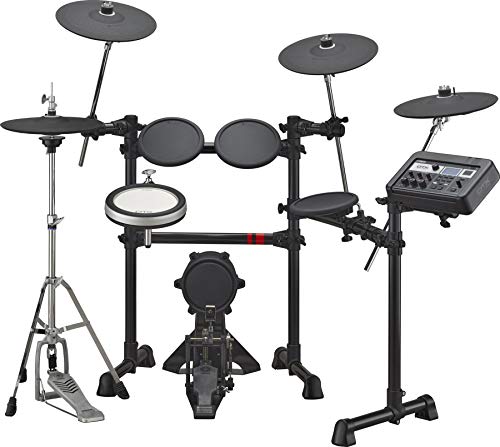
Yamaha DTP62-X
Owners of a DMR6 module or buyers planning a staged DTX6 build who want the pad set, kick tower and hi-hat stand without paying for a module twice.
Read the Yamaha DTP62-X review →
Roland TD-15
V-Drums owners who want a module with USB audio recording, a dedicated click output for live work and fast physical kit editing.
Read the Roland TD-15 review →Questions Buyers Ask
Roland TD-11
See the current listing, price and included accessories.
About This Review
Mandrillis Team
The Mandrillis editorial team researches and compares audio and music gear using manufacturer documentation, verified specs and real buyer feedback, so you can make a confident purchase without wading through marketing claims.
Read our full research methodology.