Guitar & Bass Review
Peavey Classic 20 112 Review: Tube Tone with Power Scaling
The Peavey Classic 20 112 is a tube combo that scales from 20 watts down to 1 watt, with footswitchable channels, reverb, boost, and an effects loop. A direct XLR output and USB connection make it ready for recording, though the listing omits speaker, weight, and dimensions.
Our Verdict
Research Score 80/100The Peavey Classic 20 112 offers practical tube amplification for players who want classic response at manageable volume. The power scaling from 20 watts to 5 watts and 1 watt is the main draw, and the all tube preamp and power section suggests real Peavey voice. Footswitchable channel switching, reverb, boost, and a buffered effects loop cover most live and recording needs. The MSDI XLR output with ground lift and USB output add flexibility for direct recording. The listing does not publish speaker, weight, or dimensions, which makes it hard to judge portability and tone footprint. Overall this is a well equipped upper mid-range tube combo for players who do not need silent headphone practice.
Editorial research score based on published specifications and documented features, not a customer rating or lab test.

Peavey
Peavey Classic 20 112
Best for: Guitarists who want a tube combo with flexible power scaling for home, studio, and small stage use.
Skip it if: Players who need a silent headphone practice amp or built-in amp modeling may want a different design.
Check Price on AmazonWe may earn a commission at no extra cost to you.
Listing verified: October 2026
Who Should Buy It
Buy it if
- Tube amp purists who want a compact all-tube combo
- Home players who need to reduce volume without losing tube response
- Recording musicians who want XLR and USB direct outs
- Small venue performers who can pair this with an external cab
Skip it if
- You want a simple budget practice amp with built-in effects
- You need a headphone output for silent practice
- You prefer a solid state modeling amp with many presets
Key Specifications
| Power output | 20 watts, 5 watts, or 1 watt via attenuator switch |
| Speaker | Not published in listing |
| Amp models or channels | Two footswitchable channels with three-band EQ |
| Effects | Footswitchable reverb and volume boost on both channels |
| Inputs and outputs | Buffered effects loop, MSDI XLR output with ground lift, USB output, speaker output with 16 or 8 ohm impedance switch |
| Headphone and line out | MSDI XLR line output, no headphone output published |
| Bluetooth and app | Not published in listing |
| Weight | Not published in listing |
| Dimensions | Not published in listing |
| Included accessories | Not published in listing |
Overview
Peavey positions the Classic 20 112 as a compact all tube combo for guitarists who want a traditional voice with modern recording tools. The published specification centers on a 2x EL84 power section and 3x 12AX7 preamp tubes, paired with two footswitchable channels and a three band EQ. A built in attenuator selects 20 watts, 5 watts, or 1 watt output, which addresses one of the biggest complaints about tube amps for home use.
The amp also includes footswitchable reverb and a footswitchable volume boost on both channels. A buffered effects loop allows pedals to sit between the preamp and power amp. For recording, the listing details an MSDI output with XLR and ground lift, plus a USB output. The speaker size and type are not published, which leaves the overall voice somewhat undefined on paper.
Amp Models and Tone
This is not a modeling amp. The Peavey Classic 20 112 relies on its all tube signal path, with three 12AX7 preamp tubes and two EL84 power tubes. The two footswitchable channels suggest a clean voice and a driven voice, though the listing does not explicitly name the channel types. The three band EQ is shared across both channels, which is typical for this class.
Peavey has a long history with the Classic series, and the EL84 power section generally provides chiming clean tones and a smooth overdrive when pushed. With the attenuator set to 1 watt, the power tubes can be driven harder at low volume. Buyers report that the gain structure is more rock oriented than a pristine Fender style clean, but without a published speaker spec it is hard to predict the final tonal response.
The volume boost on both channels is a practical feature for solos or for pushing the preamp harder. Because the boost is footswitchable, it works well live. The reverb is also footswitchable, and while the listing does not specify spring or digital, the presence of a dedicated reverb circuit suggests a traditional spring style voice rather than a modeled effect.
Effects and Features
The effects list is short but functional. Footswitchable reverb and volume boost are the main built in effects, and both channels can use them. There are no modulation, delay, or drive models, which is consistent with a traditional tube amp rather than a digital modeling platform.
A buffered effects loop is included and can be switched on or off from the footswitch. This makes time based pedals like delay and reverb behave better than they would in front of the amp, especially with a driven preamp. The listing does not mention an included footswitch, so buyers may need to purchase one separately to access all switching functions.
The T.S.I. circuit, or Tube Status Indication, monitors the power tubes and gives a visual warning when a tube is failing or biased out of range. This is a helpful maintenance feature for a tube amp, because it removes some of the guesswork around tube health. The listing does not describe how the indicator is displayed or whether it affects operation.
Power, Speaker and Volume
The headline feature is the attenuator switch with 20 watt, 5 watt, and 1 watt settings. This is not a simple master volume but a power reduction control that changes the output stage headroom. At 20 watts the amp can hold its own in a band context with an efficient speaker, while the 1 watt mode makes it much easier to push the output tubes into natural compression at home.
The speaker is not published in the listing, which is a significant omission for a combo. The 112 in the name suggests a single 12 inch speaker, but the exact model, magnet, and voice are unknown. The amp can also drive external cabinets, with an impedance switch for 16 or 8 ohm loads. That flexibility helps players use a favorite cab, but the internal speaker remains the biggest unknown.
- Attenuator switch offers 20, 5, or 1 watt output
- 2x EL84 power tubes and 3x 12AX7 preamp tubes
- Speaker output with 16 or 8 ohm impedance switching
- No published speaker size or type
- Power scaling helps drive tubes at lower volume
Build and Portability
Because the weight and dimensions are not published, judgment about portability is limited. The Classic series from Peavey is generally built to be reliable, and the tube complement is not unusual. The 112 name suggests a single 12 inch speaker, which would make the cabinet compact enough for most car trunks, but without measurements that is an assumption.
The faceplate layout appears straightforward with separate controls for channels, EQ, reverb, boost, and power switching. The listing does not mention cabinet material or covering, so buyers cannot assess whether it is tolex, Blackface, or another finish. The amp includes a T.S.I. circuit, which adds a maintenance friendly touch.
Connectivity and Apps
Connectivity is a strong point for a tube amp. The MSDI output with XLR and ground lift is a direct recording output that likely carries a microphone simulated signal, which eliminates the need for a microphone in many recording situations. A USB output is also present, which allows direct digital connection to a computer for recording or re-amping, though the listing does not specify the resolution or driver requirements.
There is no Bluetooth or app support mentioned, so this is not a smart amp. That is a reasonable trade off for a tube amplifier, but players who want app based preset management or wireless audio streaming should look elsewhere. The effects loop also functions as a line level connection point for external effects, but the listing does not detail loop level or whether it is series or parallel.
For live use, the XLR output with ground lift helps avoid hum when connecting to a PA or interface. The USB output makes home recording simple without an audio interface. The absence of a dedicated headphone output means silent practice requires an audio interface or a separate load box, which is a limitation for apartment use.
Setup and Daily Use
Setting up the amp involves the usual tube amp warm up and standby procedure. The power attenuator should be set before turning the amp on to avoid switching under load, though the listing does not state this. The footswitchable functions require an external footswitch, which may not be included, and the listing does not specify a compatible model number.
Daily use at home benefits from the 1 watt setting, but the lack of headphone out and unknown speaker means the amp still produces audible sound. The T.S.I. circuit helps users know when a tube needs attention, and the impedance switch must be set correctly when connecting an external cab. These are small but important operational details.
The three band EQ is simple and quick to adjust, and the two channels can be set for rhythm and lead with the footswitchable boost. Because the listing does not mention channel modes or gain levels, first time users may need to experiment. The USB and XLR outputs make it easy to integrate with a DAW without a microphone.
Home Practice Versus Stage
For home practice, the attenuator is the key feature. A 20 watt tube amp is often too loud for a bedroom, but the 5 watt and 1 watt settings lower the floor significantly. The absence of a headphone out means this is not a silent solution, but it is far more practical than a fixed 20 watt tube combo.
On stage, 20 watts of tube power can work for small clubs and rehearsals when paired with an efficient speaker. The direct XLR output makes it easy to send a signal to the PA without a microphone, and the impedance switch supports a wide range of external cabinets. The footswitchable channel switching and boost make dynamic control possible without pedalboard changes.
The biggest stage limitation is the unknown speaker, because a poor speaker can make a 20 watt amp struggle to cut through a loud band. If the internal speaker is inefficient or voiced dark, players may need an extension cab. The listing does not provide enough detail to confirm stage readiness, so buyers should try before relying on it for gigs.
Who Should Buy It
The Peavey Classic 20 112 is best for guitarists who want real tube compression and harmonic response without a massive stage amp. The power scaling makes it viable for home use, while the two footswitchable channels and boost keep it flexible for live work. It should appeal to players who are comfortable with a simple front panel and no digital menus.
It is also a strong option for home recording because the XLR and USB outputs remove the need for a microphone. Buyers who already own pedals will appreciate the buffered effects loop and the straightforward clean platform. The lack of built in amp models and Bluetooth means this is not for players seeking a do everything practice station.
Verdict
The Peavey Classic 20 112 presents a practical blend of tube tone and modern connectivity. The 20, 5, and 1 watt power settings are the most compelling feature, because they solve a common problem for tube amp owners. The MSDI XLR and USB outputs make the amp easy to record at home or send to a PA, and the T.S.I. circuit adds a layer of reliability awareness.
The main gaps are the unpublished speaker, weight, and dimensions, which prevent a complete assessment of portability and overall voice. There is also no headphone output or Bluetooth, so this amp is not ideal for silent practice or app based control. The listing also does not confirm whether a footswitch is included, which affects the value proposition.
Overall, the Classic 20 112 earns a score of 80, with strong tone and connectivity offset by missing specification details. It is a well equipped upper mid-range tube amp for players who want power scaling and direct recording, but those who require a fully specified portable practice amp may need to keep looking.
Strengths and Limitations
Strengths
- Tube preamp and power section with 2x EL84 and 3x 12AX7
- Power attenuator for 20, 5, or 1 watt
- Footswitchable channels, reverb, boost, and effects loop
- MSDI XLR direct output with ground lift
- USB output for recording
- Impedance switch for 8 or 16 ohm cabinets
Limitations
- Speaker size and type not published
- No Bluetooth or app control published
- Weight and dimensions not published
- Footswitch not listed as included
- No headphone output published
How We Scored It
Scores reflect published specifications, documented features and value against the alternatives below. They are editorial research scores, not laboratory measurements.
Alternatives to Consider
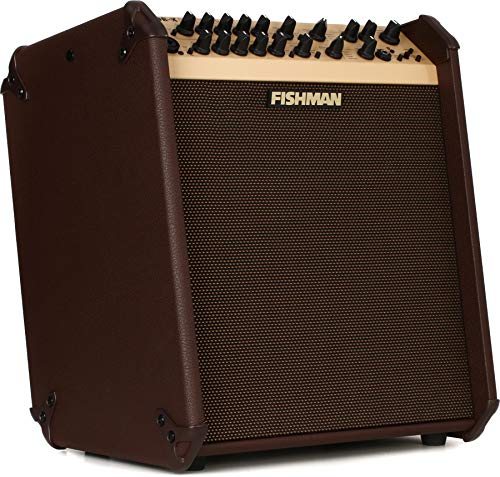
Fishman Loudbox Performer Bluetooth
Solo acoustic performers and duos who need power, dual instrument and microphone inputs, and Bluetooth backing tracks in one box.
Read the Fishman Loudbox Performer Bluetooth review →
Supro Montauk
Players seeking a simple, vintage-styled tube combo with reverb for blues, classic rock, and home recording.
Read the Supro Montauk review →
Peavey Classic 30 II
Players wanting a straightforward American-voiced tube combo for blues, rock, and country at stage or studio volume.
Read the Peavey Classic 30 II review →Head-to-Head Comparisons
- Fishman Loudbox Performer Bluetooth vs Peavey Classic 20 112 Compare →
Questions Buyers Ask
Peavey Classic 20 112
See the current listing, price and included accessories.
About This Review
Mandrillis Team
The Mandrillis editorial team researches and compares audio and music gear using manufacturer documentation, verified specs and real buyer feedback, so you can make a confident purchase without wading through marketing claims.
Read our full research methodology.