Instruments Review
Behringer UB-Xa 16-voice Review: Big Analog Polyphony, Thin Listing
The Behringer UB-Xa 16-voice is a bi-timbral analog polysynth with 32 oscillators, 16-channel five-pin MIDI In, Out and Thru and three footswitch jacks, according to a very short listing. This research review explains what those numbers mean for players and marks everything else the listing does not publish.
Our Verdict
Research Score 78/100The Behringer UB-Xa 16-voice is defined by one number: 16 analog voices, arranged bi-timbrally with two oscillators each. That architecture delivers thick pads, brass and stacked chords that four- and eight-voice synths cannot, and it is offered at an upper mid-range tier that undercuts vintage and boutique polysynths by a wide margin. The listing confirms 16-channel five-pin MIDI In, Out and Thru and three TRS footswitch jacks, and nothing else: key count, format, filter, effects, sequencer, USB, audio outputs, weight and power are all unpublished. The score of 78 rewards the voice count and value and penalizes the documentation. Confirm the format and connections, then buy it for the polyphony.
Editorial research score based on published specifications and documented features, not a customer rating or lab test.
Behringer
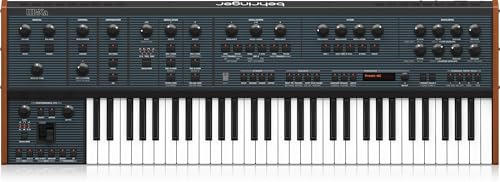
Behringer UB-Xa 16-voice
Best for: Synth players and producers who want a large analog voice count for pads, brass and stacked chords and already know how to work around a thin specification.
Skip it if: You need a documented key count, built-in effects, a sequencer or USB before buying, or you want acoustic and piano sounds.
Check Price on AmazonWe may earn a commission at no extra cost to you.
Listing verified: October 2026
Who Should Buy It
Buy it if
- Pad and brass players who want 16 analog voices without voice stealing
- Hardware studio owners who will use the MIDI Thru chain
- Film and ambient composers who need long releases
- Workstation owners who want one true analog polysynth
Skip it if
- You need built-in effects and an arpeggiator confirmed
- You want USB connectivity
- You are unsure whether you want the keyboard or desktop format
Key Specifications
| Type | 16-voice bi-timbral polyphonic analog synthesizer |
| Synthesis | Analog, 32 oscillators (two per voice) |
| Polyphony | 16 voices, bi-timbral |
| Keys or pads | Not published in listing (key count and format not stated) |
| Sequencer | Not published in listing |
| Effects | Not published in listing |
| Connectivity | 16-channel 5-pin DIN MIDI In, Out and Thru; three quarter inch TRS footswitch jacks; audio outputs and USB not published in listing |
| Power | Not published in listing |
| Weight | Not published in listing |
| Included accessories | Not published in listing |
Overview
The Behringer UB-Xa 16-voice is a polyphonic analog synthesizer, and the listing leads with the numbers that matter in that category: 16 voices, bi-timbral operation and 32 oscillators. The name signals its inspiration, the Oberheim OB-Xa of the early 1980s, and Behringer's established approach is to recreate classic analog circuits at a far lower tier than the originals or their boutique reissues.
Sixteen analog voices is a large number. Most current analog polysynths in the affordable range offer four to eight, so a 16-voice instrument that can split into two independent timbres is pitched at players who want thick stacked pads, full chords with long releases and two sounds at once from one box.
The listing is extremely short. It confirms the voice count, the bi-timbral architecture, the oscillator count, 16-channel five-pin DIN MIDI with In, Out and Thru, and three quarter inch TRS footswitch jacks, and nothing else. This research review works from those facts and from general knowledge of what they mean, and it marks every other specification as not published.
Sound Engine and Tone
Thirty-two oscillators across 16 voices works out to two oscillators per voice, which is the classic architecture for this style of polysynth. Two analog oscillators per voice allow detuning for width, interval stacking for fifths and octaves, and the slow beating that gives vintage-style pads and brass their movement.
Analog in this context means the oscillators and signal path generate and shape sound with real circuitry rather than digital modeling, which is what buyers of this category are paying for: subtle instability, warm filter behavior and a response to control changes that feels continuous rather than stepped. The listing does not state the filter type, envelope count, modulation routing or whether any digital effects are included.
Bi-timbral operation means two complete sounds can be active at once, each with its own patch settings, either split across the keyboard, layered together or addressed on separate MIDI channels. With 16 voices to share, each timbre can still have eight-voice polyphony, which is enough for full chords on both parts.
in-person Control and Workflow
The control panel is not described in the listing. Instruments modeled on early 1980s polysynths typically present one knob or switch per function, with sections for oscillators, filter, envelopes and modulation laid out left to right, and Behringer's analog recreations have followed that convention, but the listing does not confirm the layout here.
Key count and action are not published, and the listing does not state whether this is the keyboard or a desktop format. That is a significant gap for a buyer, because the two formats differ in size, price and playing experience, so confirm the format before ordering.
Three TRS footswitch jacks are documented, which is generous. Footswitches on a polysynth usually handle sustain, patch advance and a performance function such as arpeggiator hold or timbre switching, and having three means a player can keep both in-person the keys while changing sounds and sustaining chords.
Sequencer, Effects and Features
No sequencer or arpeggiator is described in the listing. Polysynths in this style often include an arpeggiator and sometimes a basic sequencer, but nothing is published for the UB-Xa, so the sequencer field is marked as not published and the score for this section is conservative.
Effects are also unstated. The original instruments this design draws on had no built-in effects, and whether Behringer added chorus, delay or reverb is not confirmed by the listing, so buyers should plan for an external effects pedal or plugin for the classic chorused pad sound.
The documented features are therefore the architecture itself: 16 voices, two timbres and two oscillators per voice. For many buyers that is the whole point, and a large analog voice count with bi-timbral splits is a feature set in its own right. Buyers coming from software synths should remember that a 16-voice analog engine is itself the expensive part.
- 16 analog voices with bi-timbral operation
- 32 oscillators, two per voice
- 16-channel five-pin DIN MIDI In, Out and Thru
- Three quarter inch TRS footswitch jacks
Build, Design and Portability
Weight, dimensions, chassis material and panel construction are not published. A 16-voice analog polysynth contains a lot of circuitry, and keyboard versions of this type are not light, so buyers who plan to gig should confirm the weight in the full specification.
Behringer's analog recreations generally use metal chassis and wooden or plastic end cheeks depending on the model, but none of that is stated for the UB-Xa in this listing, so the build score reflects the category expectation rather than documented detail.
Portability depends heavily on the unanswered format question. A desktop version would be far easier to transport than a full keyboard, and a buyer who wants a studio centerpiece will have different priorities from one who wants a stage polysynth.
Connectivity, MIDI and Sync
MIDI is the best-documented part of the listing: 16-channel five-pin DIN MIDI with In, Out and Thru. The Thru port matters in a hardware studio because it passes incoming MIDI to the next device without a merger, and 16-channel support with a bi-timbral engine means each timbre can be driven from its own channel by a sequencer or DAW.
USB, audio outputs, headphone jack, CV inputs and expression pedal inputs are not published. The three TRS footswitch jacks are confirmed, but there is no mention of a continuous pedal input, and a polysynth of this scope would be expected to have stereo outputs for the two timbres, so confirm the audio connections before buying.
Sync over MIDI clock is implied by the MIDI ports but not stated, and without a documented arpeggiator or sequencer there is nothing published that would need clock. Buyers who intend to sync modulation to tempo should check the full specification.
Setup and Daily Use
Analog polysynths need a short warm-up and often an auto-tune routine before the oscillators are stable, and a 16-voice instrument has 32 oscillators to keep in tune. The listing does not describe a tuning routine, but buyers should expect one and allow a few minutes after power-up before a performance.
In daily use the UB-Xa is a sound source for pads, brass, polysynth leads and layered splits, driven from its own keys if it is the keyboard format or from a controller and sequencer if it is the desktop. The MIDI Thru port makes it easy to chain with other hardware.
Power supply type, included cables and any accessories are not published. Plan on a stand, a sustain pedal and an external effects unit as separate purchases, and confirm whether the power supply is internal or an external adapter.
Who Should Buy It
The UB-Xa suits synth players and producers who want a large analog voice count for classic pads, brass and stacked chords at a tier far below vintage or boutique polysynths. Film and ambient composers who need long releases without voice stealing are a natural fit.
It is not for players who need a documented sequencer, built-in effects, USB connectivity or a confirmed key count before buying, and it is not for anyone who wants a stage piano library or acoustic sounds, which it does not attempt.
Owners of a digital workstation who want one true analog instrument beside it are another good match. The bi-timbral engine means the UB-Xa can cover two parts in a hardware setup, which justifies the desk space it takes.
Alternatives Worth Considering
The Korg Minilogue XD is a four-voice analog synth with a digital multi-engine, built-in effects and a sequencer, in a smaller and cheaper package. It cannot approach 16 voices, but it is far better documented and includes the features the UB-Xa listing leaves out.
The Behringer Model D is a monophonic analog recreation at a budget tier for bass and lead duties, and it makes a sensible companion rather than a rival. The Arturia MicroFreak offers experimental digital oscillators with an analog filter at a low tier for players who prioritize character over voice count.
For a player who wants a modern polysynth with full documentation, a sequencer and effects, the Roland JD-Xi or a used mid-range digital polysynth answers more questions on paper, even if neither delivers 16 analog voices.
Verdict
The Behringer UB-Xa 16-voice offers something rare at its tier: 16 analog voices, bi-timbral operation and two oscillators per voice, with five-pin MIDI In, Out and Thru and three footswitch jacks confirmed. For the sound it promises, that architecture is the whole argument.
The listing is one of the thinnest this site has worked from, with no key count, format, filter detail, effects, sequencer, USB, audio outputs, weight or power published. The score of 78 credits the analog voice count and value while penalizing the documentation gaps.
Buyers who already know the instrument and want the voice count will be satisfied by the published facts. Everyone else should confirm the format and connections before committing to an upper mid-range purchase. The lack of a documented spec is a reason to read carefully, not a reason to dismiss the instrument.
Strengths and Limitations
Strengths
- 16 analog voices with bi-timbral splits and layers
- Two oscillators per voice for detuned width
- Five-pin MIDI In, Out and Thru with 16 channels
- Three footswitch jacks for performance control
- Large analog voice count for its price tier
Limitations
- Key count and format not published
- No effects, sequencer or arpeggiator described
- USB and audio outputs not stated
- Weight and power unpublished
How We Scored It
Scores reflect published specifications, documented features and value against the alternatives below. They are editorial research scores, not laboratory measurements.
Alternatives to Consider

Roland JUNO-D7
Gigging keyboardists who cover organ, synth, clav and piano in one set and want range without the weight of a hammer action.
Read the Roland JUNO-D7 review →
Behringer UB-Xa D 16-voice
Producers with a controller keyboard who want a deep analog voice pool for vintage-style pads, brass and strings in a desktop box.
Read the Behringer UB-Xa D 16-voice review →Questions Buyers Ask
Behringer UB-Xa 16-voice
See the current listing, price and included accessories.
About This Review
Mandrillis Team
The Mandrillis editorial team researches and compares audio and music gear using manufacturer documentation, verified specs and real buyer feedback, so you can make a confident purchase without wading through marketing claims.
Read our full research methodology.