Instruments Review
Roland FANTOM 6 EX Review: Every Roland Engine in One Workstation
The Roland FANTOM 6 EX packs ACB, ZEN-Core, V-Piano, SuperNATURAL and Virtual ToneWheel engines, over 7000 sounds, a bundle of classic expansions, full sampling and standout reverbs into a 61-key synth-action workstation. This research review covers what the listing confirms, what it leaves out and who should buy it.
Our Verdict
Research Score 90/100The Roland FANTOM 6 EX combines more named engines than any other keyboard in this group, over 7000 onboard sounds, included JUPITER-8, SH-101 and JX-3P ACB Expansions plus six Model Expansions, sampling with one-shot, pitched and multisample modes, and new Shimmer and Modulation reverbs, all in a compact 61-key synth-action workstation with deep DAW integration. The listing documents the sound side thoroughly, which makes it one of the easiest premium instruments to evaluate on paper. Polyphony, aftertouch, weight, physical ports and sequencer capacity are not published, so verify them from official sources. For producers who want everything in one instrument, it is the strongest workstation here.
Editorial research score based on published specifications and documented features, not a customer rating or lab test.

Roland
Roland FANTOM 6 EX
Best for: Producers and composers who want vintage Roland synth models, pianos, organs, modern ZEN-Core sounds and sampling in one 61-key workstation.
Skip it if: You need weighted keys, a simple stage keyboard with dedicated engine sections, or confirmed polyphony and I/O before committing to a premium purchase.
Check Price on AmazonWe may earn a commission at no extra cost to you.
Listing verified: October 2026
Who Should Buy It
Buy it if
- Media composers who need every classic Roland synth in one instrument
- Electronic producers who sample and arrange onboard
- Session keyboardists who program their own sounds
- Players upgrading from an earlier FANTOM for the included expansions
Skip it if
- You want weighted piano keys
- You prefer dedicated engine sections over a workstation interface
- You need the listing to confirm ports and polyphony
Key Specifications
| Type | 61-key synthesizer workstation with synth-action keys |
| Synthesis | Multiple engines including ACB, ZEN-Core, V-Piano, SuperNATURAL and Virtual ToneWheel; includes JUPITER-8, SH-101 and JX-3P ACB Expansions and n/zyme, JD-800, JUNO-106, JUPITER-8, JX-8P and SH-101 Model Expansions |
| Polyphony | Not published in listing |
| Keys or pads | 61 synth-action keys; aftertouch not published in listing |
| Sequencer | Composition tools referenced but capacity and track count not published in listing; sampling with one-shot playback, pitched keyboard assignment and multisample support |
| Effects | Large effects library including Shimmer Reverb and Modulation Reverb; insert counts not published in listing |
| Connectivity | Deep DAW integration referenced; physical ports not published in listing |
| Power | Not published in listing |
| Weight | Not published in listing |
| Included accessories | ACB and Model Expansions included; physical accessories not published in listing |
Overview
The Roland FANTOM 6 EX is the 61-key member of the FANTOM EX line, and the listing frames it as a creative keyboard platform rather than a stage piano or a single-purpose synth. It brings together multiple Roland engines, over 7000 onboard sounds, sampling and deep DAW integration on a compact synth-action keyboard. It is a premium tier instrument. The 6 in the name denotes its 61-key span within the FANTOM EX range.
The EX designation signals an updated platform. According to the listing the series has been supercharged with advanced sound engines, enhanced composition and performance tools and improved playability, and the bundled ACB and Model Expansions mean many of Roland's classic synth models are included rather than sold separately.
This review relies on the published listing and on general knowledge of what each engine does. The copy is generous about sound sources and features and quiet about polyphony, weight, ports and sequencer capacity, which is noted wherever it affects a buying decision.
Sound Engine and Tone
Few instruments list as many engines as this one. The listing names ACB, ZEN-Core, V-Piano, SuperNATURAL and Virtual ToneWheel, with the phrase and more indicating the list is not exhaustive. ACB is Roland's Analog Circuit Behavior modeling, which recreates the component behavior of specific vintage synths, ZEN-Core is the modern synthesis platform shared across current Roland products, V-Piano models acoustic pianos, SuperNATURAL covers electric pianos and acoustic instruments, and Virtual ToneWheel handles organ.
The included expansions are a significant part of the value. The listing confirms JUPITER-8, SH-101 and JX-3P ACB Expansions, plus n/zyme, JD-800, JUNO-106, JUPITER-8, JX-8P and SH-101 Model Expansions. In practice that means the most requested Roland synth voices, from the JUNO chorus to the JD-800 digital pads, are available on the keyboard without additional purchases.
Over 7000 onboard sounds drawn from the historic Roland library is a very large palette, and it positions the FANTOM 6 EX as a one-keyboard solution for a composer who needs everything. Polyphony is not published in the listing, and because several engines are modeling-based rather than sample-based, the voice count can vary by engine, so buyers should check the manufacturer's figures.
in-person Control and Workflow
The listing describes a powerful and intuitive user interface designed for free-flowing creativity and seamless workflow during composition and performance. That is marketing language, but it points to a design philosophy where the display and panel controls are meant to keep a player out of deep menus while building sounds or arranging. For a workstation that spans sound design, sampling and arrangement, that philosophy matters more than any single knob count.
Specific control counts, the presence of a touch screen, pad arrays and faders are not stated in the published copy. Workstation buyers who rely on pads for sample triggering or on faders for mixing should confirm those details from the manufacturer's images and manual before purchase.
The 61 synth-action keys are described as responsive and expressive. Whether aftertouch is included is not published, which matters for synth players who use pressure for vibrato and filter control. For a 61-key instrument aimed at creators, synth action is the right choice over weighted keys.
Sequencer, Effects and Features
Composition tools are a core part of the FANTOM EX pitch, and the listing refers to enhanced composition and performance tools alongside deep DAW integration. Sequencer capacity, pattern structure and track counts are not published, so the depth of the onboard sequencer has to be confirmed elsewhere even though its presence is implied. Buyers who expect to arrange full songs onboard should check track counts before relying on it as a primary sequencer.
Sampling is confirmed in detail: one-shot playback, pitched keyboard assignment and multisample support. That covers drum hits, chromatic playback of a single sample across the keys and full multisampled instruments, which is the complete set a producer expects from a workstation sampler.
The effects library is described as massive, with new studio-grade Shimmer Reverb and Modulation Reverb called out by name. Shimmer reverb adds pitch-shifted tails that suit ambient pads and cinematic work, and a dedicated modulation reverb points toward lush, moving spaces. Insert counts and the full effect list are not published.
- Over 7000 onboard sounds from the Roland library
- ACB Expansions: JUPITER-8, SH-101, JX-3P
- Model Expansions: n/zyme, JD-800, JUNO-106, JUPITER-8, JX-8P, SH-101
- Sampling with one-shot, pitched and multisample modes
- Shimmer Reverb and Modulation Reverb
- Deep DAW integration
Build, Design and Portability
The listing calls the FANTOM 6 EX the compact FANTOM, and 61 synth-action keys keep the footprint manageable for a workstation of this depth. Weight and dimensions are not published, so treat it as a one-person carry in a padded case until the manufacturer's figures confirm it. For a workstation with this many engines, a 61-key chassis is the most portable format available.
Chassis materials, finish and display size are not stated. The description of the interface as intuitive and the emphasis on playability suggest a panel with plenty of physical control, but that is inference rather than specification and should be checked against product images.
Buyers who need more range should look at the larger FANTOM EX models, which are not part of this listing. The 61-key version is the natural desk companion for producers who already have a weighted controller or who work mainly with synth sounds.
Connectivity, MIDI and Sync
Deep DAW integration is the only connectivity claim in the listing. That phrase normally covers USB audio and MIDI plus control of a DAW's transport and mixer from the keyboard, but the copy does not itemize ports, channel counts or driver details.
Analog outputs, MIDI DIN, pedal inputs, CV or gate connections and external clock options are not published. For a workstation likely to sit at the center of a studio, those are important, and they should be confirmed from the official specification sheet before buying. Owners of CV-equipped modular gear in particular should not assume analog control outputs exist.
Sampling from external sources implies an audio input of some kind, but the listing does not describe it. Players who want to sample a turntable, a microphone or a hardware synth such as a Behringer Model D should verify the input type and level.
Setup and Daily Use
Daily use of the FANTOM 6 EX revolves around moving between sound design, sampling and arrangement without changing instruments. With over 7000 sounds and the included expansions, the first weeks are likely to be spent auditioning and organizing favorites rather than programming from scratch.
The DAW integration means the keyboard can act as a controller and sound source in a software session, while the onboard composition tools allow sketching without a computer. Sample management, including multisample creation, is the task most likely to require time with the manual.
Power supply, included software licenses beyond the expansions, pedals and cables are not published, so accessories are marked as unknown. The ACB and Model Expansions are the confirmed inclusions, and they are substantial. Registering the instrument is likely to be required to activate any cloud-linked content, so plan for that on day one.
Who Should Buy It
The FANTOM 6 EX is for the producer or composer who wants a single workstation that covers vintage Roland synths, acoustic and electric pianos, organs and modern ZEN-Core sounds, plus sampling, in a 61-key format. Media composers, electronic producers and session keyboardists who program their own sounds are the core audience.
Performers who want a synth-action second keyboard with a vast library will also be served, especially if the included JUPITER-8, JUNO-106 and JD-800 models are the sounds they chase. The emphasis on composition tools suits players who write as well as perform.
It is not the right choice for pianists who need weighted keys, nor for buyers who want a simple stage keyboard with dedicated engine sections. At the premium tier the depth is the point, and it should be used.
Alternatives Worth Considering
The Yamaha Montage M6 61-Key is the closest rival in size and ambition, offering three engines, 400-note polyphony and a DAW plugin on an FSX action with aftertouch. Its listing does not mention sampling, so producers who sample will lean toward the FANTOM.
The Roland V-STAGE 76 76-Key shares ZEN-Core and V-Piano technology but organizes them as a stage keyboard with four discrete engine sections and no sequencer or sampling. It is the better choice for performers who want immediacy over depth.
At the other end, a Teenage Engineering OP-1 or an Elektron Digitakt offers sampling in a far smaller and cheaper package, but neither has the engine breadth or the keyboard of a workstation. For a serious studio centerpiece the FANTOM 6 EX stands apart.
Verdict
The Roland FANTOM 6 EX offers more named engines than any other keyboard in this group, a library of over 7000 sounds, a bundle of classic ACB and Model Expansions, full-featured sampling and standout reverbs in a compact 61-key workstation. The sound side is documented thoroughly.
Polyphony, aftertouch, weight, physical ports and sequencer capacity remain unpublished, so verify them from official sources. For producers who want everything in one instrument, it is the workstation to beat.
Strengths and Limitations
Strengths
- Five named engines plus more under one roof
- Over 7000 onboard sounds from the Roland library
- JUPITER-8, SH-101 and JX-3P ACB Expansions included
- Six Model Expansions including JD-800 and JUNO-106 included
- Sampling with one-shot, pitched and multisample modes
- Shimmer Reverb and Modulation Reverb
Limitations
- Polyphony, aftertouch and weight not published in listing
- Physical ports not itemized despite DAW integration claim
- Sequencer capacity not stated
- Depth demands time with the manual
How We Scored It
Scores reflect published specifications, documented features and value against the alternatives below. They are editorial research scores, not laboratory measurements.
Alternatives to Consider
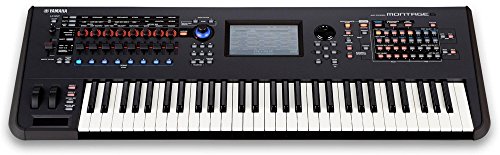
Yamaha Montage6 61-key
Sound designers and performers who want AWM2 realism and FM-X character with a fader bank and a modulation sequencer in a desk-friendly 61-key chassis.
Read the Yamaha Montage6 61-key review →
Yamaha Montage M6 61-Key
Professional synth players and producers who want a flagship 61-key instrument with massive polyphony, analog style synthesis and a matching software plugin.
Read the Yamaha Montage M6 61-Key review →
Roland VAD316
A drummer who wants the acoustic look of wood shells and a full-size kick with Roland's new V31 engine, in a kit that takes less depth than a full-shell set.
Read the Roland VAD316 review →Questions Buyers Ask
Roland FANTOM 6 EX
See the current listing, price and included accessories.
About This Review
Mandrillis Team
The Mandrillis editorial team researches and compares audio and music gear using manufacturer documentation, verified specs and real buyer feedback, so you can make a confident purchase without wading through marketing claims.
Read our full research methodology.