Speakers Review
Monoprice DT-3 50-Watt Review: Compact Desktop Sound
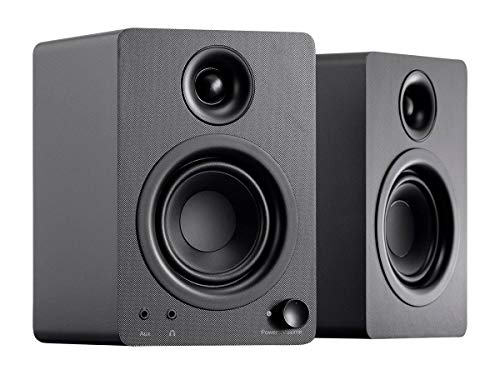
The Monoprice DT-3 50-Watt is a budget powered desktop speaker pair with a 3.5 inch woofer, silk dome tweeter, ported MDF cabinet, and a useful mix of front and rear wired inputs. It includes a headphone jack that mutes the speakers, but skips Bluetooth and lists no dimensions or weight.
Our Verdict
Research Score 65/100The Monoprice DT-3 50-Watt is a budget powered desktop speaker that prioritizes wired flexibility over wireless convenience. Its front input, rear RCA and balanced TRS jacks, and automatic headphone mute are practical features for a compact workspace. The ported MDF cabinet and silk dome tweeter are promising for the price. The main weaknesses are the lack of Bluetooth, the 75 Hz low frequency limit, and the confusing power rating. The listing also omits dimensions and weight, which is frustrating for planning. Still, for users who need a wired near field speaker with balanced inputs and do not care about wireless, the DT-3 offers a sensible budget option.
Editorial research score based on published specifications and documented features, not a customer rating or lab test.
Monoprice
Monoprice DT-3 50-Watt
Best for: Desktop or small-room listening where wired sources and a headphone output matter more than wireless convenience.
Skip it if: You need deep bass, Bluetooth streaming, or a documented full system power rating with clear continuous wattage.
Check Price on AmazonWe may earn a commission at no extra cost to you.
Listing verified: October 2026
Who Should Buy It
Buy it if
- Home office workers who want a compact powered speaker pair with multiple wired inputs
- Gamers or PC users who need front panel access and a headphone jack
- Budget conscious buyers who can accept no wireless features
- Musicians or content creators who want rear balanced TRS connections
Skip it if
- You want wireless Bluetooth or smart speaker features
- You need strong low bass below 75 Hz without a subwoofer
- You require published dimensions and weight before buying
Key Specifications
| Type | Powered desktop/bookshelf speakers |
| Drivers | 3.5-inch polypropylene woofer and 0.75-inch silk dome tweeter per speaker |
| Power or sensitivity | 50-watt class AB amplifier listed; 12 watts/channel woofer and 8 watts/channel tweeter |
| Frequency response | 75 Hz to 20 kHz |
| Inputs and connectivity | Front 3.5 mm TRS stereo, rear stereo RCA, rear stereo 1/4-inch balanced TRS, front 3.5 mm headphone output |
| Bluetooth and streaming | Not published in listing |
| Dimensions | Not published in listing |
| Weight | Not published in listing |
| Finish | Black |
| Included accessories | Not published in listing |
Overview
The Monoprice DT-3 50-Watt is a powered desktop speaker pair positioned in the budget tier. The listing frames it as a multimedia option for home, office, gaming, or entertainment setups. It uses a compact ported MDF cabinet with a 3.5 inch polypropylene woofer and a 0.75 inch silk dome tweeter per speaker.
The product listing highlights a 50 watt class AB amplifier and a set of wired inputs that include a front 3.5 mm stereo jack, rear RCA, and rear quarter inch balanced TRS. There is no Bluetooth or wireless streaming in the published feature set. The brand is Monoprice, a name often associated with affordable AV and cable products, and the DT-3 aims to deliver near field performance without moving into premium pricing.
Sound Quality
The published driver complement suggests a straightforward two way design. A 3.5 inch polypropylene woofer handles the low and midrange, while a 0.75 inch silk dome tweeter covers high frequencies. The listing states a frequency response of 75 Hz to 20 kHz, which means the speaker is not intended to produce deep sub bass or powerful low end on its own.
The ported MDF cabinet is described as custom tuned for superior near field frequency response. On paper this points to a sound that should be clear and balanced at close listening distances, with the silk dome tweeter likely contributing to smoother highs than a hard dome alternative. Without published sensitivity or crossover details, the overall tonal character remains partially unknown, but the specification does not suggest a bass heavy tuning.
For desktop use the 75 Hz low end is common in this size class, but it will not replace a subwoofer. The listing does not publish distortion, dispersion, or maximum SPL figures. Buyers should expect a controlled presentation in the upper bass and midrange rather than room filling low frequency impact.
Drivers, Power and Room Fit
The amplifier description is the most confusing part of the listing. The title and a bullet mention a 50 watt class AB amplifier, while another bullet lists woofer amplifier power at 12 watts per channel and tweeter amplifier power at 8 watts per channel. Those two per channel figures sum to 20 watts per channel, which is a common way to express biamplified desktop speaker power but does not reconcile neatly with the 50 watt headline.
On paper this could mean the 50 watt figure is a peak or system rating, or it could reflect a different measurement condition than the separate woofer and tweeter wattages. The listing does not clarify. A class AB design is often used in near field monitors for lower distortion at modest power, and the specified 12 plus 8 watt split is plausible for a compact desktop speaker.
Room fit is limited by the small woofer and 75 Hz low end. These are not speakers for large living rooms or home theater mains. They are best placed on a desk or shelf within a few feet of the listener, where their near field tuning can work as intended. In a larger room the bass will thin out quickly without a subwoofer.
Features and Connectivity
The DT-3 includes a solid set of wired connections for a budget speaker. The front panel has a 3.5 mm TRS stereo input for quick access from phones, tablets, or laptops. A front 3.5 mm headphone jack automatically mutes the speaker output when headphones are plugged in, which is a practical touch for shared spaces.
The rear panel adds a stereo pair of RCA jacks and a stereo pair of quarter inch balanced TRS jacks. The balanced TRS inputs are not always found at this price tier and make the DT-3 more flexible for audio interfaces, mixers, or other prosumer gear. There is no Bluetooth, no USB input, no optical input, and no wireless streaming in the listing.
- Front 3.5 mm TRS stereo input
- Rear stereo RCA input
- Rear stereo quarter inch balanced TRS input
- Front headphone jack with automatic speaker mute
- No Bluetooth or wireless streaming
- No remote or input selector listed
Build, Design and Finish
The cabinet is described as rounded and ported, made from MDF, and finished in black. MDF is a typical choice in affordable powered speakers because it is dense and reduces unwanted resonance better than thin plastic. The rounded edges may help reduce diffraction and give the speaker a softer visual profile.
The listing does not publish dimensions or weight, which is a notable omission for buyers who need to plan desk space or wall mounting. Without those figures the physical footprint is unknown beyond the stated driver sizes. The black finish appears to be the only color mentioned, and no grille or included accessories are listed.
In terms of build quality, the use of MDF and a ported design is a positive sign for the budget class, but the absence of published weight and dimensions makes it harder to judge cabinet thickness or overall solidity. The silk dome tweeter also suggests a step above very cheap piezo or mylar designs often found in generic speakers.
Setup and Placement
Setup should be straightforward for anyone comfortable with wired audio. Connect a source to the front 3.5 mm input or one of the rear inputs, then power the speakers on. The listing does not describe a power switch location or volume control, so buyers may need to check the manual for basic controls.
Near field placement is implied by the tuning and driver size. The speakers should be placed on a desk or shelf at ear height and angled toward the listener. The front input is convenient for temporary connections, while the rear RCA and TRS inputs suit permanent wiring from a computer, interface, or mixer.
Because the speakers are ported, some distance from the rear wall can help avoid boomy bass buildup. The listing does not mention bass or treble adjustments, so placement and room acoustics will be the main ways to shape the sound. Balanced TRS cables can reject noise over longer runs if used with compatible equipment.
Daily Use
Day to day operation is likely simple but limited by the wired only design. The front 3.5 mm input works well for quickly plugging in a phone or laptop, and the headphone jack is useful when privacy is needed. The automatic mute function means you do not have to turn off the speakers to use headphones.
Switching between multiple rear sources may require an external switcher or unplugging cables, since the listing does not mention an input selector. There is also no remote, so volume adjustments would happen at the source or through whatever control is on the speaker, but the listing does not specify a front volume knob. The lack of Bluetooth means daily use is tied to cables, which some users will find reliable and others will find inconvenient.
The small driver stays clean at moderate desktop levels, based on the published power split, but pushing these speakers hard may reveal their limits. The silk dome tweeter should keep high frequencies from becoming harsh in a near field setup. Overall the DT-3 suits focused listening or background music rather than party volume.
Who Should Buy It
The DT-3 makes sense for buyers who need an affordable powered speaker pair with more than just a basic 3.5 mm input. Home office workers, PC gamers, and students can use the front jack and headphone output without adding an audio interface. The budget price tier keeps the entry cost low.
Musicians or content creators who already own an interface or mixer may appreciate the rear balanced TRS inputs, which are uncommon in consumer desktop speakers. Anyone who values a wired, no latency signal path over Bluetooth convenience is a candidate. Those with limited desk space but no need for deep bass will find the compact format practical.
Alternatives Worth Considering
Edifier R1280DB is a common budget powered bookshelf speaker with Bluetooth and a remote, but it typically lacks balanced TRS inputs. The Edifier may be more convenient for wireless use, while the Monoprice DT-3 offers pro style connectivity. Klipsch R-51M is a passive bookshelf speaker, so it requires a separate amplifier and is not a direct all in one alternative.
For portable use, JBL Flip 6 or Bose SoundLink Flex are battery powered Bluetooth speakers that focus on rugged outdoor use rather than desktop stereo imaging. They cannot match the DT-3's stereo separation or rear balanced inputs. If deeper bass is a priority, a small subwoofer such as the SVS SB-1000 Pro would be needed, but that is a different product category and price tier.
ELAC Debut 2.0 B5.2 is a passive bookshelf speaker known for strong performance but requires amplification. Polk Audio T50 is a floorstanding speaker and not suited for desktop placement. These alternatives illustrate that the DT-3 occupies a specific niche: a budget powered speaker with wired inputs and a headphone output.
Verdict
The Monoprice DT-3 50-Watt is a budget powered desktop speaker that prioritizes wired flexibility over wireless convenience. Its front input, rear RCA and balanced TRS jacks, and automatic headphone mute are practical features for a compact workspace. The ported MDF cabinet and silk dome tweeter are promising for the price.
The main weaknesses are the lack of Bluetooth, the 75 Hz low frequency limit, and the confusing power rating. The listing also omits dimensions and weight, which is frustrating for planning. Still, for users who need a wired near field speaker with balanced inputs and do not care about wireless, the DT-3 offers a sensible budget option.
It is not a bass powerhouse or a smart speaker. It is a straightforward desktop speaker for close listening with multiple wired sources. Given the budget tier, the feature set is fair, but buyers should verify the power rating and physical size before purchase.
Strengths and Limitations
Strengths
- Front 3.5 mm input plus rear RCA and balanced TRS inputs
- Headphone output mutes speakers automatically
- Silk dome tweeter and polypropylene woofer in a ported MDF cabinet
- Class AB amplification listed
- Budget price tier
- Near-field tuning described for desktop use
Limitations
- No Bluetooth or wireless streaming listed
- Frequency response limited to 75 Hz on the low end
- Weight and dimensions not published in listing
- No remote or input selector mentioned
- Power rating details are inconsistent between system and per driver figures
How We Scored It
Scores reflect published specifications, documented features and value against the alternatives below. They are editorial research scores, not laboratory measurements.
Alternatives to Consider

Edifier QR30
A compact desk or gaming setup that wants Bluetooth multipoint, wired fallback, and RGB lighting without a separate amplifier.
Read the Edifier QR30 review →
Gemini 5"
A compact desktop or small room stereo setup where Bluetooth convenience and multiple analog inputs matter more than published lab measurements.
Read the Gemini 5" review →
Monoprice 60-Watt
Small to medium rooms where a compact powered subwoofer can add low-end support to music or home theater systems.
Read the Monoprice 60-Watt review →Questions Buyers Ask
Monoprice DT-3 50-Watt
See the current listing, price and included accessories.
About This Review
Mandrillis Team
The Mandrillis editorial team researches and compares audio and music gear using manufacturer documentation, verified specs and real buyer feedback, so you can make a confident purchase without wading through marketing claims.
Read our full research methodology.