Korg B2+ vs Roland FP-10
Quick Verdict
Choose the Roland FP-10 if the action matters most: PHA-4 Standard with escapement is the best keyboard at the entry price, and Bluetooth MIDI connects apps wirelessly. Choose the Korg B2+ if the piano sound matters most: its two sampled concert grands are warmer and more varied, it has more polyphony, and its one-button panel is the simplest to use. The Roland is the teacher's pick; the Korg is the listener's.
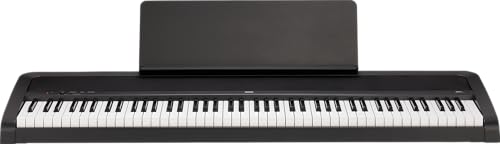

| Spec | Korg B2+ | Roland FP-10 |
|---|---|---|
| Key Action | NH (Natural Weighted Hammer) | PHA-4 Standard with escapement and Ivory Feel |
| Sound Engine | Korg stereo piano samples | Roland SuperNATURAL Piano |
| Voices | 12 | 15 |
| Polyphony | 120 notes | 96 notes |
| Speakers | Built-in stereo | 2 x 6 W |
| Bluetooth | No | MIDI only |
| USB | Yes | USB MIDI (Type B) |
| Pedals | Damper pedal included | DP-2 sustain switch included |
| Weight | 25.1 lb (11.4 kg) | 27.1 lb (12.3 kg) |
| Form Factor | Portable slab | Portable slab |
Two Entry Pianos, Two Philosophies
Both are 88-key hammer-action portables with built-in speakers at the entry price. The Roland FP-10 is about the keys: Roland fitted its mid-range action and kept everything else modest. The Korg B2+ is about the sound and the simplicity: twelve sounds including German and Italian grands, 120-note polyphony and a panel with a button per function. Prices were close at the listings we checked.
Action
PHA-4 Standard has three sensors, simulated escapement and textured Ivory Feel key tops. Korg's Natural Weighted Hammer action is graded and quiet with smooth keys, two sensors and no escapement. The Roland is heavier and more detailed; the Korg is lighter and perfectly adequate for lessons. For a student who will progress, the Roland is the better foundation.
Sound and Polyphony
The Korg's German grand is full and warm, its Italian grand brighter and more percussive, and having two distinct grands at this price is unusual. The Roland's SuperNATURAL grand is modeled, bright and responsive to touch, with sympathetic resonance. Through headphones most listeners prefer the Korg's warmth. Polyphony is 120 notes on the Korg and 96 on the Roland, both adequate for early study. The Roland has fifteen tones, the Korg twelve.
Speakers and Outputs
The Korg's built-in stereo speakers are fuller than the Roland's 2 x 6 W, which are the quietest in the entry class. The Korg has a dedicated line output and an audio input for a phone; the Roland's single headphone jack is also its only output.
Connectivity
The Roland has Bluetooth MIDI for wireless apps and USB MIDI. The Korg has USB with audio and MIDI, so it records its own sound into a computer, but no Bluetooth. Korg bundles the Skoove lesson app and its Module app for iPad; Roland's Piano App connects over Bluetooth.
Panel and Ease of Use
The Korg's panel is a volume knob and a button for each sound group and the metronome; a child can operate it without instruction. The Roland uses hold-and-press key combinations for most settings and leans on its app. For a shared family piano the Korg is easier.
Pedals, Stands and Weight
Both include a switch pedal; Korg's DS-1H and Roland's DP-10 add half-damper response. Korg's STB1 stand and PU-2 pedals, and Roland's KSC-FP10 stand and KPD-70 pedals, convert either into a console. Both weigh about 25 to 27 pounds.
Speakers, Headphones and Rooms
The Korg's built-in speakers are fuller and a little louder than the Roland's 2 x 6 W pair, which are the quietest in the entry class, and the Korg's line output means it can feed a bigger speaker while headphones stay plugged in. The Roland's single jack serves both jobs, one at a time. In a bedroom either is fine; in a living room the Korg carries further and the Roland needs help. Through headphones the Korg's grands are the warmer listen and the Roland's action is the more rewarding to play.
Apps and Learning
The Roland pairs wirelessly with its Piano App and lesson apps over Bluetooth MIDI, which is a genuine convenience for a self-taught adult. The Korg connects over USB with audio as well as MIDI, so it records its own sound into a computer, and it bundles a Skoove subscription and the Korg Module app with higher-quality piano sounds for iPad. Both have Twin or Partner modes for teacher and student and built-in metronomes. The Roland is the wireless one; the Korg is the one that records itself.
Long-Term Fit
FP-10 owners keep the thing they bought it for, the action, and upgrade for outputs and polyphony to the FP-30X, often keeping the FP-10 as a controller. B2+ owners keep the sound and upgrade for a more refined action or Bluetooth, usually to a Roland FP-30X or Kawai ES120. Both are reliable, widely serviced entry pianos with good resale. The teacher's recommendation will usually be the Roland; the family's experience with a simple panel and warm sound will often be the Korg.
Build, Size and Desk Fit
Both are plastic-bodied portables around 25 to 27 pounds. The Roland is narrower at 1284 mm and 258 mm deep, which makes it the easiest 88 in the class to fit on a small desk; the Korg is a conventional width and a little deeper, with a sturdier music rest. Both have their speakers firing upward toward the player. The Korg's panel of physical buttons is more legible across a room; the Roland's minimal panel keeps the look clean. Neither has a key cover, and both suit standard 88-key bags and X-stands.
Who Should Buy Which
Buy the Roland FP-10 for a student whose teacher cares about touch, or for anyone who wants wireless app connection. Buy the Korg B2+ for warmer grand pianos, a line output, USB audio and the simplest panel. Both are good first pianos; they lead with different strengths.
Korg B2+
Pros
- Natural Weighted Hammer action with a graded, acoustic-like weight
- Twelve sounds including three distinct grands
- Simple front panel with one button per function
- Bundled Skoove lessons and the Korg Module app
Cons
- 120-note polyphony is below Roland and Kawai rivals
- No Bluetooth
- Included pedal is a switch rather than a piano-style pedal
Roland FP-10
Pros
- PHA-4 Standard is the most realistic action at this price, with escapement and textured keys
- SuperNATURAL engine models the piano rather than looping samples
- Bluetooth MIDI connects to apps without a cable
- Compact 1284 mm width fits narrow spaces
Cons
- 96-note polyphony is low for layered playing
- Headphone jack is the only audio output
- Speakers are quiet and the included DP-2 pedal is a simple switch
Who Should Buy Each
Korg B2+
- You want a no-menu piano where every function is a button
- You like Korg's German and Italian grand samples
- You will mostly practice through the built-in speakers or headphones
Roland FP-10
- Touch is your first priority and you will practice mostly on headphones
- You want wireless app connection for lessons
- You plan to keep the piano for years as a controller even after upgrading
Quick Decision Guide
| If the action matters most | Choose Roland FP-10 |
| If the piano sound matters most | Choose Korg B2+ |
| If you want wireless app connection | Choose Roland FP-10 |
| If you want a line output and USB audio | Choose Korg B2+ |
| If you want the simplest panel for a child | Choose Korg B2+ |
FAQ
About This Comparison
Mandrillis Team
The Mandrillis editorial team researches and compares audio and music gear using manufacturer documentation, verified specs and real buyer feedback, so you can make a confident purchase without wading through marketing claims.
Read our full research methodology.
We may earn a commission at no extra cost to you.