Korg B2+ vs Yamaha P-45
Quick Verdict
The Korg B2+ wins for players who want a warmer, fuller grand sample and more sounds out of the box, with 120 note polyphony versus 64. The Yamaha P-45 holds its own for absolute beginners who prioritize a proven graded action, simple one-button operation and broad accessory compatibility, but its lower polyphony and single headphone jack are real limits. If you can find the P-45 at a discount, it remains a solid first weighted piano. If both are similarly priced, the Korg B2+ is usually the more complete starter instrument, unless you strongly prefer the Yamaha action.
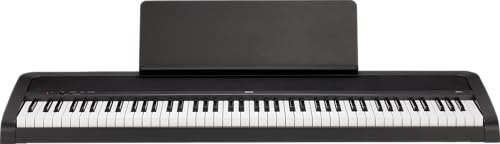

| Spec | Korg B2+ | Yamaha P-45 |
|---|---|---|
| Key Action | NH (Natural Weighted Hammer) | GHS (Graded Hammer Standard) |
| Sound Engine | Korg stereo piano samples | AWM Stereo Sampling |
| Voices | 12 | 10 |
| Polyphony | 120 notes | 64 notes |
| Speakers | Built-in stereo | 2 x 6 W |
| Bluetooth | No | No |
| USB | Yes | USB to Host (MIDI) |
| Pedals | Damper pedal included | Sustain footswitch included |
| Weight | 25.1 lb (11.4 kg) | 25.4 lb (11.5 kg) |
| Form Factor | Portable slab | Portable slab |
Key Action
The Korg B2+ uses the Natural Weighted Hammer action, which the listing describes as graded with an acoustic-like weight. The Yamaha P-45 uses the Graded Hammer Standard action, also graded to feel heavier in the bass like an acoustic piano. Both actions are fully weighted across all 88 keys, and both received a score of 24 out of 30 in this category.
The Korg pros note that the NH action feels lighter than Roland PHA-4, which may suit younger players or longer practice sessions. The Yamaha GHS action is described as teaching proper finger strength, with a heavier feel in the bass to match an acoustic. Neither action is listed with escapement or triple sensor details, so those features are not confirmed.
For a beginner, both actions are credible acoustic-style starting points. The choice may come down to subtle feel preference that the listing cannot quantify. If possible, try both before buying, but the equal key action scores mean this category should not be the sole deciding factor.
Piano Sound and Speakers
The Korg B2+ uses Korg stereo piano samples and offers 12 voices, including three distinct grand pianos. The Yamaha P-45 uses AWM Stereo Sampling with 10 voices. The Korg is described as warm and full-bodied, while the Yamaha is described as having a clean piano tone. The Yamaha cons also mention that its sound engine is older than the P-145 that replaces it.
Polyphony is a major differentiator. The Korg has 120 notes of polyphony, which the listing notes is below some Roland and Kawai rivals but still nearly double the Yamaha's 64 notes. The Yamaha cons state that 64 notes can run out on dense pedaled passages. For players who layer voices or hold sustained chords, the Korg is less likely to cut notes.
Regarding speakers, the Yamaha lists 2 x 6 W of built-in amplification. The Korg listing only says built-in stereo without stating wattage, so a direct power comparison is not possible. Both are portable slabs with onboard sound. The Korg's three grand samples offer more tonal variety, while the Yamaha's clean AWM tone may appeal to classical practice.
Features and Modes
Both instruments are intentionally simple. The Korg B2+ has a front panel with one button per function, and the Yamaha P-45 uses simple one-button operation with nothing to configure. Neither model has Bluetooth or wireless app control. The Korg bundles Skoove lessons and the Korg Module app, but this does not add wireless control from the instrument.
The Korg offers 12 voices compared to the Yamaha's 10, a small edge in creative options. Both include a basic pedal: the Korg includes a damper pedal, and the Yamaha includes a sustain footswitch. The Korg cons clarify that the damper pedal is a switch rather than a piano-style pedal. Neither includes a full piano-style pedal in the base listing.
Learning resources differ. The Korg listing specifically states bundled Skoove lessons and access to the Korg Module app. The Yamaha listing does not mention bundled lessons or an app. Neither listing states built-in rhythms, accompaniment modes, or onboard recording. These are minimal, performance-focused instruments rather than multi-track workstations.
Build, Design and Portability
Both models are nearly identical in weight and size class. The Korg B2+ weighs 25.1 lb (11.4 kg), and the Yamaha P-45 weighs 25.4 lb (11.5 kg). The 0.3 lb difference is trivial for most users. Both use a portable slab form factor and both scored 9 out of 10 for build and portability.
Yamaha's long sales history means that stands, pedals, cases and other accessories are easy to find. The Korg also uses a standard portable slab footprint, though the listing does not state its accessory ecosystem as a specific advantage. Both models require an X-style stand and a bench, neither of which is included in the base listing.
Neither instrument is a console piano, so neither includes a furniture stand or a built-in three-pedal unit. The simple control panels reduce moving parts and potential failure points. Finish and color options are not stated in the provided specifications, so compare on practical build and portability rather than aesthetics.
Connectivity
Both include USB connectivity. The Korg B2+ lists USB yes, while the Yamaha P-45 specifies USB to Host for MIDI. Neither model has Bluetooth, so there is no wireless audio or wireless app communication from the instrument. The Korg's USB capabilities beyond MIDI are not detailed in the listing.
The Yamaha P-45 explicitly has a single headphone jack that doubles as the only audio output, a limitation noted in its cons. The Korg's headphone and audio output configuration is not stated in the provided specs, so we cannot assume it is better or worse. Both include a pedal jack for the included switch or footswitch.
For home practice, a single headphone output is workable but limits connecting external speakers and headphones at the same time. If you need dual headphone outs or dedicated line outputs, neither listing confirms such features. Both models are wired only, with no Bluetooth MIDI or audio support of any kind.
Setup and Accessories
Out of the box, each includes a basic pedal: the Korg B2+ includes a damper pedal, and the Yamaha P-45 includes a sustain footswitch. Neither listing mentions an included stand, bench, or music rest. You will need to purchase or already own at least an X stand and a bench.
The Korg adds learning and app resources: bundled Skoove lessons and access to the Korg Module app. This gives new players structured lessons and additional sounds through a computer or tablet. The Yamaha does not list bundled lessons, though Yamaha does make apps available; the supplied facts do not confirm any bundle for the P-45.
Setup is straightforward for both. Place the piano on a stand, connect the pedal, plug in power, and turn it on. Neither has complex menus or deep configuration. If you buy a bundle, check that it includes a proper X stand and bench, because the base listings do not include them.
Daily Use
For daily practice, both provide immediate key action and sound without boot time. The Korg's 120 note polyphony and 12 voices mean a student can hold sustained chords or layer sounds without note dropouts as quickly. The Yamaha's 64 note polyphony may be fine for single instrument practice but can cut notes during dense pedaled passages.
The Korg's one button per function design reduces menu confusion, especially for children or non-technical users. The Yamaha's one button operation is equally simple, with no screen to navigate. Both are light enough to pick up and move daily, though you should use a padded case for transport to lessons.
Headphone practice is common for apartment and late night use. The Yamaha's single headphone jack works but cannot connect a second listener without a splitter. The Korg's headphone jack count is not stated, so check before assuming dual practice. The included pedal on both is basic and may slide on hard floors; a carpet or pedal board helps keep it in place.
The Deciding Question
The deciding question is whether you prioritize polyphony and sound variety or a long-proven Yamaha action and accessory ecosystem. The Korg B2+ offers 120 note polyphony, 12 voices including three grands, and bundled lessons. The Yamaha P-45 offers 64 note polyphony, 10 voices, and a graded hammer action from a model sold for years.
Both score within one point overall, so neither is objectively dominant. If you play layered pieces, use sustained passages, or want multiple grand piano flavors, the Korg is the safer choice. If you prefer Yamaha's clean tone, simple operation, and easy replacement parts, the P-45 remains a valid option.
The supplied verdicts support this: the Korg B2+ is the entry portable for warm, full-bodied grand samples, while the Yamaha P-45 is a sound first piano if found at a discount. Since both lack Bluetooth and app control, those requirements eliminate both models. Choose the Korg for more headroom; choose the Yamaha if price and long-term availability matter most.
Who Should Buy Which
Buy the Korg B2+ if you want a straightforward weighted piano with Korg's warm grand samples, three distinct grands, 12 voices, and 120 note polyphony for dense practice. It suits absolute beginners through early intermediate players who will use bundled Skoove lessons and prefer no configuration. Avoid it if you need Bluetooth, 192 note or higher polyphony, or app control.
Buy the Yamaha P-45 if you are a first-year student who wants a proven weighted 88-key piano at the lowest Yamaha price, especially if you find it at a clear discount to the P-145. Its GHS action teaches proper finger strength, and its one-button operation is hard to beat. Avoid it if you want Bluetooth, app control, or more than 64 notes of polyphony.
If you are unsure between them, consider what you will play in the next two years. Chordal pop and romantic classical with heavy pedal favor the Korg's polyphony. Straightforward method book practice and a tight budget favor the Yamaha. Both are excellent starters, but the Korg's extra sounds and polyphony give it a slight practical edge at a similar price.
Korg B2+
Pros
- Natural Weighted Hammer action with a graded, acoustic-like weight
- Twelve sounds including three distinct grands
- Simple front panel with one button per function
- Bundled Skoove lessons and the Korg Module app
Cons
- 120-note polyphony is below Roland and Kawai rivals
- No Bluetooth
- Included pedal is a switch rather than a piano-style pedal
Yamaha P-45
Pros
- Graded hammer action that feels heavier in the bass like an acoustic
- Simple one-button operation with nothing to configure
- Light enough to carry to lessons or gigs
- Sold for years, so stands, pedals and cases are easy to find
Cons
- 64-note polyphony runs out on dense pedaled passages
- Single headphone jack doubles as the only audio output
- Older sound engine than the P-145 that replaces it
Who Should Buy Each
Korg B2+
- You want a no-menu piano where every function is a button
- You like Korg's German and Italian grand samples
- You will mostly practice through the built-in speakers or headphones
Yamaha P-45
- You are starting lessons and your teacher asked for 88 weighted keys
- You want the simplest possible piano with no menus to learn
- You plan to connect to a computer or tablet over USB for apps
Quick Decision Guide
| If you play dense classical or layered sounds and need polyphony headroom | Choose Korg B2+ |
| If you want three distinct grand piano samples and 12 voices out of the box | Choose Korg B2+ |
| If you want the lowest Yamaha price with a proven graded hammer action | Choose Yamaha P-45 |
| If you want bundled Skoove lessons and the Korg Module app included | Choose Korg B2+ |
| If you prefer clean Yamaha tone, simple operation, and broad accessory support | Choose Yamaha P-45 |
FAQ
About This Comparison
Mandrillis Team
The Mandrillis editorial team researches and compares audio and music gear using manufacturer documentation, verified specs and real buyer feedback, so you can make a confident purchase without wading through marketing claims.
Read our full research methodology.
We may earn a commission at no extra cost to you.