Rode RODECaster Pro 2 vs Behringer X AIR XR18 18-Channel
Quick Verdict
Choose the Rode RODECaster Pro 2 bundle if you are starting a four person podcast or stream and want microphones, boom arms, headphones, and an SD recorder in one purchase with built in broadcast processing. Choose the Behringer X AIR XR18 18-Channel if you run a band, church, or small venue and need 16 recallable preamps, per channel USB recording, and tablet based mixing from anywhere in the room. The Rode scores 86 against the Behringer's 84, reflecting its all in one simplicity for a desk setup. The Behringer trades physical faders for Wi-Fi tablet control and a rack format built to live on stage. Pick the Rode for a desk bound podcast studio, pick the Behringer for live sound work.

| Spec | Rode RODECaster Pro 2 | Behringer X AIR XR18 18-Channel |
|---|---|---|
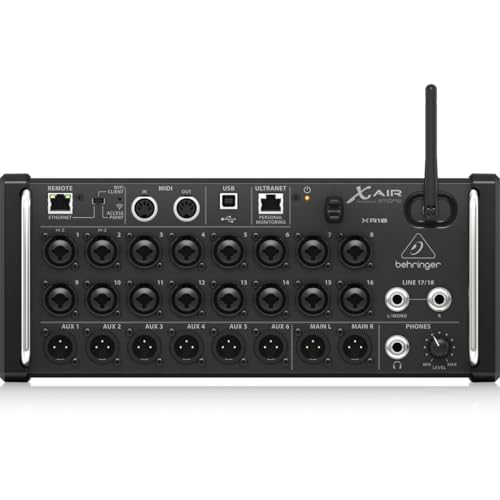
| Type | Integrated podcast production console: multitrack audio interface, mixer, sound pad controller and broadcast processor, sold as a four-person bundle | 18-channel, 12-bus digital rack mixer controlled from iPad or Android tablets |
| Inputs | XLR microphone inputs for up to four participants (bundle ships four PodMics and four XLR cables); USB and Bluetooth audio sources; exact input count not published in listing | 18 inputs including 16 Midas-designed programmable mic preamps |
| Outputs | Headphone connections for participants; USB outputs to two devices; other output types not published in listing | Main: 2 x XLR (aux outputs not published in listing) |
| Preamps | Revolution Preamps, described as ultra-low-noise; gain figure not published in this listing | 16 Midas-designed, fully programmable mic preamps (gain figure not published in listing) |
| Resolution | Not published in listing | Not published in listing |
| Phantom power | Not published in listing | Not published in listing |
| Connection | Dual USB interfaces for Mac, PC, iOS and Android; Bluetooth for phone calls and monitoring | Integrated tri-mode Wi-Fi router plus 18 x 18 bidirectional USB audio interface |
| Monitoring | Headphone outputs for the host and guests; count and level details not published in listing | Not published in listing |
| Bundled software | Not published in listing | Tablet control app implied by the listing but not named |
| Included accessories | 4 Rode PodMic microphones, 4 PSA1+ boom arms, 4 StreamEye Cans50 over-ear headphones, 4 XLR cables, 32GB SD card | Not published in listing |
Sound Quality
The Rode RODECaster Pro 2 scores 27 out of 30 for preamps and sound quality, ahead of the Behringer X AIR XR18 18-Channel at 25 out of 30. The Rode's Revolution Preamps are described as ultra low noise, with a built in exciter, compressor, and noise gate processing each channel before it is recorded.
The Behringer relies on 16 Midas designed preamps with remote programmable gain, a pedigree that carries real weight in live sound even without the broadcast processing the Rode adds. Neither listing publishes an exact gain figure for its preamps, so the comparison rests on the named technology behind each.
For podcast style processing that shapes voice automatically, the Rode's built in processing chain is the more complete answer. For live instruments and vocals that need clean, recallable gain across many channels, the Behringer's Midas lineage is the stronger foundation.
Pickup Pattern and Noise Handling
Pickup pattern does not apply directly to either product, since both are mixing consoles rather than microphones, but each handles incoming noise differently. The Rode RODECaster Pro 2 includes a built in noise gate as part of its Revolution Preamp processing, cutting low level background sound between spoken phrases automatically.
The Behringer X AIR XR18 18-Channel does not publish a built in noise gate feature in this listing, relying instead on its 16 remote programmable preamps to control gain at the source. Dugan style auto mixing is also noted for a firmware update, which would automatically balance multiple open microphones rather than reduce static noise.
For a solo or small podcast setup, the Rode's automatic processing reduces the need for manual noise control. For a live band or church setting with many open channels, the Behringer's auto mixing firmware feature, once shipped, addresses a different and arguably harder noise problem.
Build Quality
The Rode RODECaster Pro 2 scores 13 out of 15 for build and design, ahead of the Behringer X AIR XR18 18-Channel at 11 out of 15. The Rode ships as a desk mounted console with nine channels, six physical faders, and eight SMART pads built into one surface.
The Behringer is built as a rack mounted unit with no physical faders at all, since every adjustment happens through a connected tablet. That rack format is an advantage for a stage that needs the mixer tucked away, but a disadvantage for anyone who wants direct physical control.
Neither listing publishes weight or exact dimensions for either product. The choice here is less about which is sturdier and more about whether a buyer wants a tactile desk surface or a compact rack box controlled remotely.
Connectivity and Setup
The Behringer X AIR XR18 18-Channel scores 9 out of 10 for connectivity, narrowly ahead of the Rode RODECaster Pro 2 at 8 out of 10. The Behringer includes a built in tri mode Wi-Fi router alongside a bidirectional USB audio interface, removing the need for a separate wireless access point.
The Rode offers dual USB interfaces that can record and stream to two devices at once, plus Bluetooth for phone call recording and wireless monitoring. It can also record up to 14 channels directly to an SD card with no computer required at all.
The Behringer's built in Wi-Fi is purpose built for remote tablet mixing in a venue. The Rode's dual USB and standalone SD recording are purpose built for a podcast desk that still wants a backup if a computer fails.
Features, Controls and Extras
The Rode RODECaster Pro 2 scores 14 out of 15 for features and software, just ahead of the Behringer X AIR XR18 18-Channel at 14 out of 15 as well. The Rode's nine channels, six faders, and eight SMART pads give it a genuine control surface for sound effects and scene switching during a live recording.
The Behringer answers with 16 Midas designed preamps and 12 buses across an 18 channel frame, plus the previously mentioned Dugan style auto mixing planned for a firmware update. Twelve buses give an engineer real flexibility for monitor mixes and subgroups in a live setting.
For podcast production that benefits from sound pads and instant scene recall, the Rode's surface is the more direct fit. For live sound work that needs monitor buses and remote gain recall across many channels, the Behringer's feature set targets a different, more technical audience.
Use Cases: Vocals, Streaming, Podcasting and Instruments
The Rode RODECaster Pro 2 is built specifically for podcasting and streaming, with its four person bundle including Rode PodMic microphones, boom arms, headphones, and cables ready for a desk based show. The dual USB interfaces make simultaneous recording and streaming straightforward for a small team.
The Behringer X AIR XR18 18-Channel is built for live instruments and vocals on a stage, with 16 preamps able to take microphones, instruments, and line level sources from a band or worship team. Its USB interface also allows per channel recording for later mixing.
A podcast team of up to four people will find the Rode bundle removes nearly every other purchase decision. A band, church, or small venue running more sources through a stage mixer will find the Behringer's channel count and rack format better suited to that job.
Who Should Buy It
The Rode RODECaster Pro 2 is best for podcast and streaming teams of up to four people who want a complete desk mounted studio with broadcast processing and standalone SD recording in one purchase. The Behringer X AIR XR18 18-Channel is best for bands, churches, and small venues that want per channel USB recording and remote mixing from a tablet.
Buyers who record solo or with one guest may find the Rode's four person bundle more than they need, in which case a smaller interface and a single microphone could be a better use of the budget. Buyers who need physical faders and knobs rather than a tablet should also think carefully about the Behringer's control scheme.
Both products score within two points of each other, 86 for the Rode and 84 for the Behringer. The decision should follow the use case rather than the score alone.
The Deciding Question
The deciding question is whether the gear needs to sit on a desk for recorded conversations or on a stage for live sound. If the answer is a desk and a group of up to four voices, the Rode RODECaster Pro 2's complete bundle removes nearly every other decision.
If the answer is a stage, a band, or a venue with many microphones and instruments, the Behringer X AIR XR18 18-Channel's 16 preamps and remote tablet mixing are built for that exact job. Physical control matters here too, since the Behringer has no faders while the Rode has six.
Budget tier is similar for both, so the real question is control surface versus remote flexibility. Podcasters tend to prefer the Rode's tactile pads and faders, while touring or volunteer sound engineers often prefer the Behringer's tablet based remote mixing.
Who Should Buy Which
Buy the Rode RODECaster Pro 2 if you are building a four person podcast or stream and want microphones, boom arms, headphones, and SD card recording bundled with broadcast grade processing. It is the stronger choice for a desk based production team.
Buy the Behringer X AIR XR18 18-Channel if you run live sound for a band, church, or small venue and want 16 recallable Midas preamps, per channel USB recording, and a rack mixer controlled remotely from a tablet. It is the stronger choice for stage and venue work.
With scores of 86 and 84, the Rode and the Behringer are close, but they are built for different rooms entirely. Match the purchase to whether the audio happens around a podcast desk or on a stage, not to the score difference alone.
Rode RODECaster Pro 2
Pros
- Complete four-person kit with mics, boom arms, headphones, cables and SD card
- Revolution Preamps with built-in APHEX exciter, compressor and noise gate
- Dual USB interfaces allow recording and streaming to two devices at once
- Records up to 14 channels to SD card with no computer required
- Nine channels, six physical faders and eight SMART pads on one surface
- Bluetooth for phone call recording and wireless monitoring
Cons
- Listing does not publish sample rate, bit depth or preamp gain
- Phantom power and exact input count are not stated
- Bundled headphones are a third-party model rather than a Rode product
- Upper mid-range tier is a large outlay for a first podcast
- Bundled software and desktop apps are not listed
Behringer X AIR XR18 18-Channel
Pros
- 16 Midas-designed preamps with remote-programmable gain
- 18 x 18 bidirectional USB interface for per-channel recording and playback
- Built-in tri-mode Wi-Fi router removes the need for an external access point
- 12 buses on an 18-channel frame for monitors and subgroups
- Rack format keeps the mixer on stage while the engineer mixes from anywhere
- Dugan-style auto-mixing noted for a firmware update
Cons
- No physical faders, every adjustment happens on a tablet
- Resolution, phantom power and aux output count are not published
- Wi-Fi reliability in crowded venues is a known concern for tablet mixers
- Auto-mixing was listed as a future firmware feature, not a shipping one
Who Should Buy Each
Rode RODECaster Pro 2
- Interview and panel podcasts with three or four regular voices
- Streamers who need to record locally while streaming from a second device
- Small studios and agencies setting up a client-ready podcast room
- Producers who want broadcast processing without plug-ins or outboard gear
Behringer X AIR XR18 18-Channel
- Bands that mix their own monitors from the stage on phones or tablets
- Churches that want scene recall so each service starts from a saved mix
- Small studios that need an 18 x 18 interface and a live mixer in one box
- Engineers who want to walk the room while adjusting the mix
Quick Decision Guide
| If you are starting a podcast with up to four people and want everything bundled | Choose Rode RODECaster Pro 2 |
| If you run live sound for a band, church, or small venue | Choose Behringer X AIR XR18 18-Channel |
| If you want physical faders and sound pads on a desk surface | Choose Rode RODECaster Pro 2 |
| If you need 16 recallable preamps with remote tablet mixing | Choose Behringer X AIR XR18 18-Channel |
| If you want standalone SD card recording with no computer required | Choose Rode RODECaster Pro 2 |
FAQ
About This Comparison
Mandrillis Team
The Mandrillis editorial team researches and compares audio and music gear using manufacturer documentation, verified specs and real buyer feedback, so you can make a confident purchase without wading through marketing claims.
Read our full research methodology.
We may earn a commission at no extra cost to you.