Instruments Review
Arturia KeyStep Pro Review: Sequencer Meets Keyboard
Arturia KeyStep Pro pairs a 37 key slim keybed with a four track polyphonic sequencer, a seven type arpeggiator, and CV, Gate, and Mod outputs for analog gear. This review covers what the listing confirms about keys, encoders, and connectivity, plus the specs that remain unpublished, including power and bundled software.
Our Verdict
Research Score 70/100Arturia KeyStep Pro, as described in this listing, is a compact 37 key controller built around a four track polyphonic sequencer, a seven type arpeggiator, five encoders, and CV, Gate, and Mod outputs for analog gear. That combination makes it most interesting to a hybrid studio player who wants one unit that can sequence ideas and bridge software and hardware instruments, rather than someone who only needs a simple plug and play keyboard. Several specs, including power source, weight, bundled software, and specific DAW integration, are not published in this listing, which keeps some buying questions open. At a lower mid-range price, it is a reasonable pick for the sequencing and connectivity features confirmed here, provided the unpublished gaps are not deal breakers for the buyer.
Editorial research score based on published specifications and documented features, not a customer rating or lab test.

Arturia
Arturia KeyStep Pro
Best for: Hybrid studio players who want one compact controller to sequence ideas and connect both software synths and analog or modular gear.
Skip it if: Avoid it if you need drum pads, a full-size key feel, mixer style faders, or confirmed bundled production software.
Check Price on AmazonWe may earn a commission at no extra cost to you.
Listing verified: November 2026
Who Should Buy It
Buy it if
- Producers who split time between software instruments and analog or eurorack synthesizers
- Players who want a built in sequencer and arpeggiator for writing away from a DAW
- Buyers who specifically need CV and Gate output from a compact keyboard controller
Skip it if
- You need dedicated drum pads for finger drumming
- You require a full-size weighted key action
- You need confirmed bundled software or sample content in the box
Key Specifications
| Keys | 37 key slim keybed, velocity sensitive |
| Key type | Slim keys with velocity sensitivity and aftertouch support |
| Pads | Not published in listing |
| Knobs and faders | 5 encoders for sequencer pattern and tone editing, no faders mentioned |
| DAW integration | Not published in listing |
| Bundled software | Not published in listing |
| Connectivity | USB, plus CV, Gate, and Mod outputs for analog synthesizer control |
| Power | Not published in listing |
| Weight | Not published in listing |
| Included accessories | Not published in listing |
Overview
Arturia KeyStep Pro sits at the intersection of a playable keyboard controller and a dedicated hardware sequencer, built around a compact 37 key slim keybed. The product listing describes a four track polyphonic sequencer built directly into the hardware, which separates this controller from simpler USB MIDI keyboards that only transmit notes to software. Buyers shopping in the lower mid-range tier are getting a device aimed at producers who want sequencing and control options beyond a standard plug and play keyboard.
The core pitch is flexibility across two different studio setups, a software based rig running virtual instruments, and a hardware based rig built around an analog synthesizer or eurorack modules. According to the listing, the keybed pairs velocity sensitivity with aftertouch, while a built in arpeggiator section and a bank of five encoders round out the control surface. On paper, that combination positions the controller as a hub rather than a simple input device.
Keys, Pads and Feel
The keybed is a 37 key slim design, which trades the depth and spacing of a full-size piano action for a smaller footprint that fits on a crowded desk or in a gig bag. The listing specifies velocity sensitivity and aftertouch support, meaning the keys respond to how hard a note is struck and to how much pressure is applied after the note is held down. That second layer of expression is typically used to add vibrato, filter movement, or modulation while a note sustains.
Arturia KeyStep Pro does not list any dedicated drum pads in its feature set, so finger drumming or sample triggering is not part of the control surface. Rhythmic work instead runs through the built in sequencer and the keybed itself, with notes and patterns entered directly on the keys. Buyers who specifically want velocity sensitive pads for beat programming will not find them described anywhere in this listing.
Knobs, Faders and DAW Integration
Five encoders make up the in-person control section, and the listing ties them directly to sequencer pattern editing and tone or parameter adjustment on connected gear. Encoders are endless rotary controls rather than fixed sweep knobs, which makes them well suited to scrolling through steps, patterns, or parameter pages without hitting a hard limit. The listing does not break down what each individual encoder is assigned to by default.
No faders are mentioned anywhere in the feature bullets or listing title, so mixing style level control is not part of this unit as described. That is consistent with a sequencer focused controller rather than a mixer style control surface, where encoders handle most editing duties instead. Buyers wanting dedicated faders for a DAW mixer should look elsewhere, since this listing gives no indication they exist on this model.
The listing does not name any specific DAW, nor does it describe class compliant mapping for software such as Ableton Live, Logic Pro, or FL Studio. That omission does not mean the keyboard cannot send standard MIDI data to any DAW, since any class compliant USB MIDI controller can usually do that, but it does mean buyers should not expect confirmed deep integration features, custom DAW templates, or software specific mapping from the published listing alone.
Software, Sounds and Features
The standout feature in the listing is a set of seven built in arpeggiator types capable of spanning up to five octaves, giving players a way to turn a single held chord into a moving melodic or rhythmic pattern. That range is wide for a compact controller, and it suggests the arpeggiator section is meant to be a creative tool in its own right rather than a basic on and off utility.
Alongside the arpeggiator, the four track polyphonic sequencer lets a player build and layer multiple parts, which can be useful for sketching a full arrangement without opening a DAW first. The listing frames this as a built in hardware function rather than a companion app, so the sequencing happens on the controller itself and can drive both software instruments and external analog gear through the same unit.
The listing does not mention any bundled software, sample packs, or virtual instrument licenses included with purchase. That is worth noting because several competing controllers add a software bundle as part of the value proposition, and buyers who expect production software, plugins, or sound libraries in the box should treat that as unconfirmed for this specific listing.
- Four track polyphonic sequencer built into the hardware
- Seven arpeggiator types spanning up to five octaves
- Five encoders for pattern and tone editing
- CV, Gate, and Mod outputs for analog gear
- No bundled software or sample content stated in the listing
Build, Design and Portability
The 37 key slim keybed points toward a compact chassis meant to travel easily between a home studio and a gig bag, though the listing does not publish exact dimensions or weight. That gap makes it difficult to say with certainty how it will sit next to other gear on a desk, or how much it adds to a travel case.
No specific materials, finish, or chassis construction details appear in the feature bullets, so claims about build quality beyond what the listing visually implies cannot be confirmed from the data given. Buyers who care about chassis rigidity, keybed housing, or connector mounting should treat that information as currently unpublished rather than assume a particular build standard.
Connectivity and Power
Connectivity centers on a USB connection alongside CV, Gate, and Mod outputs, which the listing says can be used to control an analog synthesizer. CV, or control voltage, and Gate signals are the standard language that modular synthesizers and many analog instruments use to receive pitch and trigger information, so this output lets the keyboard step outside the USB MIDI world and talk directly to that kind of hardware.
A Mod output adds a third signal path, typically used to send a modulation source such as an envelope or a slower moving control signal to a synthesizer parameter, though the listing does not specify exactly how that output is generated or scaled. For players mixing software instruments with analog or eurorack gear, this three way output set is one of the more useful aspects of the listing, since many USB only controllers cannot bridge to that hardware at all.
Power source is not stated in the listing, so it is unconfirmed whether the unit runs on USB bus power alone, requires an external supply for the CV and Gate outputs, or supports both. That is a meaningful gap for anyone planning to run this away from a computer, since CV and Gate circuitry on some controllers draws more current than a USB port alone can comfortably supply.
Setup and Daily Use
As a USB MIDI controller, the basic setup path is connecting the unit to a computer and letting the operating system or DAW recognize it as a MIDI input device, which is standard for class compliant hardware in this category. The listing does not describe a dedicated editor application, so pattern and arpeggiator settings are likely adjusted from the hardware itself using the encoders and onboard controls.
Daily use for a hybrid studio likely centers on the sequencer and arpeggiator sections, since those are the features the listing highlights most heavily. A player could sketch a four track pattern, route one part to a software synth, and send another through the CV and Gate outputs to an analog synthesizer, all from the same control surface without extra MIDI interfaces.
Who Should Buy It
This controller suits a player who wants a single compact unit that can sequence ideas, play expressively through aftertouch, and bridge into analog or modular gear through CV and Gate outputs. Producers who already own an analog synthesizer or a small eurorack setup and want a keyboard that can talk to both that hardware and a computer are a strong match for what the listing describes.
It also fits buyers who want a built in sequencer and arpeggiator for writing without opening a laptop first, since those features work as standalone hardware functions rather than requiring a DAW to be running. The lower mid-range price tier makes this a reasonable entry point for that kind of hybrid workflow.
It is a weaker fit for someone who specifically needs drum pads for finger drumming, a full-size key feel, dedicated mixer style faders, or confirmed bundled production software, since none of those are described in this listing. Buyers with those specific priorities should look at a different model with those features explicitly published.
Alternatives Worth Considering
Buyers comparing options in this space often look at the Arturia MiniLab 3, a smaller controller generally positioned around pad and knob based production work with a bundled software focus rather than a built in hardware sequencer and CV output section. The two serve different workflows even within the same brand family, so the choice comes down to whether CV, Gate, and sequencing matter more than pads and a compact production layout.
Novation Launchkey Mini is another common comparison point for buyers who want tighter DAW specific mapping and a small footprint, though it is generally built around pads and a conventional controller layout rather than CV or Gate output for analog gear. Nektar Impact LX models are also frequently mentioned for buyers who want a transport control focused layout aimed squarely at DAW control rather than standalone sequencing.
Verdict
Arturia KeyStep Pro, as described in this listing, combines a compact 37 key slim keybed with a four track polyphonic sequencer, a seven type arpeggiator, five encoders, and CV, Gate, and Mod outputs for analog gear. Buyers get a hybrid tool rather than a simple plug and play keyboard, and the lower mid-range price reflects a product aimed at a specific kind of hybrid studio workflow.
The gaps in this listing, including power source, weight, bundled software, and named DAW integration, are real limits on what can be confirmed before buying. For a player who already knows they want hardware sequencing and CV connectivity in a small footprint, the confirmed features here support a reasonable purchase, though anyone needing those unpublished details should look for additional confirmation first.
Strengths and Limitations
Strengths
- Built in four track polyphonic sequencer for standalone composing
- Seven arpeggiator types spanning up to five octaves
- CV, Gate, and Mod outputs for controlling analog synthesizers
- Velocity sensitive 37 key slim keybed with aftertouch
- Five encoders dedicated to pattern and tone editing
Limitations
- No drum pads for finger drumming or sample triggering
- No bundled software or sample content stated in the listing
- Power source, weight, and build materials not published in the listing
- No confirmed DAW specific integration or mapping details
How We Scored It
Scores reflect published specifications, documented features and value against the alternatives below. They are editorial research scores, not laboratory measurements.
Alternatives to Consider

Yamaha Montage M6 61-Key
Professional synth players and producers who want a flagship 61-key instrument with massive polyphony, analog style synthesis and a matching software plugin.
Read the Yamaha Montage M6 61-Key review →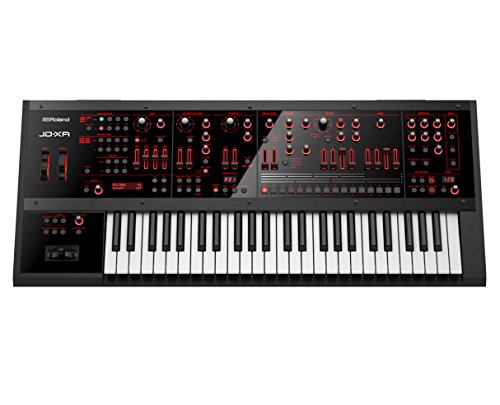
Roland JD-XA 49-Key
Synthesists who want genuine discrete analog voices and a digital engine in one 49-key crossover instrument with deep real time filter control.
Read the Roland JD-XA 49-Key review →
Pioneer DJ DDJ-FLX10 4-Channel
Mobile and open-format DJs who want a 4-channel club style controller with live stem separation and lighting control from one unit.
Read the Pioneer DJ DDJ-FLX10 4-Channel review →Questions Buyers Ask
Arturia KeyStep Pro
See the current listing, price and included accessories.
About This Review
Mandrillis Team
The Mandrillis editorial team researches and compares audio and music gear using manufacturer documentation, verified specs and real buyer feedback, so you can make a confident purchase without wading through marketing claims.
Read our full research methodology.