Instruments Review
Behringer DEEPMIND 6 Review: Real Keys, Aftertouch and a Deep Matrix
The Behringer DEEPMIND 6 is a six-voice analog polysynth with 37 full-size semi-weighted keys and aftertouch, two synced oscillators per voice, three envelopes, an eight-channel modulation matrix with 19 sources and more than 130 destinations, and four effects processors. This research review covers that specification and the filter, port and weight details the listing omits.
Our Verdict
Research Score 75/100The Behringer DEEPMIND 6 is a compact analog polysynth whose listing covers what matters most: six analog voices with two synced oscillators, three ADSR envelopes with auto-trigger, a two-channel LFO with seven waveshapes and MIDI sync, a 37-key full-size semi-weighted keyboard with expressive aftertouch, an eight-channel modulation matrix offering 19 sources and more than 130 destinations, and four effects processors with 30 algorithms from TC Electronic, Midas and Klark Teknik. The filter type, connectivity, sequencer, power and weight are not published and should be checked from the manual. For a keyboard player who wants real keys, aftertouch and deep modulation in a mid-range six-voice analog synth, it is an easy recommendation on paper; pad players should consider the twelve-voice model instead.
Editorial research score based on published specifications and documented features, not a customer rating or lab test.

Behringer
Behringer DEEPMIND 6
Best for: Keyboard players who want an expressive, compact analog poly with full-size keys, aftertouch and a deep modulation matrix in the mid-range tier.
Skip it if: You need more than six voices for pads, a confirmed onboard sequencer, or published ports and weight before you buy.
Check Price on AmazonWe may earn a commission at no extra cost to you.
Listing verified: October 2026
Who Should Buy It
Buy it if
- Performers who want aftertouch-driven expression on a real keyboard
- Sound designers who will exploit a matrix with 19 sources and 130-plus destinations
- Gigging players who want a lighter analog synth with effects built in
- Bass, lead and chord players who rarely exceed six notes
Skip it if
- You play dense sustained pads
- You want a note sequencer confirmed in the listing
- You require published connectivity before ordering
Key Specifications
| Type | 6-voice polyphonic analog synthesizer, 37-key |
| Synthesis | Analog, 2 oscillators per voice with sync modes, 7 waveshapes, 2-channel LFO (key sync, MIDI sync), 3 ADSR envelopes (VCF, VCA, MOD) with auto-trigger, 8-channel modulation matrix with 19 sources and over 130 destinations |
| Polyphony | 6 voices |
| Keys or pads | 37 full-size semi-weighted keys with aftertouch |
| Sequencer | Not published in listing |
| Effects | 4 built-in processors, 30 algorithm types (TC Electronic, Midas, Klark Teknik): reverb, chorus, flanger, delay, multi-band distortion |
| Connectivity | MIDI sync confirmed; ports not published in listing |
| Power | Not published in listing |
| Weight | Not published in listing |
| Included accessories | Not published in listing |
Overview
The Behringer DEEPMIND 6 is a six-voice analog polysynth with a 37-key semi-weighted full-size keyboard and aftertouch, and this listing is the most complete of the six-voice DeepMind listings. It confirms the keyboard, the dual-oscillator voice, the modulation matrix with 19 sources and more than 130 destinations, and four built-in effects processors. It is priced in the mid-range tier.
The six-voice DeepMind was designed as the compact performance version of the family, trading voice count for a shorter keyboard and lower cost while keeping the modulation depth and effects of the twelve-voice model. The combination of full-size keys with aftertouch in a 37-key chassis is what sets it apart from the many mini-key compact synths at this tier.
This research review is drawn from the published specification. The keyboard, voices, modulation and effects are documented in detail, while the filter type, connectivity, power supply, weight and included accessories are not, and those gaps are flagged in the sections where they matter.
Sound Engine and Tone
Six authentic analog voices, each with two analog oscillators and oscillator sync modes, form the sound source. Two oscillators per voice allow detuning for width, interval stacking for fifths and octaves, and sync for cutting leads, and the listing describes seven waveshapes available in the modulation section.
The envelope section is described as three-line ADSR, with VCF, VCA and MOD envelopes and an auto-trigger function. Separate contours for filter, amplitude and modulation are what make a sound move independently in brightness, loudness and vibrato, and envelope auto-trigger lets an LFO restart an envelope for rhythmic pulsing without a new key press.
The filter type is not published in this listing, which is a gap given how much of the DeepMind character comes from it. The family's desktop listing names an IR3109-style low-pass design, and buyers should confirm from the manual whether this keyboard model uses the same circuit.
in-person Control and Workflow
The keyboard is the headline of this listing: 37 full-size, semi-weighted keys with high sensitivity and expressive aftertouch. Semi-weighted action with aftertouch on a compact synth is unusual, and it allows a player to add vibrato, open the filter or swell an effect by pressing into a held note.
Aftertouch combined with a modulation matrix of 19 sources and more than 130 destinations gives the DEEPMIND 6 a level of expressive control that most synths in the tier cannot match. Routing aftertouch to filter cutoff for one program and to chorus depth for another is the kind of per-sound tailoring the matrix allows.
Panel layout, fader count and display type are not described in the listing. The DeepMind keyboards are known for a fader-per-function design in the Juno tradition, but the specification here does not confirm the number of controls, so buyers who want to see the panel should check product photos.
Sequencer, Effects and Features
Four built-in effects processors with 30 algorithm types from TC Electronic, Midas and Klark Teknik are confirmed, covering reverb, chorus, flanger, delay and multi-band distortion. Four processors at once means a program can be fully produced inside the synth, with a chorus for width, a delay for rhythm and a reverb for space all running together.
The eight-channel modulation matrix is the deepest feature on the instrument. With 19 sources including effect parameters, an effect control can itself become a modulator, so a delay feedback level or a reverb mix can drive a filter or an LFO rate. More than 130 destinations means almost every parameter can be a target.
No note sequencer or arpeggiator is confirmed in this listing, and the control sequencer mentioned in the family's desktop listing is not stated here either. A buyer who wants onboard pattern recording should verify it from the manual, since this listing is silent on the subject.
- 6 analog voices, 2 oscillators each with sync
- 37 full-size semi-weighted keys with aftertouch
- 8-channel modulation matrix, 19 sources, over 130 destinations
- 3 ADSR envelopes (VCF, VCA, MOD) with auto-trigger
- 2-channel LFO with 7 waveshapes, key sync and MIDI sync
- 4 effects processors, 30 algorithms
Build, Design and Portability
A 37-key full-size keyboard sets the width of the instrument, which makes the DEEPMIND 6 wider than a mini-key synth of the same note range but narrower than a 49-key keyboard. Dimensions and weight are not published, so the exact footprint and the carrying load must be confirmed.
Chassis material is not stated. Owners of DeepMind keyboards report metal construction and full-length faders, which would suit the gigging player the 37-key format targets, but this review treats that as unconfirmed for the listing.
Power supply type is unpublished. A compact performance synth benefits from an internal supply with a standard mains cable so that a lost adapter cannot stop a show, and buyers should check the manual to see which approach this model uses.
Connectivity, MIDI and Sync
MIDI sync is confirmed for the LFO section, which means the instrument receives MIDI clock, but the listing does not itemize connections. Audio outputs, MIDI in and out, USB, pedal and expression inputs are all unpublished.
Because the effects are stereo and the voices can be spread across the field, stereo outputs are the expectation, and a USB connection for a software editor would make the 130-destination matrix much easier to manage. Neither is confirmed in the published data.
For stage use, MIDI-synced LFOs allow tremolo, filter wobble and auto-triggered envelopes to lock to a drum machine or DAW tempo. Whether the DEEPMIND 6 can send clock to other gear, or respond to an analog sync pulse, is not described.
Setup and Daily Use
Setup follows the familiar analog poly routine of power, audio and MIDI, then a tuning cycle before the first session. The listing does not describe tuning behavior or warm-up time, so new owners should allow a few minutes before judging pitch stability.
Daily use of the DEEPMIND 6 is shaped by the keyboard. Full-size semi-weighted keys with aftertouch invite the instrument to be played as a performance synth rather than a sequencer-driven module, and the matrix lets each program respond to touch differently.
The modulation matrix is the part worth studying. Loading factory programs and reading their matrix assignments reveals how 19 sources and more than 130 destinations are used in practice, which is faster than building routings from scratch on day one.
Who Should Buy It
The DEEPMIND 6 is for keyboard players who want an expressive, compact analog poly with full-size keys and aftertouch, and who mostly play basses, leads and chords within six voices. The deep modulation matrix makes it as rewarding for sound designers as for performers.
Gigging musicians who need a lighter analog synth with effects built in, and who value a real keyboard over a mini-key one, are the clearest target. Producers who want aftertouch-driven expression in a mid-range analog instrument are also well served.
It is less suitable for players who need more than six voices for pads, and for anyone who wants a confirmed sequencer. Buyers who require published connectivity and weight before ordering should check the manual first.
Alternatives Worth Considering
The Behringer DEEPMIND 12 offers twelve voices with the same modulation and effects for pad-heavy players, and the DEEPMIND 12D is the desktop version for those who already own a keyboard. Both cost more than the six-voice model.
The Korg Minilogue XD is the closest competitor in format: a compact analog poly with a digital oscillator, effects and a documented sequencer. It has fewer voices, no aftertouch and far fewer modulation destinations, but its sequencer is confirmed.
The Roland JD-Xi is a lower-tier crossover with an analog section, digital parts and a pattern sequencer, for buyers who prioritize self-contained groove production over analog polyphony and keyboard feel. The Arturia MicroFreak is a budget hybrid with a touch keyboard for experimental sounds.
Verdict
The Behringer DEEPMIND 6 is a compact analog polysynth with a published specification that covers what matters: six analog voices with two synced oscillators, three envelopes, a two-channel LFO with seven waveshapes, a 37-key full-size semi-weighted keyboard with aftertouch, an eight-channel matrix with 19 sources and more than 130 destinations, and four effects processors with 30 algorithms. That is a complete performance instrument on paper.
The listing leaves the filter type, connectivity, sequencer, power and weight unpublished. Those should be checked, but the documented strengths are enough to place it among the better mid-range analog keyboards.
For a keyboard player who wants real keys, aftertouch and deep modulation in a six-voice analog synth, it is an easy recommendation on paper. Pad players should consider the twelve-voice model, and sequencer-first buyers the Minilogue XD.
Strengths and Limitations
Strengths
- 37 full-size semi-weighted keys with aftertouch
- 6 analog voices with two synced oscillators each
- 8-channel matrix, 19 sources, over 130 destinations
- Three envelopes with auto-trigger and a MIDI-synced LFO
- Four effects processors with 30 algorithms
- Compact performance format
Limitations
- Filter type not published
- No sequencer or arpeggiator confirmed
- Connectivity, power and weight unpublished
- Six voices limits layered pads
How We Scored It
Scores reflect published specifications, documented features and value against the alternatives below. They are editorial research scores, not laboratory measurements.
Alternatives to Consider
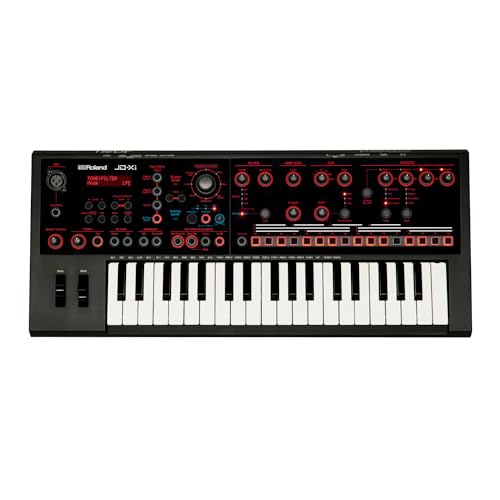
Roland JD-XI 37-Key
Electronic producers and performers who want analog bass and lead, digital pads, drums, a pattern sequencer and a vocoder in one compact mid-range keyboard.
Read the Roland JD-XI 37-Key review →
Roland GAIA 2
Learners and performers who want a hybrid synth with a transparent panel, expressive Motional Pad control and Roland chorus and reverb character in a mid-range keyboard.
Read the Roland GAIA 2 review →
Behringer DEEPMIND 6,Black
Players who want the DeepMind analog voice and onboard effects in a smaller, mid-range instrument and mostly play basses, leads and chords of six notes or fewer.
Read the Behringer DEEPMIND 6,Black review →Questions Buyers Ask
Behringer DEEPMIND 6
See the current listing, price and included accessories.
About This Review
Mandrillis Team
The Mandrillis editorial team researches and compares audio and music gear using manufacturer documentation, verified specs and real buyer feedback, so you can make a confident purchase without wading through marketing claims.
Read our full research methodology.