Instruments Review
Roland JD-XI 37-Key Review: Analog Bass, Digital Pads, One Small Box
The Roland JD-XI 37-Key is a crossover synthesizer with an analog section for leads and basses, two digital SuperNATURAL synth parts, a rhythm part, a four-track pattern sequencer, four simultaneous effects and a vocoder with AutoPitch using the included gooseneck microphone. This research review covers that feature set and the polyphony and connection details the listing omits.
Our Verdict
Research Score 73/100The Roland JD-XI 37-Key is a compact crossover synth with a documented analog section for authentic leads and basses, two digital SuperNATURAL synth sections, a rhythm part with drum sounds, a four-track pattern sequencer, four simultaneous effects and a vocoder with AutoPitch that works from the included gooseneck microphone. For the mid-range tier that is a complete groove instrument capable of building a whole arrangement without a computer. The listing does not publish polyphony, key size, connectivity, power or weight, and the key size in particular should be confirmed by anyone who intends to play it as a keyboard rather than a sequencer. For an electronic producer or performer who wants everything in one small box, it is an easy recommendation on paper; pianists and polysynth programmers should look elsewhere.
Editorial research score based on published specifications and documented features, not a customer rating or lab test.
Roland
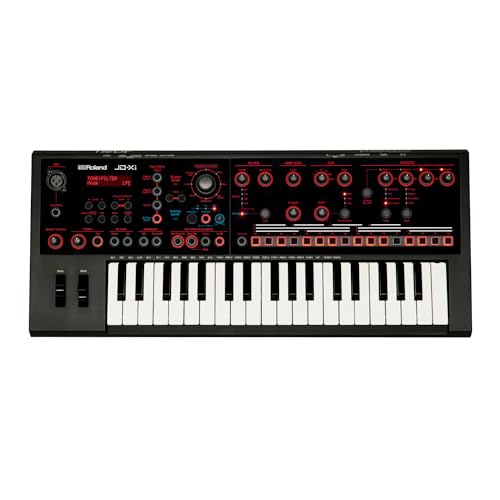
Roland JD-XI 37-Key
Best for: Electronic producers and performers who want analog bass and lead, digital pads, drums, a pattern sequencer and a vocoder in one compact mid-range keyboard.
Skip it if: You need full-size keys, wide polyphony for chordal playing, or published connectivity before buying.
Check Price on AmazonWe may earn a commission at no extra cost to you.
Listing verified: October 2026
Who Should Buy It
Buy it if
- Producers moving from software to a first self-contained hardware groove synth
- Performers who want processed vocals and synth parts from one box
- Electronic musicians who sketch loops without a computer
- Players who want a real analog bass and lead voice in a compact keyboard
Skip it if
- You play two-handed parts and need full-size keys
- You want a deep polysynth rather than a groove instrument
- You require confirmed USB, MIDI and audio ports
Key Specifications
| Type | 37-key analog/digital crossover synthesizer, black |
| Synthesis | Analog synth section (lead and bass) plus two digital SuperNATURAL synth sections and a rhythm part |
| Polyphony | Not published in listing |
| Keys or pads | 37 keys; key size and action not published in listing |
| Sequencer | Four-track pattern sequencer |
| Effects | Four simultaneous: Effect 1, Effect 2, Delay, Reverb; plus Vocoder and AutoPitch |
| Connectivity | Not published in listing (microphone input implied by included mic) |
| Power | Not published in listing |
| Weight | Not published in listing |
| Included accessories | Gooseneck microphone |
Overview
The Roland JD-XI 37-Key is a crossover synthesizer that pairs an analog synth section with two digital SuperNATURAL synth sections, a drum part, a four-track pattern sequencer and a vocoder with an included gooseneck microphone. The listing calls it interactive, which reflects its role as a compact groove instrument as much as a keyboard synth. It sits in the mid-range price tier.
When Roland introduced the JD-Xi it was the company's first keyboard in years to include a real analog voice, and it packaged that voice with the digital engines from its larger instruments and a pattern sequencer in a small 37-key chassis. The result is a self-contained writing tool for electronic music rather than a traditional polysynth.
This research review relies only on the published specification. The four sound parts, the sequencer, the vocoder and the effects are documented, but polyphony, key size and action, connectivity, power and weight are not, and each of those gaps is flagged where it matters.
Sound Engine and Tone
The analog synth section is described in the listing as providing authentic lead and bass tones, which indicates a monophonic or near-monophonic analog voice intended for the parts where analog matters most. A real analog oscillator and filter for basses and leads gives the JD-XI a weight and edge that purely digital compact keyboards lack.
Two digital synth sections use SuperNATURAL synth tones, Roland's modeling technology drawn from its larger stage and production keyboards. These digital parts handle pads, keys, plucks and polyphonic material, and they can be layered with the analog part to combine a digital chord bed with an analog bass in one pattern.
Polyphony for the digital sections is not published in the listing, and neither is the voice count of the analog section. The rhythm part is described as offering high-quality rhythm sounds, which means a drum kit sits alongside the three synth parts and completes a four-part arrangement from one unit.
in-person Control and Workflow
The JD-XI has 37 keys, which the listing confirms, but the key size and action are not published. Roland's compact synths of this type have typically used smaller-than-full-size keys, and the 37-key format suits one-handed playing over a running sequence more than two-handed performance. Buyers who intend to play it as a primary keyboard should confirm the key size.
The listing describes the instrument as interactive, and the workflow follows from the four-part structure: select a part, play or record it into the pattern, move to the next part, and build a loop. Panel controls for filter, envelope and effects are not itemized in the published data, so the depth of direct editing should be checked from product photos.
The included gooseneck microphone plugs into the instrument for the vocoder and AutoPitch functions, which turns the JD-XI into a vocal processing tool as well as a synth. Using the vocoder requires holding chords while speaking or singing, and AutoPitch applies pitch correction and robotic effects to the voice, both of which are performance features as much as production ones.
Sequencer, Effects and Features
The four-track pattern sequencer is the heart of the JD-XI. Each track corresponds to one of the four parts, analog synth, two digital synths and drums, so a complete loop with bass, chords, lead and rhythm can be built on the instrument. Pattern length, number of stored patterns and whether parameter movement can be recorded are not published.
Four simultaneous effects are confirmed: Effect 1, Effect 2, Delay and Reverb. Two general-purpose effect slots alongside dedicated delay and reverb is a sensible arrangement for a groove instrument, since it allows distortion or bit-crushing on one part while the whole mix receives delay and reverb. The effect types available in the two general slots are not named in the listing.
The vocoder and AutoPitch complete the feature list. A vocoder on a synth in this tier is unusual, and shipping the microphone in the box means the feature is usable immediately. AutoPitch provides the hard-tuned vocal effect common in pop and electronic production.
- Analog synth section for leads and basses
- Two digital SuperNATURAL synth sections
- Rhythm part with drum sounds
- Four-track pattern sequencer
- Vocoder and AutoPitch with included gooseneck microphone
- Four simultaneous effects: Effect 1, Effect 2, Delay, Reverb
Build, Design and Portability
The 37-key format makes the JD-XI one of the more compact synthesizers with an analog section, and the black finish is confirmed in the listing. Weight and dimensions are not published, though an instrument of this key count is normally light enough to carry in a backpack-style bag.
Chassis material and panel construction are not described. Compact Roland synths in this class are generally built with plastic bodies and small controls, and buyers report them as durable enough for regular travel, but that is context rather than a published fact.
Power supply type is unstated. Whether the JD-XI runs from an external adapter, USB power or batteries is an important question for a portable groove instrument, and it should be confirmed from the manual before planning to use it away from mains power.
Connectivity, MIDI and Sync
Connectivity is not published in the listing beyond the microphone input implied by the included gooseneck mic. Audio outputs, headphone jack, MIDI ports, USB and pedal inputs are all unconfirmed, which is a gap for an instrument likely to be used alongside a computer or other hardware.
USB audio and MIDI would be a reasonable expectation on a Roland instrument of this generation, allowing patterns and audio to be recorded into a DAW, but it must be verified. Five-pin MIDI for syncing with hardware drum machines is likewise unconfirmed.
Clock sync for the pattern sequencer is not described. A groove instrument that can follow or send MIDI clock integrates far better with other gear than one that cannot, and the behavior should be checked in the manual.
Setup and Daily Use
Setup for the JD-XI is quick: connect power and audio or headphones, plug in the gooseneck microphone if the vocoder is wanted, and select a program. Because the instrument combines four parts in each program, the first task for a new owner is learning how parts, patterns and programs relate.
Daily use centers on building patterns. A typical session starts with the drum part, adds an analog bass, then layers digital chords and a lead, with the four effects shaping the mix. The pattern sequencer makes the JD-XI a sketchpad that can run without a computer.
The vocoder and AutoPitch add a second mode of use for singers and producers who want processed vocals in a live set. Because the microphone is included, no additional purchase is needed to try these features on the first day.
Who Should Buy It
The JD-XI suits producers and performers in electronic genres who want a compact, self-contained groove instrument with a real analog bass and lead voice, digital pads and a drum part, all sequenced on the device. It is a strong first hardware synth for someone moving from software because it covers a whole arrangement.
Vocalists and performers who want a vocoder and AutoPitch in the same box as their synth parts will find it unusually complete for the tier. The 37-key format and included microphone make it a stage-ready setup.
It is a weaker fit for pianists and players who need full-size keys and wide polyphony, and for buyers who require published connectivity. Those who want a deep polysynth rather than a groove tool should look elsewhere.
Alternatives Worth Considering
The Korg Minilogue XD offers a four-voice analog poly with a digital oscillator, effects and a sequencer, with a stronger emphasis on polyphonic synthesis and no vocoder or drum part. It is the better choice for chordal analog playing.
The Arturia MicroFreak is a lower-tier hybrid with a touch keyboard and sequencer, more experimental in character and lacking the drum part and vocoder. The Roland GAIA 2 is the step up for buyers who want full-size keys and a hybrid wavetable engine with a larger effects library.
For sequencing-first buyers, the Elektron Digitakt is a desktop sampler and drum machine with a deep step sequencer but no keyboard or analog voice. The Roland SH-4d is a desktop groovebox with multiple oscillator models and a multitimbral sequencer, for those who already own a controller.
Verdict
The Roland JD-XI 37-Key is a compact crossover synth with a documented analog section for leads and basses, two digital SuperNATURAL synth sections, a rhythm part, a four-track pattern sequencer, four simultaneous effects and a vocoder with AutoPitch using the included gooseneck microphone. For the mid-range tier that is a complete groove instrument.
The listing does not publish polyphony, key size, connectivity, power or weight, and all of those should be confirmed. The key size matters most for anyone who intends to play it as a keyboard rather than a sequencer.
For an electronic producer or performer who wants a whole arrangement from one small box, the JD-XI is an easy recommendation on paper. For a pianist or a polysynth programmer, the alternatives above are a better fit.
Strengths and Limitations
Strengths
- Real analog section for leads and basses
- Two digital SuperNATURAL synth parts plus drums
- Four-track pattern sequencer builds whole loops
- Vocoder and AutoPitch with microphone included
- Four simultaneous effects
- Compact 37-key format
Limitations
- Polyphony not published
- Key size and action unstated
- Connectivity, power and weight unpublished
- Not suited to two-handed keyboard playing
How We Scored It
Scores reflect published specifications, documented features and value against the alternatives below. They are editorial research scores, not laboratory measurements.
Alternatives to Consider

Behringer DEEPMIND 6,Black
Players who want the DeepMind analog voice and onboard effects in a smaller, mid-range instrument and mostly play basses, leads and chords of six notes or fewer.
Read the Behringer DEEPMIND 6,Black review →
Behringer DEEPMIND 6
Keyboard players who want an expressive, compact analog poly with full-size keys, aftertouch and a deep modulation matrix in the mid-range tier.
Read the Behringer DEEPMIND 6 review →
Roland GAIA 2
Learners and performers who want a hybrid synth with a transparent panel, expressive Motional Pad control and Roland chorus and reverb character in a mid-range keyboard.
Read the Roland GAIA 2 review →Questions Buyers Ask
Roland JD-XI 37-Key
See the current listing, price and included accessories.
About This Review
Mandrillis Team
The Mandrillis editorial team researches and compares audio and music gear using manufacturer documentation, verified specs and real buyer feedback, so you can make a confident purchase without wading through marketing claims.
Read our full research methodology.