Instruments Review
PartyKeys 36-Key Review: Open MIDI, RGB-Guided Play
The PartyKeys 36-Key is an open MIDI keyboard with individually addressable RGB keys, browser-based games, and a modular path to 108 keys. This research review covers what the listing confirms and the key action and weight details it leaves unstated.
Our Verdict
Research Score 57/100The PartyKeys 36-Key stands apart through its open protocol approach, confirming this works as an open MIDI instrument with any compatible software or DAW rather than locking a buyer into fixed onboard tones, alongside individually addressable RGB lighting on each of its 36 keys for guided play and browser-based music games. A modular design lets up to 3 units combine into a 108-key layout, and published MIDI and SysEx documentation gives developers a genuine path to building custom experiences. Bluetooth MIDI or USB-C connectivity and a 2200mAh battery rated for 6 hours round out a portable package. The listing does not state key action or weight. At a budget price tier, this is a genuinely distinctive, software-open choice.
Editorial research score based on published specifications and documented features, not a customer rating or lab test.

PartyKeys
PartyKeys 36-Key
Best for: Buyers who want an open, software-agnostic MIDI keyboard with RGB-guided play and games, and a clear modular path to a larger key layout.
Skip it if: You want onboard sounds without a connected device, or you need knobs, faders or pads for mixing and beat making.
Check Price on AmazonWe may earn a commission at no extra cost to you.
Listing verified: November 2026
Who Should Buy It
Buy it if
- Buyers who want an open MIDI instrument that works with any compatible software rather than a fixed sound set
- Learners who want RGB-guided play and browser-based music games without needing to install software
- Developers who want published MIDI and SysEx documentation to build custom experiences
- Buyers who want a modular keyboard that can grow to 108 keys across multiple units
Skip it if
- You want onboard sounds that work without a connected device
- You need knobs, faders or pads for mixing or beat making
- You need a confirmed weight figure or key action detail before purchase
Key Specifications
| Keys | 36 keys, spanning 3 octaves |
| Key type | Not published in listing as a specific key size or action |
| Pads | Not published in listing; no pad grid is included |
| Knobs and faders | Not published in listing |
| DAW integration | Open MIDI instrument that works with any compatible MIDI software or DAW, or with PartyStudio as a dedicated creative environment |
| Bundled software | PartyStudio software ecosystem for modular multi-unit setups and creative use; optional Anything Piano integration is available separately |
| Connectivity | Bluetooth MIDI or USB-C |
| Power | A 2200mAh battery rated for up to 6 hours of use |
| Weight | Not published in listing as a weight figure; dimensions are stated as 16.6 by 5.5 by 1.3 inches |
| Included accessories | Not published in listing |
Overview
The PartyKeys 36-Key distinguishes itself from most other MIDI keyboards in this research series through a deliberately open design philosophy, confirmed in its listing as working as an open MIDI instrument rather than limiting a user to a fixed set of onboard tones.
Buyers choose their own sound and creative environment, whether that is a traditional DAW, other compatible MIDI software, or PartyStudio, the manufacturer's own dedicated software ecosystem, giving this keyboard genuine flexibility in how it gets used.
RGB-guided play is a standout feature, with each of the 36 keys individually addressable for lighting, supporting guided learning games, chord and scale visualization tools, and custom color schemes, all accessible through a compatible browser without needing to install any software.
This combination of open MIDI protocol and consumer-friendly RGB learning tools positions this keyboard somewhat differently from the production-focused controllers covered elsewhere in this research series, leaning more toward an accessible, game-like entry point into playing and learning music.
Keys, Pads and Feel
The listing confirms 36 keys spanning 3 octaves, a modest range suited to learning, simple melodic playing, and the guided games this product specifically markets, rather than full keyboard-spanning performance.
No specific key size, such as full-sized or mini, or key action detail is published in this listing, so buyers who care about exact tactile feel should treat that as an open question rather than assuming a particular key type.
No pad grid is mentioned anywhere in this listing, so buyers who want beat making or finger drumming capability should look at a different controller or add a separate pad device to their setup.
The modular design lets a buyer start with this single 36-key unit and later combine up to 3 units into a 108-key layout through PartyStudio, giving a genuine upgrade path without needing to replace the original unit.
Knobs, Faders and DAW Integration
No knobs or faders are mentioned anywhere in this listing, which is a significant gap for buyers who want in-person mixing or sound shaping control beyond the keys themselves.
DAW integration is handled through the open MIDI protocol rather than any proprietary mapping, meaning this keyboard should work as a standard class-compliant MIDI device with any DAW that accepts generic MIDI input, though it will not offer the deep, pre-mapped integration some DAW-specific controllers in this research series provide.
The listing specifically emphasizes choosing compatible MIDI software, a DAW, or PartyStudio as the sound and creative environment, reinforcing that this keyboard functions as a flexible input device rather than one tied to a single ecosystem.
Buyers who need deep, automatic parameter mapping with a specific DAW should treat this keyboard's open protocol approach as a tradeoff, gaining broad compatibility at the cost of the specialized, no-setup integration some purpose-built controllers offer.
Software, Sounds and Features
PartyStudio functions as the manufacturer's own software ecosystem, specifically used for managing modular multi-unit setups and serving as a creative environment, though the listing describes this as one option among several compatible software choices rather than a requirement.
Official Anything Piano integration is confirmed as available, described as interactive piano-roll practice with synchronized RGB key lighting, though this integration is explicitly optional and available separately rather than included with the base purchase.
Published MIDI and SysEx documentation is a genuinely distinctive feature for a consumer keyboard, supporting custom per-key lighting, visualizers, chord and scale tools, and browser games, with the listing specifically citing example code in JavaScript, Python, Node.js and Swift for developers who want to build their own experiences.
The Game Center, accessible through a compatible browser without any install or login required, lowers the barrier to trying the guided play and music game features immediately after unboxing this keyboard.
- 36 keys, 3 octaves
- Individually addressable RGB lighting per key
- Open MIDI instrument, any compatible software or DAW
- Modular, up to 3 units for 108 keys
- Published MIDI and SysEx documentation
- Bluetooth MIDI or USB-C, 2200mAh battery
Build, Design and Portability
The listing confirms specific dimensions of 16.6 by 5.5 by 1.3 inches, a genuinely compact footprint that the listing states fits compact desks and mobile setups without requiring significant dedicated space.
No weight figure is published, so buyers specifically planning travel with this keyboard should confirm that detail with the manufacturer, even though the stated dimensions suggest a lightweight, portable design.
The modular expansion path, combining up to 3 units into a 108-key layout, is itself a build and design feature, implying each individual unit is engineered to physically align and connect with additional PartyKeys units through PartyStudio.
Individually addressable RGB lighting across all 36 keys also implies a meaningful amount of internal electronics dedicated to that lighting system, beyond what a purely functional, non-illuminated keyboard would require.
Connectivity and Power
The listing confirms both Bluetooth MIDI and USB-C connectivity, giving buyers flexibility to connect wirelessly to a mobile device or computer, or through a wired USB-C connection when a more stable, lower latency connection is preferred.
A 2200mAh battery is confirmed, rated for up to 6 hours of use, which is a reasonably solid figure for a portable keyboard intended for practice sessions, casual play, or mobile creative sessions away from a fixed power source.
Having both wireless and wired connectivity options is a genuine practical advantage, letting a buyer choose wireless convenience for casual play or games, and a wired USB-C connection when working in a DAW where minimizing latency matters more.
Buyers planning extended practice or performance sessions beyond 6 hours should plan for a mid-session recharge, or keep a USB-C cable on hand to charge while playing.
Setup and Daily Use
Setting up this keyboard for basic play involves connecting via Bluetooth MIDI or USB-C to a compatible device, then choosing a sound source, whether a DAW, other MIDI software, or the PartyStudio environment, since this keyboard itself has no onboard tones.
For the RGB-guided games and learning tools, setup is specifically designed to require no install or login, letting a user open a compatible browser and start exploring the Game Center immediately.
Daily use for a learner might center on the guided play and chord, scale and custom-color tools, while a more experienced musician might primarily use this keyboard as a simple, portable MIDI input device for a DAW.
Developers interested in building custom lighting visualizers or browser games can reference the published MIDI and SysEx documentation directly, with example code provided across several common programming languages.
Who Should Buy It
This keyboard suits buyers who want an open, software-agnostic MIDI instrument with engaging RGB-guided learning tools, rather than buyers who want fixed onboard sounds or a deep production control surface.
It is a weaker fit for buyers who want knobs, faders or pads for mixing and beat making, or for buyers who need a confirmed key action and weight figure before purchase.
Learners and casual players who want a low barrier entry point into guided play and music games will find the browser-based Game Center particularly approachable, requiring no install or login.
Developers and hobbyists interested in building custom lighting or visualization tools will find the published MIDI and SysEx documentation a genuinely rare and valuable inclusion for a consumer keyboard.
Alternatives Worth Considering
Buyers who want onboard sounds without needing a connected device should look at a standalone digital keyboard or synthesizer instead of this open MIDI design.
Buyers who want knobs, faders or pads for production work should look at a dedicated production controller rather than this keys-only, learning-focused design.
Buyers who need a confirmed key action and weight figure before purchase should check PartyKeys' own specification sheet for this model.
Buyers who need more than 36 keys immediately, rather than through a later modular expansion, should consider a larger single-unit keyboard controller instead.
Verdict
The PartyKeys 36-Key stands out for its open MIDI philosophy, RGB-guided learning and game features, and a genuinely distinctive published documentation set for developers, none of which is common among consumer keyboards at this price tier.
The unpublished key action and weight details, along with the lack of any knobs, faders or pads, are the main gaps buyers should weigh against this keyboard's unusual strengths.
For learners, casual players and developer-minded buyers who want an open, flexible MIDI instrument with engaging guided play, this is a genuinely interesting choice at its budget price tier.
Buyers who want a traditional production controller with onboard sounds or deep mixing control should look elsewhere in the broader MIDI keyboard market instead.
Strengths and Limitations
Strengths
- Open MIDI protocol works with any compatible software or DAW, not locked to fixed onboard tones
- Individually addressable RGB lighting on each of the 36 keys for guided play and games
- Modular design lets up to 3 units combine into a 108-key layout
- Published MIDI and SysEx documentation for developers, with examples in several programming languages
- Portable at 16.6 by 5.5 by 1.3 inches
- Bluetooth MIDI or USB-C connectivity with a 2200mAh battery rated for up to 6 hours
Limitations
- No onboard sounds; fully depends on connected software for tones
- No stated key size, action or weight figure
- No knobs, faders or pads
- Additional PartyKeys units and PartyStudio are sold separately for modular expansion
How We Scored It
Scores reflect published specifications, documented features and value against the alternatives below. They are editorial research scores, not laboratory measurements.
Alternatives to Consider

Yamaha Montage M6 61-Key
Professional synth players and producers who want a flagship 61-key instrument with massive polyphony, analog style synthesis and a matching software plugin.
Read the Yamaha Montage M6 61-Key review →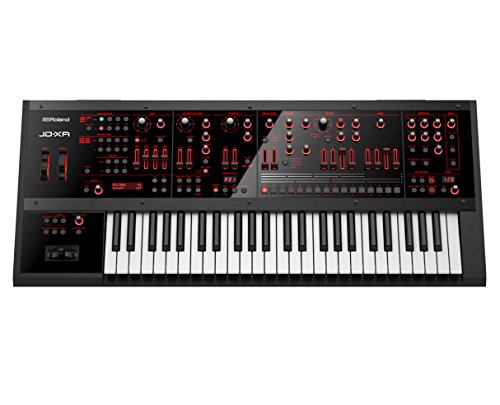
Roland JD-XA 49-Key
Synthesists who want genuine discrete analog voices and a digital engine in one 49-key crossover instrument with deep real time filter control.
Read the Roland JD-XA 49-Key review →
Pioneer DJ DDJ-FLX10 4-Channel
Mobile and open-format DJs who want a 4-channel club style controller with live stem separation and lighting control from one unit.
Read the Pioneer DJ DDJ-FLX10 4-Channel review →Questions Buyers Ask
PartyKeys 36-Key
See the current listing, price and included accessories.
About This Review
Mandrillis Team
The Mandrillis editorial team researches and compares audio and music gear using manufacturer documentation, verified specs and real buyer feedback, so you can make a confident purchase without wading through marketing claims.
Read our full research methodology.