Instruments Review
Roland GO:KEYS 3 Review: Speakers, Styles and Bluetooth MIDI
The Roland GO:KEYS 3 is a 61-note music creation keyboard with a ZEN-Core engine of over 1000 sounds, more than 200 accompaniment styles, a chord sequencer, built-in stereo speakers and Bluetooth audio and MIDI. This research review weighs those published strengths against the ports, power and control details the listing leaves out.
Our Verdict
Research Score 72/100The Roland GO:KEYS 3 is best understood as a self-contained instrument that can also send MIDI wirelessly. Its 61 touch-sensitive notes, over 1000 ZEN-Core sounds, more than 200 auto-accompaniment styles and a chord sequencer with over 300 presets give a beginner everything needed to make complete music without a computer, and the built-in stereo speakers plus Bluetooth audio make play-along practice simple. As a controller it is thin on paper: no pads, knobs or faders are published, DAW integration is not described, and wired ports, power and weight are missing from the listing. In the lower mid-range tier it earns 72 out of 100, a strong keyboard for learners and a weak substitute for a dedicated control surface.
Editorial research score based on published specifications and documented features, not a customer rating or lab test.

Roland
Roland GO:KEYS 3
Best for: Beginners and casual creators who want a 61-key keyboard with onboard sounds, backing styles and speakers that can also send MIDI to a tablet or computer over Bluetooth.
Skip it if: You want a dedicated controller with pads, encoders, faders and documented DAW mapping rather than a self-contained keyboard with its own sound engine.
Check Price on AmazonWe may earn a commission at no extra cost to you.
Listing verified: October 2026
Who Should Buy It
Buy it if
- Newcomers who want to make music without a computer
- Songwriters who sketch chord ideas over backing styles
- Players who stream songs to the keyboard speakers over Bluetooth
- Buyers who like the dark red finish on a desk or shelf
Skip it if
- You need pads and faders for beat production
- You must confirm USB and pedal ports before buying
- You want weighted or hammer action keys
Key Specifications
| Type | Music Creation Keyboard |
| Keys | 61 notes, touch sensitive |
| Power | Not published in listing |
| Key type | Touch-sensitive keyboard; key size and action type not published in listing |
| Pads | Not published in listing |
| Knobs and faders | Not published in listing |
| DAW integration | Not published in listing; Bluetooth MIDI support is stated |
| Bundled software | Not published in listing |
| Connectivity | Bluetooth audio and Bluetooth MIDI; wired ports not published in listing |
| Weight | Not published in listing |
| Included accessories | Not published in listing |
Overview
The Roland GO:KEYS 3 is a 61-note music creation keyboard in a dark red finish, sold in the lower mid-range tier. Unlike a bare controller, it carries its own sound engine, built-in stereo speakers and auto-accompaniment styles, so it works without a computer. Bluetooth audio and MIDI support let it stream songs and talk to apps wirelessly.
Roland positions it as a bridge from listening to creating, and the product listing stresses that no previous experience is required. The ZEN-Core engine with over 1000 sounds, more than 200 styles and a chord sequencer with over 300 presets form the core of that pitch. The model code is GOKEYS3-RD, where the suffix marks the dark red color.
This is an editorial research review built from the published listing only. Several details a controller shopper would ask about, including wired ports, power source, weight and bundled software, are not published, and this review flags each gap rather than guessing at an answer.
Keys, Pads and Feel
The keyboard has 61 touch-sensitive notes, which the listing frames as expressive and friendly to players exploring sounds in the moment. Touch sensitivity means velocity shapes volume and tone, a basic requirement for piano and synth parts. The listing does not state whether the keys are full size or whether aftertouch is present.
Action type is also not published. GO:KEYS products have traditionally used a light, unweighted action suited to synth, organ and pad sounds rather than a hammer feel, and nothing in the listing contradicts that reading. Buyers who want piano-like resistance should look for a model that publishes a weighted or graded action.
There are no drum pads in the published description. Rhythm parts come from the auto-accompaniment styles instead, so finger drumming is not part of the workflow here. A pad-driven producer would be better served by a controller such as the Akai MPK Mini MK3 or the Novation Launchkey Mini.
Knobs, Faders and DAW Integration
No knobs or faders are published in the listing, which is the clearest sign that the GO:KEYS 3 is a keyboard first and a controller second. Sound selection, style control and chord sequencing happen through the onboard panel, and the listing describes user editing features for the chord sequencer. The exact control layout is not described.
DAW integration is not published either. Bluetooth MIDI support is stated, so the keyboard can send note data to a phone, tablet or Bluetooth-equipped computer and play software instruments. Whether a dedicated script, transport controls or a wired USB MIDI path exists is not confirmed in the listing.
Compared with purpose-built controllers such as the Arturia MiniLab 3 or the M-Audio Oxygen Pro, which publish encoder counts and DAW scripts, the GO:KEYS 3 asks you to trade mixer-style control for self-contained playability. That is a fair trade for a learner, and a poor one for a mix engineer.
Software, Sounds and Features
The ZEN-Core sound engine is the headline. The listing counts over 1000 Roland sounds drawn from five decades of the company's synths, pianos and drum machines, which is a deep palette for a keyboard in this tier. ZEN-Core is the same engine family Roland uses across its modern synth line, so the tones are not toy presets.
Over 200 onboard auto-accompaniment styles supply drums, bass and backing parts that follow the chords you play. The chord sequencer adds over 300 ready-to-play presets and user editing, which turns a chord progression into a loop you can jam over. Together these features let a beginner build a complete arrangement without a DAW.
No bundled computer software is published in the listing. The Bluetooth audio feature plays songs from a phone through the keyboard's speakers for learning by ear. If you need a DAW license or a lesson app, that cost sits outside the box as far as the listing shows.
- ZEN-Core engine with over 1000 Roland sounds
- Over 200 auto-accompaniment styles
- Chord sequencer with over 300 presets and user editing
- Bluetooth audio streaming to built-in stereo speakers
- Bluetooth MIDI for apps and software instruments
Build, Design and Portability
Built-in stereo speakers are published, which sets the GO:KEYS 3 apart from a controller that needs monitors or headphones. The dark red finish is a deliberate style choice aimed at living rooms rather than studio racks. Speaker wattage and driver size are not published.
Weight is not published, nor are the dimensions. A 61-note keyboard with speakers is typically carried under one arm rather than slipped into a backpack, so plan for a soft case if it will travel. The listing does not mention battery operation, which would matter for busking or outdoor play.
Build materials are not described. Roland's portable keyboards are generally light enough for one person to move easily, but the listing gives no weight or shell material to confirm that here. Treat it as a home and classroom instrument until the published details say otherwise.
Connectivity and Power
Bluetooth audio and Bluetooth MIDI are the only connections stated. Audio streaming lets you play along to tracks through the speakers, and MIDI over Bluetooth sends performance data to compatible apps and software instruments. Pairing is typically simple on a phone or tablet, though the listing does not describe the pairing steps.
Wired ports are not published. A USB connection, a headphone jack, a sustain pedal input and a line output would all be normal for this type of keyboard, but none of them appear in the listing, and this review will not assume them. Ask the seller or check the manual before relying on a wired setup.
Power is not published. The lack of an AC adapter mention or battery count is a real gap for a keyboard that may travel between rooms or lessons. Budget for the published power accessory once you confirm what ships in the box.
Setup and Daily Use
On paper, setup is as simple as switching on and playing, because sounds, styles and speakers are all onboard. The product listing promises a simple new approach to making music with no previous experience required, and the chord sequencer presets back that up with ready-made progressions.
Daily use revolves around choosing a sound, picking a style and playing chords while the accompaniment follows. The sequencer's user editing lets you refine progressions over time, which is where the keyboard grows with a learner. For wireless control of software, pairing over Bluetooth MIDI adds a second workflow.
Where it may frustrate is the lack of published physical controllers. Without listed knobs or faders, shaping a sound inside a DAW means reaching for the mouse. Keyboards in this class are best treated as instruments that happen to send MIDI, not as mixing surfaces.
Who Should Buy It
The GO:KEYS 3 suits a first keyboard buyer who wants immediate results. Built-in speakers, over 1000 sounds and more than 200 styles mean a complete practice and composition setup without extra gear. Bluetooth audio for play-along makes it a natural fit for anyone learning songs by ear.
Songwriters who think in chords will also find value in the sequencer. Laying down a progression, picking a style and singing over the result is faster here than building a template in a DAW. The dark red finish will appeal to buyers who care how the instrument looks in a shared room.
Producers who need pads, encoders and faders should look elsewhere. So should anyone who must confirm USB, pedal inputs or power before buying, because those details are not published. It is a lower mid-range instrument rather than a controller bargain.
Alternatives Worth Considering
For pure controller duties, the Akai MPK Mini MK3 and the Arturia MiniLab 3 publish pads, encoders and DAW scripts, and both are smaller and cheaper on paper. Neither has speakers or an onboard sound engine, so they rely on a computer at all times.
The Native Instruments Komplete Kontrol M32 pairs a compact keyboard with deep software integration, which makes it a stronger choice for a DAW-centered producer. The M-Audio Oxygen Pro and the Nektar Impact LX offer full-size key counts with transport controls, filling the gap the GO:KEYS 3 leaves in mixer-style control.
Within Roland's own range, earlier GO:KEYS models and the GO:PIANO line offer similar self-contained playability with different sound sets. If the chord sequencer and the 200 plus styles are the attraction, the GO:KEYS 3 is the one that publishes them.
Verdict
The Roland GO:KEYS 3 delivers what the listing promises: a 61-note touch-sensitive keyboard, a ZEN-Core engine with over 1000 sounds, over 200 styles, a chord sequencer with 300 plus presets, stereo speakers and Bluetooth audio and MIDI. For a beginner, that is a full music creation kit in one dark red box.
As a MIDI controller it is limited by what is not published. No pads, knobs, faders, wired ports, power details or bundled software appear in the listing, and the keys section has no stated size or aftertouch. Those gaps keep the score at 72 out of 100 despite the strong sound engine.
Buy it as an instrument with wireless MIDI as a bonus, and it is easy to recommend in the lower mid-range tier. Buy it expecting a studio control surface, and the Akai, Arturia or M-Audio alternatives will serve better.
Strengths and Limitations
Strengths
- 61 touch-sensitive keys in a self-contained instrument
- ZEN-Core engine with over 1000 Roland sounds
- Over 200 auto-accompaniment styles and a chord sequencer with 300 plus presets
- Built-in stereo speakers for practice without a computer
- Bluetooth audio and MIDI for streaming and wireless control
Limitations
- Wired ports, power and weight are not published
- No pads, knobs or faders are listed
- DAW integration and bundled software are not stated
- Key size and action type are not described
How We Scored It
Scores reflect published specifications, documented features and value against the alternatives below. They are editorial research scores, not laboratory measurements.
Alternatives to Consider

Behringer X-TOUCH Universal Surface
Home and project studios that want nine motorized faders and protocol-based control across DAWs, with Ethernet connectivity as a bonus.
Read the Behringer X-TOUCH Universal Surface review →
Behringer XENYX QX2442USB 24-Input 4/2-Bus
Bands, rehearsal rooms and small venues that want many inputs, confirmed phantom power, one-knob compression and a tap tempo effects processor with a USB connection at a lower mid-range.
Read the Behringer XENYX QX2442USB 24-Input 4/2-Bus review →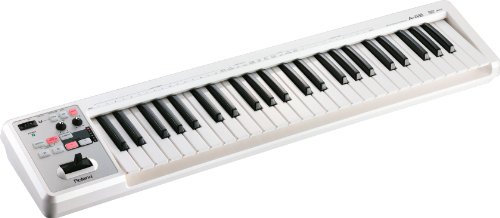
Roland A-49-WH 49-Key MIDI
Players who want a slim, bus-powered 49-key controller with proper full-size keys for playing parts rather than a pad and fader surface for mixing.
Read the Roland A-49-WH 49-Key MIDI review →Head-to-Head Comparisons
- Yamaha PSR-E383 vs Roland GO:KEYS 3 Compare →
Questions Buyers Ask
Roland GO:KEYS 3
See the current listing, price and included accessories.
About This Review
Mandrillis Team
The Mandrillis editorial team researches and compares audio and music gear using manufacturer documentation, verified specs and real buyer feedback, so you can make a confident purchase without wading through marketing claims.
Read our full research methodology.