Studio Gear Review
Tascam DR 70D Professional Recorder for Review: Four Channel Field Audio
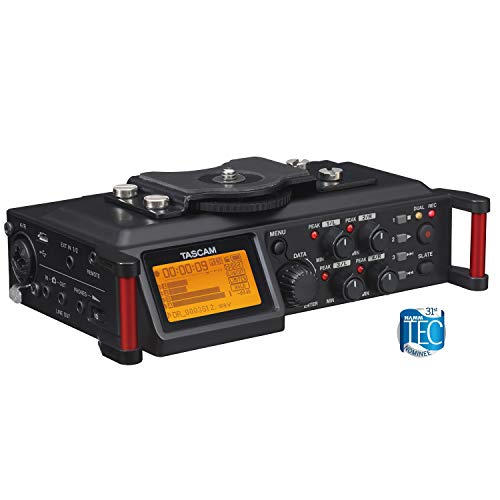
The Tascam DR 70D Professional Recorder for is a camera mountable four channel field recorder with combo XLR/TRS inputs, 64dB preamps, dual recording, and SD card storage. The listing omits several key specifications, so buyers should read this review for what is known and unknown.
Our Verdict
Research Score 73/100The Tascam DR 70D Professional Recorder for offers a strong on paper feature set for location sound: four combo XLR/TRS inputs, 64dB of preamp gain, phantom power, dual recording, and SD card storage up to 128GB. Its compact camera mountable design and built in microphones directly target DSLR video production at a lower mid-range price. However, the listing leaves important details unpublished, including resolution, outputs, monitoring, battery, and bundled software. This uncertainty prevents a full evaluation of sound quality and daily usability. For buyers who can accept those unknowns, the recorder appears to be a solid value. For those who need detailed specifications or a computer audio interface, alternatives may be a better fit. The published feature set earns a score of 73 out of 100, reflecting strong functionality balanced against missing details.
Editorial research score based on published specifications and documented features, not a customer rating or lab test.
Tascam
Tascam DR 70D Professional Recorder for
Best for: Videographers and DSLR shooters who need four XLR inputs with phantom power and a safety track in a camera mountable recorder.
Skip it if: You need a computer audio interface with published output, monitoring, and driver specifications.
Check Price on AmazonWe may earn a commission at no extra cost to you.
Listing verified: October 2026
Who Should Buy It
Buy it if
- Independent filmmakers
- Documentary producers
- Event videographers needing multiple microphones
- Content creators who record away from a computer
Skip it if
- You require a traditional USB audio interface
- You need detailed technical specifications before purchase
- You need built in effects or mixing beyond a limiter and high pass filter
Key Specifications
| Type | 4-channel portable audio recorder |
| Inputs | 4 combo XLR/TRS inputs |
| Outputs | Not published in listing |
| Preamps | HDDA mic preamps with 64dB of gain |
| Resolution | Not published in listing |
| Phantom power | Yes, on four XLR inputs |
| Connection | SD/SDHC/SDXC card recording up to 128GB |
| Monitoring | Not published in listing |
| Bundled software | Not published in listing |
| Included accessories | Not published in listing |
Overview
The Tascam DR 70D Professional Recorder for is a four channel portable audio recorder aimed at filmmakers, television producers, advertisers, and documentarians. The listing describes a compact unit that can mount above or below a camera, with four balanced XLR combo inputs and a pair of built in microphones. This is not a conventional desktop audio interface or mixer, but it occupies a similar space for location sound capture. The lower mid-range price tier makes it an option for indie DSLR shooters who need multi track recording without a computer.
The published feature set includes phantom power, a limiter, a high pass filter, individual gain controls, and a dual recording mode that captures a safety copy at a lower level. Storage is on SD, SDHC, or SDXC cards up to 128GB. The listing does not publish several important specifications, including recording resolution, sample rate, output configuration, monitoring options, or bundled software. Buyers who require those details should treat them as unknown until confirmed.
Preamps and Sound Quality
The Tascam DR 70D Professional Recorder for uses high quality HDDA microphone preamps with up to 64dB of gain on each of the four inputs. That amount of gain is useful for dynamic microphones and quieter sources, and it compares well to many budget audio interfaces that offer less total gain. Each input has its own gain control, which the listing describes as part of a quick adjustment interface. The presence of a limiter and high pass filter on the inputs can help control transients and low frequency rumble before recording.
The published specifications omit equivalent input noise, total harmonic distortion, maximum input level, and A/D converter quality. This makes it difficult to assess the ultimate sound quality of the recorder beyond the gain figure. The dual recording mode is a practical sound quality feature, because it records a second copy of the source at a lower level to prevent distorted takes from clipping. Buyers who rely on the listing will find that the preamps are marketed as quiet, but no numerical noise performance is provided.
Inputs, Outputs and Routing
The listing states that the Tascam DR 70D Professional Recorder for has four balanced XLR mic inputs with phantom power, and the product title describes them as combo XLR/TRS inputs. This means each input can accept either a microphone via XLR or a line level source via TRS, but the listing does not explicitly describe line level use. The four inputs all have individual gain controls, which allows separate level adjustment for multiple microphones on set.
Outputs are not published in the listing. There is no mention of a headphone output, line output, or camera output, although a portable recorder of this type typically includes some monitoring output. Routing and mixing features are also not described. The recorder appears to capture four discrete tracks to an SD card, but the listing does not state whether the built in microphones are mixed into those tracks or recorded separately. This lack of published output detail is a significant gap for potential buyers planning a camera feed.
Features, Monitoring and Software
The Tascam DR 70D Professional Recorder for includes several features aimed at location recording. Dual Recording mode records a lower level safety copy to avoid distortion. A limiter and high pass filter are included to manage levels and low end noise. The recorder captures to SD, SDHC, or SDXC media, with cards up to 128GB supported. A pair of built in microphones can capture on set audio without external microphones.
Monitoring details are not published in the listing. The listing does not state whether there is a headphone jack, a monitor mix, or zero latency monitoring path for videographers who need to hear the signal while recording. Bundled software is also not mentioned. The compact design and camera mounting suggest a standalone workflow, but without published monitoring specifications, users cannot confirm how they will audition audio during a take. The quick adjustment interface is mentioned, but the specific controls are not itemized.
- Dual Recording mode for a safety track at lower level
- Limiter and high pass filter on inputs
- Built in stereo microphones for on set capture
- SD, SDHC, SDXC media up to 128GB
- Camera mountable above or below
Build, Design and Controls
The compact format can be mounted either above or below a camera, as the listing describes. The physical dimensions and weight are not published, so portability claims rely on the listing's description. The recorder is designed for quick adjustment, suggesting that gain controls and other key functions are accessible during a shoot. No information is given about the chassis material, battery type, or power supply.
The inclusion of built in microphones adds utility for run and gun recording, but their quality is not specified. The controls are not detailed beyond individual gain controls for each input. The listing does not state whether the recorder uses a plastic or metal body, or whether it has any weather resistance. Build quality remains an open question for buyers who need a durable field recorder.
Connectivity, Drivers and Latency
The Tascam DR 70D Professional Recorder for uses SD card media for storage, so it operates as a standalone recorder and does not require a computer driver to capture audio. The listing does not mention any USB connection or computer interface functionality, so this is not a traditional audio interface in the sense of connecting to a DAW. Latency is primarily a concern for monitoring, but the listing does not publish any monitoring output or latency figures.
Connectivity to a camera or mixer is not described. There is no mention of a line output to feed a camera audio input, which is a common need for DSLR shooters. The recorder's four combo inputs are the only clearly defined connections. Buyers who need to send audio to a camera or monitor should verify output options before purchase, because the listing does not provide those details.
Setup and Daily Use
Setup for the Tascam DR 70D Professional Recorder for appears to involve mounting the unit on a camera, connecting microphones, and inserting an SD card. The listing suggests the interface is designed for quick adjustment, which should help in fast moving production environments. Phantom power is available for condenser microphones, and individual gain controls allow level setting for each input. The dual recording mode reduces the need for constant level monitoring to avoid clipping.
Daily use would likely involve formatting SD cards, checking battery life, and managing files after a shoot, but the listing does not state battery type or power options. The lack of published output specifications means users may need to rely on the recorder's own monitoring, if present, and then transfer files to a computer later. Without bundled software details, the post production workflow is also unspecified. Buyers should consider these practical unknowns before committing.
Who Should Buy It
The Tascam DR 70D Professional Recorder for is suited to videographers, independent filmmakers, and documentary producers who need four microphone inputs in a camera mounted package. The phantom power and 64dB of gain make it compatible with condenser and dynamic microphones. The dual recording mode is valuable for interview and event work where a clipped take is costly.
Content creators who record away from a computer and need multi track capture will find the SD card workflow convenient. Podcasters recording on location may also benefit, though the recorder is marketed for video production. Buyers who already own a separate mixer or audio interface may see this as a mobile companion. The lower mid-range price tier positions it as an accessible step up from handheld recorders with fewer XLR inputs.
Alternatives Worth Considering
If you need a traditional USB audio interface for computer recording, the Focusrite Scarlett 2i2 or Universal Audio Volt 2 are common reference points in the lower mid-range category. Those devices connect to a computer and include published specifications for resolution and monitoring, but they are not portable field recorders. The PreSonus AudioBox and MOTU M2 are similar alternatives with different feature sets.
For videographers who need a field recorder with built in microphones, other Tascam models and competitors like Zoom offer similar functionality, but the listing does not provide comparative specifications. If you need more inputs or a full mixer, the Yamaha MG10XU or Behringer UMC202HD may be more appropriate, though they are not camera mountable. The Tascam DR 70D Professional Recorder for stands out for its four combo inputs and dual recording feature at its price tier.
Verdict
The Tascam DR 70D Professional Recorder for offers a compelling set of features for location sound on paper: four combo XLR/TRS inputs, 64dB preamp gain, phantom power, dual recording, and SD card storage up to 128GB. Its camera mountable design and built in microphones directly target the DSLR video market. The lower mid-range price makes it attractive for indie shooters who need more than a handheld recorder.
However, the listing leaves too many important specifications unpublished, including resolution, outputs, monitoring, battery, and bundled software. This uncertainty prevents a full evaluation of sound quality and daily usability. For buyers who can accept those unknowns, the recorder appears to be a solid value. For those who need detailed specs or a computer interface, alternatives may be a better fit. The published feature set earns a score of 73 out of 100, reflecting strong functionality balanced against missing details.
Strengths and Limitations
Strengths
- Four combo XLR/TRS inputs
- 64dB of microphone preamp gain
- Dual recording safety track
- Built in stereo microphones
- SD card recording up to 128GB
- Compact camera mountable design
Limitations
- Listing does not publish resolution or sample rate
- No published output or monitoring details
- Bundled software not stated
- Physical build materials not disclosed
- No USB audio interface stated in listing
How We Scored It
Scores reflect published specifications, documented features and value against the alternatives below. They are editorial research scores, not laboratory measurements.
Alternatives to Consider

Behringer XENYX 1204USB Mixer
Budget conscious buyers who want an analog mixer with USB recording for multiple sources.
Read the Behringer XENYX 1204USB Mixer review →
PreSonus Revelator io24 USB Audio Interface
Streamers, podcasters, and solo musicians who need XLR mics, instruments, MIDI, and loopback mixing in one budget USB interface.
Read the PreSonus Revelator io24 USB Audio Interface review →Questions Buyers Ask
Tascam DR 70D Professional Recorder for
See the current listing, price and included accessories.
About This Review
Mandrillis Team
The Mandrillis editorial team researches and compares audio and music gear using manufacturer documentation, verified specs and real buyer feedback, so you can make a confident purchase without wading through marketing claims.
Read our full research methodology.