Guides
Best Height for a Digital Piano Bench (Simple Setup Guide)
Bench height affects comfort, technique and even tone control. Sit too low and your wrists drop, too high and your shoulders tense. This guide explains the ideal forearm angle, typical bench and key heights in inches, how far to sit from the keys, and how to adjust a setup for children and taller players.
Quick Answer
The best height for a digital piano bench puts your forearms level with the keys, with elbows just above the white keys. For most adults that means a bench seat about 19 to 21 inches high when the keys sit around 28 to 30 inches from the floor. Adjust from there for your body.
How this guide was put together
This guide is based on manufacturer manuals, published specifications and widely used audio reference standards. Mandrillis does not run hands-on tests for these guides, so treat figures as typical values and check the manual for your own gear before changing settings.
Why Bench Height Matters
Your bench height sets the angle of your arms and wrists. That angle affects how freely your fingers move and how much strain builds in your hands, shoulders and back.
A good height lets the weight of your arms flow into the keys. A poor height makes you push from the wrists or lift your shoulders, which tires you faster.
- Too low: wrists drop below the keys and strain.
- Too high: shoulders lift and fingers press down too hard.
- Just right: forearms level, wrists relaxed.
- Good height also helps control soft and loud playing.
The Basic Rule: Level Forearms
Sit on the bench with your hands resting on the white keys. Your forearms should be roughly level with the keys, or slope very slightly down toward them.
Your elbows should sit just above the height of the keys, and your wrists should stay in a straight line with your forearms.
Quick Check
Use this quick check every time you sit down.
- Elbows slightly above key level.
- Wrists in line with forearms, not bent up or down.
- Shoulders relaxed and down.
- Thighs roughly level, feet flat on the floor.
Typical Heights for Keys and Benches
Common measurements in inches. Adjust to your own body.
| Setup | Key height from floor | Typical bench seat height |
|---|---|---|
| Acoustic piano | About 28 to 29 inches | About 19 to 20 inches |
| Digital piano on its own stand | About 28 to 30 inches | About 19 to 21 inches |
| Portable piano on an X stand | Adjustable, often 26 to 32 inches | Match to forearm level |
| Child beginner | Standard key height | Higher bench, often with a footrest |
| Taller adult | Standard or raised stand | Lower bench or raised keys |
Measure Your Setup
Use a tape measure from the floor to the top of the white keys, then from the floor to the top of the bench seat. The difference is usually about 8 to 10 inches for adults.
That gap is a starting point. Your arm length and torso height decide the final number, so adjust by feel after measuring.
How Far to Sit From the Keys
Distance matters as much as height. Sit so your fingertips rest on the keys with a slight bend in your elbows, and your elbows are a little in front of your body.
A common guide is to sit on the front half of the bench, with your knees just under the front edge of the keyboard.
- Too close: elbows jam into your sides.
- Too far: you lean forward and strain your back.
- Center the bench on middle C.
- Keep your back upright but not stiff.
Choose an Adjustable Bench
An adjustable bench makes it easy to find and keep the right height, especially if several people share the piano.
Look for a bench that adjusts across a range of about 18 to 22 inches, with a sturdy frame that does not wobble.
Bench Types
Each type has its own strengths.
- X style benches: light, portable and adjustable, good for small spaces.
- Knob adjustable benches: smooth, fine height control.
- Fixed wooden benches: stable but not adjustable.
- Duet benches: wider for teacher and student.
Setting Up for Children
Children need a higher bench to get their forearms level with the keys. Because they then cannot reach the floor, a footrest or sturdy box keeps their feet supported.
Recheck the height every few months, since children grow quickly. A setting that worked in spring may be too low by autumn.
- Raise the bench until forearms are level.
- Add a footrest so feet are flat and supported.
- Use a cushion only if it is firm and does not slide.
- Check posture often during practice.
Setting Up for Taller Players
Taller players may find even the lowest bench too high, with knees hitting the keyboard. Lower the bench as far as it goes, then raise the piano stand if possible.
On portable pianos with X or Z stands, small height changes are easy. Make sure the stand stays stable after adjusting.
Using a Chair Instead of a Bench
Many people start with a dining or office chair. That can work if the height is right, but chairs with arms or backs can get in the way of free movement.
Office chairs that roll and spin can shift during playing. If you use one, lock the wheels or choose a fixed chair, and sit on the front half of the seat.
Signs Your Height Is Wrong
Your body often tells you before you notice the setup. Watch for these signs during and after practice.
- Sore wrists or forearms after short sessions.
- Tight shoulders or neck.
- Lower back ache from leaning.
- Hands tiring quickly in fast passages.
- Soft notes are hard to control.
Healthy Practice Habits
Even with perfect height, long sessions without breaks cause strain. Take a short break every 20 to 30 minutes to stretch your hands and shoulders.
If you feel pain, stop and rest. Ongoing pain is a reason to see a doctor or ask a piano teacher to check your posture.
Pedal Position and Foot Placement
Your feet need to reach the pedal comfortably without stretching. Place the sustain pedal under the right side of the keyboard, roughly in line with your right foot when you sit centered on middle C.
Keep your heel on the floor and press with the ball of your foot. If you have to point your toes or slide forward to reach the pedal, move the bench slightly closer or adjust its height.
- Heel rests on the floor while pedaling.
- Left foot flat and steady for balance.
- Use a non slip mat so the pedal does not slide.
- Children may need a pedal extender.
The Bottom Line
Set the bench so your forearms are level with the keys and your elbows sit just above them. For most adults, that is a seat about 19 to 21 inches high with keys at 28 to 30 inches.
Use an adjustable bench, sit on the front half, center on middle C, and add a footrest for children.
Digital Pianos From Our Reviews
Portable digital pianos that pair with a stand and adjustable bench.
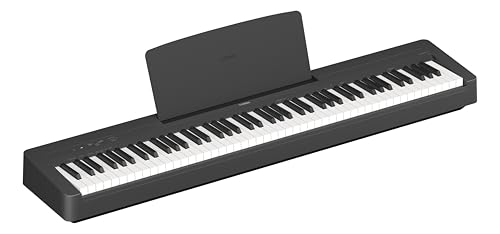
Yamaha P-145
Mentioned
Who Should Buy It
- You are buying a first piano and want the newest entry-level Yamaha
- Space is tight and you need a shallow, light instrument
- You practice with play-along tracks from a phone
Skip It If
- You already play intermediate repertoire with heavy pedaling
- You need line outs for stage or recording use
- You want more than ten sounds
We may earn a commission at no extra cost to you.
Last verified: October 2026

Roland FP-30X
Mentioned
Who Should Buy It
- You want the best action under the FP-60X without compromise elsewhere
- You stream backing tracks over Bluetooth and record over USB
- You gig and need line outs plus two headphone jacks
Skip It If
- Weight and depth are the constraint; the PX-S1100 is lighter and slimmer
- You prefer the Kawai sound signature
- You never leave the house and want a console with three pedals built in
We may earn a commission at no extra cost to you.
Last verified: October 2026

Casio CDP-S160
Mentioned
Who Should Buy It
- You need to carry the piano regularly or store it upright
- You want battery operation for busking, school or outdoor use
- A first piano on a tight budget with a real hammer action
Skip It If
- You play pedal-heavy pieces that need more than 64 notes
- You want Bluetooth or app control over a wireless link
- You need quarter-inch outputs for a PA
We may earn a commission at no extra cost to you.
Last verified: October 2026
Keep Reading
Related guides and picks on Mandrillis:
- Best Digital Pianos for Beginners : pianos with stands and benches
- Weighted vs Semi Weighted Keys for Beginners : comfort and key feel
- How to Reduce Digital Piano Key Noise in an Apartment : set up stand and floor
FAQs
About This Guide
Daniel Brooks
Daniel Brooks edits the buying guides and how-to articles at Mandrillis. He works from manufacturer manuals, published specifications and common owner questions to explain music and audio gear in plain language, from turntables and headphones to digital pianos and electronic drums.
Read our full research methodology.