Instruments Review
Arturia KeyLab mk3 49 White Review: Pads Plus Keys
The Arturia KeyLab mk3 49 White combines a 49-key aftertouch keybed with 12 pressure-sensitive performance pads and 9 assignable encoders over USB-C power. The listing is light on software and DAW integration details, but the core hardware feature set covers keys, pads and controls in one unit.
Our Verdict
Research Score 77/100The Arturia KeyLab mk3 49 White brings together the core elements expected from this well-regarded controller line: a 49-key aftertouch keybed, 12 pressure-sensitive performance pads and 9 assignable encoders, all running over simple USB-C power. Sustain and auxiliary pedal inputs round out a setup that covers melodic playing, pad triggering and parameter control in one unit. What this particular listing does not confirm is bundled software, DAW integration or weight, which is thinner detail than buyers might expect from the KeyLab name. Taken purely on the hardware features that are published, it is a well-rounded 49-key controller for a lower mid-range price, though buyers who care about software bundling should confirm that directly with Arturia before purchase.
Editorial research score based on published specifications and documented features, not a customer rating or lab test.

Arturia
Arturia KeyLab mk3 49 White
Best for: Producers who want a 49-key aftertouch keybed with performance pads and assignable encoders in a straightforward USB-C controller.
Skip it if: You need confirmed bundled software or DAW integration details before purchasing, since neither is stated in this listing.
Check Price on AmazonWe may earn a commission at no extra cost to you.
Listing verified: November 2026
Who Should Buy It
Buy it if
- Producers who want pads and encoders alongside a 49-key aftertouch keyboard
- Buyers who prefer USB-C power and cabling over older USB standards
- Players who want pedal flexibility with both sustain and auxiliary inputs
- Anyone comfortable researching software compatibility separately before buying
Skip it if
- You need confirmed bundled software before purchasing
- You require dedicated faders rather than encoders for mixing
- You need published weight and dimension figures in advance
Key Specifications
| Keys | 49 keys |
| Key type | Keys with aftertouch; whether the action is weighted or synth style is not published in listing |
| Pads | 12 pressure-sensitive performance pads |
| Knobs and faders | 9 assignable encoders; no faders are mentioned in the listing |
| DAW integration | Not published in listing |
| Bundled software | Not published in listing |
| Connectivity | USB-C; sustain and auxiliary pedal inputs |
| Power | USB-C power |
| Weight | Not published in listing |
| Included accessories | Not published in listing |
Overview
The Arturia KeyLab mk3 49 White is the 49-key, white finished entry in Arturia's KeyLab mk3 controller line. The listing describes a 49-key MIDI keyboard with aftertouch, 12 pressure-sensitive performance pads and 9 assignable encoders, which covers the three core control surfaces most producers look for in a single controller.
Power comes over USB-C, and the listing specifically calls out both sustain and auxiliary pedal inputs, which gives a player more expressive options than sustain alone. That combination of pads, encoders and pedal inputs points toward a controller designed for both studio production and more performance oriented use.
What stands out by its absence is any mention of bundled software or DAW integration, both of which Arturia's KeyLab line has traditionally emphasized. This specific listing simply does not confirm those details, so this review treats software as an open question rather than assuming the standard bundle applies.
Keys, Pads and Feel
The 49-key bed includes aftertouch, which lets a player add expression after a note is struck by applying extra pressure. The listing does not specify whether the action is weighted or a lighter synth style action, so buyers who have a strong preference between those two feels should confirm that detail before buying.
The 12 pressure-sensitive performance pads are a meaningful addition for finger drumming, sample triggering and clip launching, extending the controller's usefulness well beyond playing notes on the keybed alone. Pressure sensitivity on the pads typically allows dynamic control similar to velocity sensitivity on keys, giving more expressive hits than a simple on-off trigger.
Together, the keybed and pads give this controller a dual identity, suited both to melodic playing and beat making, which is a common and useful design choice for a general purpose production controller in this price range.
Knobs, Faders and DAW Integration
Nine assignable encoders are the stated control surface for parameters, and the listing does not mention any faders. Encoders are rotary controls that can be mapped to any software parameter, which gives flexibility but typically lacks the visual position feedback that a physical fader provides for level or automation work.
The absence of faders may matter to producers who specifically want to ride volume levels or automate mix moves with a tactile slider, since encoders are better suited to adjusting effect parameters, synth settings or plugin controls than to mixing level rides.
DAW integration is not described in the listing at all. Arturia's KeyLab controllers have historically included a DAW command center mode for transport and mixer control in popular software, but since this listing does not confirm that feature for this specific unit, buyers should not assume it is present without checking Arturia's own specification page.
Software, Sounds and Features
This listing does not name any bundled software, which is a notable gap for a controller from a line that has often shipped with Arturia's own Analog Lab software and a selection of virtual instruments in other packages. Buyers should not assume software is included based on reputation alone, since nothing here confirms it for this specific listing.
Beyond the hardware control surfaces already covered, the feature bullets provided are limited to the keys, pads, encoders, pedal inputs and power connection. There is no mention of an onboard display, arpeggiator, chord mode or any other creative feature that some competing controllers include at a similar price.
This sparseness does not necessarily mean those features are absent from the actual product, only that this particular listing does not state them. Anyone making a purchase decision based specifically on software bundling or onboard creative tools should verify those directly with Arturia before buying. Listings for the same physical product can vary in how much detail a given retailer chooses to publish, and that gap is exactly what this review is flagging rather than filling in with assumptions.
Build, Design and Portability
The listing does not publish weight, dimensions or chassis materials for the KeyLab mk3 49 White, so this review cannot describe its physical build in specific terms. The white finish is the one cosmetic detail confirmed, distinguishing it from other color options in the same product line.
Given that it includes a 49-key bed, 12 pads and 9 encoders on one surface, the unit is likely to have a moderately dense front panel, consistent with other all in one controllers of similar scope, though exact panel layout is not described.
Without published weight or case dimensions, touring musicians who need to plan travel cases precisely should confirm those figures directly with Arturia before finalizing a bag or case choice around this controller. Studio based buyers who plan to leave the controller on a desk will find this gap considerably less important than a performer packing a gig bag for regular travel.
Connectivity and Power
Connectivity in this listing is limited to USB-C for power and presumably data, along with sustain and auxiliary pedal inputs. USB-C is a modern standard that should simplify cabling for anyone already using USB-C peripherals or laptops, though the listing does not confirm whether the unit also provides MIDI in and out ports.
The dual pedal input design, offering both sustain and auxiliary connections, gives more performance flexibility than a single sustain jack alone, letting a player assign a second pedal to an expression or control function if their software supports it.
Beyond those two details, the listing does not describe any other connectivity options, such as audio output, headphone jack or additional MIDI ports, so buyers who need those features should confirm them separately before purchase. A controller of this scope would typically include at least standard MIDI out for driving external hardware, but since that is not stated here, it should be treated as unconfirmed rather than assumed.
Setup and Daily Use
Based on the published feature set, daily use would likely involve connecting over USB-C, mapping the 9 encoders to whatever software parameters a producer needs most often, and using the pads for finger drumming or sample triggering alongside melodic playing on the keybed.
Because DAW integration is not confirmed in this listing, setup may require more manual MIDI mapping than a controller with a dedicated DAW command mode, at least until a buyer confirms whether that feature exists on this specific model.
The dual pedal inputs add flexibility to a performance setup, letting a player use sustain for keyboard parts while assigning the auxiliary input to a separate function, such as an expression pedal for a synth parameter, depending on what the connected software allows.
Who Should Buy It
This suits producers who want a straightforward 49-key controller with pads and encoders covering most everyday production tasks, without needing to rely on deep native DAW integration. The combination of aftertouch keys, pressure-sensitive pads and assignable encoders covers a broad range of production needs in one unit.
Buyers comfortable researching software compatibility and DAW integration separately, rather than relying on bundled software claims, will have the easiest time with this particular listing, since those details are simply not confirmed here.
Anyone who specifically needs faders rather than encoders, or who wants guaranteed bundled software as part of the purchase, should look closely at Arturia's own specification pages or consider a different listing of this same product line before buying. Taking a few extra minutes to cross-check the manufacturer's own page against any retailer listing is a reasonable habit whenever a feature this important is left unconfirmed.
Alternatives Worth Considering
Buyers drawn to the KeyLab name but wanting more confirmed detail on bundled software should compare this listing directly against Arturia's own product page or other retailer listings of the same KeyLab mk3 49 model, since feature bullets can vary between listings of the same hardware.
Those who specifically want the higher tier Ultra variant in the same line, which typically adds extra control surface features, should weigh that option directly, keeping in mind that different listings of each model publish different levels of detail.
Producers who prioritize dedicated faders over encoders for mixing work should look at a controller built around physical faders rather than one that relies entirely on assignable rotary encoders, since this model does not include faders based on the published bullets.
Verdict
On its published hardware alone, the KeyLab mk3 49 White is a well-rounded controller, pairing a 49-key aftertouch keybed with performance pads, assignable encoders and flexible pedal inputs over USB-C power.
The listing's silence on bundled software and DAW integration is the clearest gap, especially for a line historically associated with a strong software bundle, and buyers should treat that as unconfirmed rather than assumed.
For someone who wants a capable all-in-one controller and is comfortable verifying software details separately, this remains a solid lower mid-range option within a well-known controller family.
Strengths and Limitations
Strengths
- 49 keys with aftertouch for added expression beyond basic velocity
- 12 pressure-sensitive performance pads for finger drumming and sample triggering
- 9 assignable encoders for direct control of software parameters
- Both sustain and auxiliary pedal inputs for a more complete performance setup
- USB-C power simplifies cabling on a modern laptop based rig
Limitations
- Bundled software and DAW integration details are not published in this listing
- Weight and dimensions are not stated
- No faders are mentioned, only encoders, which may limit some mixing workflows
- The listing provides fewer feature details than is typical for this well-known controller line
How We Scored It
Scores reflect published specifications, documented features and value against the alternatives below. They are editorial research scores, not laboratory measurements.
Alternatives to Consider

Yamaha Montage M6 61-Key
Professional synth players and producers who want a flagship 61-key instrument with massive polyphony, analog style synthesis and a matching software plugin.
Read the Yamaha Montage M6 61-Key review →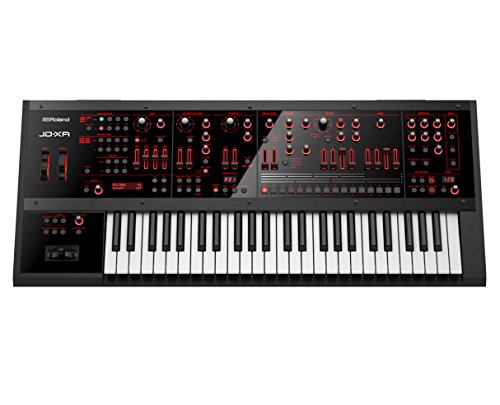
Roland JD-XA 49-Key
Synthesists who want genuine discrete analog voices and a digital engine in one 49-key crossover instrument with deep real time filter control.
Read the Roland JD-XA 49-Key review →
Pioneer DJ DDJ-FLX10 4-Channel
Mobile and open-format DJs who want a 4-channel club style controller with live stem separation and lighting control from one unit.
Read the Pioneer DJ DDJ-FLX10 4-Channel review →Questions Buyers Ask
Arturia KeyLab mk3 49 White
See the current listing, price and included accessories.
About This Review
Mandrillis Team
The Mandrillis editorial team researches and compares audio and music gear using manufacturer documentation, verified specs and real buyer feedback, so you can make a confident purchase without wading through marketing claims.
Read our full research methodology.